
NETWORK SECURITY
name- anoop negi
roll no- 27
Date: 4-04-2016
CONTENTS
 understand principles of network security:
 cryptography
 Digital Signatures
 Security at Various Layers
 Firewalls
INTRODUCTION
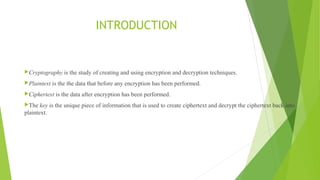
Cryptography is the study of creating and using encryption and decryption techniques.
Plaintext is the the data that before any encryption has been performed.
Ciphertext is the data after encryption has been performed.
The key is the unique piece of information that is used to create ciphertext and decrypt the ciphertext back into
plaintext.
KEY TERMS
 Confidentiality: only sender, intended receiver should “ understand” message
contents
 sender encrypts message
 receiver decrypts message
 Authentication: sender, receiver want to confirm identity of each other
 Message Integrity: sender, receiver want to ensure message not altered (in
transit, or afterwards) .
 Access and Availability: services must be accessible and available to users
CONTINUE………..
❍ eavesdrop: intercept messages
❍ impersonation: can fake (spoof) source address in packet (or any field in
packet)
❍ hijacking: “take over” ongoing connection by removing sender or receiver,
inserting himself in place
SYMMETRIC KEY
CRYPTOGRAPHY
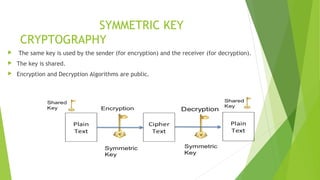
 The same key is used by the sender (for encryption) and the receiver (for decryption).
 The key is shared.
 Encryption and Decryption Algorithms are public.
Continue……….
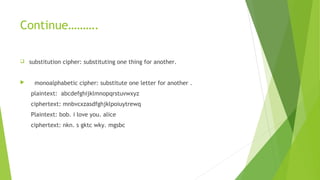
 substitution cipher: substituting one thing for another.
 monoalphabetic cipher: substitute one letter for another .
plaintext: abcdefghijklmnopqrstuvwxyz
ciphertext: mnbvcxzasdfghjklpoiuytrewq
Plaintext: bob. i love you. alice
ciphertext: nkn. s gktc wky. mgsbc
Data Encryption Standard
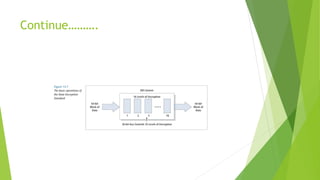
 Created in 1977 and in operation into the 1990s, the data encryption standard took a 64-
bit block of data and subjected it to 16 levels of encryption.
 The choice of encryption performed at each of the 16 levels depends on the 56-bit key
applied.
 Even though 56 bits provides over 72 quadrillion combinations, a system using this
standard has been cracked (in 1998 by Electronic Frontier Foundation in 3 days).
Continue……….
Public Key Cryptography
 Very powerful encryption technique in which two keys are used: the first key (the
public key) encrypts the message while the second key (the private key) decrypts the
message.
 Not possible to deduce one key from the other.
 Not possible to break the code given the public key.
 If you want someone to send you secure data, give them your public key, you keep the
private key.
 Secure sockets layer on the Internet is a common example of public key cryptography.
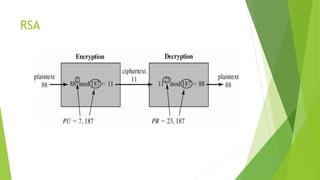
RSA
 The most common public key algorithm .
 Private key is a pair of numbers (n,d).
 Public key is a pair of numbers (n,e).
 The sender uses the following algorithm to encrypt the message:
 C=p*pow(e) mod n
 P=plaintext ,C=cyphertext and e,n are components of public key.
 Receiver : p=C*pow(d) mod n
RSA
Digital Signature
Digital signature can provide:
Authentication
Integrity
Nonrepudiation
The sender uses her private key to encrypt(sign) the message .
The receiver on the other hand uses the public key of sender to decrypt the msg.
No need to sign the entire document(digest).
Digital signature does not provide privacy.
Message Digests
 Computationally expensive to public-key-encrypt long messages.
 Goal: fixed-length, easy to-compute digital “fingerprint”.
 apply hash function H to m, get fixed size message digest, H(m).
 Hash function properties:
 Hashing is one way: digest can only be created from the msg , not vice versa.
 Hashing is one to one function: there is little probability that two msg produce same digest.
SECURITY AT IP LEVEL
 IP Security (ipsec) is a collection of protocols to provide security for a packet at the IP level.
 Ipsec requires a logical connection between two hosts using a signalling protocol called Security
Association.
 An SA connection can be simplex or duplex.
 SA is uniquely defined by three elements:
 A 32 bit security parameter index (spi),which acts as virtual circuit identifier in connection
oriented protocols.
 The source ip address.
 The type of protocol used- AH,ESP.
AUTHENTICATION HEADER (AH)
 AH provides authentication , integrity and anti-replay for the entire
packet(ip header & data payload).
 It does not provide confidentiality , which means it does not encrypt the
data.
 The data is readable but protected from modification.
 Integrity and authentication are provided by placement of AH header
between the Ip header and transport layer protocol .
 AH uses an ip protocol id of 51 to identify itself in the IP header.
AH FIELDS
 Next Header: Identifies the next header that uses IP protocol id,
ex- value might be 6 to indicate tcp.
 Length: indicate length of AH header.
 SPI: used in combination with the destination address and security protocol(AH OR ESP) to
identify correct security association for the communication.
 Sequence no. : provides anti-relay protection. It is a 32 bit number that is never allowed to
cycle . The receiver checks this field to verify that a packet with this number has not been
received yet. If one is received ,the packet is rejected.
 Authentication data: contains integrity check value to verify the integrity of the msg.
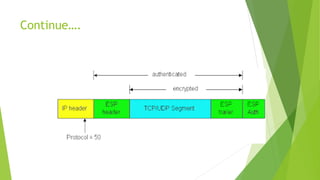
ENCAPSULATING SECURITY PAYLOAD
Provides confidentiality in addition to authentication , integrity and anti-replay.
ESP indicates itself in the IP header using IP protocol id of 50.
Ex- alice on computer A sends data to bob on computer B.
The data payload is encrypted and signed for integrity. Upon receipt the data
payload packet is decrypted . Bob can be certain it was really alice who send the
data. Also the data is unmodified and no other was able to read it.
ESP HEADER AND TRAILER FIELD
 SECURITY PARAMETER INDEX (SPI): same as in AH.
 Sequence no : same as in AH.
 Padding : the variable length field of 0’s serves as padding.
 Padding length: indicates the length of the padding field in bytes.
 This field is used by the receiver to discard the padding field.
 Next header: identifies the type of payload tcp or udp.
 Authentication data: contains the integrity check value(icv) and a msg
authentication code that is used to verify the sender’s identity and msg
integrity.
Continue….
Transport layer security
 TLS was designed to provide security at transport layer.
 TLS allows two parties to exchange messages in a secure environment. To accomplish this TLS
require that
 Two parties must agree on 3 protocols : an entity authentication protocol, a message
authentication protocol and encrypt/decrypt protocol.
 TLS has two layers.
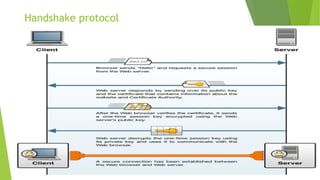
 The top layer includes three protocols ,one for session setup(handshaking),one for alerting the
other party of unusual situation, and one informing the establishment of security parameters.
 The lower layer ,the record protocol ,is used to encapsulate msg from the upper layer.
Handshake protocol
Alert protocol
 The alert protocol is used to signal an error or a potential error to other party.
 The packet exchanged defines the severity level of the condition.
Change cipher spee protocol
 This protocol is designed to activate the security services (message
authentication and encryption/decryption) after all the agreements are
confirmed in the handshake protocol.
 After exchanging the one message defined in this protocol ,the two parties
can use the services.
FIREWALLS
 A system or combination of systems that supports an access control policy between two networks.
 A firewall can limit the types of transactions that enter a system, as well as the types of transactions that
leave a system.
 Firewalls can be programmed to stop certain types or ranges of IP addresses, as well as certain types of TCP
port numbers (applications).
 A packet filter firewall is essentially a router that has been programmed to filter out or allow to pass certain
IP addresses or TCP port numbers.
 A proxy server is a more advanced firewall that acts as a doorman into a corporate network. Any external
transaction that request something from the corporate network must enter through the proxy server.
 Proxy servers are more advanced but make external accesses slower.
THANK YOU

Network security

  • 1.
    NETWORK SECURITY name- anoopnegi roll no- 27 Date: 4-04-2016
  • 2.
    CONTENTS  understand principlesof network security:  cryptography  Digital Signatures  Security at Various Layers  Firewalls
  • 3.
    INTRODUCTION Cryptography is thestudy of creating and using encryption and decryption techniques. Plaintext is the the data that before any encryption has been performed. Ciphertext is the data after encryption has been performed. The key is the unique piece of information that is used to create ciphertext and decrypt the ciphertext back into plaintext.
  • 4.
    KEY TERMS  Confidentiality:only sender, intended receiver should “ understand” message contents  sender encrypts message  receiver decrypts message  Authentication: sender, receiver want to confirm identity of each other  Message Integrity: sender, receiver want to ensure message not altered (in transit, or afterwards) .  Access and Availability: services must be accessible and available to users
  • 5.
    CONTINUE……….. ❍ eavesdrop: interceptmessages ❍ impersonation: can fake (spoof) source address in packet (or any field in packet) ❍ hijacking: “take over” ongoing connection by removing sender or receiver, inserting himself in place
  • 6.
    SYMMETRIC KEY CRYPTOGRAPHY  Thesame key is used by the sender (for encryption) and the receiver (for decryption).  The key is shared.  Encryption and Decryption Algorithms are public.
  • 7.
    Continue……….  substitution cipher:substituting one thing for another.  monoalphabetic cipher: substitute one letter for another . plaintext: abcdefghijklmnopqrstuvwxyz ciphertext: mnbvcxzasdfghjklpoiuytrewq Plaintext: bob. i love you. alice ciphertext: nkn. s gktc wky. mgsbc
  • 8.
    Data Encryption Standard Created in 1977 and in operation into the 1990s, the data encryption standard took a 64- bit block of data and subjected it to 16 levels of encryption.  The choice of encryption performed at each of the 16 levels depends on the 56-bit key applied.  Even though 56 bits provides over 72 quadrillion combinations, a system using this standard has been cracked (in 1998 by Electronic Frontier Foundation in 3 days).
  • 9.
  • 10.
    Public Key Cryptography Very powerful encryption technique in which two keys are used: the first key (the public key) encrypts the message while the second key (the private key) decrypts the message.  Not possible to deduce one key from the other.  Not possible to break the code given the public key.  If you want someone to send you secure data, give them your public key, you keep the private key.  Secure sockets layer on the Internet is a common example of public key cryptography.
  • 11.
    RSA  The mostcommon public key algorithm .  Private key is a pair of numbers (n,d).  Public key is a pair of numbers (n,e).  The sender uses the following algorithm to encrypt the message:  C=p*pow(e) mod n  P=plaintext ,C=cyphertext and e,n are components of public key.  Receiver : p=C*pow(d) mod n
  • 12.
  • 13.
    Digital Signature Digital signaturecan provide: Authentication Integrity Nonrepudiation The sender uses her private key to encrypt(sign) the message . The receiver on the other hand uses the public key of sender to decrypt the msg. No need to sign the entire document(digest). Digital signature does not provide privacy.
  • 14.
    Message Digests  Computationallyexpensive to public-key-encrypt long messages.  Goal: fixed-length, easy to-compute digital “fingerprint”.  apply hash function H to m, get fixed size message digest, H(m).  Hash function properties:  Hashing is one way: digest can only be created from the msg , not vice versa.  Hashing is one to one function: there is little probability that two msg produce same digest.
  • 15.
    SECURITY AT IPLEVEL  IP Security (ipsec) is a collection of protocols to provide security for a packet at the IP level.  Ipsec requires a logical connection between two hosts using a signalling protocol called Security Association.  An SA connection can be simplex or duplex.  SA is uniquely defined by three elements:  A 32 bit security parameter index (spi),which acts as virtual circuit identifier in connection oriented protocols.  The source ip address.  The type of protocol used- AH,ESP.
  • 16.
    AUTHENTICATION HEADER (AH) AH provides authentication , integrity and anti-replay for the entire packet(ip header & data payload).  It does not provide confidentiality , which means it does not encrypt the data.  The data is readable but protected from modification.  Integrity and authentication are provided by placement of AH header between the Ip header and transport layer protocol .  AH uses an ip protocol id of 51 to identify itself in the IP header.
  • 17.
    AH FIELDS  NextHeader: Identifies the next header that uses IP protocol id, ex- value might be 6 to indicate tcp.  Length: indicate length of AH header.  SPI: used in combination with the destination address and security protocol(AH OR ESP) to identify correct security association for the communication.  Sequence no. : provides anti-relay protection. It is a 32 bit number that is never allowed to cycle . The receiver checks this field to verify that a packet with this number has not been received yet. If one is received ,the packet is rejected.  Authentication data: contains integrity check value to verify the integrity of the msg.
  • 18.
    ENCAPSULATING SECURITY PAYLOAD Providesconfidentiality in addition to authentication , integrity and anti-replay. ESP indicates itself in the IP header using IP protocol id of 50. Ex- alice on computer A sends data to bob on computer B. The data payload is encrypted and signed for integrity. Upon receipt the data payload packet is decrypted . Bob can be certain it was really alice who send the data. Also the data is unmodified and no other was able to read it.
  • 19.
    ESP HEADER ANDTRAILER FIELD  SECURITY PARAMETER INDEX (SPI): same as in AH.  Sequence no : same as in AH.  Padding : the variable length field of 0’s serves as padding.  Padding length: indicates the length of the padding field in bytes.  This field is used by the receiver to discard the padding field.  Next header: identifies the type of payload tcp or udp.  Authentication data: contains the integrity check value(icv) and a msg authentication code that is used to verify the sender’s identity and msg integrity.
  • 20.
  • 21.
    Transport layer security TLS was designed to provide security at transport layer.  TLS allows two parties to exchange messages in a secure environment. To accomplish this TLS require that  Two parties must agree on 3 protocols : an entity authentication protocol, a message authentication protocol and encrypt/decrypt protocol.  TLS has two layers.  The top layer includes three protocols ,one for session setup(handshaking),one for alerting the other party of unusual situation, and one informing the establishment of security parameters.  The lower layer ,the record protocol ,is used to encapsulate msg from the upper layer.
  • 22.
  • 23.
    Alert protocol  Thealert protocol is used to signal an error or a potential error to other party.  The packet exchanged defines the severity level of the condition.
  • 24.
    Change cipher speeprotocol  This protocol is designed to activate the security services (message authentication and encryption/decryption) after all the agreements are confirmed in the handshake protocol.  After exchanging the one message defined in this protocol ,the two parties can use the services.
  • 25.
    FIREWALLS  A systemor combination of systems that supports an access control policy between two networks.  A firewall can limit the types of transactions that enter a system, as well as the types of transactions that leave a system.  Firewalls can be programmed to stop certain types or ranges of IP addresses, as well as certain types of TCP port numbers (applications).  A packet filter firewall is essentially a router that has been programmed to filter out or allow to pass certain IP addresses or TCP port numbers.  A proxy server is a more advanced firewall that acts as a doorman into a corporate network. Any external transaction that request something from the corporate network must enter through the proxy server.  Proxy servers are more advanced but make external accesses slower.
  • 26.