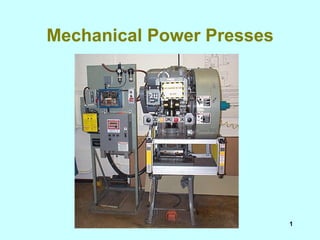
Mechanical Power Presses
Mechanical power presses OSHA 1910.217 is the vertical regulation OSHA 1910.212, general requirement; 1910.219 MPTA ANSI B11.1 - 1998 for best safety practices 350,000 in the U.S. Full revolution clutch since 1857 Part revolution clutch since 1927
Full Revolution Clutch
Part Revolution Clutch
Capacity  1/4 to bench-top to 5000 lbs. Smaller one likely to be Gap (C) Frame If inclinable, OBI, if not incliniable, OBS Larger ones tend to be straight side frame 4 columns from bed (bottom) to crown (top) Distinctive features:  flywheel, crankshaft, clutch, brake, ram (slide) goes up and down
Part revolution bench top press
Bench top press  (cont’d) Light Curtain Overhead Guard
Full vs. Part Revolution Clutch? Is an air line going to the clutch? If yes, it’s a part revolution clutch press If no, then look for an operating rod coming down the side of machine to identify it as a full revolution clutch
Part  revolution clutch Air line going to clutch
Full revolution  clutch Single Stroke Mechanism
Hydraulic Power Presses OSHA 1910.212, general requirements, 1910.219 MPTA ANSI B11.2 - 1995 for best safety practices
Hydraulic Press Light curtain Foot control
Power Press Brakes OSHA 1910.212, general requirements, 1910.219 MPTA ANSI B11.4 - 1993 for best safety practices
Press Brake
Modes of operation for mechanical power press Inch:  Short hops of ram used for setup, maintenance, but not for production Single stroke:  Often hand fed, sometimes with H.I.D. feeding.  Safeguarding  Devices  most common Continuous:  Makes many cycles without stopping using an automatic feed & coil stock.  Sging:  Guards  most common
Modes of Operation, Control Selector inch, single stroke,  continuous Emergency stop button
Primary operations  Automatics or blankers Coil stock with automatic feeds Payoff reels or cradles to unwind Continuous mode
Secondary operations? Single-stroke mode of operation Manually fed - one at a time Often use Hands-in-Die Feeding Hand feeding tools are the BSP Cycle initiation can be hand or foot Ergonomic issues if high repetition
Types of mechanical presses  Two general frame configurations “ C” frame Used for maximum rated forces up 300 tons Similar to “C” clamp in appearance  Three subcategories  OBI (Open Back Inclinable) Gap Press (OBS) Horn Press
Open Back  Inclinable Press Hand operated  inclining mechanism  on OBI.  Turning  hand crank rotates  screw to tilt press back to desired position.
Open Back Stationery  Press Flywheel is located at the rear of the  press frame on  front-to-back presses, eliminating obstruction around the die frame.
Horn Press
General frame configurations  (cont’d) Straight side frame  Used on most presses that can develop a maximum rated tonnage of 20 tons or more Consist of bed with a four corner post arrangement called uprights.
Part Revolution Straight-Side Press - Left Side View Main Drive Air Surge Drive Air Releasing Brake Dual Solenoid Valve Lifting Lug Crown Lubricator Operator’s Station Side Guard Bed Air Pressure Switch for Clutch/Brake Air Pressure-Gauge & Lubricator Assembly for Clutch/Brake Air Pressure Switch for Counterbalance Upright or Column Filter-Regulator-Gauge for Die Cushion
Air Counterbalance Belts Sheave Main Gear Flywheel Air Friction Clutch Cover Rotating Limit  Switch Assembly Knockout bracket Knockout Rod Knockout Bar Control panel with  Starter and Disconnect Switch Emergency-Stop Button Tie Rod Nut Tie Rod Crankshaft Connection (Pitman) Side Adjusting Mechanism Side (Ram) Gib Run Buttons Top-Stop  Buttons Bolster Straight Side- Front View
Cam and Limit Switch Drag Brake Knockout Knockout Bracket Operator’s Station Slide (Ram) Knockout Bar Side Barriers Leg Motor Motor Starter Disconnect Switch Control Box Inclining Mechanism Frame (Body) Full Revolution - Left Side View
Foot Control Leg Bolts Bolster Rear Barrier Die Clamp Lubricator Connection (Pitman) Crankshaft Limit Switch Belts Sheave Lifting Bolt Flywheel Clutch Area Cover Side Adjusting Screw Run Buttons  (Two-Hand Trip) Gib Air Cylinder (Solenoid Valve, & Filter-Regulator-Gauge and  Lubricator Assembly Not Shown) Bed Leg Tie Rod Full Revolution - Front View
Types of mechanical power presses  (cont’d) Functional type Operating characteristics Full revolution clutch Part revolution clutch Electric motor is primary drive source Motor drives press flywheel, which generates energy that’s applied by way of the crankshaft and ram to the lower dies.
Full revolution clutch Uses keys, pins, or jaws to engage crankshaft to flywheel Once engaged, clutch drags crankshaft through one complete revolution before it can be disengaged Uses friction brake that is always applied to hold slide stationery when clutch is not engaged Will not stop until it has completed one full stroke
Clutch Pin
Clutch pin
Clutch Pin
Jaw type Striking plate on flywheel Sliding sleeve with multiple  engaging jaws Rotary  air seal Direct-acting pneumatic chamber
Friction  Brake
Part revolution clutch Engaged and disengaged at any point in slide Engaged with air pressure/released with absence of air pressure A friction brake that is air released and spring applied is used to stop and hold slide in position when clutch is not engaged Can be stopped at any point in the stroke
Air line for clutch engagement.  Engaged with air pressure, released with absence of air pressure. Part  revolution clutch
Air released and spring  applied  Part  revolution brake
Mechanical power presses and their controls -  (full revolution clutch) Machines using full revolution clutches Will incorporate single stroke mechanism Single stroke mechanism dependent on spring action Springs will be compression type operating on a rod or guide within a hole or tube Designed to prevent interleaving of spring coils in event of breakage
Compression spring operating on a rod or guided within a hole or  tube. Single stroke  mechanism
Methods of initiating press cycle Foot pedals - treadle Protected to prevent unintended operation from falling or moving objects.  Pad with nonslip contact area firmly attached to pedal Pedal return springs will be compression type  If counterweights are provided, path of travel of weight will be enclosed Enclose the weight’s path of travel to prevent interference with its movement
Foot treadle Treadle Canopy guard Removable foot pedal
Foot Control Protection from  unintended objects Compression type spring Applicable Safety Warnings Manufactures Specifications
Hand operated levers Will be equipped with a spring latch on the operating lever to prevent premature and accidental tripping Operating levers, if provided are required for each operator, and require concurrent operation
Two-Hand trips Protected against unintentional operation Requires both hands, concurrent operation, and provided for all operators
Two-Hand Trips/Controls Note:  Red  stop button normally not present
Two-Hand Trips/Controls
Two-Hand Trip/Controls Top Stop Emergency Stop Two Hand  Control Prior  Action  Button
Part revolution clutches Machines using part revolution clutches Clutch release and brake will be applied when external clutch engaging means is removed, deactivated or de-energized Stop control Red stop control, required at each station Top stop, if provided, will be yellow Stop control will override any other control
Part revolution clutches  (cont’d) Press stroking selector A means of selecting off, inch, single stroke and continuous will be available.  Means capable of being supervised Inch Operation Designed to prevent exposure of worker’s hands by: Requiring concurrent use of both hands Being a single control protected against accidental actuation Will not be used for production (ANSI)
Part revolution clutches  (cont’d) Multiple operating stations Control station for each operator capable of being supervised Continuous Will be supervised, and require prior action or decision by the operator in addition to the selection of the continuous mode Hand-foot selection If provided, selection method for foot control will be separate from stroking selector Will be supervised by employer
Part revolution clutches  (cont’d) Foot control Protected against unintentional operation Clutch/brake air valve failure Control of air-clutch machines will be designed to prevent significant increase in normal stopping time due to a failure within the operating valve mechanism, and to inhibit further operation if such failure does occur.
Part revolution clutches  (cont’d) Press drive motor interlock Clutch/brake control should not initiate the press stroke unless the drive motor is in the forward direction Engaging method failure Clutch/brake control will automatically deactivate in event of power failure or pressure supply for the clutch engaging means Reactivation will require restoration of normal supply and the use of the tripping mechanism
Part revolution clutches  (cont’d) Air counterbalance supply Clutch/brake control will automatically deactivate in event of failure of the counterbalance air supply Reactivation of the clutch will require restoration of normal air supply and use of the tripping mechanism Turnover bar operation Selection of bar operation will be by means capable of being supervised by the employer
Part revolution clutches - control reliability  When required, control system will be constructed so that a failure within the system does not prevent the normal stopping action from being applied to the press when required, but does prevent initiation of a successive stroke until the failure is detected Failure will be detectable by a simple test, or indicated by the control system
Part revolution clutches - control reliability  (cont’d) Dual-air valves Air-filter regulator Air Pressure switch Rotating cam switch assembly
Dual-Air Valve Single-Air Valve
Cam Assembly Air Pressure Switch Dual-Air Valve Air Pressure Regulator
Rotating Cam Switch Assembly Belt  Assembly Rotating Cam Switches
Part revolution clutches - brake monitoring Be constructed to automatically prevent the activation of a successive stroke if stopping time or braking distance deteriorates to a point where the safety distance being utilized does not meet the requirements Used with the Type “B” gate or movable barrier device, will be installed to detect slide top-stop overrun beyond the normal limit reasonably established by employer
Solid State Diagnostic Display Panel
Part revolution clutches - brake monitoring  (cont’d) Be installed so indicates when performance of the braking system has deteriorated Be constructed and installed to monitor brake system performance on each stroke
Part revolution clutch - top stop overrun brake monitors Top stop brake monitor checks the crankshaft position at the end of each stroke, and will not let the operator initiate another stroke if the crankshaft is too far past top dead center.
Other safety requirements - electrical Control circuit  All clutch/brake control circuits will incorporate features to minimize unintended stroke in event of control component failure Disconnects Main power disconnect capable of being locked only in the Off position Starters Protect against accidental operation Drive motor with a magnetic motor restart function
Other safety requirements - electrical  (cont’d) Transformer Used to reduce voltage of operator controls Ground  Electrical circuits shall be protected against an accidental grounding
Motor starter control panel start/stop switch Disconnect switch capable of being locked in off position
Disconnect  Switch, turns  to locked  position Solid control panel
Motor starter and fused disconnect switches MOTOR START SWITCH MOTOR START STOP CONTROL SWITCH TURNS TO LOCKED  POSITION
Solid state  control panel Light curtain switch Control selector Motor stop button
Other safety requirements  (cont’d) Counterbalance Air counterbalance system with adequate capacity that will hold slide and attachments Air controlling equipment Protected against foreign material and water entering pneumatic system Hydraulic equipment Maximum working pressure will not exceed working pressure rating of any components Pressure vessels Must meet ANSI/ASME code for pressure vessels, 1968 edition
Point of operation safeguarding - Two-Hand Trip Point of operation devices - will protect operator by Preventing and/or stopping normal stroking of the press if the operator’s hands are placed I n the point of operation Preventing the operator from reaching into the point of operation, or withdrawing his hands if they are inadvertently located in the point of operation as the dies close
Point of operation safeguarding - Two-Hand Trip  (cont’d) Preventing the operator from reaching into the point of operation at all times Requiring application of both of the operator’s hands to machine operating controls and locating such controls at a safe distance from the point of operation that the slide completes the downward travel or stops before the operator can reach into the point of operation with his hands
Point of operation safeguarding - Two-Hand Trip  (cont’d) Enclosing the point of operation before a press stroke can be initiated, and maintaining this closed condition until the motion of the slide has ceased Enclosing the point of operation before a press stroke can be initiated so as to prevent an operator from reaching into the point of operation prior to die closure or prior to cessation of slide motion during the downward stroke
Point of operation safeguarding - Two-Hand Trips Require use of both operator’s hands Located at safe distance from P.O.O. Provided for each operator Require concurrent application Incorporate antirepeat feature Fixed so only a supervisor is capable of relocating the trips
Point of operation safeguarding - Two-Hand Trips  (cont’d) Incorporate antirepeat feature Fixed in position so only a supervisor is capable of relocating the trips Safety distance calculation Tm = 1/2 +  1  X  Time necessary to  # of engaging  complete one points per  revolution of the revolution  crankshaft
Two-Hand controls - part revolution only  Require use of both operator’s hands Located a safe distance from P.O.O. Provided for each operator Require concurrent application Protected against unintentional operation Incorporate antirepeat feature
Two-Hand Controls Top Stop Emergency Stop Key Selector capable of being supervised Indicator Light
Two-Hand Controls - part revolution only  (cont’d) Fixed in position so only a supervisor is capable of relocating the controls  Safety distance  Ds = 63 inches/second x Ts; where Ds = minimum safety distance (inches) 63 inches/second = hand speed constant; and Ts = stopping time of the press measured at  approximately 90 degree of the crankshaft rotation
Presence sensing device Device will be interlocked into control circuit to prevent or stop slide motion if the operator’s hand or other part of his/her body is within the sensing field of the device during the downstroke of the press slide
Presence sensing device  (cont’d) May not be used on machines using full revolution clutches May not be used as a tripping means to initiate slide motion Will be constructed so failure within system does not prevent the normal stopping action from being applied to press when required, but does prevent initiation of a successive stroke until the failure is corrected Muting (bypassing) of protective function of such device during the upstroke of press slide is permitted
Presence sensing device  (cont’d) Guards will be used to protect all areas of entry to the P.O.O. not protected by the presence sensing device Safety distance from sensing field to P.O.O. will be greater than the distance determined by the following formula: Ds = 63 inches/second X Ts where: Ds = minimum safety distance (inches) 63 inches/seconds = hand speed constant; and  Ts = stopping time of the press measured at  approximately 90 degree position of crankshaft rotation (seconds)
Light Curtain - Presence Sensing Device Receiver Transmitter 20” Cables Control box Features *  Meets industry standards *  Self-checking circuitry *  Strobe-light and weld flash immunity without increasing response time *  Detects objects 1” or larger *  Channel blanking *  50’ max operating  range
Light Curtain - Flex Systems Applications Transmitters Receivers
Presence sensing device Light  curtain Control box
Presence sensing device Light curtain Top guard assembly
Presence sensing devices  light curtain Horizontal mounted light  curtain  Vertical  mounted light  curtain
Pullbacks Device will include attachments for each operator’s hands Attachments will be connected to and operated only by the press slide or upper die Attachments will be adjusted to prevent operator from reaching into P.O.O. A separate pull-out device will be provided for each operator
Arm-Type Pullback
Overhead Type Pullback
Two-Man  Operation
Two-Man Operation Side Guard Panel Light  Curtain Pullbacks
Wristlets and Cables
Point-of Operation Devices Protect Hands Ram Up - Die Open Ram Descending - Die Closing
Point-of-Operation Devices Protect  Hands  (cont’d) Ram Down - Die is Closed
Pullbacks  (cont’d) Inspected, checked and adjusted at start of each operator’s shift, following a new die setup, and when operators are changed Necessary maintenance, repair or both will be performed and completed before press is operated Records of adjustments, inspections and maintenance will be kept in accordance with paragraph (e) of this section Sweep device may not be used for point-of-operation safeguarding after December 31, 1976
Restraint Devices Device will include attachments for each operator’s hands Attachments will be securely anchored and adjusted so that operator is restrained from reaching into P.O.O. Separate set of restraints will be provided for each operator if more than one operator is required on a press Records of adjustments, inspection and maintenance will be kept in accordance with paragraph (e) of this section
Two-person sliding restraint
Gates  A gate or movable device will protect the operator as follows: Type “A” gate or movable barrier device will protect the operator as specified in paragraph (c)(3)(I)(f) Type “B” gate or movable barrier device will protect the operator as specified in paragraph (c)(3)(I)(g)
Guards  Every point-of-operation guard will meet the following design, construction, application and adjustment requirements: Prevent entry of hands/fingers into P.O.O. by reaching through, over, under or around guard Conform to the maximum permissible openings of Table 0-10 Create no pinch point between guard and moving machine parts
Guards  (cont’d) Utilize fasteners not readily removable by the operator Exception:  Electrical interlock switch Facilitate its inspection Offer maximum visibility of the point of operation consistent with the other requirements
Guards  (cont’d) A die enclosure guard will be attached to the die shoe or stripper in a fixed position Good for one particular press A fixed barrier guard will be secured to the frame of the press or to the bolster plate No openings
Guards  (cont’d) An interlocked press barrier guard will be attached to the press frame or bolster plates, and will be interlocked with the press clutch control The adjustable barrier guard will be securely attached to the press bed, bolster plate, or die shoe, and will be adjusted and operated in conformity with Table 0-10 A point-of-operation enclosure which does not meet the requirements of Table 0-10 will be used only in conjunction with P.O.O. devices
Front Guard Interlock switch
Side Guard Adjustable guard Fixed Panel
Barrier Guard Fixed panel  in back of  machine
Expanded metal  lexan guarding  materials Adjustable guarding sections
Various Guards
Various guards  (cont’d)
Spring lift guard Black square mesh Adjustable  hairpins Mechanical motor springs
Spring lift guard Air cylinders Nonadjustable  portion of panel with black mesh Key-operated  control station Linear bearing assembly Adjustable  hairpins
Design, setting and feeding of dies Die setting Establish die setting procedures Provide and require use of hand tools for removing scrap pieces Scrap handling Provide means for handling scrap material Guide post hazard Hazard created by a guide post when separated from its bushing
Design, setting and feeding of dies  (cont’d) Unitized tooling Opening between top of the punch holder and face of the slide, or striking pad will be guarded Tonnage, stroke and weight designation All dies will be: Stamped with the tonnage and stroke requirements Stamped to indicate upper die weight Stamped to indicate complete die weight when handling equipment may become overloaded
Tonnage, stroke and weight designation Model number Tonnage Stroke
Design, setting and feeding of dies  (cont’d) Die fastening Securely mount die to bolster plate and slide When clamp caps or setscrews are used in conjunction with punch stems, additional means of securing the upper shoes to the slide will be used Die handling Handling equipment attach points will be provided on all dies requiring mechanical handling
Design, setting and feeding of dies  (cont’d) Die setting Employer will establish a die setting procedure that will enhance compliance with paragraph (c) of this section Provide spring loaded turnover bars Provide die stops, or other means to prevent losing control of the die while setting or removing dies Provide and enforce the use of safety blocks Provide brushes, swabs, lubricating rolls, and automatic/manual pressure guns so operators and die setters will not be required to reach into P.O.O.
Spring loaded turnover bar Fully enclosed spring Made of high tensile steel Vinyl-coated yellow handle
Design, setting and feeding of dies  (cont’d) Inspection and maintenance records Periodic and regular inspections of all presses and safeguards Inspected and tested no less than weekly; clutch/brake, antirepeat, and single stroke mechanism Modifications Establish new or changed guidelines for care and use
Sample Press Inspection Report Parts Inspected OK Defective Condition Corrective Action Date Repaired Frame/Motor Flywheel/Gears Clutch/Brake Connection and slide adjusting screw Slide and Gibs Slide counterbalance Air/Electrical system Foot switch Crankshaft  P.O.O. safeguarding Guards and presence sensing devices Pullbacks/Restraints “ A” or “B”  Gate/ Two Hand Trip or Control
Guide for inspecting mechanical power presses Frame  Cracks, broken or loose parts  Motor Clean, and lubricated  Flywheel  Rotates in correct direction, free running Gears Loose, broken/cracked teeth, excess noise? Crankshaft Cracks, bent, proper clearance in bearings
Guide for inspecting mechanical power presses  (cont’d)   Clutch Full revolution single stroke capability, loose or worn parts, weak or broken springs Part revolution Air or oil leaks, proper alignment, disengagement, stopping position, worn clutch lining, weak or broken springs Brake Linings worn, properly adjusted, does it stop slide quickly
Guide for inspecting mechanical power presses  (cont’d) Slide and gibs Face of slide parallel to bolster, proper gib clearance, any scoring Connection & slide adjusting screw Proper bearing and ball seat clearance, screw turns freely Slide counterbalance Spring type Proper adjustment, broken springs or loose nuts Pneumatic type Air leakage, proper pressure, loose connection to slide
Guide for inspecting mechanical power presses  (cont’d) Air system Proper air pressure, valve operation, pressure gauges, leaks Electrical system Can main power switch be locked only in “off” position, grounding, condition of wiring Foot switch Nonslip pad on contact area, shielded from accidental operation
Guide for inspecting mechanical power presses  (cont’d) Point-of-operation safeguarding Guard  Barrier that prevents entry of operator’s hands or fingers into point-of-operation area Presence sensing Reliable design and proper electrical tie-in to control Fixed at proper distance Pullback Enough or too muck pull on cables Is adjustment being made for change of operator, die, shift Records of inspection/maintenance
Guide for inspecting mechanical power presses  (cont’d) Point-of-operation-safeguarding “A” or “B” Gate Point of operation enclosed before press cycle can be initiated Restraint Adjusted so operator’s fingers cannot reach into dies Securely anchored Adjusted for each operator Two-hand Trip or Control Shielded against unintended operation  Concurrent antirepeat Fixed at proper “safety distance” from pinpoint
Design, setting and feeding of dies  (cont’d) Instructions to operators Training shall be provided for press operators Work area Adequate clearance between machines for movement of operator Ample room for cleaning, and material handling Floors kept in good condition
Design, setting and feeding of dies  (cont’d) Overloading  Operate presses within manufacturer specifications Report of injuries Report injuries within 30 days
Bellows safety shield
Die set shields Bellows safety shield  Bellows safety  shield
Hand feeding and retrieving tools
Die safety block accessories Two-piece aluminum safety wedges Adjustable screw device
Die safety block accessories  (cont’d) Safety plug is disconnected. Press is inoperable. Block in use
Die safety block accessories  (cont’d) Electric safety plug is connected.  Control circuit is made and press can be operated Block in storage
Die safety block accessories  (cont’d) Interlock must be interfaced into the  control system so that when plug is pulled, power to the main drive motor is  disconnected.
Die safety block accessories  (cont’d) Electrical power cut-off system Die safety  block Wedges Die safety block holder
Types of  Press brakes Press brakes are machines that have a long narrow bed and slide, usually supported by “C” form frames on the ends of the bed and slide  Part revolution clutch - mechanical friction Part revolution clutch - air Hydraulic Hydra-Mechanical
Two-speed air-clutch  press brake Custom  control box Barriers Two operator stations Light  curtain on floor stands
Hydraulic  press brake Light  curtain Side guards and mounting brackets Foot switch Control box Interface box
Hydra-mechanical press brake Control box Hydraulic valve Light  curtain
 
 
Side  shield Light curtain Press brake
Application of press brakes Press brakes are used to perform a variety of operations on sheet, plate, and other metals The primary application of a press brake is to bend sheet metal at an angle to form flanges, boxes, channels, etc.
Press brake bending metal
Safeguarding point of operation (guards) Barrier guards Adjustable guards Self-adjusting guards Interlock guards
Safeguarding point of operation (devices) Two-Hand controls Restraints/Pullbacks Presence sensing devices Gates
Safeguarding standards 29 CFR 1910.212(a)(3)(ii) Section 5(a)(1) ANSI B11.3
1-1/2” 1” 1” 2” 1” 1” 5” 3” 2” 14” 17-1/2” Danger Line Clearance Line Minimum Guarding Line 1/4” 3/8” 1/2” 5/8” 3/4” 7/8” 1-1/4” 1-1/2” 1-7/8” 2-1/8” Guarding must extend from some point on  clearance line to some point on opening line Typical guard locations Table 0 -10 At distances over 31-1/2” use 6” as maximum  opening  6” Maximum 1/2” Travel Stock Line  Table 0 -10 Distance of opening from P.O.O. hazard Max  width of opening 1/2 to 1-1/2  1/4 1-/12/ to 2-1/2  3/8 2-1/2  to 3-1/2  1/2 3-1/2  to 5-1/2  5/8 5-1/2  to 6-1/2  3/4 6-1/2  to 7-1/2  7/8 7-1/2  to 12 -1/2  1-1/4 12-1/2 to15 -1/2  1-1/2 15-1/2 to 17-1/2  1-7/8 17-1/2 to 31 -1/2  2-1/8

Press

  • 1.
  • 2.
    Mechanical power pressesOSHA 1910.217 is the vertical regulation OSHA 1910.212, general requirement; 1910.219 MPTA ANSI B11.1 - 1998 for best safety practices 350,000 in the U.S. Full revolution clutch since 1857 Part revolution clutch since 1927
  • 3.
  • 4.
  • 5.
    Capacity 1/4to bench-top to 5000 lbs. Smaller one likely to be Gap (C) Frame If inclinable, OBI, if not incliniable, OBS Larger ones tend to be straight side frame 4 columns from bed (bottom) to crown (top) Distinctive features: flywheel, crankshaft, clutch, brake, ram (slide) goes up and down
  • 6.
  • 7.
    Bench top press (cont’d) Light Curtain Overhead Guard
  • 8.
    Full vs. PartRevolution Clutch? Is an air line going to the clutch? If yes, it’s a part revolution clutch press If no, then look for an operating rod coming down the side of machine to identify it as a full revolution clutch
  • 9.
    Part revolutionclutch Air line going to clutch
  • 10.
    Full revolution clutch Single Stroke Mechanism
  • 11.
    Hydraulic Power PressesOSHA 1910.212, general requirements, 1910.219 MPTA ANSI B11.2 - 1995 for best safety practices
  • 12.
    Hydraulic Press Lightcurtain Foot control
  • 13.
    Power Press BrakesOSHA 1910.212, general requirements, 1910.219 MPTA ANSI B11.4 - 1993 for best safety practices
  • 14.
  • 15.
    Modes of operationfor mechanical power press Inch: Short hops of ram used for setup, maintenance, but not for production Single stroke: Often hand fed, sometimes with H.I.D. feeding. Safeguarding Devices most common Continuous: Makes many cycles without stopping using an automatic feed & coil stock. Sging: Guards most common
  • 16.
    Modes of Operation,Control Selector inch, single stroke, continuous Emergency stop button
  • 17.
    Primary operations Automatics or blankers Coil stock with automatic feeds Payoff reels or cradles to unwind Continuous mode
  • 18.
    Secondary operations? Single-strokemode of operation Manually fed - one at a time Often use Hands-in-Die Feeding Hand feeding tools are the BSP Cycle initiation can be hand or foot Ergonomic issues if high repetition
  • 19.
    Types of mechanicalpresses Two general frame configurations “ C” frame Used for maximum rated forces up 300 tons Similar to “C” clamp in appearance Three subcategories OBI (Open Back Inclinable) Gap Press (OBS) Horn Press
  • 20.
    Open Back Inclinable Press Hand operated inclining mechanism on OBI. Turning hand crank rotates screw to tilt press back to desired position.
  • 21.
    Open Back Stationery Press Flywheel is located at the rear of the press frame on front-to-back presses, eliminating obstruction around the die frame.
  • 22.
  • 23.
    General frame configurations (cont’d) Straight side frame Used on most presses that can develop a maximum rated tonnage of 20 tons or more Consist of bed with a four corner post arrangement called uprights.
  • 24.
    Part Revolution Straight-SidePress - Left Side View Main Drive Air Surge Drive Air Releasing Brake Dual Solenoid Valve Lifting Lug Crown Lubricator Operator’s Station Side Guard Bed Air Pressure Switch for Clutch/Brake Air Pressure-Gauge & Lubricator Assembly for Clutch/Brake Air Pressure Switch for Counterbalance Upright or Column Filter-Regulator-Gauge for Die Cushion
  • 25.
    Air Counterbalance BeltsSheave Main Gear Flywheel Air Friction Clutch Cover Rotating Limit Switch Assembly Knockout bracket Knockout Rod Knockout Bar Control panel with Starter and Disconnect Switch Emergency-Stop Button Tie Rod Nut Tie Rod Crankshaft Connection (Pitman) Side Adjusting Mechanism Side (Ram) Gib Run Buttons Top-Stop Buttons Bolster Straight Side- Front View
  • 26.
    Cam and LimitSwitch Drag Brake Knockout Knockout Bracket Operator’s Station Slide (Ram) Knockout Bar Side Barriers Leg Motor Motor Starter Disconnect Switch Control Box Inclining Mechanism Frame (Body) Full Revolution - Left Side View
  • 27.
    Foot Control LegBolts Bolster Rear Barrier Die Clamp Lubricator Connection (Pitman) Crankshaft Limit Switch Belts Sheave Lifting Bolt Flywheel Clutch Area Cover Side Adjusting Screw Run Buttons (Two-Hand Trip) Gib Air Cylinder (Solenoid Valve, & Filter-Regulator-Gauge and Lubricator Assembly Not Shown) Bed Leg Tie Rod Full Revolution - Front View
  • 28.
    Types of mechanicalpower presses (cont’d) Functional type Operating characteristics Full revolution clutch Part revolution clutch Electric motor is primary drive source Motor drives press flywheel, which generates energy that’s applied by way of the crankshaft and ram to the lower dies.
  • 29.
    Full revolution clutchUses keys, pins, or jaws to engage crankshaft to flywheel Once engaged, clutch drags crankshaft through one complete revolution before it can be disengaged Uses friction brake that is always applied to hold slide stationery when clutch is not engaged Will not stop until it has completed one full stroke
  • 30.
  • 31.
  • 32.
  • 33.
    Jaw type Strikingplate on flywheel Sliding sleeve with multiple engaging jaws Rotary air seal Direct-acting pneumatic chamber
  • 34.
  • 35.
    Part revolution clutchEngaged and disengaged at any point in slide Engaged with air pressure/released with absence of air pressure A friction brake that is air released and spring applied is used to stop and hold slide in position when clutch is not engaged Can be stopped at any point in the stroke
  • 36.
    Air line forclutch engagement. Engaged with air pressure, released with absence of air pressure. Part revolution clutch
  • 37.
    Air released andspring applied Part revolution brake
  • 38.
    Mechanical power pressesand their controls - (full revolution clutch) Machines using full revolution clutches Will incorporate single stroke mechanism Single stroke mechanism dependent on spring action Springs will be compression type operating on a rod or guide within a hole or tube Designed to prevent interleaving of spring coils in event of breakage
  • 39.
    Compression spring operatingon a rod or guided within a hole or tube. Single stroke mechanism
  • 40.
    Methods of initiatingpress cycle Foot pedals - treadle Protected to prevent unintended operation from falling or moving objects. Pad with nonslip contact area firmly attached to pedal Pedal return springs will be compression type If counterweights are provided, path of travel of weight will be enclosed Enclose the weight’s path of travel to prevent interference with its movement
  • 41.
    Foot treadle TreadleCanopy guard Removable foot pedal
  • 42.
    Foot Control Protectionfrom unintended objects Compression type spring Applicable Safety Warnings Manufactures Specifications
  • 43.
    Hand operated leversWill be equipped with a spring latch on the operating lever to prevent premature and accidental tripping Operating levers, if provided are required for each operator, and require concurrent operation
  • 44.
    Two-Hand trips Protectedagainst unintentional operation Requires both hands, concurrent operation, and provided for all operators
  • 45.
    Two-Hand Trips/Controls Note: Red stop button normally not present
  • 46.
  • 47.
    Two-Hand Trip/Controls TopStop Emergency Stop Two Hand Control Prior Action Button
  • 48.
    Part revolution clutchesMachines using part revolution clutches Clutch release and brake will be applied when external clutch engaging means is removed, deactivated or de-energized Stop control Red stop control, required at each station Top stop, if provided, will be yellow Stop control will override any other control
  • 49.
    Part revolution clutches (cont’d) Press stroking selector A means of selecting off, inch, single stroke and continuous will be available. Means capable of being supervised Inch Operation Designed to prevent exposure of worker’s hands by: Requiring concurrent use of both hands Being a single control protected against accidental actuation Will not be used for production (ANSI)
  • 50.
    Part revolution clutches (cont’d) Multiple operating stations Control station for each operator capable of being supervised Continuous Will be supervised, and require prior action or decision by the operator in addition to the selection of the continuous mode Hand-foot selection If provided, selection method for foot control will be separate from stroking selector Will be supervised by employer
  • 51.
    Part revolution clutches (cont’d) Foot control Protected against unintentional operation Clutch/brake air valve failure Control of air-clutch machines will be designed to prevent significant increase in normal stopping time due to a failure within the operating valve mechanism, and to inhibit further operation if such failure does occur.
  • 52.
    Part revolution clutches (cont’d) Press drive motor interlock Clutch/brake control should not initiate the press stroke unless the drive motor is in the forward direction Engaging method failure Clutch/brake control will automatically deactivate in event of power failure or pressure supply for the clutch engaging means Reactivation will require restoration of normal supply and the use of the tripping mechanism
  • 53.
    Part revolution clutches (cont’d) Air counterbalance supply Clutch/brake control will automatically deactivate in event of failure of the counterbalance air supply Reactivation of the clutch will require restoration of normal air supply and use of the tripping mechanism Turnover bar operation Selection of bar operation will be by means capable of being supervised by the employer
  • 54.
    Part revolution clutches- control reliability When required, control system will be constructed so that a failure within the system does not prevent the normal stopping action from being applied to the press when required, but does prevent initiation of a successive stroke until the failure is detected Failure will be detectable by a simple test, or indicated by the control system
  • 55.
    Part revolution clutches- control reliability (cont’d) Dual-air valves Air-filter regulator Air Pressure switch Rotating cam switch assembly
  • 56.
  • 57.
    Cam Assembly AirPressure Switch Dual-Air Valve Air Pressure Regulator
  • 58.
    Rotating Cam SwitchAssembly Belt Assembly Rotating Cam Switches
  • 59.
    Part revolution clutches- brake monitoring Be constructed to automatically prevent the activation of a successive stroke if stopping time or braking distance deteriorates to a point where the safety distance being utilized does not meet the requirements Used with the Type “B” gate or movable barrier device, will be installed to detect slide top-stop overrun beyond the normal limit reasonably established by employer
  • 60.
  • 61.
    Part revolution clutches- brake monitoring (cont’d) Be installed so indicates when performance of the braking system has deteriorated Be constructed and installed to monitor brake system performance on each stroke
  • 62.
    Part revolution clutch- top stop overrun brake monitors Top stop brake monitor checks the crankshaft position at the end of each stroke, and will not let the operator initiate another stroke if the crankshaft is too far past top dead center.
  • 63.
    Other safety requirements- electrical Control circuit All clutch/brake control circuits will incorporate features to minimize unintended stroke in event of control component failure Disconnects Main power disconnect capable of being locked only in the Off position Starters Protect against accidental operation Drive motor with a magnetic motor restart function
  • 64.
    Other safety requirements- electrical (cont’d) Transformer Used to reduce voltage of operator controls Ground Electrical circuits shall be protected against an accidental grounding
  • 65.
    Motor starter controlpanel start/stop switch Disconnect switch capable of being locked in off position
  • 66.
    Disconnect Switch,turns to locked position Solid control panel
  • 67.
    Motor starter andfused disconnect switches MOTOR START SWITCH MOTOR START STOP CONTROL SWITCH TURNS TO LOCKED POSITION
  • 68.
    Solid state control panel Light curtain switch Control selector Motor stop button
  • 69.
    Other safety requirements (cont’d) Counterbalance Air counterbalance system with adequate capacity that will hold slide and attachments Air controlling equipment Protected against foreign material and water entering pneumatic system Hydraulic equipment Maximum working pressure will not exceed working pressure rating of any components Pressure vessels Must meet ANSI/ASME code for pressure vessels, 1968 edition
  • 70.
    Point of operationsafeguarding - Two-Hand Trip Point of operation devices - will protect operator by Preventing and/or stopping normal stroking of the press if the operator’s hands are placed I n the point of operation Preventing the operator from reaching into the point of operation, or withdrawing his hands if they are inadvertently located in the point of operation as the dies close
  • 71.
    Point of operationsafeguarding - Two-Hand Trip (cont’d) Preventing the operator from reaching into the point of operation at all times Requiring application of both of the operator’s hands to machine operating controls and locating such controls at a safe distance from the point of operation that the slide completes the downward travel or stops before the operator can reach into the point of operation with his hands
  • 72.
    Point of operationsafeguarding - Two-Hand Trip (cont’d) Enclosing the point of operation before a press stroke can be initiated, and maintaining this closed condition until the motion of the slide has ceased Enclosing the point of operation before a press stroke can be initiated so as to prevent an operator from reaching into the point of operation prior to die closure or prior to cessation of slide motion during the downward stroke
  • 73.
    Point of operationsafeguarding - Two-Hand Trips Require use of both operator’s hands Located at safe distance from P.O.O. Provided for each operator Require concurrent application Incorporate antirepeat feature Fixed so only a supervisor is capable of relocating the trips
  • 74.
    Point of operationsafeguarding - Two-Hand Trips (cont’d) Incorporate antirepeat feature Fixed in position so only a supervisor is capable of relocating the trips Safety distance calculation Tm = 1/2 + 1 X Time necessary to # of engaging complete one points per revolution of the revolution crankshaft
  • 75.
    Two-Hand controls -part revolution only Require use of both operator’s hands Located a safe distance from P.O.O. Provided for each operator Require concurrent application Protected against unintentional operation Incorporate antirepeat feature
  • 76.
    Two-Hand Controls TopStop Emergency Stop Key Selector capable of being supervised Indicator Light
  • 77.
    Two-Hand Controls -part revolution only (cont’d) Fixed in position so only a supervisor is capable of relocating the controls Safety distance Ds = 63 inches/second x Ts; where Ds = minimum safety distance (inches) 63 inches/second = hand speed constant; and Ts = stopping time of the press measured at approximately 90 degree of the crankshaft rotation
  • 78.
    Presence sensing deviceDevice will be interlocked into control circuit to prevent or stop slide motion if the operator’s hand or other part of his/her body is within the sensing field of the device during the downstroke of the press slide
  • 79.
    Presence sensing device (cont’d) May not be used on machines using full revolution clutches May not be used as a tripping means to initiate slide motion Will be constructed so failure within system does not prevent the normal stopping action from being applied to press when required, but does prevent initiation of a successive stroke until the failure is corrected Muting (bypassing) of protective function of such device during the upstroke of press slide is permitted
  • 80.
    Presence sensing device (cont’d) Guards will be used to protect all areas of entry to the P.O.O. not protected by the presence sensing device Safety distance from sensing field to P.O.O. will be greater than the distance determined by the following formula: Ds = 63 inches/second X Ts where: Ds = minimum safety distance (inches) 63 inches/seconds = hand speed constant; and Ts = stopping time of the press measured at approximately 90 degree position of crankshaft rotation (seconds)
  • 81.
    Light Curtain -Presence Sensing Device Receiver Transmitter 20” Cables Control box Features * Meets industry standards * Self-checking circuitry * Strobe-light and weld flash immunity without increasing response time * Detects objects 1” or larger * Channel blanking * 50’ max operating range
  • 82.
    Light Curtain -Flex Systems Applications Transmitters Receivers
  • 83.
    Presence sensing deviceLight curtain Control box
  • 84.
    Presence sensing deviceLight curtain Top guard assembly
  • 85.
    Presence sensing devices light curtain Horizontal mounted light curtain Vertical mounted light curtain
  • 86.
    Pullbacks Device willinclude attachments for each operator’s hands Attachments will be connected to and operated only by the press slide or upper die Attachments will be adjusted to prevent operator from reaching into P.O.O. A separate pull-out device will be provided for each operator
  • 87.
  • 88.
  • 89.
  • 90.
    Two-Man Operation SideGuard Panel Light Curtain Pullbacks
  • 91.
  • 92.
    Point-of Operation DevicesProtect Hands Ram Up - Die Open Ram Descending - Die Closing
  • 93.
    Point-of-Operation Devices Protect Hands (cont’d) Ram Down - Die is Closed
  • 94.
    Pullbacks (cont’d)Inspected, checked and adjusted at start of each operator’s shift, following a new die setup, and when operators are changed Necessary maintenance, repair or both will be performed and completed before press is operated Records of adjustments, inspections and maintenance will be kept in accordance with paragraph (e) of this section Sweep device may not be used for point-of-operation safeguarding after December 31, 1976
  • 95.
    Restraint Devices Devicewill include attachments for each operator’s hands Attachments will be securely anchored and adjusted so that operator is restrained from reaching into P.O.O. Separate set of restraints will be provided for each operator if more than one operator is required on a press Records of adjustments, inspection and maintenance will be kept in accordance with paragraph (e) of this section
  • 96.
  • 97.
    Gates Agate or movable device will protect the operator as follows: Type “A” gate or movable barrier device will protect the operator as specified in paragraph (c)(3)(I)(f) Type “B” gate or movable barrier device will protect the operator as specified in paragraph (c)(3)(I)(g)
  • 98.
    Guards Everypoint-of-operation guard will meet the following design, construction, application and adjustment requirements: Prevent entry of hands/fingers into P.O.O. by reaching through, over, under or around guard Conform to the maximum permissible openings of Table 0-10 Create no pinch point between guard and moving machine parts
  • 99.
    Guards (cont’d)Utilize fasteners not readily removable by the operator Exception: Electrical interlock switch Facilitate its inspection Offer maximum visibility of the point of operation consistent with the other requirements
  • 100.
    Guards (cont’d)A die enclosure guard will be attached to the die shoe or stripper in a fixed position Good for one particular press A fixed barrier guard will be secured to the frame of the press or to the bolster plate No openings
  • 101.
    Guards (cont’d)An interlocked press barrier guard will be attached to the press frame or bolster plates, and will be interlocked with the press clutch control The adjustable barrier guard will be securely attached to the press bed, bolster plate, or die shoe, and will be adjusted and operated in conformity with Table 0-10 A point-of-operation enclosure which does not meet the requirements of Table 0-10 will be used only in conjunction with P.O.O. devices
  • 102.
  • 103.
    Side Guard Adjustableguard Fixed Panel
  • 104.
    Barrier Guard Fixedpanel in back of machine
  • 105.
    Expanded metal lexan guarding materials Adjustable guarding sections
  • 106.
  • 107.
    Various guards (cont’d)
  • 108.
    Various guards (cont’d)
  • 109.
    Various guards (cont’d)
  • 110.
    Spring lift guardBlack square mesh Adjustable hairpins Mechanical motor springs
  • 111.
    Spring lift guardAir cylinders Nonadjustable portion of panel with black mesh Key-operated control station Linear bearing assembly Adjustable hairpins
  • 112.
    Design, setting andfeeding of dies Die setting Establish die setting procedures Provide and require use of hand tools for removing scrap pieces Scrap handling Provide means for handling scrap material Guide post hazard Hazard created by a guide post when separated from its bushing
  • 113.
    Design, setting andfeeding of dies (cont’d) Unitized tooling Opening between top of the punch holder and face of the slide, or striking pad will be guarded Tonnage, stroke and weight designation All dies will be: Stamped with the tonnage and stroke requirements Stamped to indicate upper die weight Stamped to indicate complete die weight when handling equipment may become overloaded
  • 114.
    Tonnage, stroke andweight designation Model number Tonnage Stroke
  • 115.
    Tonnage, stroke andweight designation Model number Tonnage Stroke
  • 116.
    Design, setting andfeeding of dies (cont’d) Die fastening Securely mount die to bolster plate and slide When clamp caps or setscrews are used in conjunction with punch stems, additional means of securing the upper shoes to the slide will be used Die handling Handling equipment attach points will be provided on all dies requiring mechanical handling
  • 117.
    Design, setting andfeeding of dies (cont’d) Die setting Employer will establish a die setting procedure that will enhance compliance with paragraph (c) of this section Provide spring loaded turnover bars Provide die stops, or other means to prevent losing control of the die while setting or removing dies Provide and enforce the use of safety blocks Provide brushes, swabs, lubricating rolls, and automatic/manual pressure guns so operators and die setters will not be required to reach into P.O.O.
  • 118.
    Spring loaded turnoverbar Fully enclosed spring Made of high tensile steel Vinyl-coated yellow handle
  • 119.
    Design, setting andfeeding of dies (cont’d) Inspection and maintenance records Periodic and regular inspections of all presses and safeguards Inspected and tested no less than weekly; clutch/brake, antirepeat, and single stroke mechanism Modifications Establish new or changed guidelines for care and use
  • 120.
    Sample Press InspectionReport Parts Inspected OK Defective Condition Corrective Action Date Repaired Frame/Motor Flywheel/Gears Clutch/Brake Connection and slide adjusting screw Slide and Gibs Slide counterbalance Air/Electrical system Foot switch Crankshaft P.O.O. safeguarding Guards and presence sensing devices Pullbacks/Restraints “ A” or “B” Gate/ Two Hand Trip or Control
  • 121.
    Guide for inspectingmechanical power presses Frame Cracks, broken or loose parts Motor Clean, and lubricated Flywheel Rotates in correct direction, free running Gears Loose, broken/cracked teeth, excess noise? Crankshaft Cracks, bent, proper clearance in bearings
  • 122.
    Guide for inspectingmechanical power presses (cont’d) Clutch Full revolution single stroke capability, loose or worn parts, weak or broken springs Part revolution Air or oil leaks, proper alignment, disengagement, stopping position, worn clutch lining, weak or broken springs Brake Linings worn, properly adjusted, does it stop slide quickly
  • 123.
    Guide for inspectingmechanical power presses (cont’d) Slide and gibs Face of slide parallel to bolster, proper gib clearance, any scoring Connection & slide adjusting screw Proper bearing and ball seat clearance, screw turns freely Slide counterbalance Spring type Proper adjustment, broken springs or loose nuts Pneumatic type Air leakage, proper pressure, loose connection to slide
  • 124.
    Guide for inspectingmechanical power presses (cont’d) Air system Proper air pressure, valve operation, pressure gauges, leaks Electrical system Can main power switch be locked only in “off” position, grounding, condition of wiring Foot switch Nonslip pad on contact area, shielded from accidental operation
  • 125.
    Guide for inspectingmechanical power presses (cont’d) Point-of-operation safeguarding Guard Barrier that prevents entry of operator’s hands or fingers into point-of-operation area Presence sensing Reliable design and proper electrical tie-in to control Fixed at proper distance Pullback Enough or too muck pull on cables Is adjustment being made for change of operator, die, shift Records of inspection/maintenance
  • 126.
    Guide for inspectingmechanical power presses (cont’d) Point-of-operation-safeguarding “A” or “B” Gate Point of operation enclosed before press cycle can be initiated Restraint Adjusted so operator’s fingers cannot reach into dies Securely anchored Adjusted for each operator Two-hand Trip or Control Shielded against unintended operation Concurrent antirepeat Fixed at proper “safety distance” from pinpoint
  • 127.
    Design, setting andfeeding of dies (cont’d) Instructions to operators Training shall be provided for press operators Work area Adequate clearance between machines for movement of operator Ample room for cleaning, and material handling Floors kept in good condition
  • 128.
    Design, setting andfeeding of dies (cont’d) Overloading Operate presses within manufacturer specifications Report of injuries Report injuries within 30 days
  • 129.
  • 130.
    Die set shieldsBellows safety shield Bellows safety shield
  • 131.
    Hand feeding andretrieving tools
  • 132.
    Die safety blockaccessories Two-piece aluminum safety wedges Adjustable screw device
  • 133.
    Die safety blockaccessories (cont’d) Safety plug is disconnected. Press is inoperable. Block in use
  • 134.
    Die safety blockaccessories (cont’d) Electric safety plug is connected. Control circuit is made and press can be operated Block in storage
  • 135.
    Die safety blockaccessories (cont’d) Interlock must be interfaced into the control system so that when plug is pulled, power to the main drive motor is disconnected.
  • 136.
    Die safety blockaccessories (cont’d) Electrical power cut-off system Die safety block Wedges Die safety block holder
  • 137.
    Types of Press brakes Press brakes are machines that have a long narrow bed and slide, usually supported by “C” form frames on the ends of the bed and slide Part revolution clutch - mechanical friction Part revolution clutch - air Hydraulic Hydra-Mechanical
  • 138.
    Two-speed air-clutch press brake Custom control box Barriers Two operator stations Light curtain on floor stands
  • 139.
    Hydraulic pressbrake Light curtain Side guards and mounting brackets Foot switch Control box Interface box
  • 140.
    Hydra-mechanical press brakeControl box Hydraulic valve Light curtain
  • 141.
  • 142.
  • 143.
    Side shieldLight curtain Press brake
  • 144.
    Side shieldLight curtain Press brake
  • 145.
    Application of pressbrakes Press brakes are used to perform a variety of operations on sheet, plate, and other metals The primary application of a press brake is to bend sheet metal at an angle to form flanges, boxes, channels, etc.
  • 146.
  • 147.
    Safeguarding point ofoperation (guards) Barrier guards Adjustable guards Self-adjusting guards Interlock guards
  • 148.
    Safeguarding point ofoperation (devices) Two-Hand controls Restraints/Pullbacks Presence sensing devices Gates
  • 149.
    Safeguarding standards 29CFR 1910.212(a)(3)(ii) Section 5(a)(1) ANSI B11.3
  • 150.
    1-1/2” 1” 1”2” 1” 1” 5” 3” 2” 14” 17-1/2” Danger Line Clearance Line Minimum Guarding Line 1/4” 3/8” 1/2” 5/8” 3/4” 7/8” 1-1/4” 1-1/2” 1-7/8” 2-1/8” Guarding must extend from some point on clearance line to some point on opening line Typical guard locations Table 0 -10 At distances over 31-1/2” use 6” as maximum opening 6” Maximum 1/2” Travel Stock Line Table 0 -10 Distance of opening from P.O.O. hazard Max width of opening 1/2 to 1-1/2 1/4 1-/12/ to 2-1/2 3/8 2-1/2 to 3-1/2 1/2 3-1/2 to 5-1/2 5/8 5-1/2 to 6-1/2 3/4 6-1/2 to 7-1/2 7/8 7-1/2 to 12 -1/2 1-1/4 12-1/2 to15 -1/2 1-1/2 15-1/2 to 17-1/2 1-7/8 17-1/2 to 31 -1/2 2-1/8