
Data and ComputerData and Computer
CommunicationsCommunications
Eighth EditionEighth Edition
by William Stallingsby William Stallings
Lecture slides by Lawrie BrownLecture slides by Lawrie Brown
Chapter 21 – Network SecurityChapter 21 – Network Security
Network SecurityNetwork Security
To guard against the baneful influence exerted by
strangers is therefore an elementary dictate of savage
prudence. Hence before strangers are allowed to enter
a district, or at least before they are permitted to
mingle freely with the inhabitants, certain ceremonies
are often performed by the natives of the country for
the purpose of disarming the strangers of their magical
powers, or of disinfecting, so to speak, the tainted
atmosphere by which they are supposed to be
surrounded.
—The Golden Bough, Sir James George Frazer
Security RequirementsSecurity Requirements
 confidentiality - protect data content/accessconfidentiality - protect data content/access
 integrity - protect data accuracyintegrity - protect data accuracy
 availability - ensure timely serviceavailability - ensure timely service
 authenticity - protect data originauthenticity - protect data origin
Passive AttacksPassive Attacks
 eavesdropping on transmissionseavesdropping on transmissions
 to obtain informationto obtain information

release of possibly sensitive/confidentialrelease of possibly sensitive/confidential
message contentsmessage contents

traffic analysis which monitors frequency andtraffic analysis which monitors frequency and
length of messages to get info on senderslength of messages to get info on senders
 difficult to detectdifficult to detect
 can be prevented using encryptioncan be prevented using encryption
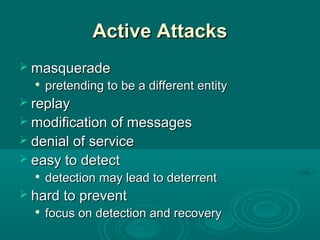
Active AttacksActive Attacks
 masquerademasquerade

pretending to be a different entitypretending to be a different entity
 replayreplay
 modification of messagesmodification of messages
 denial of servicedenial of service
 easy to detecteasy to detect

detection may lead to deterrentdetection may lead to deterrent
 hard to preventhard to prevent

focus on detection and recoveryfocus on detection and recovery
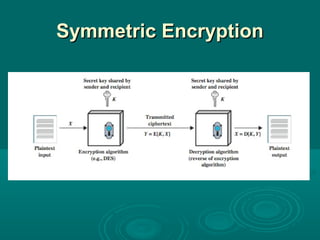
Symmetric EncryptionSymmetric Encryption
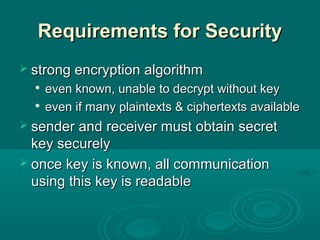
Requirements for SecurityRequirements for Security
 strong encryption algorithmstrong encryption algorithm

even known, unable to decrypt without keyeven known, unable to decrypt without key

even if many plaintexts & ciphertexts availableeven if many plaintexts & ciphertexts available
 sender and receiver must obtain secretsender and receiver must obtain secret
key securelykey securely
 once key is known, all communicationonce key is known, all communication
using this key is readableusing this key is readable
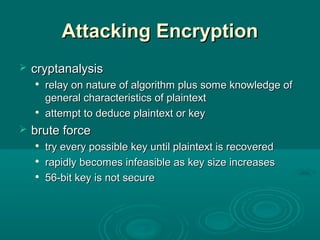
Attacking EncryptionAttacking Encryption
 cryptanalysiscryptanalysis

relay on nature of algorithm plus some knowledge ofrelay on nature of algorithm plus some knowledge of
general characteristics of plaintextgeneral characteristics of plaintext

attempt to deduce plaintext or keyattempt to deduce plaintext or key
 brute forcebrute force

try every possible key until plaintext is recoveredtry every possible key until plaintext is recovered

rapidly becomes infeasible as key size increasesrapidly becomes infeasible as key size increases

56-bit key is not secure56-bit key is not secure
Block CiphersBlock Ciphers
 most common symmetric algorithmsmost common symmetric algorithms
 process plain text in fixed block sizesprocess plain text in fixed block sizes
producing block of cipher text of equal sizeproducing block of cipher text of equal size
 most important current block ciphers:most important current block ciphers:

DataData Encryption StandardEncryption Standard (DES)(DES)

Advanced Encryption StandardAdvanced Encryption Standard
Data Encryption StandardData Encryption Standard
 US standardUS standard
 64 bit plain text blocks64 bit plain text blocks
 56 bit key56 bit key
 broken in 1998 by Electronic Frontierbroken in 1998 by Electronic Frontier
FoundationFoundation

special purpose US$250,000 machinespecial purpose US$250,000 machine

with detailed published descriptionwith detailed published description

less than three daysless than three days

DES now worthlessDES now worthless
Triple DEATriple DEA
 ANSI X9.17 (1985)ANSI X9.17 (1985)
 incorporated in DEA standard 1999incorporated in DEA standard 1999
 uses 2 or 3 keysuses 2 or 3 keys
 3 executions of DEA algorithm3 executions of DEA algorithm
 effective key lengtheffective key length 112 or112 or 168 bit168 bit
 slowslow
 block size (64 bit) now too smallblock size (64 bit) now too small
Advanced EncryptionAdvanced Encryption
StandardStandard
 NIST issued call for proposals for an AdvancedNIST issued call for proposals for an Advanced
Encryption Standard (AES) in 1997Encryption Standard (AES) in 1997

security strength equal to or better than 3DESsecurity strength equal to or better than 3DES

significantly improved efficiencysignificantly improved efficiency

symmetric block ciphersymmetric block cipher withwith block length 128 bitsblock length 128 bits

key lengths 128, 192, and 256 bitskey lengths 128, 192, and 256 bits

evaluation include security, computational efficiency,evaluation include security, computational efficiency,
memory requirements, hardware and softwarememory requirements, hardware and software
suitability, and flexibilitysuitability, and flexibility

AESAES issued as FIPS 197 in 2001issued as FIPS 197 in 2001
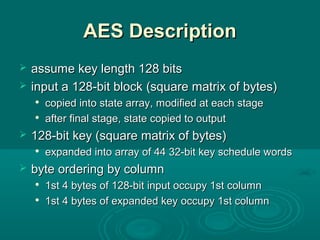
AES DescriptionAES Description
 assume key length 128 bitsassume key length 128 bits
 input a 128-bit blockinput a 128-bit block ((square matrix of bytes)square matrix of bytes)

copied into state arraycopied into state array, m, modified at each stageodified at each stage

after final stage, state copied to outputafter final stage, state copied to output
 128-bit key (square matrix of bytes)128-bit key (square matrix of bytes)

expanded into array of 44 32-bit key schedule wordsexpanded into array of 44 32-bit key schedule words
 byte orderingbyte ordering by columnby column

1st 4 bytes of1st 4 bytes of 128-bit input occupy 1st column128-bit input occupy 1st column

1st 4 bytes of expanded key1st 4 bytes of expanded key occupy 1st columnoccupy 1st column
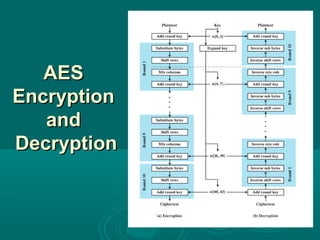
AESAES
EncryptionEncryption
andand
DecryptionDecryption
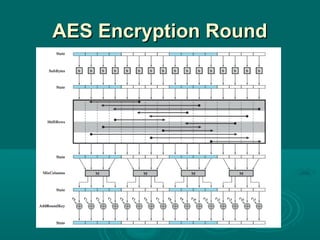
AES Encryption RoundAES Encryption Round
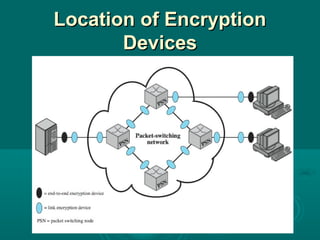
Location of EncryptionLocation of Encryption
DevicesDevices
Link EncryptionLink Encryption
 each communication link equipped at both endseach communication link equipped at both ends
 all traffic secureall traffic secure
 high level of securityhigh level of security
 requires lots of encryption devicesrequires lots of encryption devices
 message must be decrypted at each switch tomessage must be decrypted at each switch to
read address (virtual circuit number)read address (virtual circuit number)
 security vulnerable at switchessecurity vulnerable at switches

particularly on public switched networkparticularly on public switched network
End to End EncryptionEnd to End Encryption
 encryption done at ends of systemencryption done at ends of system
 data in encrypted form crosses networkdata in encrypted form crosses network
unalteredunaltered
 destination shares key with source to decryptdestination shares key with source to decrypt
 host can only encrypt user datahost can only encrypt user data

otherwise switching nodes could not read header orotherwise switching nodes could not read header or
route packetroute packet
 hence traffic pattern not securehence traffic pattern not secure
 solution is to use both link and end to endsolution is to use both link and end to end
Key DistributionKey Distribution
 symmetric encryption needs key distributionsymmetric encryption needs key distribution

protected for access by othersprotected for access by others

changed frequentlychanged frequently
 possibilities for key distributionpossibilities for key distribution
1.1. key selected by A and delivered to Bkey selected by A and delivered to B
2.2. third party selects key and delivers to A and Bthird party selects key and delivers to A and B
3.3. use old key to encrypt & transmit new key from A to Buse old key to encrypt & transmit new key from A to B
4.4. use old key to transmit new key from third party to Ause old key to transmit new key from third party to A
and Band B
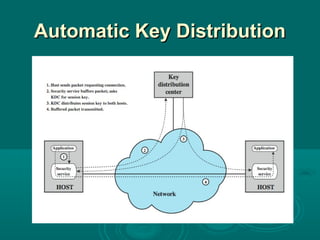
Automatic Key DistributionAutomatic Key Distribution
Traffic PaddingTraffic Padding
 addresses concern about traffic analysisaddresses concern about traffic analysis

though link encryption reduces opportunitythough link encryption reduces opportunity

attacker can still assess traffic volumeattacker can still assess traffic volume
 traffic padding produces ciphertexttraffic padding produces ciphertext
continuouslycontinuously
 if no plaintext, sends random dataif no plaintext, sends random data
 makes traffic analysis impossiblemakes traffic analysis impossible
Message AuthenticationMessage Authentication
 protection against active attacks withprotection against active attacks with

falsification of datafalsification of data

falsification of sourcefalsification of source
 authentication allows receiver to verify thatauthentication allows receiver to verify that
message is authenticmessage is authentic

has not been alteredhas not been altered

is from claimed/authentic sourceis from claimed/authentic source

timelinesstimeliness
Authentication UsingAuthentication Using
Symmetric EncryptionSymmetric Encryption
 assume sender & receiver only know keyassume sender & receiver only know key
 only sender could have encryptedonly sender could have encrypted
message for other partymessage for other party
 message must include one of:message must include one of:

error detection codeerror detection code

sequence numbersequence number

time stamptime stamp
Authentication WithoutAuthentication Without
EncryptionEncryption
 authentication tag generated and appended toauthentication tag generated and appended to
each messageeach message
 message not encryptedmessage not encrypted
 useful when don’t want encryption because:useful when don’t want encryption because:

messages broadcast to multiple destinationsmessages broadcast to multiple destinations
• have one destination responsible for authenticationhave one destination responsible for authentication

one side heavily loadedone side heavily loaded
• encryption adds to workloadencryption adds to workload
• can authenticate random messagescan authenticate random messages

programs authenticated without encryption can beprograms authenticated without encryption can be
executed without decodingexecuted without decoding
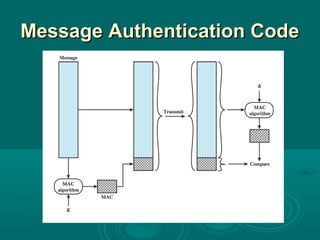
Message Authentication CodeMessage Authentication Code
 generate authentication code based on sharedgenerate authentication code based on shared
key and messagekey and message
 common key shared between A and Bcommon key shared between A and B
 if only sender and receiver know key and codeif only sender and receiver know key and code
matches:matches:

receiver assured message has not alteredreceiver assured message has not altered

receiver assured message is from alleged senderreceiver assured message is from alleged sender

if message has sequence number, receiver assuredif message has sequence number, receiver assured
of proper sequenceof proper sequence
 can use various algorithms, eg. DEScan use various algorithms, eg. DES
Message Authentication CodeMessage Authentication Code
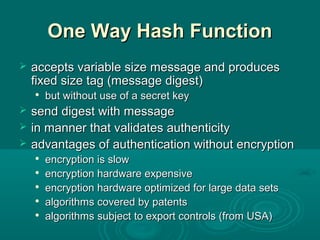
One Way Hash FunctionOne Way Hash Function
 accepts variable size message and producesaccepts variable size message and produces
fixed size tag (message digest)fixed size tag (message digest)

but without use of a secret keybut without use of a secret key
 send digest with messagesend digest with message
 in manner that validates authenticityin manner that validates authenticity
 advantages of authentication without encryptionadvantages of authentication without encryption

encryption is slowencryption is slow

encryption hardware expensiveencryption hardware expensive

encryption hardware optimized for large data setsencryption hardware optimized for large data sets

algorithms covered by patentsalgorithms covered by patents

algorithms subject to export controls (from USA)algorithms subject to export controls (from USA)
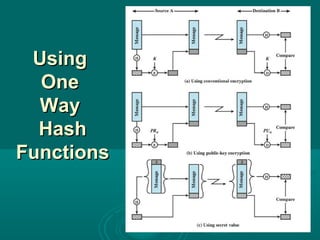
UsingUsing
OneOne
WayWay
HashHash
FunctionsFunctions
Secure Hash FunctionsSecure Hash Functions
 produce a “fingerprint” of message/fileproduce a “fingerprint” of message/file
 must have the following properties:must have the following properties:

can be applied to any size data blockcan be applied to any size data block

produce fixed length outputproduce fixed length output

easy to computeeasy to compute

not feasible to reversenot feasible to reverse

not feasible to find two messages with thenot feasible to find two messages with the
same hashsame hash
 giving “weak” & “strong” hash functionsgiving “weak” & “strong” hash functions
 also used for data integrityalso used for data integrity
Secure Hash AlgorithmSecure Hash Algorithm
 Secure Hash Algorithm (SHA)Secure Hash Algorithm (SHA)

SHA defined in FIPS 180 (1993), 160-bit hashSHA defined in FIPS 180 (1993), 160-bit hash

SHA-1 defined in FIPS 180-1 (1995)SHA-1 defined in FIPS 180-1 (1995)

SHA-256, SHA-384, SHA-512 defined in FIPSSHA-256, SHA-384, SHA-512 defined in FIPS
180-2 (2002), 256/384/512-bit hashes180-2 (2002), 256/384/512-bit hashes
 SHA-1 being phased out, attack knownSHA-1 being phased out, attack known
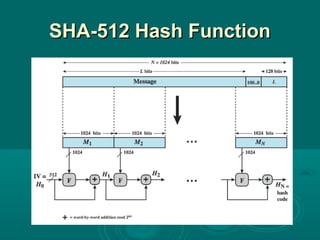
 SHA-512 processes input messageSHA-512 processes input message

with total size less than 2with total size less than 2128128
bitsbits

in 1024 bit blocksin 1024 bit blocks

to produce a 512-bit digestto produce a 512-bit digest
SHA-512 Hash FunctionSHA-512 Hash Function
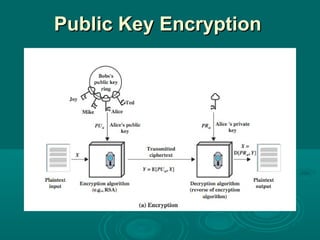
Public KeyPublic Key EncryptionEncryption
Public Key Encryption -Public Key Encryption -
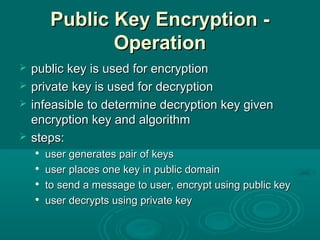
OperationOperation
 public key is used for encryptionpublic key is used for encryption
 private key is used for decryptionprivate key is used for decryption
 infeasible to determine decryption key giveninfeasible to determine decryption key given
encryption key and algorithmencryption key and algorithm
 steps:steps:

user generates pair of keysuser generates pair of keys

user places one key in public domainuser places one key in public domain

to send a message to user, encrypt using public keyto send a message to user, encrypt using public key

user decrypts using private keyuser decrypts using private key
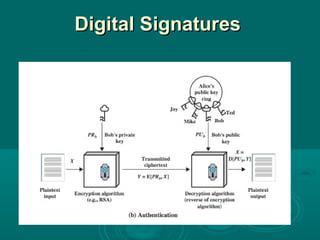
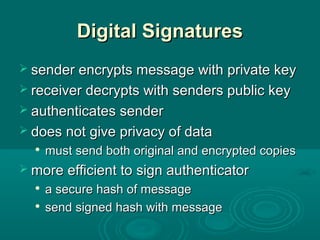
Digital SignaturesDigital Signatures
 sender encrypts message with private keysender encrypts message with private key
 receiver decrypts with senders public keyreceiver decrypts with senders public key
 authenticates senderauthenticates sender
 does not give privacy of datadoes not give privacy of data

must send both original and encrypted copiesmust send both original and encrypted copies
 more efficient to sign authenticatormore efficient to sign authenticator

a secure hash of messagea secure hash of message

send signed hash with messagesend signed hash with message
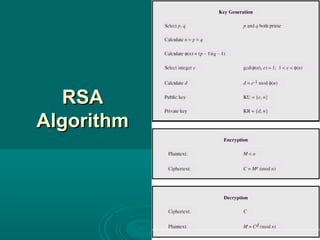
RSARSA
AlgorithmAlgorithm
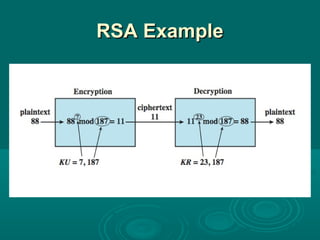
RSA ExampleRSA Example
RSA SecurityRSA Security
 brute force search of all keysbrute force search of all keys

given size of parameters is infeasiblegiven size of parameters is infeasible

but larger keys do slow calculationsbut larger keys do slow calculations
 factor n to recover p & qfactor n to recover p & q

a hard problema hard problem

well known 129 digit challenge broken in 1994well known 129 digit challenge broken in 1994

key size of 1024-bits (300 digits) currentlykey size of 1024-bits (300 digits) currently
secure for most appssecure for most apps
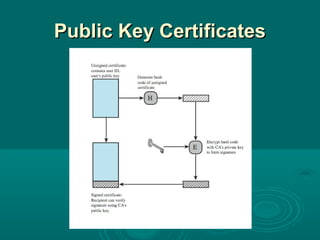
Public Key CertificatesPublic Key Certificates
Secure Sockets Layer /Secure Sockets Layer /
Transport Layer SecurityTransport Layer Security
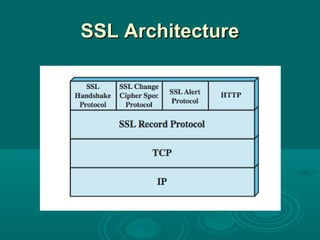
 Secure Sockets Layer (SSL) is a widely used setSecure Sockets Layer (SSL) is a widely used set
of general purpose security protocolsof general purpose security protocols

use TCPuse TCP to provideto provide reliable end-to-end servicereliable end-to-end service
 Transport Layer Security (TLS) inTransport Layer Security (TLS) in RFC 2246RFC 2246
 two implementationtwo implementation optionsoptions

incorporated in underlying protocol suiteincorporated in underlying protocol suite

embedded in specific packagesembedded in specific packages
 minor differences betweenminor differences between SSLv3SSLv3 andand TLSTLS
SSL ArchitectureSSL Architecture
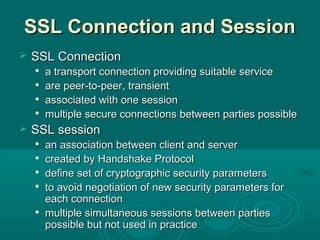
SSL Connection and SessionSSL Connection and Session
 SSL ConnectionSSL Connection

a transport connection providing suitable servicea transport connection providing suitable service

are peer-to-peerare peer-to-peer, t, transientransient

associated with one sessionassociated with one session

multiple secure connectionsmultiple secure connections between parties possiblebetween parties possible
 SSL sessionSSL session

an association between client and serveran association between client and server

createdcreated byby Handshake ProtocolHandshake Protocol

define set of cryptographic security parametersdefine set of cryptographic security parameters

to avoid negotiation of new security parameters forto avoid negotiation of new security parameters for
each connectioneach connection

multiple simultaneous sessions between partiesmultiple simultaneous sessions between parties
possible but not used in practicepossible but not used in practice
SSL Record ProtocolSSL Record Protocol
 provides confidentiality serviceprovides confidentiality service

used to encrypt SSL payload dataused to encrypt SSL payload data
 provides message integrity serviceprovides message integrity service

usedused to form message authentication codeto form message authentication code
(MAC)(MAC)
 Handshake Protocol defines shared secretHandshake Protocol defines shared secret
keys for each of above serviceskeys for each of above services
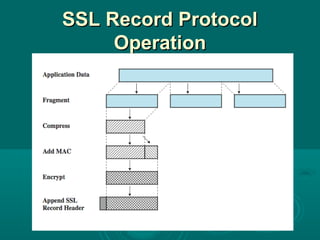
SSL Record ProtocolSSL Record Protocol
OperationOperation
Record Protocol HeaderRecord Protocol Header
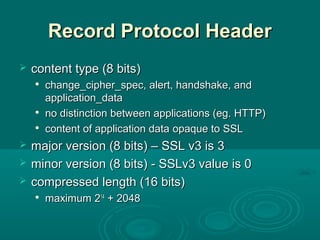
 content type (8 bits)content type (8 bits)

change_cipher_spec, alert, handshake, andchange_cipher_spec, alert, handshake, and
application_dataapplication_data

no distinctionno distinction betweenbetween applications (eg. HTTP)applications (eg. HTTP)

content of application datacontent of application data opaque to SSLopaque to SSL
 major version (8 bits)major version (8 bits) – SSL v3 is 3– SSL v3 is 3
 minor version (8 bits)minor version (8 bits) -- SSLv3 value is 0SSLv3 value is 0
 compressed length (16 bits)compressed length (16 bits)

maximum 2maximum 21414
+ 2048+ 2048
Change Cipher Spec ProtocolChange Cipher Spec Protocol
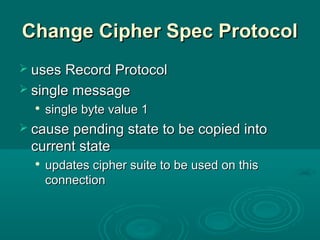
 usesuses Record ProtocolRecord Protocol
 single messagesingle message

single byte value 1single byte value 1
 causecause pending state to be copied intopending state to be copied into
current statecurrent state

updates cipher suite to be used on thisupdates cipher suite to be used on this
connectionconnection
Alert ProtocolAlert Protocol
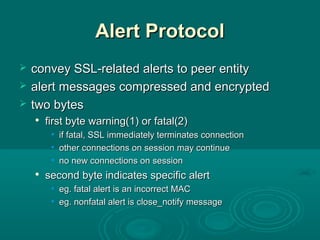
 convey SSL-related alerts to peer entityconvey SSL-related alerts to peer entity
 alertalert messages compressed and encryptedmessages compressed and encrypted
 two bytestwo bytes

first byte warning(1) or fatal(2)first byte warning(1) or fatal(2)
• if fatal, SSL immediately terminates connectionif fatal, SSL immediately terminates connection
• other connections on session may continueother connections on session may continue
• nono new connections on sessionnew connections on session

second byte indicates specific alertsecond byte indicates specific alert
• eg.eg. fatal alert is an incorrect MACfatal alert is an incorrect MAC
• eg.eg. nonfatal alert is close_notify messagenonfatal alert is close_notify message
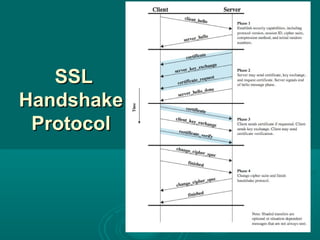
Handshake ProtocolHandshake Protocol
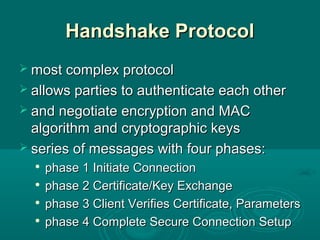
 most complex protocolmost complex protocol
 allows parties to authenticate each otherallows parties to authenticate each other
 and negotiate encryption and MACand negotiate encryption and MAC
algorithmalgorithm and cryptographic keysand cryptographic keys
 series of messages with four phases:series of messages with four phases:

phase 1 Initiate Connectionphase 1 Initiate Connection

phase 2 Certificate/Key Exchangephase 2 Certificate/Key Exchange

phase 3 Client Verifies Certificate, Parametersphase 3 Client Verifies Certificate, Parameters

phase 4 Complete Secure Connection Setupphase 4 Complete Secure Connection Setup
SSLSSL
HandshakeHandshake
ProtocolProtocol
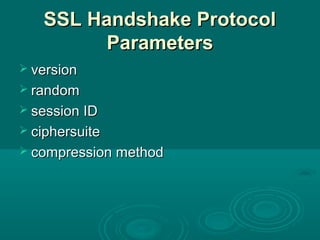
SSL Handshake ProtocolSSL Handshake Protocol
ParametersParameters
 versionversion
 randomrandom
 session IDsession ID
 ciphersuiteciphersuite
 compression methodcompression method
IPv4 and IPv6 SecurityIPv4 and IPv6 Security
 IP Security extensions (IPSec) for IPv4/v6IP Security extensions (IPSec) for IPv4/v6
 developed in response to observed weaknessesdeveloped in response to observed weaknesses
 to stop unauthorized traffic monitoring, secureto stop unauthorized traffic monitoring, secure
user traffic with authentication & encryptionuser traffic with authentication & encryption
 example uses:example uses:

secure branch office connectivity over Internetsecure branch office connectivity over Internet

secure remote access over Internetsecure remote access over Internet

extranet and intranet connectivityextranet and intranet connectivity

enhanced electronic commerce securityenhanced electronic commerce security
 can encrypt / authenticate all traffic at IP levelcan encrypt / authenticate all traffic at IP level
IPSec FacilitiesIPSec Facilities
 Authentication Header (AH)Authentication Header (AH)

authentication only serviceauthentication only service
 Encapsulated Security Payload (ESP)Encapsulated Security Payload (ESP)

combined authentication & encryption servicecombined authentication & encryption service

generally used for virtual private networksgenerally used for virtual private networks
 key exchangekey exchange

both manual and automatedboth manual and automated
 in RFC’s 2401,2402,2406,2408 (1998)in RFC’s 2401,2402,2406,2408 (1998)
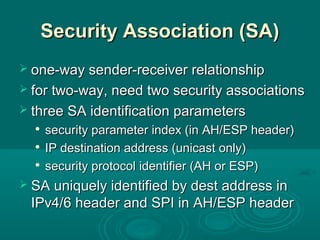
Security Association (SA)Security Association (SA)
 one-way sender-receiver relationshipone-way sender-receiver relationship
 for two-way, need two security associationsfor two-way, need two security associations
 three SA identification parametersthree SA identification parameters

security parameter index (in AH/ESP header)security parameter index (in AH/ESP header)

IP destination address (unicast only)IP destination address (unicast only)

security protocol identifier (AH or ESP)security protocol identifier (AH or ESP)
 SA uniquely identified by dest address inSA uniquely identified by dest address in
IPv4/6 header and SPI in AH/ESP headerIPv4/6 header and SPI in AH/ESP header
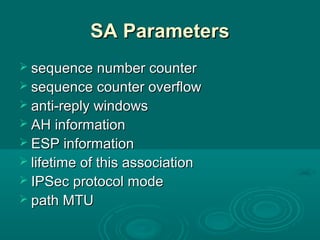
SA ParametersSA Parameters
 sequence number countersequence number counter
 sequence counter overflowsequence counter overflow
 anti-reply windowsanti-reply windows
 AH informationAH information
 ESP informationESP information
 lifetime of this associationlifetime of this association
 IPSec protocol modeIPSec protocol mode
 path MTUpath MTU
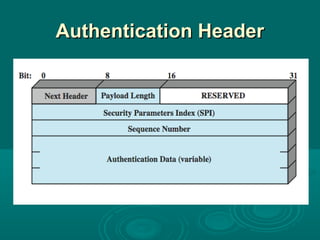
Authentication HeaderAuthentication Header
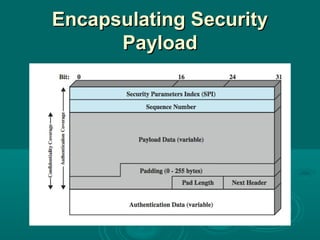
Encapsulating SecurityEncapsulating Security
PayloadPayload
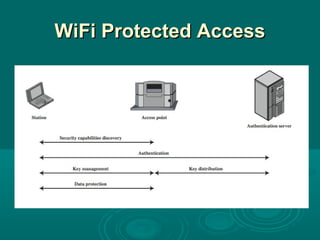
WiFi Protected AccessWiFi Protected Access
 WiFi Protected Access (WPA) extensionsWiFi Protected Access (WPA) extensions
to address 802.11 security issuesto address 802.11 security issues

based on current 802.11i standardbased on current 802.11i standard

addresses authentication, key management,addresses authentication, key management,
data transfer privacydata transfer privacy
 uses authentication server and a moreuses authentication server and a more
robust protocolrobust protocol
 encryption with AES or 104-bit RC4encryption with AES or 104-bit RC4
WiFi Protected AccessWiFi Protected Access
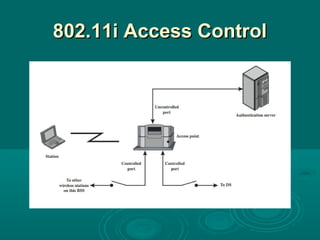
802.11i Access Control802.11i Access Control
802.11i Privacy & Integrity802.11i Privacy & Integrity
 have Temporal Key Integrity Protocolhave Temporal Key Integrity Protocol
(TKIP) or WPA-1(TKIP) or WPA-1

s/w only changes to existing equipments/w only changes to existing equipment

using same RC4 algorithm as older WEPusing same RC4 algorithm as older WEP
 and Counter Mode CBC MAC (CCMP) orand Counter Mode CBC MAC (CCMP) or
WPA-2 using AES encryptionWPA-2 using AES encryption
 both add message integrity code (MIC)both add message integrity code (MIC)

generated using Michael algorithmgenerated using Michael algorithm
SummarySummary
 security requirements and attackssecurity requirements and attacks
 confidentiality using symmetric encryptionconfidentiality using symmetric encryption
 message authentication & hash functionsmessage authentication & hash functions
 public-key encryption & digital signaturespublic-key encryption & digital signatures
 secure socket layer (SSL)secure socket layer (SSL)
 IPSecIPSec
 WiFi Protected AccessWiFi Protected Access

network security

  • 1.
    Data and ComputerDataand Computer CommunicationsCommunications Eighth EditionEighth Edition by William Stallingsby William Stallings Lecture slides by Lawrie BrownLecture slides by Lawrie Brown Chapter 21 – Network SecurityChapter 21 – Network Security
  • 2.
    Network SecurityNetwork Security Toguard against the baneful influence exerted by strangers is therefore an elementary dictate of savage prudence. Hence before strangers are allowed to enter a district, or at least before they are permitted to mingle freely with the inhabitants, certain ceremonies are often performed by the natives of the country for the purpose of disarming the strangers of their magical powers, or of disinfecting, so to speak, the tainted atmosphere by which they are supposed to be surrounded. —The Golden Bough, Sir James George Frazer
  • 3.
    Security RequirementsSecurity Requirements confidentiality - protect data content/accessconfidentiality - protect data content/access  integrity - protect data accuracyintegrity - protect data accuracy  availability - ensure timely serviceavailability - ensure timely service  authenticity - protect data originauthenticity - protect data origin
  • 4.
    Passive AttacksPassive Attacks eavesdropping on transmissionseavesdropping on transmissions  to obtain informationto obtain information  release of possibly sensitive/confidentialrelease of possibly sensitive/confidential message contentsmessage contents  traffic analysis which monitors frequency andtraffic analysis which monitors frequency and length of messages to get info on senderslength of messages to get info on senders  difficult to detectdifficult to detect  can be prevented using encryptioncan be prevented using encryption
  • 5.
    Active AttacksActive Attacks masquerademasquerade  pretending to be a different entitypretending to be a different entity  replayreplay  modification of messagesmodification of messages  denial of servicedenial of service  easy to detecteasy to detect  detection may lead to deterrentdetection may lead to deterrent  hard to preventhard to prevent  focus on detection and recoveryfocus on detection and recovery
  • 6.
  • 7.
    Requirements for SecurityRequirementsfor Security  strong encryption algorithmstrong encryption algorithm  even known, unable to decrypt without keyeven known, unable to decrypt without key  even if many plaintexts & ciphertexts availableeven if many plaintexts & ciphertexts available  sender and receiver must obtain secretsender and receiver must obtain secret key securelykey securely  once key is known, all communicationonce key is known, all communication using this key is readableusing this key is readable
  • 8.
    Attacking EncryptionAttacking Encryption cryptanalysiscryptanalysis  relay on nature of algorithm plus some knowledge ofrelay on nature of algorithm plus some knowledge of general characteristics of plaintextgeneral characteristics of plaintext  attempt to deduce plaintext or keyattempt to deduce plaintext or key  brute forcebrute force  try every possible key until plaintext is recoveredtry every possible key until plaintext is recovered  rapidly becomes infeasible as key size increasesrapidly becomes infeasible as key size increases  56-bit key is not secure56-bit key is not secure
  • 9.
    Block CiphersBlock Ciphers most common symmetric algorithmsmost common symmetric algorithms  process plain text in fixed block sizesprocess plain text in fixed block sizes producing block of cipher text of equal sizeproducing block of cipher text of equal size  most important current block ciphers:most important current block ciphers:  DataData Encryption StandardEncryption Standard (DES)(DES)  Advanced Encryption StandardAdvanced Encryption Standard
  • 10.
    Data Encryption StandardDataEncryption Standard  US standardUS standard  64 bit plain text blocks64 bit plain text blocks  56 bit key56 bit key  broken in 1998 by Electronic Frontierbroken in 1998 by Electronic Frontier FoundationFoundation  special purpose US$250,000 machinespecial purpose US$250,000 machine  with detailed published descriptionwith detailed published description  less than three daysless than three days  DES now worthlessDES now worthless
  • 11.
    Triple DEATriple DEA ANSI X9.17 (1985)ANSI X9.17 (1985)  incorporated in DEA standard 1999incorporated in DEA standard 1999  uses 2 or 3 keysuses 2 or 3 keys  3 executions of DEA algorithm3 executions of DEA algorithm  effective key lengtheffective key length 112 or112 or 168 bit168 bit  slowslow  block size (64 bit) now too smallblock size (64 bit) now too small
  • 12.
    Advanced EncryptionAdvanced Encryption StandardStandard NIST issued call for proposals for an AdvancedNIST issued call for proposals for an Advanced Encryption Standard (AES) in 1997Encryption Standard (AES) in 1997  security strength equal to or better than 3DESsecurity strength equal to or better than 3DES  significantly improved efficiencysignificantly improved efficiency  symmetric block ciphersymmetric block cipher withwith block length 128 bitsblock length 128 bits  key lengths 128, 192, and 256 bitskey lengths 128, 192, and 256 bits  evaluation include security, computational efficiency,evaluation include security, computational efficiency, memory requirements, hardware and softwarememory requirements, hardware and software suitability, and flexibilitysuitability, and flexibility  AESAES issued as FIPS 197 in 2001issued as FIPS 197 in 2001
  • 13.
    AES DescriptionAES Description assume key length 128 bitsassume key length 128 bits  input a 128-bit blockinput a 128-bit block ((square matrix of bytes)square matrix of bytes)  copied into state arraycopied into state array, m, modified at each stageodified at each stage  after final stage, state copied to outputafter final stage, state copied to output  128-bit key (square matrix of bytes)128-bit key (square matrix of bytes)  expanded into array of 44 32-bit key schedule wordsexpanded into array of 44 32-bit key schedule words  byte orderingbyte ordering by columnby column  1st 4 bytes of1st 4 bytes of 128-bit input occupy 1st column128-bit input occupy 1st column  1st 4 bytes of expanded key1st 4 bytes of expanded key occupy 1st columnoccupy 1st column
  • 14.
  • 15.
    AES Encryption RoundAESEncryption Round
  • 16.
    Location of EncryptionLocationof Encryption DevicesDevices
  • 17.
    Link EncryptionLink Encryption each communication link equipped at both endseach communication link equipped at both ends  all traffic secureall traffic secure  high level of securityhigh level of security  requires lots of encryption devicesrequires lots of encryption devices  message must be decrypted at each switch tomessage must be decrypted at each switch to read address (virtual circuit number)read address (virtual circuit number)  security vulnerable at switchessecurity vulnerable at switches  particularly on public switched networkparticularly on public switched network
  • 18.
    End to EndEncryptionEnd to End Encryption  encryption done at ends of systemencryption done at ends of system  data in encrypted form crosses networkdata in encrypted form crosses network unalteredunaltered  destination shares key with source to decryptdestination shares key with source to decrypt  host can only encrypt user datahost can only encrypt user data  otherwise switching nodes could not read header orotherwise switching nodes could not read header or route packetroute packet  hence traffic pattern not securehence traffic pattern not secure  solution is to use both link and end to endsolution is to use both link and end to end
  • 19.
    Key DistributionKey Distribution symmetric encryption needs key distributionsymmetric encryption needs key distribution  protected for access by othersprotected for access by others  changed frequentlychanged frequently  possibilities for key distributionpossibilities for key distribution 1.1. key selected by A and delivered to Bkey selected by A and delivered to B 2.2. third party selects key and delivers to A and Bthird party selects key and delivers to A and B 3.3. use old key to encrypt & transmit new key from A to Buse old key to encrypt & transmit new key from A to B 4.4. use old key to transmit new key from third party to Ause old key to transmit new key from third party to A and Band B
  • 20.
  • 21.
    Traffic PaddingTraffic Padding addresses concern about traffic analysisaddresses concern about traffic analysis  though link encryption reduces opportunitythough link encryption reduces opportunity  attacker can still assess traffic volumeattacker can still assess traffic volume  traffic padding produces ciphertexttraffic padding produces ciphertext continuouslycontinuously  if no plaintext, sends random dataif no plaintext, sends random data  makes traffic analysis impossiblemakes traffic analysis impossible
  • 22.
    Message AuthenticationMessage Authentication protection against active attacks withprotection against active attacks with  falsification of datafalsification of data  falsification of sourcefalsification of source  authentication allows receiver to verify thatauthentication allows receiver to verify that message is authenticmessage is authentic  has not been alteredhas not been altered  is from claimed/authentic sourceis from claimed/authentic source  timelinesstimeliness
  • 23.
    Authentication UsingAuthentication Using SymmetricEncryptionSymmetric Encryption  assume sender & receiver only know keyassume sender & receiver only know key  only sender could have encryptedonly sender could have encrypted message for other partymessage for other party  message must include one of:message must include one of:  error detection codeerror detection code  sequence numbersequence number  time stamptime stamp
  • 24.
    Authentication WithoutAuthentication Without EncryptionEncryption authentication tag generated and appended toauthentication tag generated and appended to each messageeach message  message not encryptedmessage not encrypted  useful when don’t want encryption because:useful when don’t want encryption because:  messages broadcast to multiple destinationsmessages broadcast to multiple destinations • have one destination responsible for authenticationhave one destination responsible for authentication  one side heavily loadedone side heavily loaded • encryption adds to workloadencryption adds to workload • can authenticate random messagescan authenticate random messages  programs authenticated without encryption can beprograms authenticated without encryption can be executed without decodingexecuted without decoding
  • 25.
    Message Authentication CodeMessageAuthentication Code  generate authentication code based on sharedgenerate authentication code based on shared key and messagekey and message  common key shared between A and Bcommon key shared between A and B  if only sender and receiver know key and codeif only sender and receiver know key and code matches:matches:  receiver assured message has not alteredreceiver assured message has not altered  receiver assured message is from alleged senderreceiver assured message is from alleged sender  if message has sequence number, receiver assuredif message has sequence number, receiver assured of proper sequenceof proper sequence  can use various algorithms, eg. DEScan use various algorithms, eg. DES
  • 26.
  • 27.
    One Way HashFunctionOne Way Hash Function  accepts variable size message and producesaccepts variable size message and produces fixed size tag (message digest)fixed size tag (message digest)  but without use of a secret keybut without use of a secret key  send digest with messagesend digest with message  in manner that validates authenticityin manner that validates authenticity  advantages of authentication without encryptionadvantages of authentication without encryption  encryption is slowencryption is slow  encryption hardware expensiveencryption hardware expensive  encryption hardware optimized for large data setsencryption hardware optimized for large data sets  algorithms covered by patentsalgorithms covered by patents  algorithms subject to export controls (from USA)algorithms subject to export controls (from USA)
  • 28.
  • 29.
    Secure Hash FunctionsSecureHash Functions  produce a “fingerprint” of message/fileproduce a “fingerprint” of message/file  must have the following properties:must have the following properties:  can be applied to any size data blockcan be applied to any size data block  produce fixed length outputproduce fixed length output  easy to computeeasy to compute  not feasible to reversenot feasible to reverse  not feasible to find two messages with thenot feasible to find two messages with the same hashsame hash  giving “weak” & “strong” hash functionsgiving “weak” & “strong” hash functions  also used for data integrityalso used for data integrity
  • 30.
    Secure Hash AlgorithmSecureHash Algorithm  Secure Hash Algorithm (SHA)Secure Hash Algorithm (SHA)  SHA defined in FIPS 180 (1993), 160-bit hashSHA defined in FIPS 180 (1993), 160-bit hash  SHA-1 defined in FIPS 180-1 (1995)SHA-1 defined in FIPS 180-1 (1995)  SHA-256, SHA-384, SHA-512 defined in FIPSSHA-256, SHA-384, SHA-512 defined in FIPS 180-2 (2002), 256/384/512-bit hashes180-2 (2002), 256/384/512-bit hashes  SHA-1 being phased out, attack knownSHA-1 being phased out, attack known  SHA-512 processes input messageSHA-512 processes input message  with total size less than 2with total size less than 2128128 bitsbits  in 1024 bit blocksin 1024 bit blocks  to produce a 512-bit digestto produce a 512-bit digest
  • 31.
  • 32.
    Public KeyPublic KeyEncryptionEncryption
  • 33.
    Public Key Encryption-Public Key Encryption - OperationOperation  public key is used for encryptionpublic key is used for encryption  private key is used for decryptionprivate key is used for decryption  infeasible to determine decryption key giveninfeasible to determine decryption key given encryption key and algorithmencryption key and algorithm  steps:steps:  user generates pair of keysuser generates pair of keys  user places one key in public domainuser places one key in public domain  to send a message to user, encrypt using public keyto send a message to user, encrypt using public key  user decrypts using private keyuser decrypts using private key
  • 34.
  • 35.
    Digital SignaturesDigital Signatures sender encrypts message with private keysender encrypts message with private key  receiver decrypts with senders public keyreceiver decrypts with senders public key  authenticates senderauthenticates sender  does not give privacy of datadoes not give privacy of data  must send both original and encrypted copiesmust send both original and encrypted copies  more efficient to sign authenticatormore efficient to sign authenticator  a secure hash of messagea secure hash of message  send signed hash with messagesend signed hash with message
  • 36.
  • 37.
  • 38.
    RSA SecurityRSA Security brute force search of all keysbrute force search of all keys  given size of parameters is infeasiblegiven size of parameters is infeasible  but larger keys do slow calculationsbut larger keys do slow calculations  factor n to recover p & qfactor n to recover p & q  a hard problema hard problem  well known 129 digit challenge broken in 1994well known 129 digit challenge broken in 1994  key size of 1024-bits (300 digits) currentlykey size of 1024-bits (300 digits) currently secure for most appssecure for most apps
  • 39.
  • 40.
    Secure Sockets Layer/Secure Sockets Layer / Transport Layer SecurityTransport Layer Security  Secure Sockets Layer (SSL) is a widely used setSecure Sockets Layer (SSL) is a widely used set of general purpose security protocolsof general purpose security protocols  use TCPuse TCP to provideto provide reliable end-to-end servicereliable end-to-end service  Transport Layer Security (TLS) inTransport Layer Security (TLS) in RFC 2246RFC 2246  two implementationtwo implementation optionsoptions  incorporated in underlying protocol suiteincorporated in underlying protocol suite  embedded in specific packagesembedded in specific packages  minor differences betweenminor differences between SSLv3SSLv3 andand TLSTLS
  • 41.
  • 42.
    SSL Connection andSessionSSL Connection and Session  SSL ConnectionSSL Connection  a transport connection providing suitable servicea transport connection providing suitable service  are peer-to-peerare peer-to-peer, t, transientransient  associated with one sessionassociated with one session  multiple secure connectionsmultiple secure connections between parties possiblebetween parties possible  SSL sessionSSL session  an association between client and serveran association between client and server  createdcreated byby Handshake ProtocolHandshake Protocol  define set of cryptographic security parametersdefine set of cryptographic security parameters  to avoid negotiation of new security parameters forto avoid negotiation of new security parameters for each connectioneach connection  multiple simultaneous sessions between partiesmultiple simultaneous sessions between parties possible but not used in practicepossible but not used in practice
  • 43.
    SSL Record ProtocolSSLRecord Protocol  provides confidentiality serviceprovides confidentiality service  used to encrypt SSL payload dataused to encrypt SSL payload data  provides message integrity serviceprovides message integrity service  usedused to form message authentication codeto form message authentication code (MAC)(MAC)  Handshake Protocol defines shared secretHandshake Protocol defines shared secret keys for each of above serviceskeys for each of above services
  • 44.
    SSL Record ProtocolSSLRecord Protocol OperationOperation
  • 45.
    Record Protocol HeaderRecordProtocol Header  content type (8 bits)content type (8 bits)  change_cipher_spec, alert, handshake, andchange_cipher_spec, alert, handshake, and application_dataapplication_data  no distinctionno distinction betweenbetween applications (eg. HTTP)applications (eg. HTTP)  content of application datacontent of application data opaque to SSLopaque to SSL  major version (8 bits)major version (8 bits) – SSL v3 is 3– SSL v3 is 3  minor version (8 bits)minor version (8 bits) -- SSLv3 value is 0SSLv3 value is 0  compressed length (16 bits)compressed length (16 bits)  maximum 2maximum 21414 + 2048+ 2048
  • 46.
    Change Cipher SpecProtocolChange Cipher Spec Protocol  usesuses Record ProtocolRecord Protocol  single messagesingle message  single byte value 1single byte value 1  causecause pending state to be copied intopending state to be copied into current statecurrent state  updates cipher suite to be used on thisupdates cipher suite to be used on this connectionconnection
  • 47.
    Alert ProtocolAlert Protocol convey SSL-related alerts to peer entityconvey SSL-related alerts to peer entity  alertalert messages compressed and encryptedmessages compressed and encrypted  two bytestwo bytes  first byte warning(1) or fatal(2)first byte warning(1) or fatal(2) • if fatal, SSL immediately terminates connectionif fatal, SSL immediately terminates connection • other connections on session may continueother connections on session may continue • nono new connections on sessionnew connections on session  second byte indicates specific alertsecond byte indicates specific alert • eg.eg. fatal alert is an incorrect MACfatal alert is an incorrect MAC • eg.eg. nonfatal alert is close_notify messagenonfatal alert is close_notify message
  • 48.
    Handshake ProtocolHandshake Protocol most complex protocolmost complex protocol  allows parties to authenticate each otherallows parties to authenticate each other  and negotiate encryption and MACand negotiate encryption and MAC algorithmalgorithm and cryptographic keysand cryptographic keys  series of messages with four phases:series of messages with four phases:  phase 1 Initiate Connectionphase 1 Initiate Connection  phase 2 Certificate/Key Exchangephase 2 Certificate/Key Exchange  phase 3 Client Verifies Certificate, Parametersphase 3 Client Verifies Certificate, Parameters  phase 4 Complete Secure Connection Setupphase 4 Complete Secure Connection Setup
  • 49.
  • 50.
    SSL Handshake ProtocolSSLHandshake Protocol ParametersParameters  versionversion  randomrandom  session IDsession ID  ciphersuiteciphersuite  compression methodcompression method
  • 51.
    IPv4 and IPv6SecurityIPv4 and IPv6 Security  IP Security extensions (IPSec) for IPv4/v6IP Security extensions (IPSec) for IPv4/v6  developed in response to observed weaknessesdeveloped in response to observed weaknesses  to stop unauthorized traffic monitoring, secureto stop unauthorized traffic monitoring, secure user traffic with authentication & encryptionuser traffic with authentication & encryption  example uses:example uses:  secure branch office connectivity over Internetsecure branch office connectivity over Internet  secure remote access over Internetsecure remote access over Internet  extranet and intranet connectivityextranet and intranet connectivity  enhanced electronic commerce securityenhanced electronic commerce security  can encrypt / authenticate all traffic at IP levelcan encrypt / authenticate all traffic at IP level
  • 52.
    IPSec FacilitiesIPSec Facilities Authentication Header (AH)Authentication Header (AH)  authentication only serviceauthentication only service  Encapsulated Security Payload (ESP)Encapsulated Security Payload (ESP)  combined authentication & encryption servicecombined authentication & encryption service  generally used for virtual private networksgenerally used for virtual private networks  key exchangekey exchange  both manual and automatedboth manual and automated  in RFC’s 2401,2402,2406,2408 (1998)in RFC’s 2401,2402,2406,2408 (1998)
  • 53.
    Security Association (SA)SecurityAssociation (SA)  one-way sender-receiver relationshipone-way sender-receiver relationship  for two-way, need two security associationsfor two-way, need two security associations  three SA identification parametersthree SA identification parameters  security parameter index (in AH/ESP header)security parameter index (in AH/ESP header)  IP destination address (unicast only)IP destination address (unicast only)  security protocol identifier (AH or ESP)security protocol identifier (AH or ESP)  SA uniquely identified by dest address inSA uniquely identified by dest address in IPv4/6 header and SPI in AH/ESP headerIPv4/6 header and SPI in AH/ESP header
  • 54.
    SA ParametersSA Parameters sequence number countersequence number counter  sequence counter overflowsequence counter overflow  anti-reply windowsanti-reply windows  AH informationAH information  ESP informationESP information  lifetime of this associationlifetime of this association  IPSec protocol modeIPSec protocol mode  path MTUpath MTU
  • 55.
  • 56.
  • 57.
    WiFi Protected AccessWiFiProtected Access  WiFi Protected Access (WPA) extensionsWiFi Protected Access (WPA) extensions to address 802.11 security issuesto address 802.11 security issues  based on current 802.11i standardbased on current 802.11i standard  addresses authentication, key management,addresses authentication, key management, data transfer privacydata transfer privacy  uses authentication server and a moreuses authentication server and a more robust protocolrobust protocol  encryption with AES or 104-bit RC4encryption with AES or 104-bit RC4
  • 58.
    WiFi Protected AccessWiFiProtected Access
  • 59.
  • 60.
    802.11i Privacy &Integrity802.11i Privacy & Integrity  have Temporal Key Integrity Protocolhave Temporal Key Integrity Protocol (TKIP) or WPA-1(TKIP) or WPA-1  s/w only changes to existing equipments/w only changes to existing equipment  using same RC4 algorithm as older WEPusing same RC4 algorithm as older WEP  and Counter Mode CBC MAC (CCMP) orand Counter Mode CBC MAC (CCMP) or WPA-2 using AES encryptionWPA-2 using AES encryption  both add message integrity code (MIC)both add message integrity code (MIC)  generated using Michael algorithmgenerated using Michael algorithm
  • 61.
    SummarySummary  security requirementsand attackssecurity requirements and attacks  confidentiality using symmetric encryptionconfidentiality using symmetric encryption  message authentication & hash functionsmessage authentication & hash functions  public-key encryption & digital signaturespublic-key encryption & digital signatures  secure socket layer (SSL)secure socket layer (SSL)  IPSecIPSec  WiFi Protected AccessWiFi Protected Access

Editor's Notes

  • #2 Lecture slides prepared by Dr Lawrie Brown (UNSW@ADFA) for “Data and Computer Communications”, 8/e, by William Stallings, Chapter 21 “Network Security”.
  • #3 This quote is from the start of Stallings DCC8e Chapter 21. It hints at issues of security which must be addressed. The requirements of information security within an organization have undergone major changes in the last several decades. With the introduction of the computer, the need for automated tools for protecting files and other information stored on the computer became evident. The generic name for the collection of tools designed to protect data and to thwart hackers is computer security. Although this is an important topic, it is beyond the scope of this book. The second major change that affected security is the introduction of distributed systems and the use of networks and communications facilities for carrying data between terminal user and computer and between computer and computer. Network security measures are needed to protect data during their transmission and to guarantee that data transmissions are authentic. The essential technology underlying virtually all automated network and computer security applications is encryption. The chapter begins with an overview of the requirements for network security. Next, we look at uses of encryption. The chapter closes with an examination of security features in SSL, IPSec, and Wi-Fi Protected Access.
  • #4 To understand the types of threats to security that exist, we need to have a definition of security requirements. Computer and network security address four requirements: • Confidentiality: Requires that data only be accessible by authorized parties. This type of access includes printing, displaying, and other forms of disclosure, including simply revealing the existence of an object. • Integrity: Requires that only authorized parties can modify data. Modification includes writing, changing, changing status, deleting, and creating. • Availability: Requires that data are available to authorized parties. • Authenticity: Requires that a host or service be able to verify the identity of a user.
  • #5 A useful means of classifying security attacks (RFC 2828) is in terms of passive attacks and active attacks. A passive attack attempts to learn or make use of information from the system but does not affect system resources. An active attack attempts to alter system resources or affect their operation. Passive attacks are in the nature of eavesdropping on, or monitoring of, transmissions. The goal of the opponent is to obtain information that is being transmitted. Two types of passive attacks are release of message contents (which may contain sensitive or confidential information), and traffic analysis which is subtler. Even with encryption protecting message contents, an opponent might still be able to observe the pattern of these messages. The opponent could determine the location and identity of communicating hosts and could observe the frequency and length of messages being exchanged. This information might be useful in guessing the nature of the communication that was taking place. Passive attacks are very difficult to detect because they do not involve any alteration of the data. Typically, the message traffic is sent and received in an apparently normal fashion and neither the sender nor receiver is aware that a third party has read the messages or observed the traffic pattern. However, it is feasible to prevent the success of these attacks, usually by means of encryption. Thus, the emphasis in dealing with passive attacks is on prevention rather than detection.
  • #6 Active attacks involve some modification of the data stream or the creation of a false stream and can be subdivided into four categories: masquerade, replay, modification of messages, and denial of service. Masquerade attacks take place when one entity pretends to be a different entity. A masquerade attack usually includes some other forms of active attack. Replay involves the passive capture of a data unit and its subsequent retransmission to produce an unauthorized effect. Modification of messages simply means that some portion of a legitimate message is altered, or that messages are delayed or reordered, to produce an unauthorized effect. The denial of service prevents or inhibits the normal use or management of communications facilities. This attack may have a specific target. Another form of service denial is the disruption of an entire network or a server. Active attacks present the opposite characteristics of passive attacks. Whereas passive attacks are difficult to detect, measures are available to prevent their success. On the other hand, it is quite difficult to prevent active attacks absolutely, because to do so would require physical protection of all communications facilities and paths at all times. Instead, the goal is to detect them and to recover from any disruption or delays caused by them. Because the detection has a deterrent effect, it may also contribute to prevention.
  • #7 Symmetric encryption, also referred to as conventional encryption or single-key encryption, was the only type of encryption in use prior to the introduction of public-key encryption in the late 1970s. It remains by far the more widely used of the two types of encryption. A symmetric encryption scheme has five ingredients , as shown in Stallings DCC8e Figure 21.1 above: • Plaintext: This is the original message or data that is fed into the algorithm as input. • Encryption algorithm: The encryption algorithm performs various substitutions and transformations on the plaintext. • Secret key: The secret key is also input to the encryption algorithm. The exact substitutions and transformations performed by the algorithm depend on the key. • Ciphertext: This is the scrambled message produced as output. It depends on the plaintext and the secret key. For a given message, two different keys will produce two different ciphertexts. • Decryption algorithm: This is essentially the encryption algorithm run in reverse. It takes the ciphertext and the secret key and produces the original plaintext.
  • #8 There are two requirements for secure use of symmetric encryption: 1. We need a strong encryption algorithm. At a minimum, we would like the algorithm to be such that an opponent who knows the algorithm and has access to one or more ciphertexts would be unable to decipher the ciphertext or figure out the key. This requirement is usually stated in a stronger form: The opponent should be unable to decrypt ciphertext or discover the key even if he or she is in possession of a number of ciphertexts together with the plaintext that produced each ciphertext. 2. Sender and receiver must have obtained copies of the secret key in a secure fashion and must keep the key secure. If someone can discover the key and knows the algorithm, all communication using this key is readable.
  • #9 There are two general approaches to attacking a symmetric encryption scheme. The first attack is known as cryptanalysis. Cryptanalytic attacks rely on the nature of the algorithm plus perhaps some knowledge of the general characteristics of the plaintext or even some sample plaintext-ciphertext pairs. This type of attack exploits the characteristics of the algorithm to attempt to deduce a specific plaintext or to deduce the key being used. If the attack succeeds in deducing the key, the effect is catastrophic: All future and past messages encrypted with that key are compromised. The second method, known as the brute-force attack, is to try every possible key on a piece of ciphertext until an intelligible translation into plaintext is obtained. On average, half of all possible keys must be tried to achieve success. Table 21.1 shows how much time is involved for various key sizes. The table shows results for each key size, assuming that it takes 1 µs to perform a single decryption, a reasonable order of magnitude for today's computers. With the use of massively parallel organizations of microprocessors, it may be possible to achieve processing rates many orders of magnitude greater. The final column of the table considers the results for a system that can process 1 million keys per microsecond. As one can see, at this performance level, a 56-bit key can no longer be considered computationally secure.
  • #10 The most commonly used symmetric encryption algorithms are block ciphers. A block cipher processes the plaintext input in fixed-size blocks and produces a block of ciphertext of equal size for each plaintext block. The two most important symmetric algorithms, both of which are block ciphers, are the Data Encryption Standard (DES) and the Advanced Encryption Standard (AES).
  • #11 DES has been the dominant encryption algorithm since its introduction in 1977. However, because DES uses only a 56-bit key, it was only a matter of time before computer processing speed made DES obsolete. In 1998, the Electronic Frontier Foundation (EFF) announced that it had broken a DES challenge using a special-purpose "DES cracker" machine that was built for less than $250,000. The attack took less than three days. The EFF has published a detailed description of the machine, enabling others to build their own cracker. And, of course, hardware prices will continue to drop as speeds increase, making DES worthless.
  • #12 The life of DES was extended by the use of triple DES (3DES), which involves repeating the basic DES algorithm three times, using either two or three unique keys, for a key size of 112 or 168 bits. The principal drawback of 3DES is that the algorithm is relatively sluggish in software. A secondary drawback is that both DES and 3DES use a 64-bit block size. For reasons of both efficiency and security, a larger block size is desirable.
  • #13 Because of these drawbacks, 3DES is not a reasonable candidate for long-term use. As a replacement, the National Institute of Standards and Technology (NIST) in 1997 issued a call for proposals for a new Advanced Encryption Standard (AES), which should have a security strength equal to or better than 3DES and significantly improved efficiency. In addition to these general requirements, NIST specified that AES must be a symmetric block cipher with a block length of 128 bits and support for key lengths of 128, 192, and 256 bits. Evaluation criteria include security, computational efficiency, memory requirements, hardware and software suitability, and flexibility. In 2001, AES was issued as a federal information processing standard (FIPS 197).
  • #14 In the description of this section, we assume a key length of 128 bits, which is likely to be the one most commonly implemented. The input to the encryption and decryption algorithms is a single 128-bit block. In FIPS 197, this block is depicted as a square matrix of bytes. This block is copied into the State array, which is modified at each stage of encryption or decryption. After the final stage, State is copied to an output matrix. Similarly, the 128-bit key is depicted as a square matrix of bytes. This key is then expanded into an array of key schedule words; each word is four bytes and the total key schedule is 44 words for the 128-bit key. The ordering of bytes within a matrix is by column. So, for example, the first four bytes of a 128-bit plaintext input to the encryption cipher occupy the first column of the in matrix, the second four bytes occupy the second column, and so on. Similarly, the first four bytes of the expanded key, which form a word, occupy the first column of the w matrix.
  • #15 Stallings DCC8e Figure 21.2 shows the overall structure of AES. The following comments give some insight into AES: 1. The key that is provided as input is expanded into an array of forty-four 32-bit words. Four distinct words (128 bits) serve as a round key for each round. 2. Four different stages are used, one of permutation and three of substitution: Substitute bytes: Uses a table, referred to as an S-box, to perform a byte-by-byte substitution of the block Shift rows: A simple permutation that is performed row by row Mix columns: A substitution that alters each byte in a column as a function of all of the bytes in the column Add round key: A simple bitwise XOR of the current block with a portion of the expanded key 3. The structure is quite simple. For both encryption and decryption, the cipher begins with an Add Round Key stage, followed by nine rounds that each includes all four stages, followed by a tenth round of three stages. Figure 21.3 depicts the structure of a full encryption round. 4. Only the Add Round Key stage makes use of the key. For this reason, the cipher begins and ends with an Add Round Key stage. Any other stage, applied at the beginning or end, is reversible without knowledge of the key and so would add no security.
  • #16 More comments on AES: 5. The Add Round Key stage by itself would not be formidable. The other three stages together scramble the bits, but by themselves would provide no security because they do not use the key. We can view the cipher as alternating operations of XOR encryption (Add Round Key) of a block, followed by scrambling of the block (the other three stages), followed by XOR encryption, and so on. This scheme is both efficient and highly secure. 6. Each stage is easily reversible. For the Substitute Byte, Shift Row, and Mix Columns stages, an inverse function is used in the decryption algorithm. For the Add Round Key stage, XOR is its own inverse. 7. As with most block ciphers, the decryption algorithm makes use of the expanded key in reverse order. However, the decryption algorithm is not identical to the encryption algorithm. This is a consequence of the particular structure of AES. 8. Once it is established that all four stages are reversible, it is easy to verify that decryption does recover the plaintext. Figure 21.2 lays out encryption and decryption going in opposite vertical directions. At each horizontal point State is the same for both encryption and decryption. 9. The final round of both encryption and decryption consists of only three stages. Again, this is a consequence of the particular structure of AES and is required to make the cipher reversible.
  • #17 The most powerful, and most common, approach to countering the threats to network security is encryption. In using encryption, we need to decide what to encrypt and where the encryption gear should be located. As Stallings DCC8e Figure 21.4 indicates, there are two fundamental alternatives: link encryption and end-to-end encryption.
  • #18 With link encryption, each vulnerable communications link is equipped on both ends with an encryption device. Thus, all traffic over all communications links is secured. Although this requires a lot of encryption devices in a large network, it provides a high level of security. One disadvantage of this approach is that the message must be decrypted each time it enters a packet switch; this is necessary because the switch must read the address (virtual circuit number) in the packet header to route the packet. Thus, the message is vulnerable at each switch. If this is a public packet-switching network, the user has no control over the security of the nodes.
  • #19 With end-to-end encryption, the encryption process is carried out at the two end systems. The source host or terminal encrypts the data. The data, in encrypted form, are then transmitted unaltered across the network to the destination terminal or host. The destination shares a key with the source and so is able to decrypt the data. This approach would seem to secure the transmission against attacks on the network links or switches. There is, however, still a weak spot. The host may only encrypt the user data portion of the packet and must leave the header in the clear, so that the switching nodes in the network can read it in order to route the packet to its destination. Thus, with end-to-end encryption, the user data are secure. However, the traffic pattern is not, because packet headers are transmitted in the clear. To achieve greater security, both link and end-to-end encryption are needed, as is shown in Stallings DCC8e Figure 21.4.
  • #20 For symmetric encryption to work, the two parties to an exchange must share the same key, and that key must be protected from access by others. Furthermore, frequent key changes are usually desirable to limit the amount of data compromised if an attacker learns the key. Therefore, the strength of any cryptographic system rests with the key distribution technique, a term that refers to the means of delivering a key to two parties that wish to exchange data, without allowing others to see the key. Key distribution can be achieved in a number of ways. For two parties A and B, 1. A key could be selected by A and physically delivered to B. 2. A third party could select the key and physically deliver it to A and B. 3. If A and B have previously and recently used a key, one party could transmit the new key to the other, encrypted using the old key. 4. If A and B each have an encrypted connection to a third party C, C could deliver a key on the encrypted links to A and B. Options 1 and 2 call for manual delivery of a key. For link encryption, this is a reasonable requirement. However, for end-to-end encryption, manual delivery is awkward. Option 3 is a possibility for either link encryption or end-to-end encryption, but if an attacker ever succeeds in gaining access to one key, then all subsequent keys are revealed. Even if frequent changes are made to the link encryption keys, these should be done manually. To provide keys for end-to-end encryption, option 4 is preferable.
  • #21 Stallings DCC8e Figure 21.5 illustrates an implementation of option 4 for end-to-end encryption. For this scheme, two kinds of keys are identified: • Session key: used for the duration of that logical connection, to encrypt all user data are with a one-time session key, which is then destroyed. • Permanent key: A permanent key is a key used between entities for the purpose of distributing session keys. The configuration consists of the following elements: • Key distribution center: The key distribution center determines which systems are allowed to communicate with each other and provides a one-time session key for that connection. • Security service module (SSM): This module, which may consist of functionality at one protocol layer, performs end-to-end encryption and obtains session keys on behalf of users. The steps involved in establishing a connection are shown in the figure. The automated key distribution approach provides the flexibility and dynamic characteristics needed to allow a number of terminal users to access a number of hosts and for the hosts to exchange data with each other.
  • #22 We mentioned that, in some cases, users are concerned about security from traffic analysis. With the use of link encryption, packet headers are encrypted, reducing the opportunity for traffic analysis. However, it is still possible in those circumstances for an attacker to assess the amount of traffic on a network and to observe the amount of traffic entering and leaving each end system. An effective countermeasure to this attack is traffic padding. Traffic padding is a function that produces ciphertext output continuously, even in the absence of plaintext. A continuous random data stream is generated. When plaintext is available, it is encrypted and transmitted. When input plaintext is not present, the random data are encrypted and transmitted. This makes it impossible for an attacker to distinguish between true data flow and noise and therefore impossible to deduce the amount of traffic.
  • #23 Encryption protects against passive attack (eavesdropping). A different requirement is to protect against active attack (falsification of data and transactions). Protection against such attacks is known as message authentication which allows communicating parties to verify that received messages are authentic. The two important aspects are to verify that the contents of the message have not been altered and that the source is authentic. We may also wish to verify a message's timeliness (it has not been artificially delayed and replayed) and sequence relative to other messages flowing between two parties.
  • #24 It is possible to perform authentication simply by the use of symmetric encryption. If we assume that only the sender and receiver share a key (which is as it should be), then only the genuine sender would be able successfully to encrypt a message for the other participant. Furthermore, if the message includes an error-detection code and a sequence number, the receiver is assured that no alterations have been made and that sequencing is proper. If the message also includes a timestamp, the receiver is assured that the message has not been delayed beyond that normally expected for network transit.
  • #25 Now examine several approaches to message authentication that do not rely on message encryption, but where an authentication tag is generated and appended to each message for transmission. The message itself is not encrypted and can be read at the destination independent of the authentication function at the destination. Because the approaches discussed in this section do not encrypt the message, message confidentiality is not provided. There is a place for both authentication and encryption in meeting security requirements. Here are three situations in which message authentication without confidentiality is preferable: 1. There are a number of applications in which the same message is broadcast to a number of destinations. eg, notification to users that the network is now unavailable or an alarm signal in a control center. It is cheaper and more reliable to have only one destination responsible for monitoring authenticity. The responsible system performs authentication. If a violation occurs, the other destination systems are alerted by a general alarm. 2. Another possible scenario is an exchange in which one side has a heavy load and cannot afford the time to decrypt all incoming messages. Authentication is carried out on a selective basis, with messages chosen at random for checking. 3. Authentication of a computer program in plaintext is an attractive service. The computer program can be executed without having to decrypt it every time, which would be wasteful of processor resources. However, if a message authentication tag were attached to the program, it could be checked whenever assurance is required of the integrity of the program.
  • #26 One authentication technique involves the use of a secret key to generate a small block of data, known as a message authentication code, that is appended to the message. This technique assumes that two communicating parties, say A and B, share a common secret key KAB. If we assume that only the receiver and the sender know the identity of the secret key, and if the received code matches the calculated code, then 1. The receiver is assured that the message has not been altered. If an attacker alters the message but does not alter the code, then the receiver's calculation of the code will differ from the received code. Because the attacker is assumed not to know the secret key, the attacker cannot alter the code to correspond to the alterations in the message. 2. The receiver is assured that the message is from the alleged sender. Because no one else knows the secret key, no one else could prepare a message with a proper code. 3. If the message includes a sequence number (such as is used with X.25, HDLC, and TCP), then the receiver can be assured of the proper sequence, because an attacker cannot successfully alter the sequence number. A number of algorithms could be used to generate the code. The National Bureau of Standards, in its publication DES Modes of Operation, recommends the use of DES. DES is used to generate an encrypted version of the message, and the last number of bits of ciphertext are used as the code. A 16- or 32-bit code is typical. The process just described is similar to encryption, but is less vulnerable.
  • #27 Assume A and B, share a common secret key KAB. When A has a message M to send to B, it calculates the message authentication code as a function of the message and the key: MACM = F(KAB, M). The message plus code are transmitted to the intended recipient. The recipient performs the same calculation on the received message, using the same secret key, to generate a new message authentication code. The received code is compared to the calculated code, as shown in Stallings DCC8e Figure 21.6.
  • #28 A variation on the message authentication code that has received much attention recently is the one-way hash function. As with the message authentication code, a hash function accepts a variable-size message M as input and produces a fixed-size message digest H(M) as output. Unlike the MAC, a hash function does not also take a secret key as input. To authenticate a message, the message digest is sent with the message in such a way that the message digest is authentic. These two approaches have an advantage over approaches that encrypt the entire message in that less computation is required. Reasons for this are: • Encryption software is quite slow. Even though the amount of data to be encrypted per message is small, there may be a steady stream of messages into and out of a system. • Encryption hardware costs are nonnegligible. Low-cost chip implementations of DES are available, but the cost adds up if all nodes in a network must have this capability. • Encryption hardware is optimized toward large data sizes. For small blocks of data, a high proportion of the time is spent in initialization/invocation overhead. • Encryption algorithms may be covered by patents. Some encryption algorithms, such as the RSA public-key algorithm, are patented and must be licensed, adding a cost. • Encryption algorithms may be subject to export control.
  • #29 Stallings DCC8e Figure 21.7 illustrates three ways in which the message can be authenticated. The message digest can be encrypted using symmetric encryption (part a); if it is assumed that only the sender and receiver share the encryption key, then authenticity is assured. The message digest can also be encrypted using public-key encryption (part b); this is explained in Stallings DCC8e Section 21.4. The public-key approach has two advantages: it provides a digital signature as well as message authentication, and it does not require the distribution of keys to communicating parties. Stallings DCC8e Figure 21.7c shows a technique that uses a hash function but no encryption for message authentication. This technique assumes that two communicating parties, say A and B, share a common secret value SAB. When A has a message to send to B, it calculates the hash function over the concatenation of the secret value and the message: MDM = H(SAB||M). It then sends [M||MDM] to B. Because B possesses SAB, it can recompute H(SAB||M) and verify MDM. Because the secret value itself is not sent, it is not possible for an attacker to modify an intercepted message. As long as the secret value remains secret, it is also not possible for an attacker to generate a false message. This third technique, using a shared secret value, is the one adopted for IP security; it has also been specified for SNMPv3, discussed in Ch 22.
  • #30 The one-way hash function, or secure hash function, is important not only in message authentication but in digital signatures. The purpose of a hash function is to produce a "fingerprint" of a file, message, or other block of data. To be useful for message authentication, a hash function H must have the following properties: 1. H can be applied to a block of data of any size. 2. H produces a fixed-length output. 3. H(x) is relatively easy to compute for any given x, making both hardware and software implementations practical. 4. For any given code h, it is computationally infeasible to find x such that H(x) = h. 5. For any given block x, it is computationally infeasible to find y ≠ x with H(y) = H(x). 6. It is computationally infeasible to find any pair (x, y) such that H(x) = H(y). A hash function that satisfies the first five properties in the preceding list is referred to as a weak hash function. If the sixth property is also satisfied, then it is referred to as a strong hash function. In addition to providing authentication, a message digest also provides data integrity. It performs the same function as a frame check sequence: if any bits in the message are accidentally altered in transit, the message digest will be in error.
  • #31 The Secure Hash Algorithm (SHA) was developed by NIST and published as a federal information processing standard (FIPS 180) in 1993; a revised version was issued as FIPS 180-1 in 1995 and is generally referred to as SHA-1. SHA-1 produces a hash value of 160 bits. In 2002, NIST produced a new version of the standard, FIPS 180-2, that defined three new versions of SHA, with hash value lengths of 256, 384, and 512 bits, known as SHA-256, SHA-384, and SHA-512. These new versions have the same underlying structure and use the same types of modular arithmetic and logical binary operations as SHA-1. In 2005, NIST announced the intention to phase out approval of SHA-1 and move to a reliance on the other SHA versions by 2010. Shortly thereafter, a research team described an attack in which two separate messages could be found that deliver the same SHA-1 hash using 269 operations, far fewer than the 280 operations previously thought needed to find a collision with an SHA-1 hash. This result should hasten the transition to the other versions of SHA. The SHA-512 algorithm takes as input a message with a maximum length of less than 2128 bits and produces as output a 512-bit message digest. The input is processed in 1024-bit blocks.
  • #32 Stallings DCC8e Figure 21.8 depicts the overall processing of a message to produce a digest. The processing consists of the following steps: Step 1: Append padding bits. The message is padded so that its length is congruent to 896 modulo 1024 [length mod 1024 = 896). Step 2: Append length. A block of 128 bits is appended to the message. This block is treated as an unsigned 128-bit integer (most significant byte first) and contains the length of the original message (before the padding) Step 3: Initialize MD buffer. A 512-bit buffer is used to hold intermediate and final results of the hash function. Step 4: Process message in 512-bit (16-word) blocks. The heart of the algorithm is a module that consists of 80 rounds of processing. The 80 rounds have a the same structure, but vary some constants and logical functions. Step 5: Output. After all N 1024-bit blocks have been processed, the output from the Nth stage is the 512-bit message digest. The SHA-512 algorithm has the property that every bit of the hash code is a function of every bit of the input. The complex repetition of the basic function F produces results that are well mixed; that is, it is unlikely that two messages chosen at random, even if they exhibit similar regularities, will have the same hash code.
  • #33 Of equal importance to symmetric encryption is public-key encryption, which finds use in message authentication and key distribution. Public-key encryption, first publicly proposed by Diffie and Hellman in 1976, is the first truly revolutionary advance in encryption in literally thousands of years. They are based on mathematical functions rather than on simple operations on bit patterns, and are asymmetric, involving the use of two separate keys. The use of two keys has profound consequences in the areas of confidentiality, key distribution, and authentication. A public-key encryption scheme has six ingredients, as shown in Stallings DCC8e Figure 21.9: • Plaintext: the readable message or data fed into the algorithm as input. • Encryption algorithm: performs various transformations on the plaintext. • Public and private key: a pair of keys where one is used for encryption and the other for decryption. The public key of the pair is made public for others to use, while the private key is known only to its owner. • Ciphertext: the scrambled message produced as output, which depends on the plaintext and key. • Decryption algorithm: accepts the ciphertext and the matching key and produces the original plaintext.
  • #34 A general-purpose public-key cryptographic algorithm relies on one key for encryption and a different but related key for decryption, and have the following important characteristics: It is computationally infeasible to determine the decryption key given only knowledge of the cryptographic algorithm and the encryption key, and for most public-key schemes, either of the two related keys can be used for encryption, with the other for decryption. The essential steps to perform public key encryption are: 1. Each user generates a pair of keys to be used for the encryption and decryption of messages. 2. Each user places one of the two keys in a public register or other accessible file. This is the public key. The companion key is kept private. As Figure 21.9 suggests, each user maintains a collection of public keys obtained from others. 3. If Bob wishes to send a private message to Alice, Bob encrypts the message using Alice's public key. 4. When Alice receives the message, she decrypts it using her private key. No other recipient can decrypt the message because only Alice knows Alice's private key. With this approach, all participants have access to public keys, and private keys are generated locally by each participant and therefore need never be distributed. As long as a user protects his or her private key, incoming communication is secure. At any time, a user can change the private key and publish the companion public key to replace the old public key.
  • #35 Public-key encryption can be used in another way, as illustrated in Stallings DCC8e Figure 21.9b. Suppose that Bob wants to send a message to Alice and, although it is not important that the message be kept secret, he wants Alice to be certain that the message is indeed from him. In this case Bob uses his own private key to encrypt the message. When Alice receives the ciphertext, she finds that she can decrypt it with Bob's public key, thus proving that the message must have been encrypted by Bob. No one else has Bob's private key and therefore no one else could have created a ciphertext that could be decrypted with Bob's public key. Therefore, the entire encrypted message serves as a digital signature. In addition, it is impossible to alter the message without access to Bob's private key, so the message is authenticated both in terms of source and in terms of data integrity.
  • #36 In the preceding scheme, the entire message is encrypted, which, although validating both author and contents, requires a great deal of storage. Each document must be kept in plaintext to be used for practical purposes. A copy also must be stored in ciphertext so that the origin and contents can be verified in case of a dispute. A more efficient way of achieving the same results is to encrypt a small block of bits that is a function of the document. Such a block, called an authenticator, must have the property that it is infeasible to change the document without changing the authenticator. If the authenticator is encrypted with the sender's private key, it serves as a signature that verifies origin, content, and sequencing. A secure hash code such as SHA-1 can serve this function. It is important to emphasize that the digital signature does not provide confidentiality. That is, the message being sent is safe from alteration but not safe from eavesdropping. This is obvious in the case of a signature based on a portion of the message, because the rest of the message is transmitted in the clear. Even in the case of complete encryption, there is no protection of confidentiality because any observer can decrypt the message by using the sender's public key.
  • #37 One of the first public-key schemes was developed in 1977 by Ron Rivest, Adi Shamir, and Len Adleman at MIT and first published in 1978. The RSA scheme has since that time reigned supreme as the only widely accepted and implemented approach to public-key encryption. RSA is a block cipher in which the plaintext and ciphertext are integers between 0 and n – 1 for some n. Encryption and decryption are of the following form, for some plaintext block M and ciphertext block C: C = Me mod n M = Cd mod n = (Me)d mod n = Med mod n Both sender and receiver must know the values of n and e, and only the receiver knows the value of d. This is a public-key encryption algorithm with a public key of PU = {e, n} and a private key of PR = {d, n}. For this algorithm to be satisfactory for public-key encryption, some requirements must be met. The first two are easy. The third can be met for large values of e and n. Stallings DCC8e Figure 21.10 summarizes the RSA algorithm. Begin by selecting two prime numbers, p and q and calculating their product n, which is the modulus for encryption and decryption. Next, we need the quantity (n), referred to as the Euler totient of n, which is the number of positive integers less than n and relatively prime to n. Then select an integer e that is relatively prime to (n) [i.e., the greatest common divisor of e and (n) is 1]. Finally, calculate d such that de mod (n) = 1. It can be shown that d and e have the desired properties.
  • #38 An example is shown in Stallings DCC8e Figure 21.11. For this example, the keys were generated as follows: 1. Select two prime numbers, p = 17 and q = 11. 2. Calculate n = pq = 17  11 = 187. 3. Calculate (n) = (p – 1)(q – 1) = 16  10 = 160. 4. Select e such that e is relatively prime to (n) = 160 and less than (n); we choose e = 7. 5. Determine d such that de mod 160 = 1 and d < 160. The correct value is d = 23, because 23  7 = 161 = 10  160 + 1. The resulting keys are public key PU = {7, 187} and private key PR = {23, 187}. The example shows the use of these keys for a plaintext input of M = 88. For encryption, we need to calculate C = 887 mod 187. For decryption, we calculate M = 1123 mod 187.
  • #39 There are two possible approaches to defeating the RSA algorithm. The first is the brute force approach: try all possible private keys. Thus, the larger the number of bits in e and d, the more secure the algorithm. However, because the calculations involved, both in key generation and in encryption/decryption, are complex, the larger the size of the key, the slower the system will run. Most discussions of the cryptanalysis of RSA have focused on the task of factoring n into its two prime factors. For a large n with large prime factors, factoring is a hard problem, but not as hard as it used to be. A striking illustration of this is the following. In 1977, the three inventors of RSA dared Scientific American readers to decode a cipher they printed in Martin Gardner's "Mathematical Games" column. They offered a $100 reward for the return of a plaintext sentence, an event they predicted might not occur for some 40 quadrillion years. In April of 1994, a group working over the Internet and using over 1600 computers claimed the prize after only eight months of work. This challenge used a public-key size (length of n) of 129 decimal digits, or around 428 bits. This result does not invalidate the use of RSA; it simply means that larger key sizes must be used. Currently, a 1024-bit key size (about 300 decimal digits) is considered strong enough for virtually all applications.
  • #40 With symmetric encryption, a fundamental requirement for two parties to communicate securely is that they share a secret key. How to distribute secret keys securely is the most difficult problem for symmetric encryption. This problem is wiped away with public-key encryption by the simple fact that the private key is never distributed. If Bob wants to correspond with Alice and other people, he generates a single pair of keys, one private and one public. He keeps the private key secure and broadcasts the public key to all and sundry. If Alice does the same, then Bob has Alice's public key, Alice has Bob's public key, and they can now communicate securely. In particular they can use the public key to encrypt and exchange a random session key. This is then used to encrypt the message using a fast symmetric cipher. But we have replaced one problem with another. Alice's private key is secure because she need never reveal it; however, Bob must be sure that the public key with Alice's name written all over it is in fact Alice's public key. Someone else could have broadcast a public key and said it was Alice's. The solution to this problem is the public-key certificate. In essence, a certificate consists of a public key plus a User ID of the key owner, with the whole block signed by a trusted third party. Typically, the third party is a certificate authority (CA) that is trusted by the user community, such as a government agency or a financial institution. A user can present his or her public key to the authority in a secure manner and obtain a certificate. The user can then publish the certificate. Anyone needing this user's public key can obtain the certificate and verify that it is valid by way of the attached trusted signature. Stallings DCC8e Figure 21.12 illustrates the process.
  • #41 One of the most widely used security services is the Secure Sockets Layer (SSL) and the follow-on Internet standard known as Transport Layer Security (TLS), the latter defined in RFC 2246. SSL is a general-purpose service, implemented as a set of protocols that rely on TCP, to provide a reliable end-to-end secure service. At this level, there are two implementation choices. For full generality, SSL (or TLS) could be provided as part of the underlying protocol suite and therefore be transparent to applications. Alternatively, SSL can be embedded in specific packages. For example, Netscape and Microsoft Explorer browsers come equipped with SSL, and most Web servers have implemented the protocol. This section discusses SSLv3. Only minor changes are found in TLS.
  • #42 SSL is not a single protocol but rather two layers of protocols, as illustrated in Stallings DCC8e Figure 21.13. The SSL Record Protocol provides basic security services to various higher-layer protocols. In particular, the Hypertext Transfer Protocol (HTTP), which provides the transfer service for Web client/server interaction, can operate on top of SSL. Three higher-layer protocols are defined as part of SSL: the Handshake Protocol, The Change Cipher Spec Protocol, and the Alert Protocol. These SSL-specific protocols are used in the management of SSL exchanges and are examined later in this section.
  • #43 Two important SSL concepts are the SSL session and the SSL connection, which are defined in the specification as follows: • Connection: A connection is a transport (in the OSI layering model definition) that provides a suitable type of service. For SSL, such connections are peer-to-peer relationships. The connections are transient. Every connection is associated with one session. • Session: An SSL session is an association between a client and a server. Sessions are created by the Handshake Protocol. Sessions define a set of cryptographic security parameters, which can be shared among multiple connections. Sessions are used to avoid the expensive negotiation of new security parameters for each connection. Between any pair of parties (applications such as HTTP on client and server), there may be multiple secure connections. In theory, there may also be multiple simultaneous sessions between parties, but this feature is not used in practice.
  • #44 The SSL Record Protocol provides two services for SSL connections: • Confidentiality: The Handshake Protocol defines a shared secret key that is used for symmetric encryption of SSL payloads. • Message Integrity: The Handshake Protocol also defines a shared secret key that is used to form a message authentication code (MAC).
  • #45 Stallings DCC8e Figure 21.14 indicates the overall operation of the SSL Record Protocol. The first step is fragmentation. Each upper-layer message is fragmented into blocks of 214 bytes (16384 bytes) or less. Next, compression is optionally applied. The next step in processing is to compute a message authentication code over the compressed data. Next, the compressed message plus the MAC are encrypted using symmetric encryption. The final step of SSL Record Protocol processing is to prepend a header. The Record Protocol then transmits the resulting unit in a TCP segment. Received data are decrypted, verified, decompressed, and reassembled and then delivered to higher-level users.
  • #46 SSL Record Protocol header consists of the following fields: • Content Type (8 bits): The higher-layer protocol used to process the enclosed fragment. • Major Version (8 bits): Indicates major version of SSL in use. For SSLv3, the value is 3. • Minor Version (8 bits): Indicates minor version in use. For SSLv3, the value is 0. • Compressed Length (16 bits): The length in bytes of the plaintext fragment (or compressed fragment if compression is used). The maximum value is 214 + 2048. The content types that have been defined are change_cipher_spec, alert, handshake, and application_data. The first three are the SSL-specific protocols, discussed next. Note that no distinction is made among the various applications (e.g., HTTP) that might use SSL; the content of the data created by such applications is opaque to SSL.
  • #47 The Change Cipher Spec Protocol is one of the three SSL-specific protocols that use the SSL Record Protocol, and it is the simplest. This protocol consists of a single message, which consists of a single byte with the value 1. The sole purpose of this message is to cause the pending state to be copied into the current state, which updates the cipher suite to be used on this connection.
  • #48 The Alert Protocol is used to convey SSL-related alerts to the peer entity. As with other applications that use SSL, alert messages are compressed and encrypted, as specified by the current state. Each message in this protocol consists of two bytes. The first byte takes the value warning(1) or fatal(2) to convey the severity of the message. If the level is fatal, SSL immediately terminates the connection. Other connections on the same session may continue, but no new connections on this session may be established. The second byte contains a code that indicates the specific alert. An example of a fatal alert is an incorrect MAC. An example of a nonfatal alert is a close_notify message, which notifies the recipient that the sender will not send any more messages on this connection.
  • #49 The most complex part of SSL is the Handshake Protocol. This protocol allows the server and client to authenticate each other and to negotiate an encryption and MAC algorithm and cryptographic keys to be used to protect data sent in an SSL record. The Handshake Protocol is used before any application data is transmitted. The Handshake Protocol consists of a series of messages exchanged by client and server, which can be viewed as having four phases. Phase 1 is used to initiate a logical connection and to establish the security capabilities that will be associated with it. The details of phase 2 depend on the underlying public-key encryption scheme that is used. In some cases, the server passes a certificate to the client, possibly additional key information, and a request for a certificate from the client. The final message in Phase 2, and one that is always required, is the server_done message, which is sent by the server to indicate the end of the server hello and associated messages. After sending this message, the server will wait for a client response. In phase 3, upon receipt of the server_done message, the client should verify that the server provided a valid certificate if required and check that the server_hello parameters are acceptable. If all is satisfactory, the client sends one or more messages back to the server, depending on the underlying public-key scheme. Phase 4 completes the setting up of a secure connection.
  • #50 Stallings DCC8e Figure 21.15 shows the initial exchange needed to establish a logical connection between client and server. Phase 1 is used to initiate a logical connection and to establish the security capabilities that will be associated with it. The details of phase 2 depend on the underlying public-key encryption scheme that is used. The final message in Phase 2, and one that is always required, is the server_done message, which is sent by the server to indicate the end of the server hello and associated messages. After sending this message, the server will wait for a client response. In phase 3, the client should verify that the server provided a valid certificate if required and check that the server_hello parameters are acceptable. If all is satisfactory, the client sends one or more messages back to the server, depending on the underlying public-key scheme. Phase 4 completes the setting up of a secure connection. The client sends a change_cipher_spec message and copies the pending CipherSpec into the current CipherSpec. Note that this message is not considered part of the Handshake Protocol but is sent using the Change Cipher Spec Protocol. The client then immediately sends the finished message under the new algorithms, keys, and secrets. The finished message verifies that the key exchange and authentication processes were successful. In response to these two messages, the server sends its own change_cipher_spec message, transfers the pending to the current CipherSpec, and sends its finished message. At this point the handshake is complete and the client and server may begin to exchange application layer data.
  • #51 The Handshake Protocol phase 1 exchange is initiated by the client, which sends a client_hello message with the following parameters: • Version: The highest SSL version understood by the client. • Random: A client-generated random structure, consisting of a 32-bit timestamp and 28 bytes generated by a secure random number generator. • Session ID: A variable-length session identifier. A nonzero value indicates that the client wishes to update the parameters of an existing connection or create a new connection on this session. A zero value indicates that the client wishes to establish a new connection on a new session. • CipherSuite: This is a list that contains the combinations of cryptographic algorithms supported by the client, in decreasing order of preference. Each element of the list (each cipher suite) defines both a key exchange algorithm and a CipherSpec. • Compression Method: a list of the compression methods the client supports. After sending the client_hello message, the client waits for the server_hello message, which contains the same parameters as the client_hello message.
  • #52 In 1994, the Internet Architecture Board (IAB) issued a report entitled Security in the Internet Architecture (RFC 1636). The report stated the general consensus that the Internet needs more and better security, and it identified key areas for security mechanisms. Among these were the need to secure the network infrastructure from unauthorized monitoring and control of network traffic and the need to secure end-user-to-end-user traffic using authentication and encryption mechanisms. In response to these issues, the IAB included authentication and encryption as necessary security features in the next-generation IP, which has been issued as IPv6. Fortunately, these security capabilities were designed to be usable both with IPv4 and IPv6. IPSec provides the capability to secure communications across a LAN, across private and public WANs, and across the Internet. Examples of its use include: • Secure branch office connectivity over the Internet: using a secure virtual private network over the Internet or over a public WAN. • Secure remote access over the Internet: using a local call to an Internet service provider (ISP) and gain secure access to a company network. • Establishing extranet and intranet connectivity with partners: ensuring authentication and confidentiality and providing a key exchange mechanism. • Enhancing electronic commerce security: with IPSec The principal feature of IPSec that enables it to support these varied applications is that it can encrypt and/or authenticate all traffic at the IP level, for all distributed applications.
  • #53 IPSec provides three main facilities: an authentication-only function referred to as Authentication Header (AH), a combined authentication/encryption function called Encapsulating Security Payload (ESP), and a key exchange function. For virtual private networks, both authentication and encryption are generally desired, because it is important both to (1) assure that unauthorized users do not penetrate the virtual private network and (2) assure that eavesdroppers on the Internet cannot read messages sent over the virtual private network. Because both features are generally desirable, most implementations are likely to use ESP rather than AH. The key exchange function allows for manual exchange of keys as well as an automated scheme. The IPSec specification is quite complex and covers numerous documents. The most important of these, issued in November of 1998, are RFCs 2401, 2402, 2406, and 2408.
  • #54 A key concept that appears in both the authentication and confidentiality mechanisms for IP is the security association (SA). An association is a one-way relationship between a sender and a receiver that affords security services to the traffic carried on it. If a peer relationship is needed, for two-way secure exchange, then two security associations are required. Security services are afforded to an SA for the use of AH or ESP, but not both. A security association is uniquely identified by three parameters: • Security parameters index (SPI): A bit string assigned to this SA and having local significance only. The SPI is carried in AH and ESP headers to enable the receiving system to select the SA under which a received packet will be processed. • IP destination address: Currently, only unicast addresses are allowed; this is the address of the destination endpoint of the SA, which may be an end user system or a network system such as a firewall or router. • Security protocol identifier: This indicates whether the association is an AH or ESP security association. Hence, in any IP packet, the security association is uniquely identified by the Destination Address in the IPv4 or IPv6 header and the SPI in the enclosed extension header (AH or ESP).
  • #55 An IPSec implementation includes a security association database that defines the parameters associated with each SA. A security association is defined by the following parameters: • Sequence number counter: A 32-bit value used to generate the sequence number field in AH or ESP headers. • Sequence counter overflow: A flag indicating whether overflow of the sequence number counter should generate an auditable event and prevent further transmission of packets on this SA. • Anti-replay window: determines whether an inbound AH or ESP packet is a replay by defining a sliding window within which the seq no must fall. • AH information: Authentication algorithm, keys, key lifetimes, and related parameters being used with AH. • ESP information: Encryption and authentication algorithm, keys, initialization values, key lifetimes, and related parameters used with ESP. • Lifetime of this security association: A time interval or byte count after which an SA must be replaced with a new SA (and new SPI) or terminated, plus an indication of which of these actions should occur. • IPSec protocol mode: Tunnel, transport, or wildcard. • Path MTU: Any observed path maximum transmission unit (maximum size of a packet that can be transmitted without fragmentation) and aging variables (required for all implementations).
  • #56 The key management mechanism that is used to distribute keys is coupled to the authentication and privacy mechanisms only by way of the security parameters index. Hence, authentication and privacy have been specified independent of any specific key management mechanism. The authentication header provides support for data integrity and authentication of IP packets. Authentication is based on the use of a message authentication code (MAC), as described in Stallings DCC8e Section 21.3; hence the two parties must share a secret key. The authentication header consists of the following fields, as shown in Stallings DCC8e Figure 21.16: • Next Header (8 bits): the type of header immediately following this header. • Payload Length (8 bits): Length of authentication header in 32-bit words, minus 2. • Reserved (16 bits): For future use. • Security Parameters Index (32 bits): Identifies a security association. • Sequence Number (32 bits): A monotonically increasing counter value. • Authentication Data (variable): A variable-length field (must be an integral number of 32-bit words) that contains the integrity check value (ICV), or MAC, for this packet. The authentication data field is calculated over: IP header fields that either do not change in transit (immutable) or that are predictable in value upon arrival at the endpoint for the AH SA; the AH header other than the Authentication Data field; and the entire upper-level protocol data, which is assumed to be immutable in transit.
  • #57 The encapsulating security payload provides confidentiality services, including confidentiality of message contents and limited traffic flow confidentiality. As an optional feature, ESP can also provide an authentication service. Stallings DCC8e Figure 21.17 shows the format of an ESP packet. It contains the following fields: • Security Parameters Index (32 bits): Identifies a security association. • Sequence Number (32 bits): A monotonically increasing counter value. • Payload Data (variable): This is a upper-level segment protected by encryption. • Padding (0 - 255 bytes): May be required if the encryption algorithm requires the plaintext to be a multiple of some number of octets. • Pad Length (8 bits): Indicates the number of pad bytes immediately preceding this field. • Next Header (8 bits): Identifies the type of data contained in the payload data field by identifying the first header in that payload (for example, an extension header in IPv6, or an upper-layer protocol such as TCP). • Authentication Data (variable): A variable-length field (must be an integral number of 32-bit words) that contains the integrity check value computed over the ESP packet minus the Authentication Data field.
  • #58 The 802.11i task group has developed a set of capabilities to address the WLAN security issues. In order to accelerate the introduction of strong security into WLANs, the Wi-Fi Alliance promulgated Wi-Fi Protected Access (WPA) as a Wi-Fi standard. WPA is a set of security mechanisms that eliminates most 802.11 security issues and was based on the current state of the 802.11i standard. As 802.11i evolves, WPA will evolve to maintain compatibility. IEEE 802.11i addresses three main security areas: authentication, key management, and data transfer privacy. To improve authentication, 802.11i requires the use of an authentication server (AS) and defines a more robust authentication protocol. The AS also plays a role in key distribution. For privacy, 802.11i provides three different encryption schemes. The scheme that provides a long-term solution makes use of the Advanced Encryption Standard (AES) with 128-bit keys. However, because the use of AES would require expensive upgrades to existing equipment, alternative schemes based on 104-bit RC4 are also defined.
  • #59 Stallings DCC8e Figure 21.18 gives a general overview of 802.11i operation. First, an exchange between a station and an AP enables the two to agree on a set of security capabilities to be used. Then, an exchange involving the AS and the station provides for secure authentication. The AS is responsible for key distribution to the AP, which in turn manages and distributes keys to stations. Finally, strong encryption is used to protect data transfer between the station and the AP. The 802.11i architecture consists of three main ingredients: • Authentication: A protocol is used to define an exchange between a user and an AS that provides mutual authentication and generates temporary keys to be used between the client and the AP over the wireless link. • Access control: This function enforces the use of the authentication function, routes the messages properly, and facilitates key exchange. It can work with a variety of authentication protocols. • Privacy with message integrity: MAC-level data (e.g., an LLC PDU) are encrypted, along with a message integrity code that ensures that the data have not been altered.
  • #60 IEEE 802.11i makes use of another standard that was designed to provide access control functions for LANs. The standard is IEEE 802.1X, Port-Based Network Access Control. IEEE 802.1X uses the terms supplicant (wireless station), authenticator (access point), and authentication server (AS). Before a supplicant is authenticated by the AS, using an authentication protocol, the authenticator only passes control or authentication messages between the supplicant and the AS; the 802.1X control channel is unblocked but the 802.11 data channel is blocked. Once a supplicant is authenticated and keys are provided, the authenticator can forward data from the supplicant, subject to predefined access control limitations for the supplicant to the network. Under these circumstances, the data channel is unblocked. As indicated in Stallings DCC8e Figure 21.19, 802.1X uses the concepts of controlled and uncontrolled ports. Ports are logical entities defined within the authenticator and refer to physical network connections. For a WLAN, the authenticator (the AP) may have only two physical ports, one connecting to the DS and one for wireless communication within its BSS. Each logical port is mapped to one of these two physical ports. An uncontrolled port allows the exchange of PDUs between the supplicant and other the AS regardless of the authentication state of the supplicant. A controlled port allows the exchange of PDUs between a supplicant and other systems on the LAN only if the current state of the supplicant authorizes such an exchange.
  • #61 IEEE 802.11i defines two schemes for protecting data transmitted in 802.11 MAC PDUs. The first scheme is known as the Temporal Key Integrity Protocol (TKIP) or WPA-1. TKIP is designed to require only software changes to devices that are implemented with an older wireless LAN security approach called Wired Equivalent Privacy (WEP); it uses the same RC4 stream encryption algorithm as WEP. The second scheme is known as Counter Mode-CBC MAC Protocol (CCMP) or WPA-2. CCMP makes use of the Advanced Encryption Standard (AES) encryption protocol. Both TKIP and WPA-2 add a message integrity code (MIC) to the 802.11 MAC frame after the data field. The MIC is generated by an algorithm, called Michael, that computes a 64-bit value calculated using the source and destination MAC address values and the Data field. This value is then encrypted using a separate key from that used for encrypting the Data fields. Thus, both the data and MIC fields are encrypted. The use of a more complex algorithm, a separate encryption key, and a 64-bit length, all make the MIC and substantially stronger message authentication feature than the ICV. The MIC serves the purpose of message authentication.
  • #62 Chapter21 summary.