What is a PLC?  Introduction to Programmable Logic Controllers (PLCs) Hardware components of a PLC Memory structure of a PLC PLC Modes of Operation Wiring Diagram Digital Inputs/Outputs
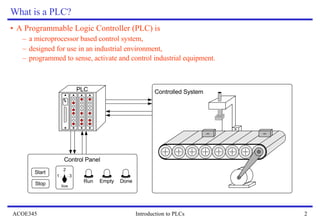
What is a PLC? A Programmable Logic Controller (PLC) is a microprocessor based control system,  designed for use in an industrial environment, programmed to sense, activate and control industrial equipment.
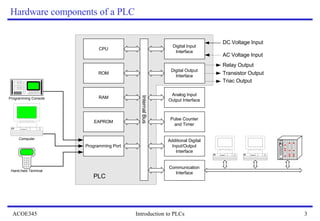
Hardware components of a PLC
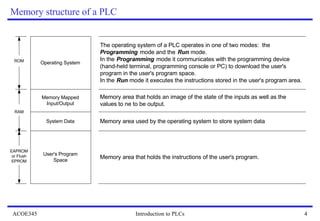
Memory structure of a PLC
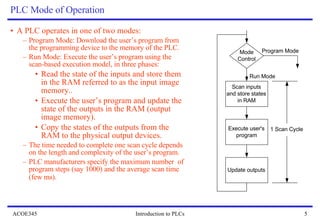
PLC Mode of Operation A PLC operates in one of two modes: Program Mode: Download the user’s program from the programming device to the memory of the PLC. Run Mode: Execute the user’s program using the scan-based execution model, in three phases: Read the state of the inputs and store them in the RAM referred to as the input image memory.. Execute the user’s program and update the state of the outputs in the RAM (output image memory). Copy the states of the outputs from the RAM to the physical output devices.  The time needed to complete one scan cycle depends on the length and complexity of the user’s program. PLC manufacturers specify the maximum number  of program steps (say 1000) and the average scan time (few ms).
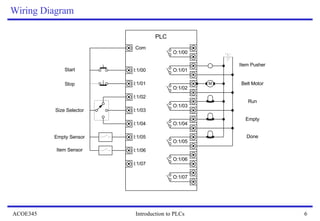
Wiring Diagram
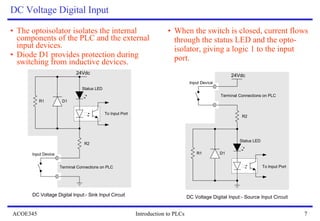
DC Voltage Digital Input The optoisolator isolates the internal components of the PLC and the external input devices. Diode D1 provides protection during switching from inductive devices. When the switch is closed, current flows through the status LED and the opto-isolator, giving a logic 1 to the input port.
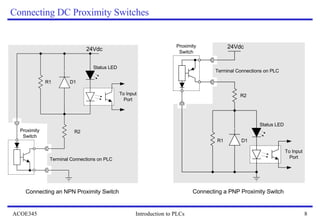
Connecting DC Proximity Switches
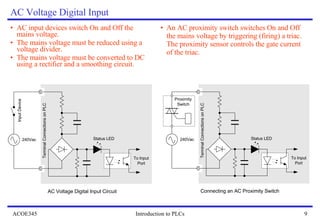
AC Voltage Digital Input AC input devices switch On and Off the mains voltage. The mains voltage must be reduced using a voltage divider.  The mains voltage must be converted to DC using a rectifier and a smoothing circuit. An AC proximity switch switches On and Off the mains voltage by triggering (firing) a triac. The proximity sensor controls the gate current of the triac.
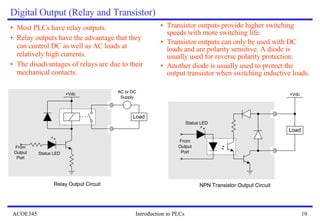
Digital Output (Relay and Transistor) Most PLCs have relay outputs. Relay outputs have the advantage that they can control DC as well as AC loads at relatively high currents. The disadvantages of relays are due to their mechanical contacts.  Transistor outputs provide higher switching speeds with more switching life. Transistor outputs can only be used with DC loads and are polarity sensitive. A diode is usually used for reverse polarity protection. Another diode is usually used to protect the output transistor when switching inductive loads.
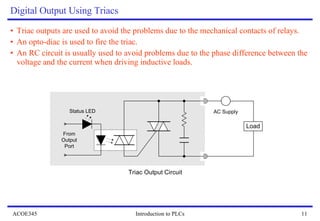
Digital Output Using Triacs Triac outputs are used to avoid the problems due to the mechanical contacts of relays. An opto-diac is used to fire the triac. An RC circuit is usually used to avoid problems due to the phase difference between the voltage and the current when driving inductive loads.

P L C

  • 1.
    What is aPLC? Introduction to Programmable Logic Controllers (PLCs) Hardware components of a PLC Memory structure of a PLC PLC Modes of Operation Wiring Diagram Digital Inputs/Outputs
  • 2.
    What is aPLC? A Programmable Logic Controller (PLC) is a microprocessor based control system, designed for use in an industrial environment, programmed to sense, activate and control industrial equipment.
  • 3.
  • 4.
  • 5.
    PLC Mode ofOperation A PLC operates in one of two modes: Program Mode: Download the user’s program from the programming device to the memory of the PLC. Run Mode: Execute the user’s program using the scan-based execution model, in three phases: Read the state of the inputs and store them in the RAM referred to as the input image memory.. Execute the user’s program and update the state of the outputs in the RAM (output image memory). Copy the states of the outputs from the RAM to the physical output devices. The time needed to complete one scan cycle depends on the length and complexity of the user’s program. PLC manufacturers specify the maximum number of program steps (say 1000) and the average scan time (few ms).
  • 6.
  • 7.
    DC Voltage DigitalInput The optoisolator isolates the internal components of the PLC and the external input devices. Diode D1 provides protection during switching from inductive devices. When the switch is closed, current flows through the status LED and the opto-isolator, giving a logic 1 to the input port.
  • 8.
  • 9.
    AC Voltage DigitalInput AC input devices switch On and Off the mains voltage. The mains voltage must be reduced using a voltage divider. The mains voltage must be converted to DC using a rectifier and a smoothing circuit. An AC proximity switch switches On and Off the mains voltage by triggering (firing) a triac. The proximity sensor controls the gate current of the triac.
  • 10.
    Digital Output (Relayand Transistor) Most PLCs have relay outputs. Relay outputs have the advantage that they can control DC as well as AC loads at relatively high currents. The disadvantages of relays are due to their mechanical contacts. Transistor outputs provide higher switching speeds with more switching life. Transistor outputs can only be used with DC loads and are polarity sensitive. A diode is usually used for reverse polarity protection. Another diode is usually used to protect the output transistor when switching inductive loads.
  • 11.
    Digital Output UsingTriacs Triac outputs are used to avoid the problems due to the mechanical contacts of relays. An opto-diac is used to fire the triac. An RC circuit is usually used to avoid problems due to the phase difference between the voltage and the current when driving inductive loads.