IP ADDRESSINGDeveloped by Peter Smith
The 32-bit IP address is broken up into 4 octets, which are arranged into a dotted-decimal notation scheme.An octet is a set of 8 bits & not a musical instrument.Example of an IP version 4:172.64.126.52Peter Smith2Octets
IP addresses are divided into 5 classes, each of which is designated with the alphabetic letters A to E.Class D addresses are used for multicasting.Class E addresses are reserved for testing & some mysterious future use.Peter Smith3IP Address Classes
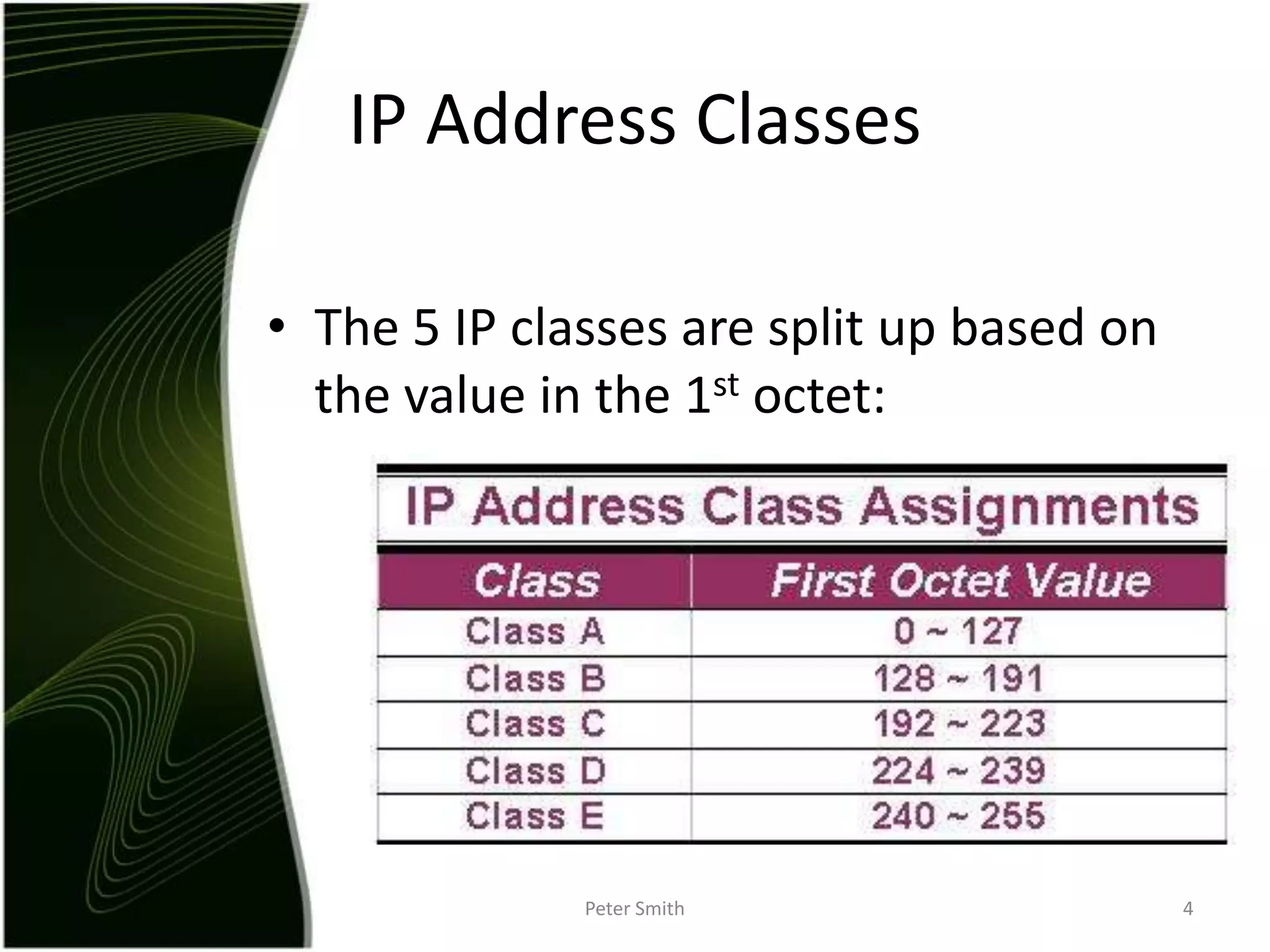
The 5 IP classes are split up based on the value in the 1st octet:Peter Smith4IP Address Classes
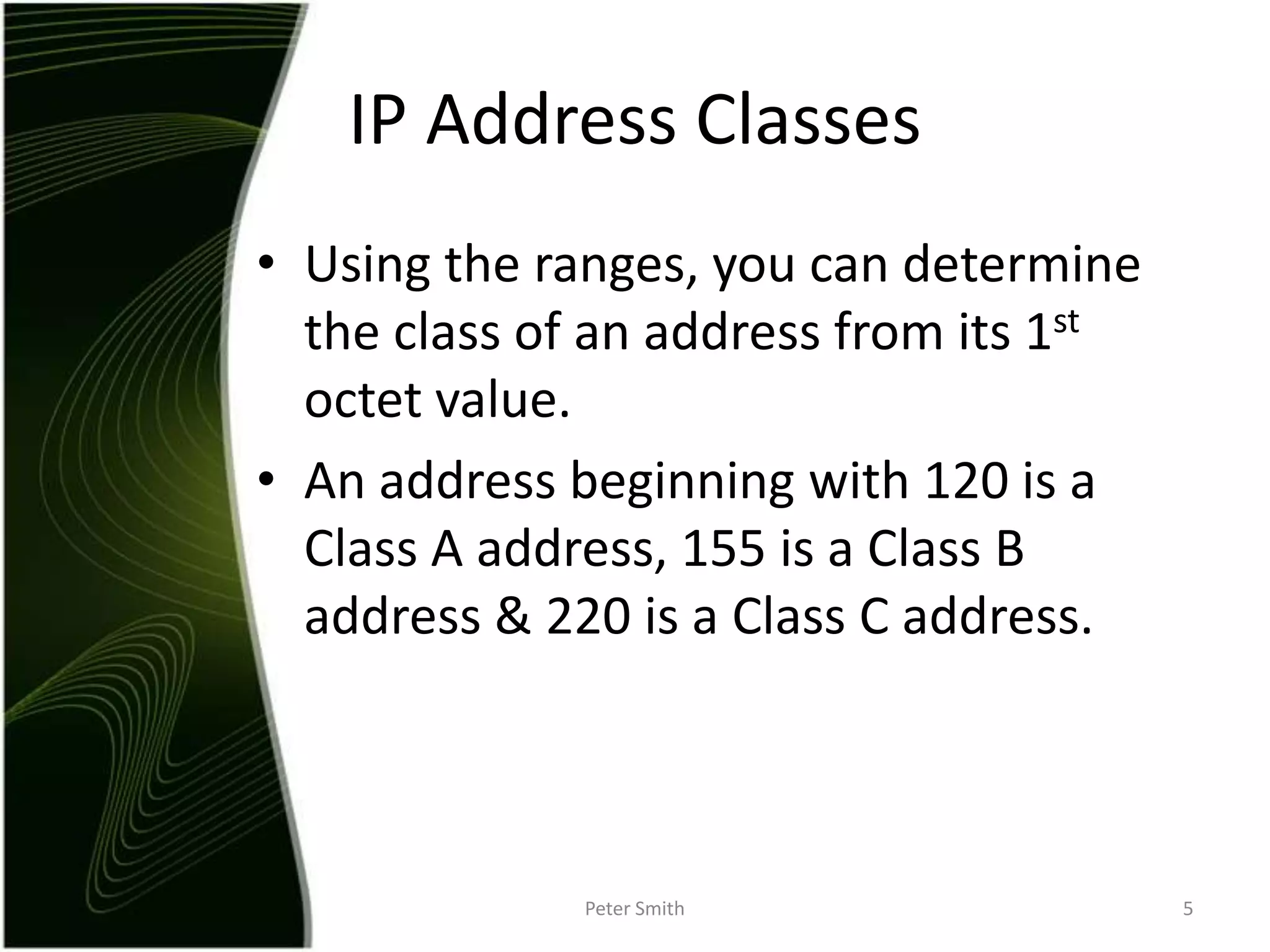
Using the ranges, you can determine the class of an address from its 1st octet value.An address beginning with 120 is a Class A address, 155 is a Class B address & 220 is a Class C address.Peter Smith5IP Address Classes
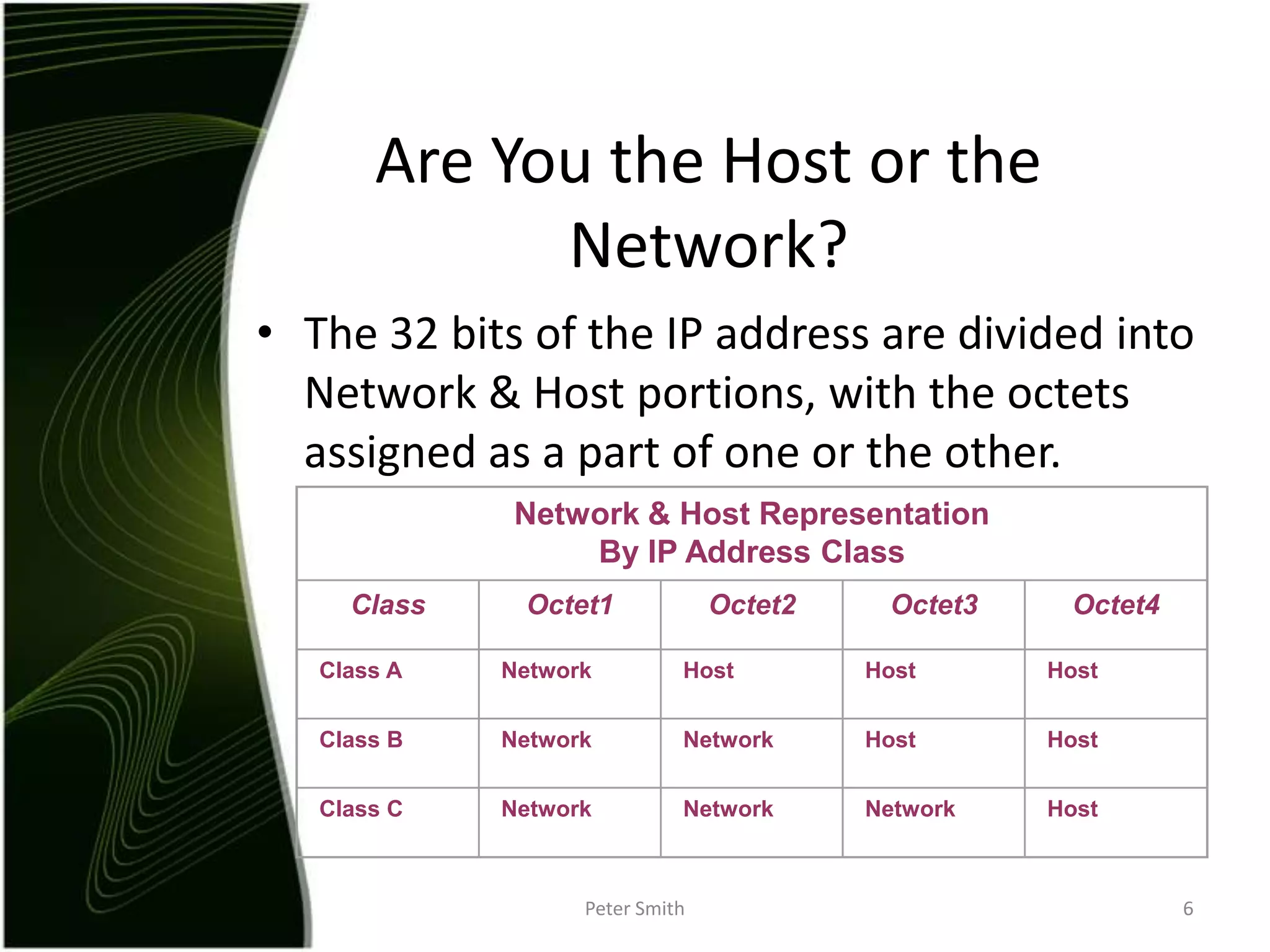
Peter Smith6Network & Host RepresentationBy IP Address Class ClassOctet1Octet2Octet3Octet4Class ANetworkHostHostHostClass BNetworkNetworkHostHostClass CNetworkNetworkNetworkHostAre You the Host or the Network?The 32 bits of the IP address are divided into Network & Host portions, with the octets assigned as a part of one or the other.
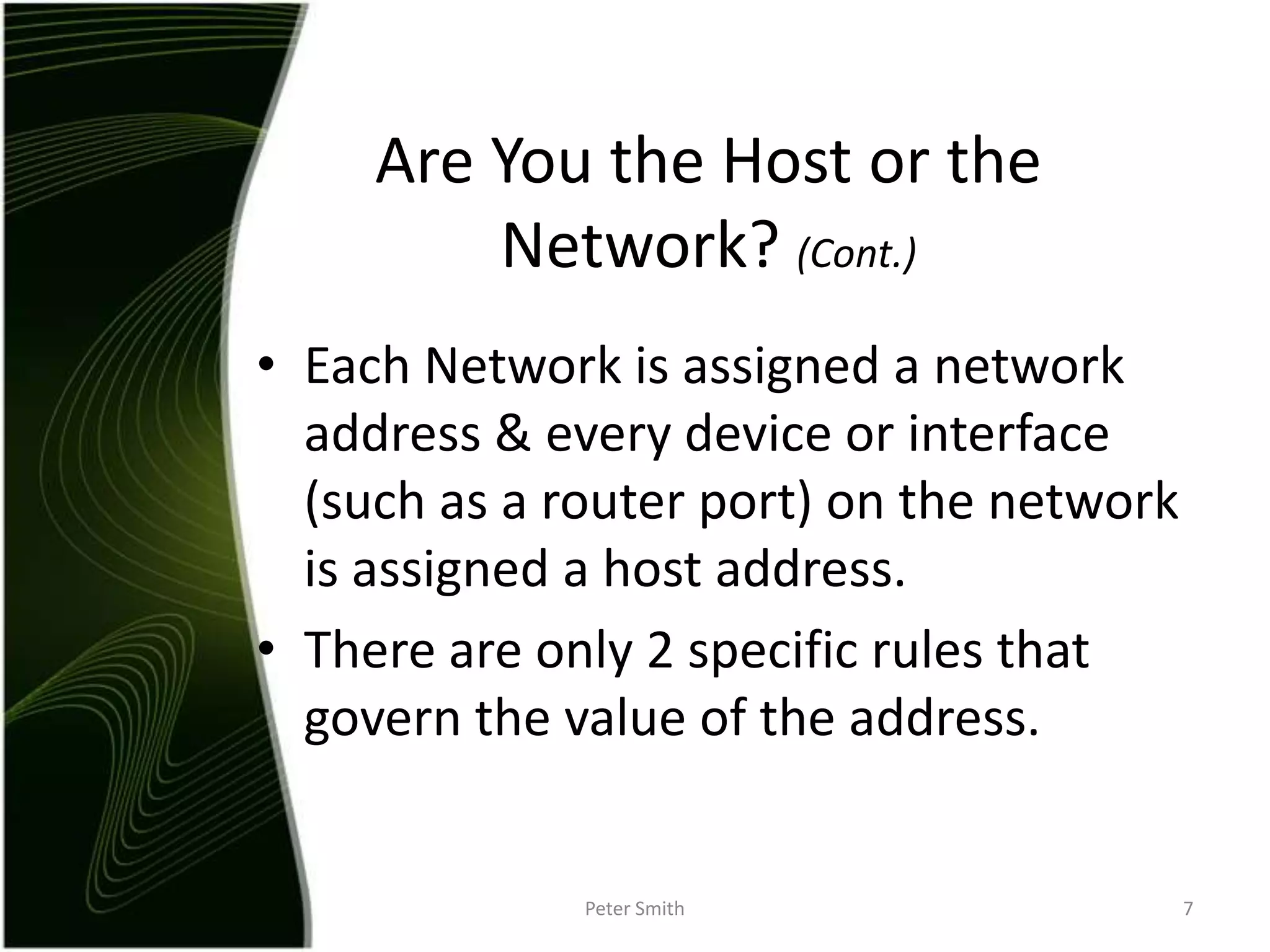
Each Network is assigned a network address & every device or interface (such as a router port) on the network is assigned a host address.There are only 2 specific rules that govern the value of the address. Peter Smith7Are You the Host or the Network? (Cont.)
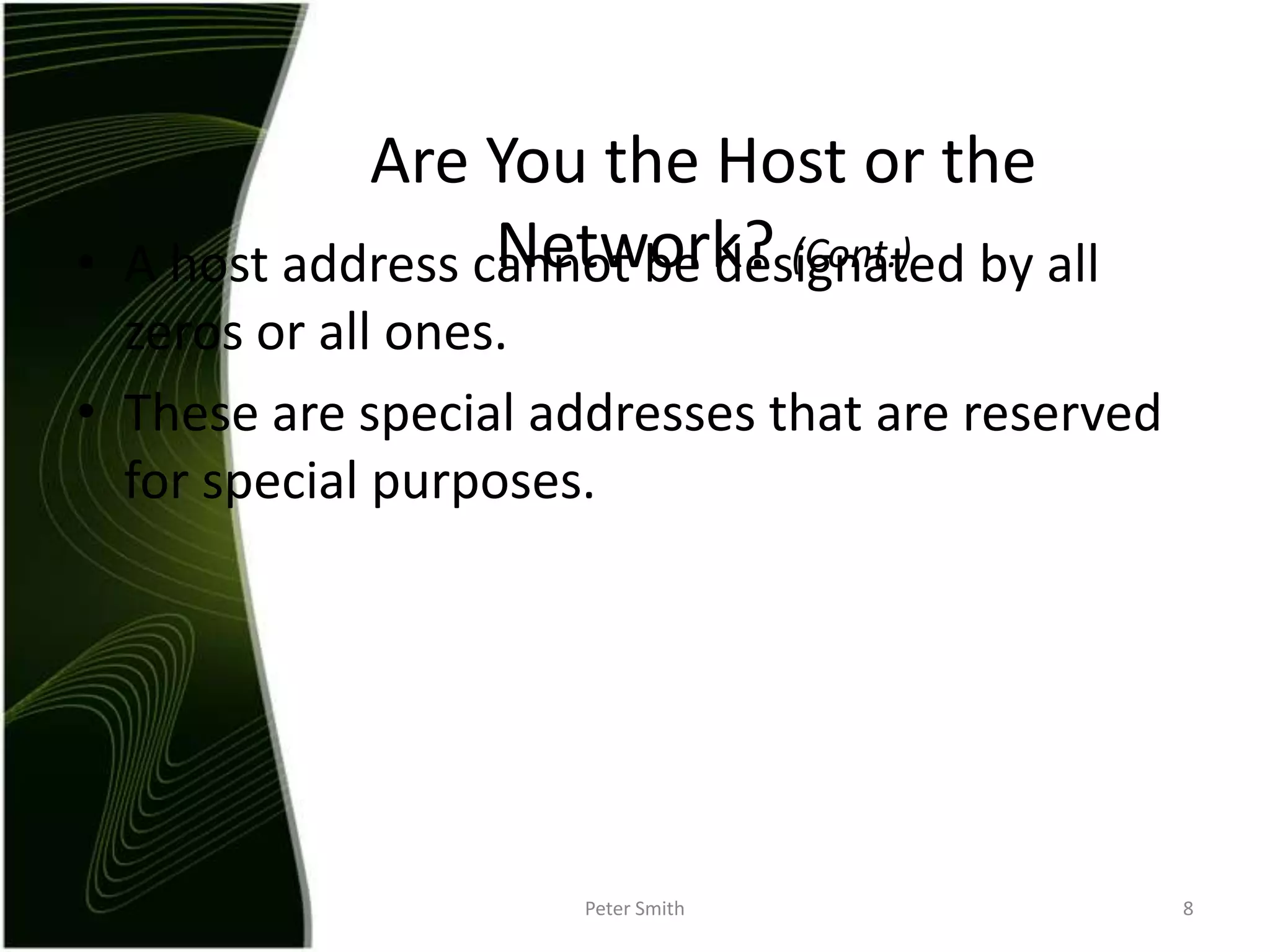
A host address cannot be designated by all zeros or all ones.These are special addresses that are reserved for special purposes.Peter Smith8Are You the Host or the Network? (Cont.)
Class A IP addresses use the 1st 8 bits (1st Octet) to designate the Network address.The 1st bit which is always a 0, is used to indicate the address as a Class A address & the remaining 7 bits are used to designate the Network.The other 3 octets contain the Host address. Peter Smith9Class A Addresses
There are 128 Class A Network Addresses, but because addresses with all zeros aren’t used & address 127 is a special purpose address, 126 Class A Networks are available.Peter Smith10Class A Addresses
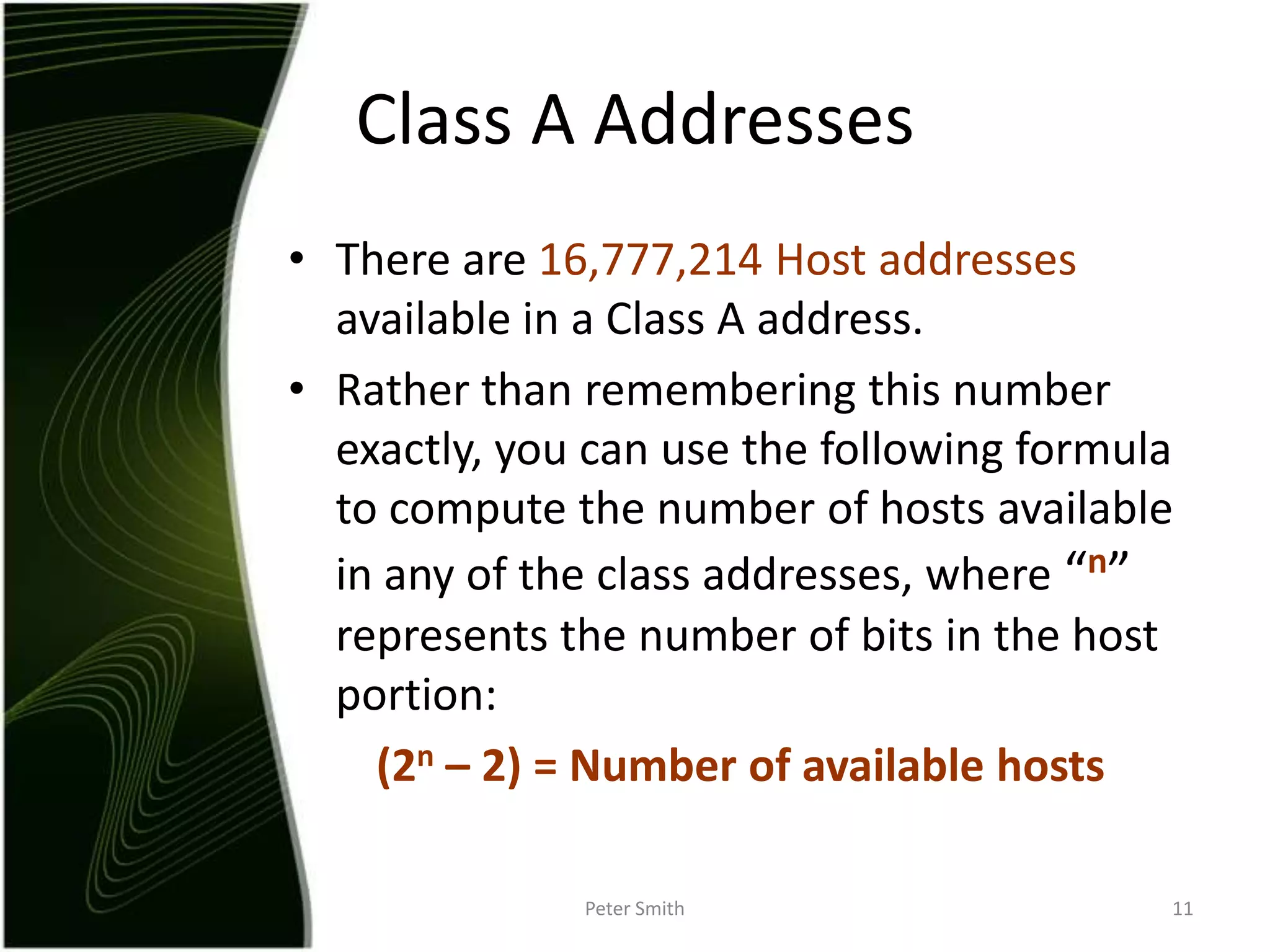
There are 16,777,214 Host addresses available in a Class A address.Rather than remembering this number exactly, you can use the following formula to compute the number of hosts available in any of the class addresses, where “n” represents the number of bits in the host portion: (2n – 2) = Number of available hostsPeter Smith11Class A Addresses
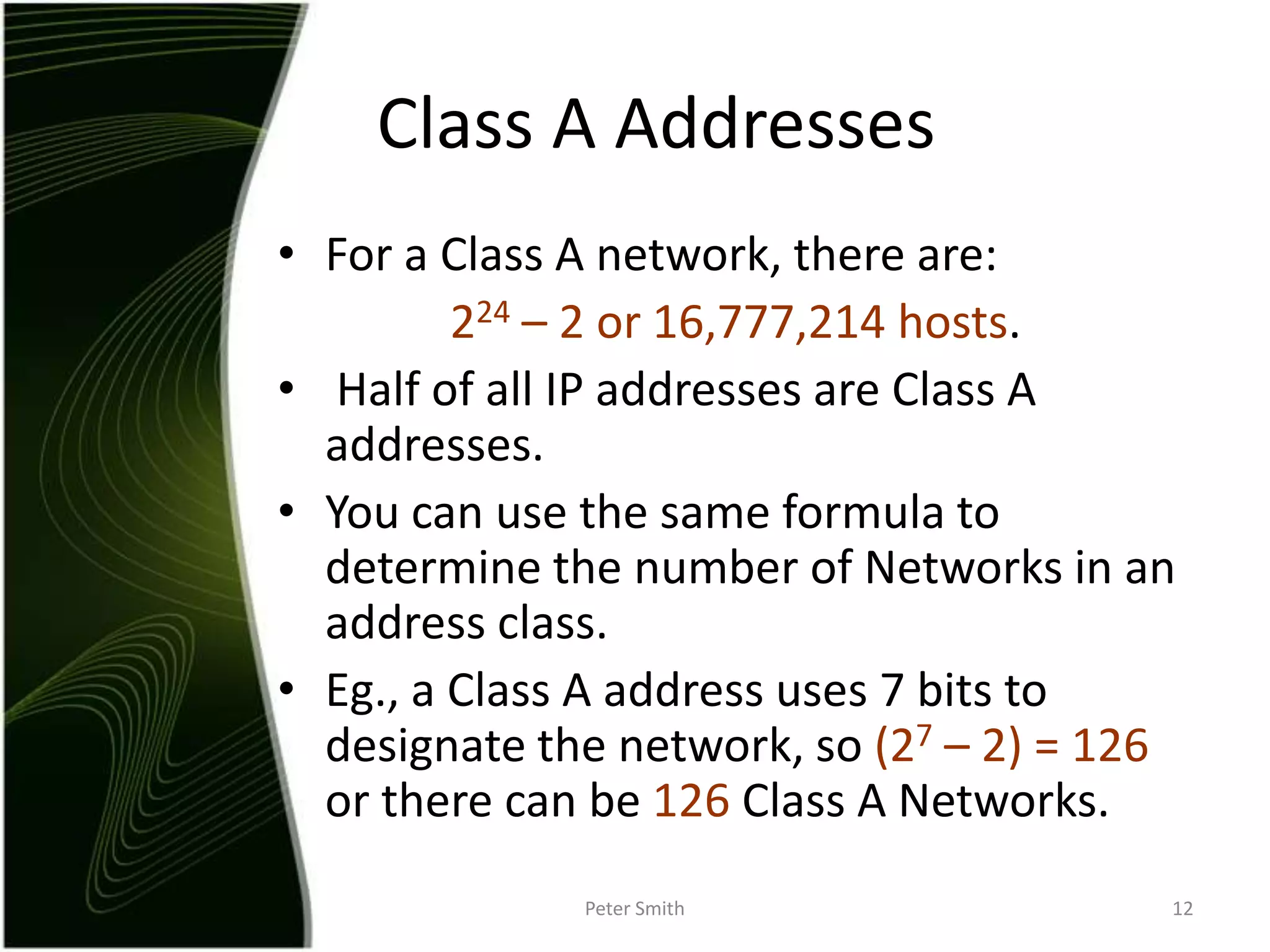
For a Class A network, there are:224 – 2 or 16,777,214 hosts. Half of all IP addresses are Class A addresses.You can use the same formula to determine the number of Networks in an address class.Eg., a Class A address uses 7 bits to designate the network, so (27 – 2) = 126 or there can be 126 Class A Networks. Peter Smith12Class A Addresses
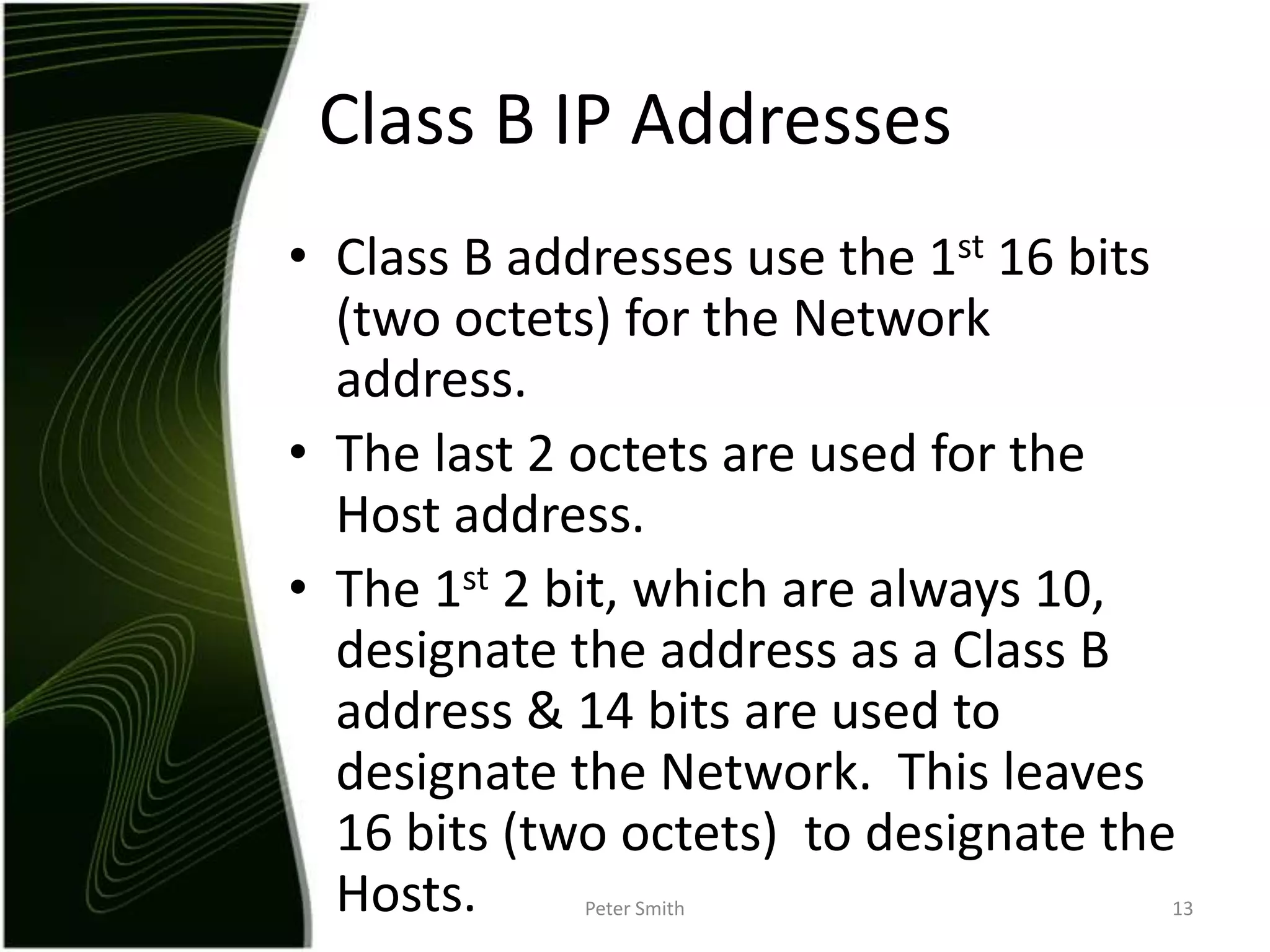
Class B addresses use the 1st 16 bits (two octets) for the Network address.The last 2 octets are used for the Host address.The 1st 2 bit, which are always 10, designate the address as a Class B address & 14 bits are used to designate the Network.  This leaves 16 bits (two octets)  to designate the Hosts. Peter Smith13Class B IP Addresses
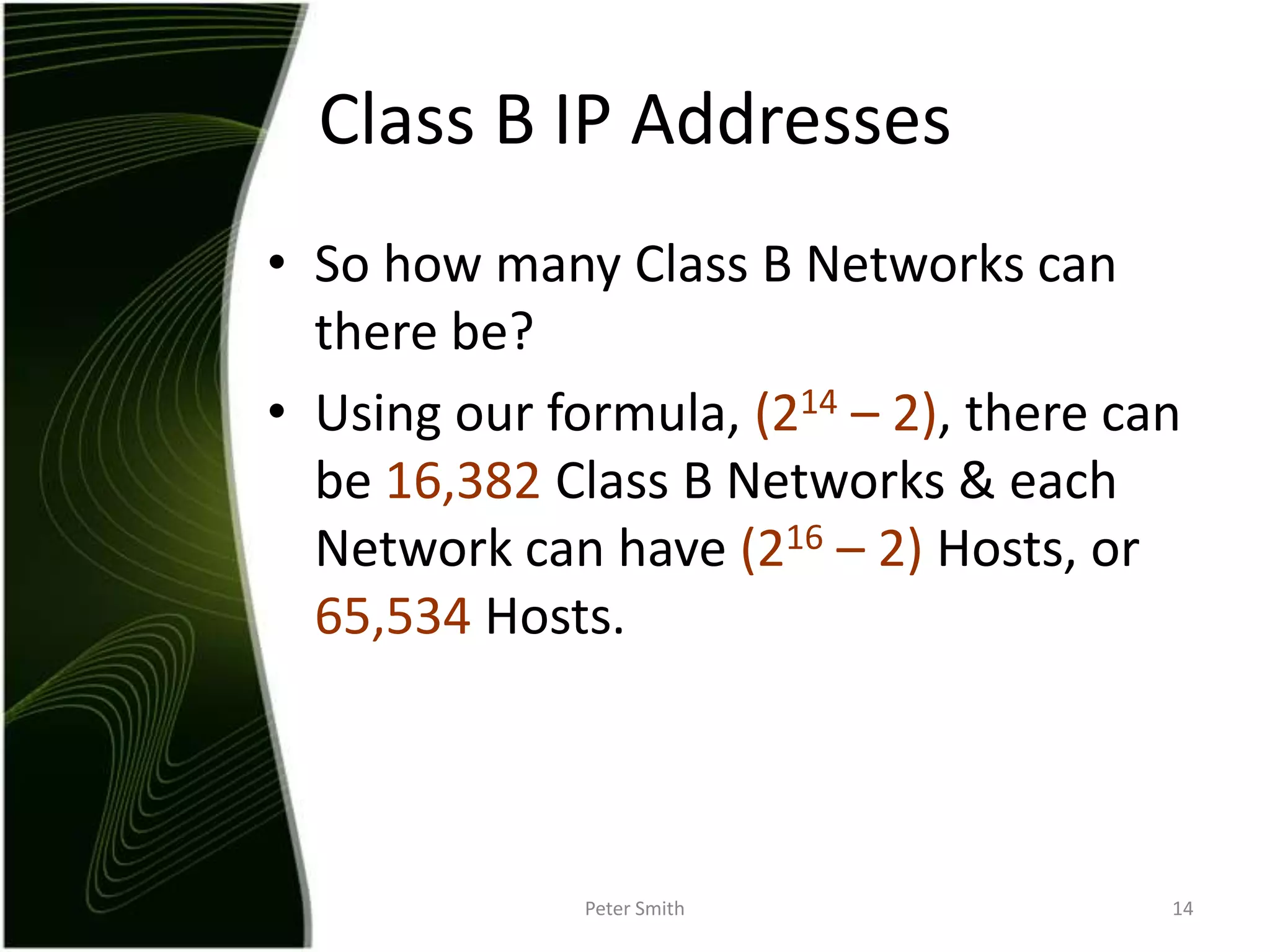
So how many Class B Networks can there be?Using our formula, (214 – 2), there can be 16,382 Class B Networks & each Network can have (216 – 2) Hosts, or 65,534 Hosts.Peter Smith14Class B IP Addresses
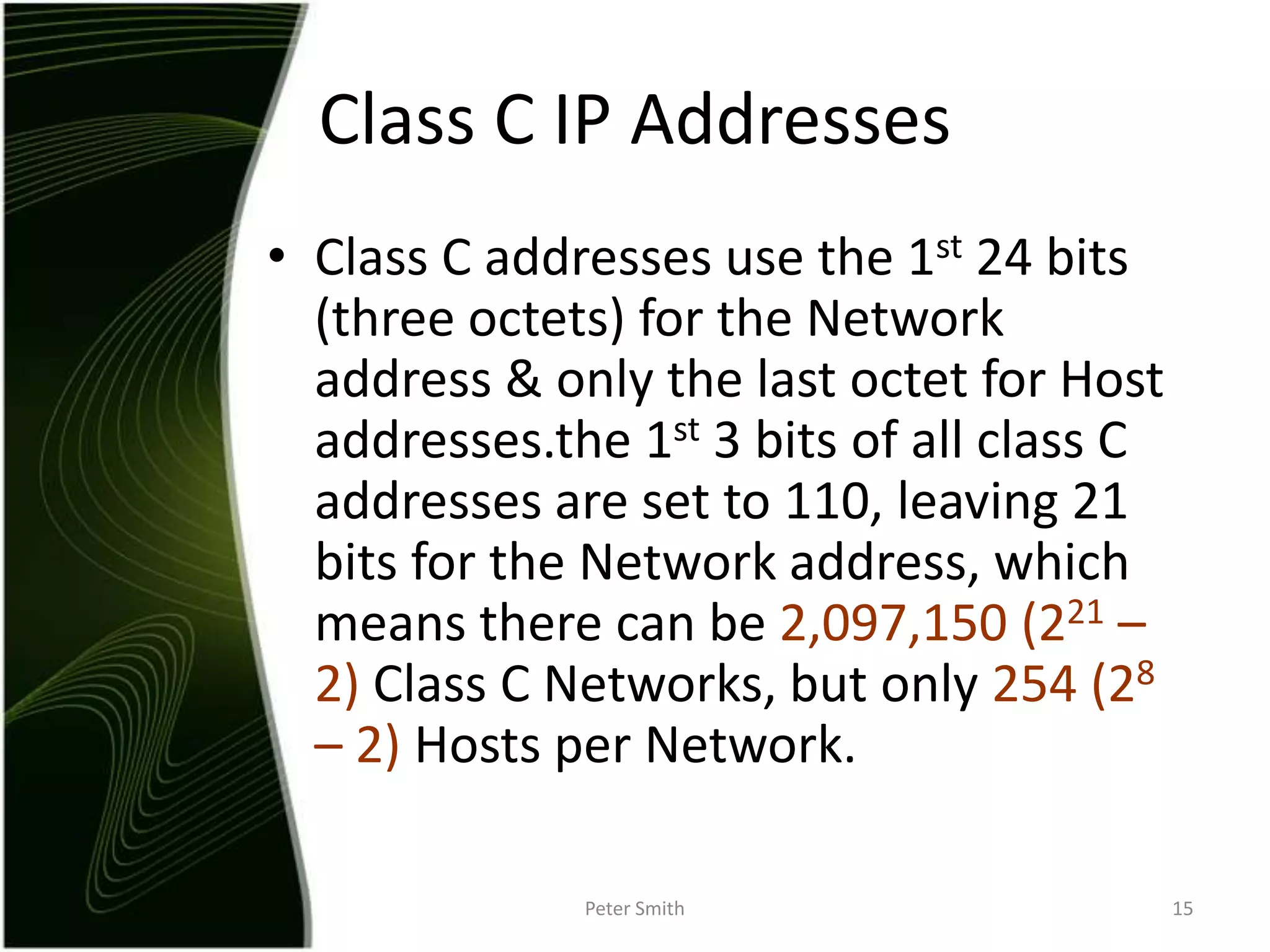
Class C addresses use the 1st 24 bits (three octets) for the Network address & only the last octet for Host addresses.the 1st 3 bits of all class C addresses are set to 110, leaving 21 bits for the Network address, which means there can be 2,097,150(221 – 2) Class C Networks, but only 254 (28 – 2) Hosts per Network.Peter Smith15Class C IP Addresses
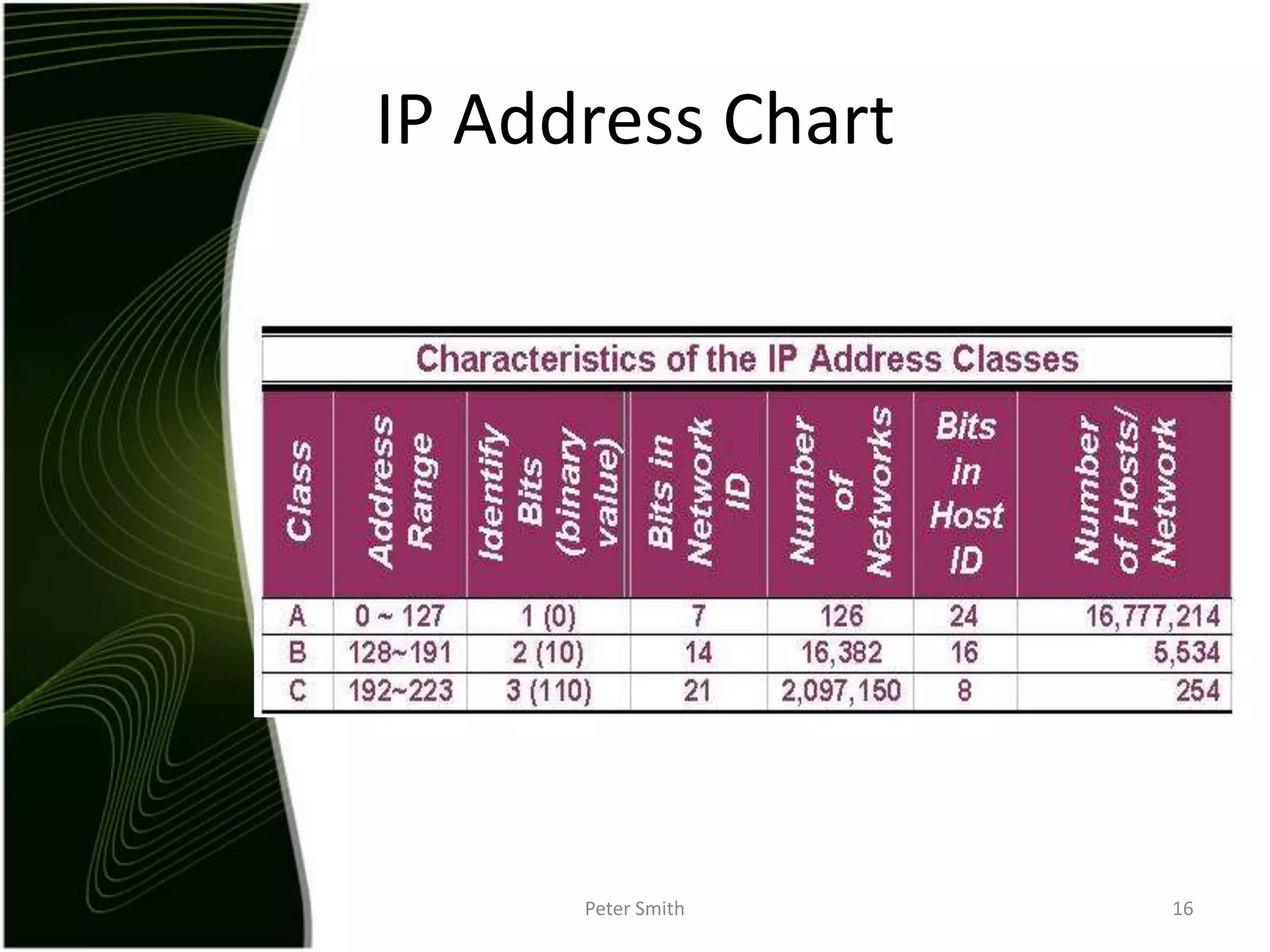
Peter Smith16IP Address Chart
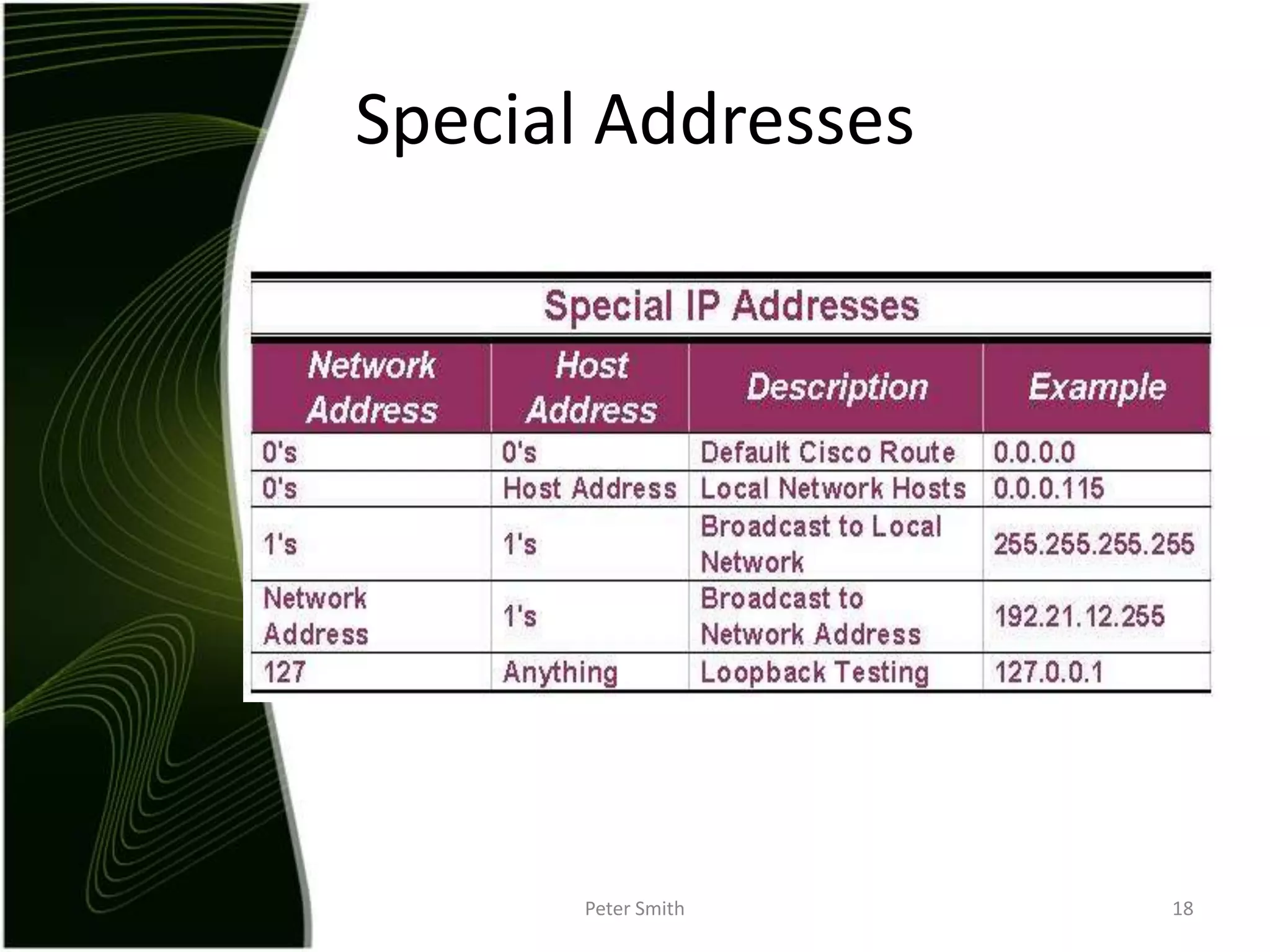
A few addresses are set aside for specific purposes.Network addresses that are all binary zeros, all binary ones & Network addresses beginning with 127 are special Network addresses.Peter Smith17Special Addresses
Peter Smith18Special Addresses
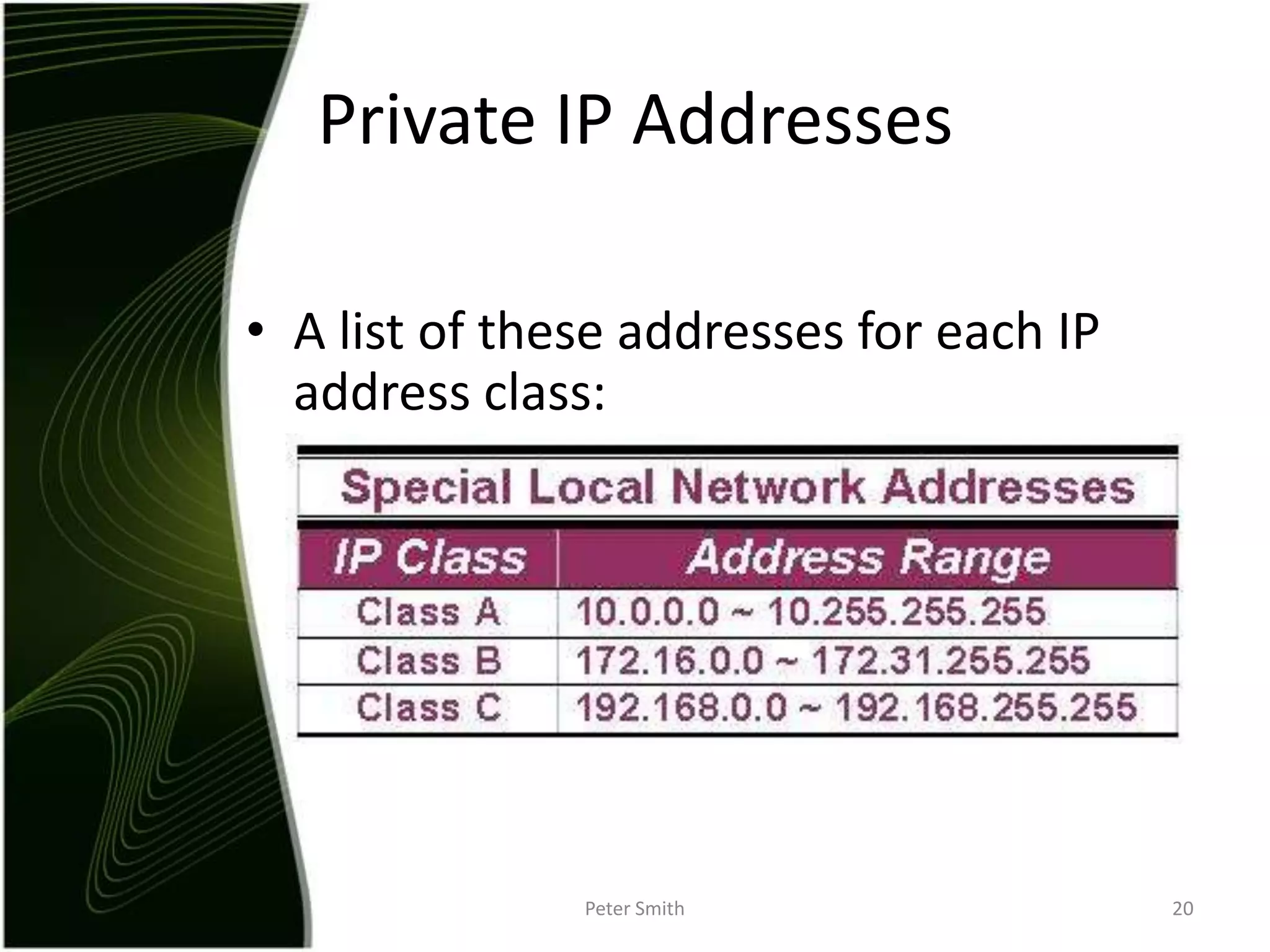
Within each address class is a set of addresses that are set aside for use in local networks sitting behind a firewall or NAT (Network Address Translation) device or Networks not connected to the Internet.Peter Smith19Special Addresses
A list of these addresses for each IP address class:Peter Smith20Private IP Addresses

Ip Addressing

  • 1.
  • 2.
    The 32-bit IPaddress is broken up into 4 octets, which are arranged into a dotted-decimal notation scheme.An octet is a set of 8 bits & not a musical instrument.Example of an IP version 4:172.64.126.52Peter Smith2Octets
  • 3.
    IP addresses aredivided into 5 classes, each of which is designated with the alphabetic letters A to E.Class D addresses are used for multicasting.Class E addresses are reserved for testing & some mysterious future use.Peter Smith3IP Address Classes
  • 4.
    The 5 IPclasses are split up based on the value in the 1st octet:Peter Smith4IP Address Classes
  • 5.
    Using the ranges,you can determine the class of an address from its 1st octet value.An address beginning with 120 is a Class A address, 155 is a Class B address & 220 is a Class C address.Peter Smith5IP Address Classes
  • 6.
    Peter Smith6Network &Host RepresentationBy IP Address Class ClassOctet1Octet2Octet3Octet4Class ANetworkHostHostHostClass BNetworkNetworkHostHostClass CNetworkNetworkNetworkHostAre You the Host or the Network?The 32 bits of the IP address are divided into Network & Host portions, with the octets assigned as a part of one or the other.
  • 7.
    Each Network isassigned a network address & every device or interface (such as a router port) on the network is assigned a host address.There are only 2 specific rules that govern the value of the address. Peter Smith7Are You the Host or the Network? (Cont.)
  • 8.
    A host addresscannot be designated by all zeros or all ones.These are special addresses that are reserved for special purposes.Peter Smith8Are You the Host or the Network? (Cont.)
  • 9.
    Class A IPaddresses use the 1st 8 bits (1st Octet) to designate the Network address.The 1st bit which is always a 0, is used to indicate the address as a Class A address & the remaining 7 bits are used to designate the Network.The other 3 octets contain the Host address. Peter Smith9Class A Addresses
  • 10.
    There are 128Class A Network Addresses, but because addresses with all zeros aren’t used & address 127 is a special purpose address, 126 Class A Networks are available.Peter Smith10Class A Addresses
  • 11.
    There are 16,777,214Host addresses available in a Class A address.Rather than remembering this number exactly, you can use the following formula to compute the number of hosts available in any of the class addresses, where “n” represents the number of bits in the host portion: (2n – 2) = Number of available hostsPeter Smith11Class A Addresses
  • 12.
    For a ClassA network, there are:224 – 2 or 16,777,214 hosts. Half of all IP addresses are Class A addresses.You can use the same formula to determine the number of Networks in an address class.Eg., a Class A address uses 7 bits to designate the network, so (27 – 2) = 126 or there can be 126 Class A Networks. Peter Smith12Class A Addresses
  • 13.
    Class B addressesuse the 1st 16 bits (two octets) for the Network address.The last 2 octets are used for the Host address.The 1st 2 bit, which are always 10, designate the address as a Class B address & 14 bits are used to designate the Network. This leaves 16 bits (two octets) to designate the Hosts. Peter Smith13Class B IP Addresses
  • 14.
    So how manyClass B Networks can there be?Using our formula, (214 – 2), there can be 16,382 Class B Networks & each Network can have (216 – 2) Hosts, or 65,534 Hosts.Peter Smith14Class B IP Addresses
  • 15.
    Class C addressesuse the 1st 24 bits (three octets) for the Network address & only the last octet for Host addresses.the 1st 3 bits of all class C addresses are set to 110, leaving 21 bits for the Network address, which means there can be 2,097,150(221 – 2) Class C Networks, but only 254 (28 – 2) Hosts per Network.Peter Smith15Class C IP Addresses
  • 16.
  • 17.
    A few addressesare set aside for specific purposes.Network addresses that are all binary zeros, all binary ones & Network addresses beginning with 127 are special Network addresses.Peter Smith17Special Addresses
  • 18.
  • 19.
    Within each addressclass is a set of addresses that are set aside for use in local networks sitting behind a firewall or NAT (Network Address Translation) device or Networks not connected to the Internet.Peter Smith19Special Addresses
  • 20.
    A list ofthese addresses for each IP address class:Peter Smith20Private IP Addresses