MILLING IE 262 Class Notes by Figen Eren
MILLING Milling is  another basic machining process by which surface is generated progressively by the removal of chips from a work piece as it is fed a rotating cutter.  Milling operations can be classified into two broad categories 1. Peripheral Milling 2. Face Milling IE 262 Class Notes by Figen Eren
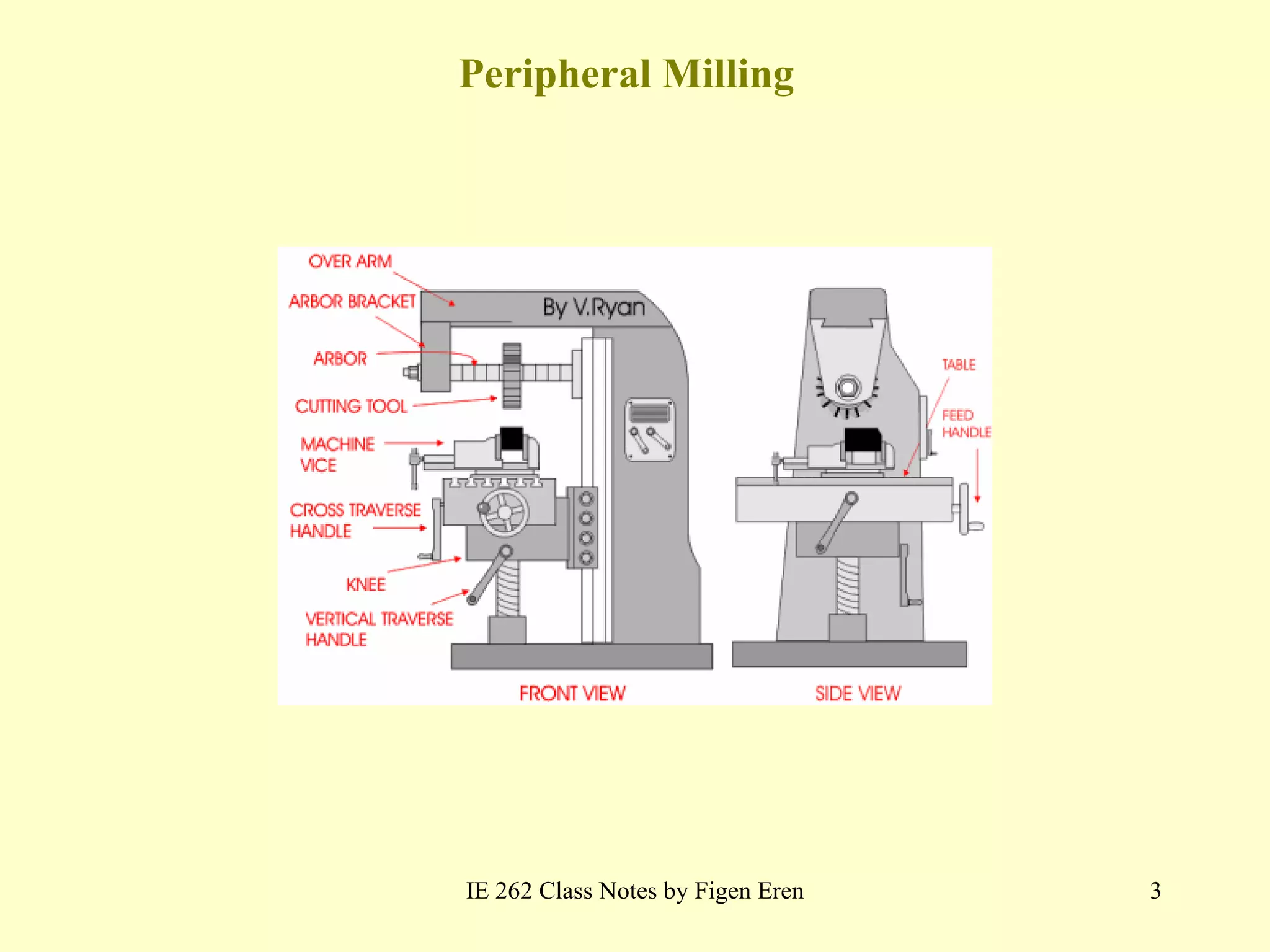
Peripheral   Milling   IE 262 Class Notes by Figen Eren
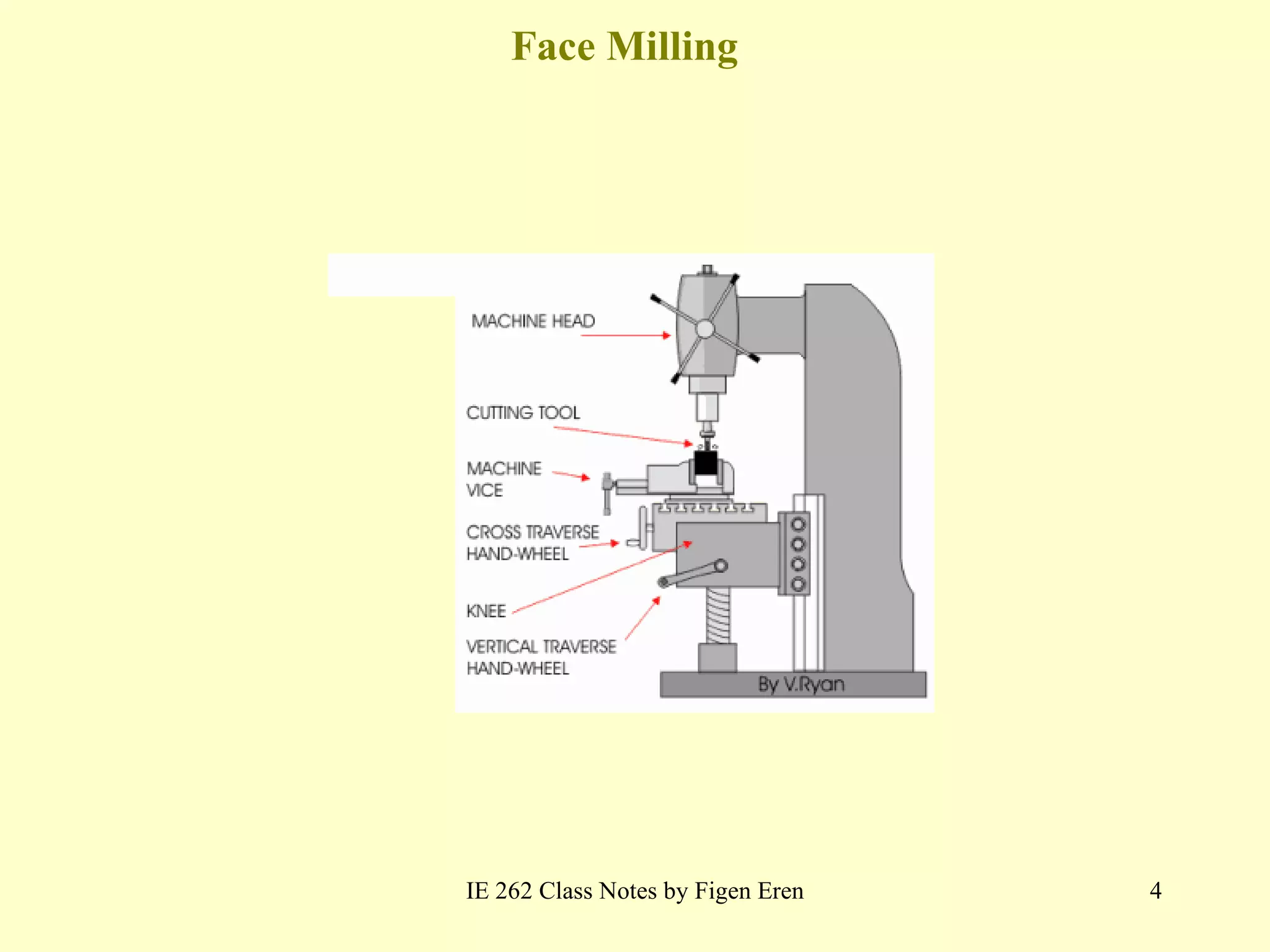
Face Milling IE 262 Class Notes by Figen Eren
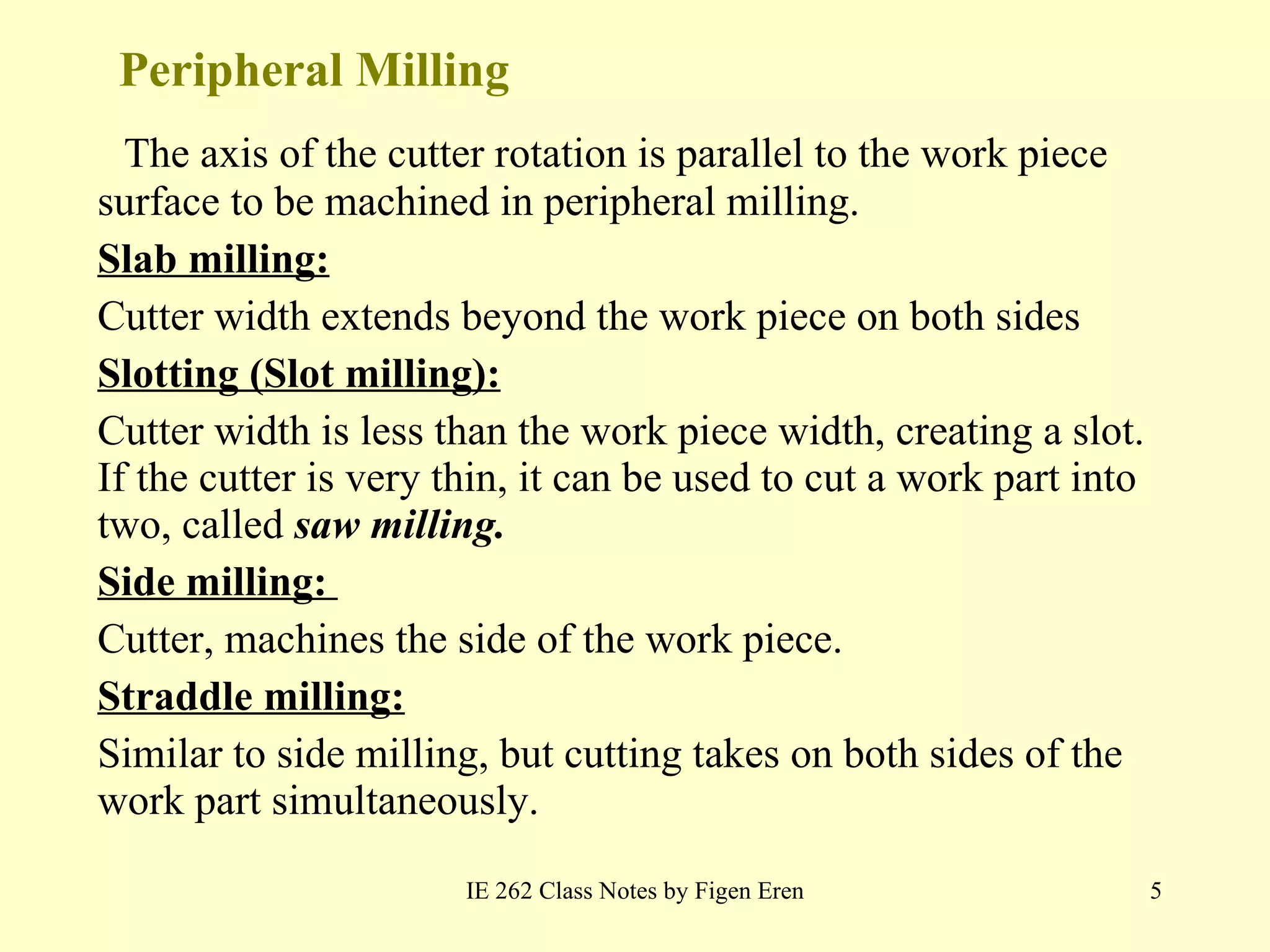
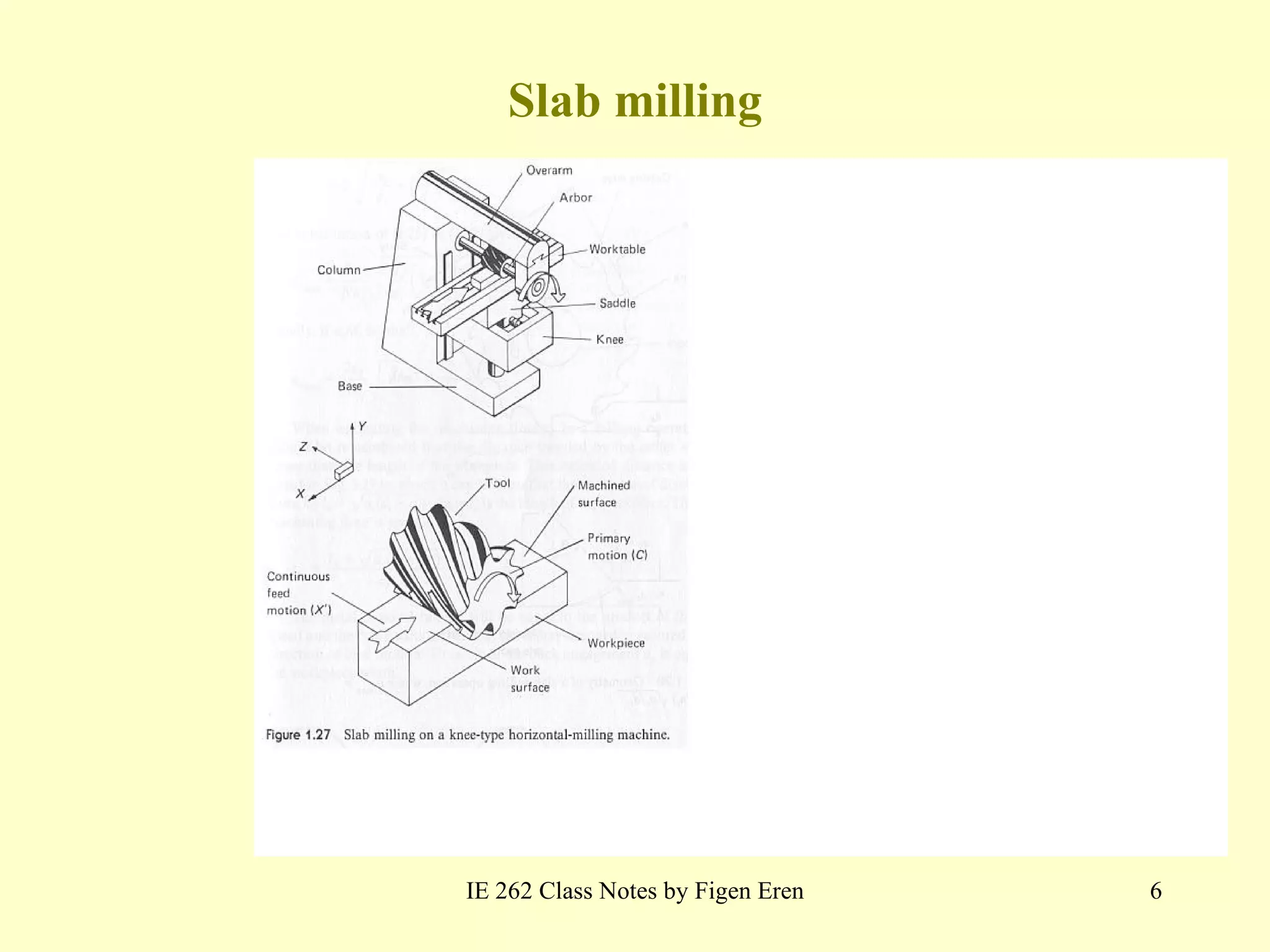
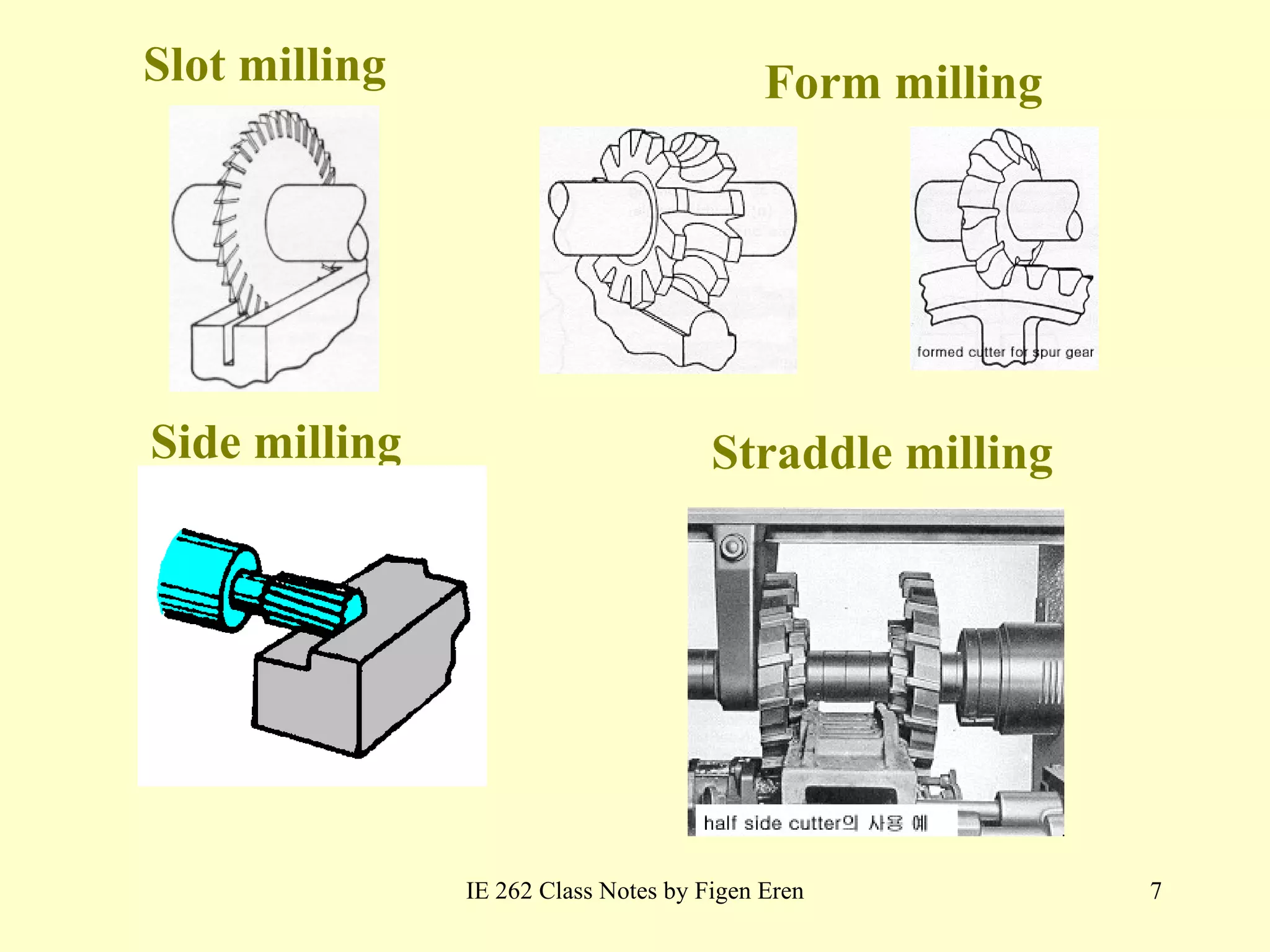
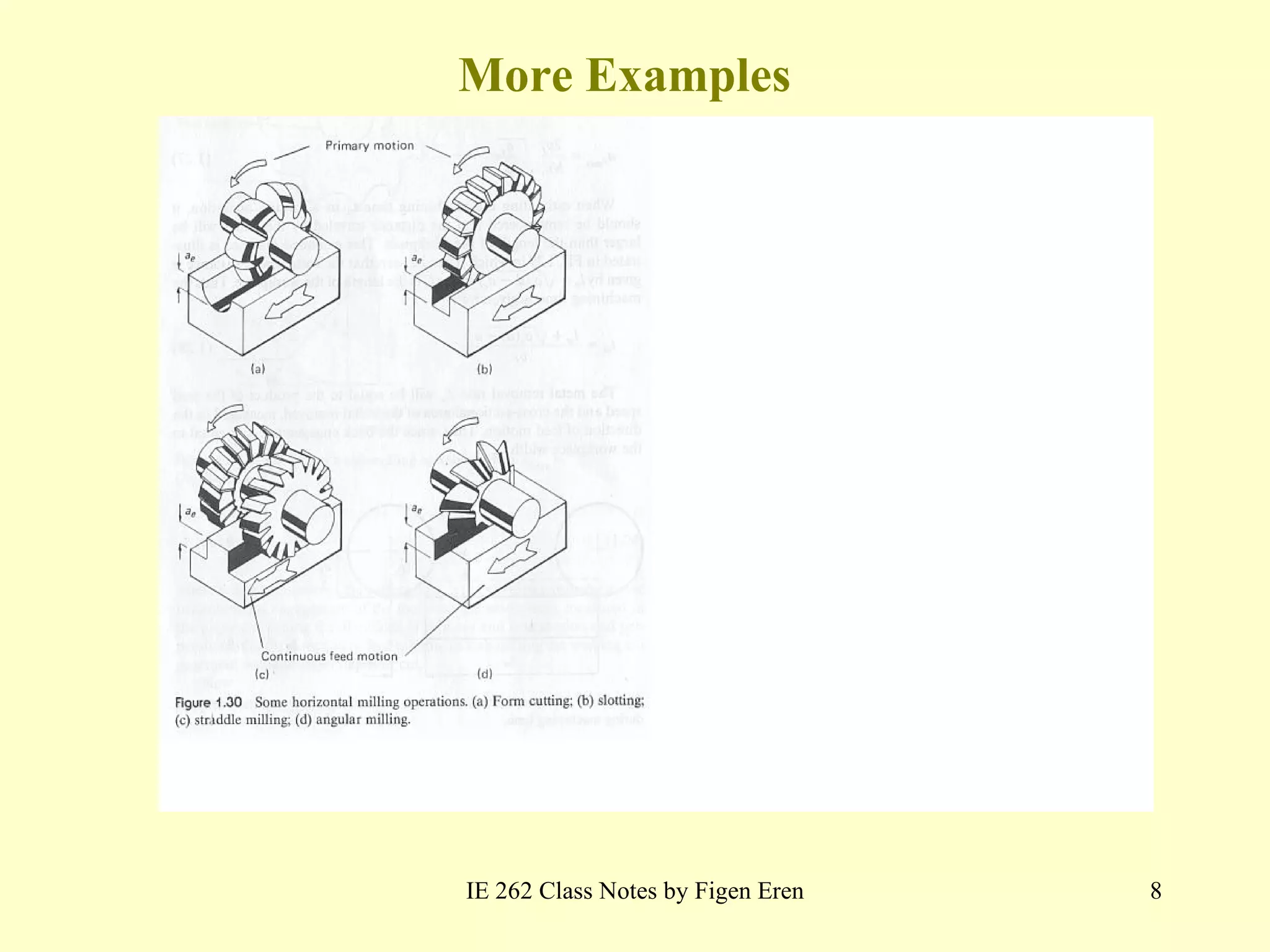
Peripheral Milling The axis of the cutter rotation is parallel to the work piece surface to be machined in peripheral milling. Slab milling: Cutter width extends beyond the work piece on both sides Slotting (Slot milling): Cutter width is less than the work piece width, creating a slot. If the cutter is very thin, it can be used to cut a work part into two, called  saw milling. Side milling:  Cutter, machines the side of the work piece. Straddle milling: Similar to side milling, but cutting takes on both sides of the work part simultaneously. IE 262 Class Notes by Figen Eren
Slab milling IE 262 Class Notes by Figen Eren
Slot  milling IE 262 Class Notes by Figen Eren S ide  milling S traddle  milling Form  milling
More Examples IE 262 Class Notes by Figen Eren
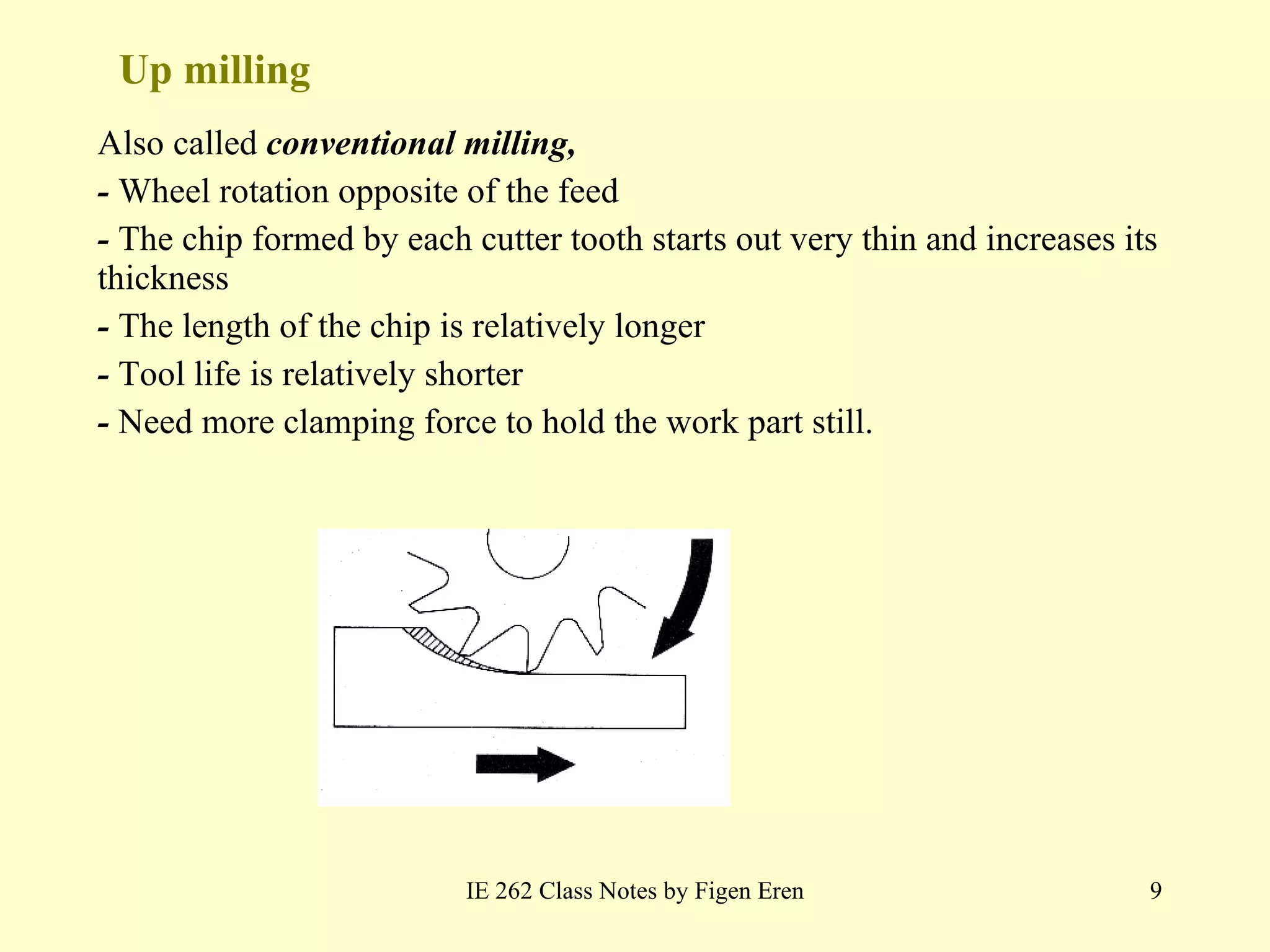
Up milling Also called  conventional milling, -  Wheel rotation opposite of the feed -  The chip formed by each cutter tooth starts out very thin and increases its thickness -  The length of the chip is relatively longer -  Tool life is relatively shorter -  Need more clamping force to hold the work part still. IE 262 Class Notes by Figen Eren
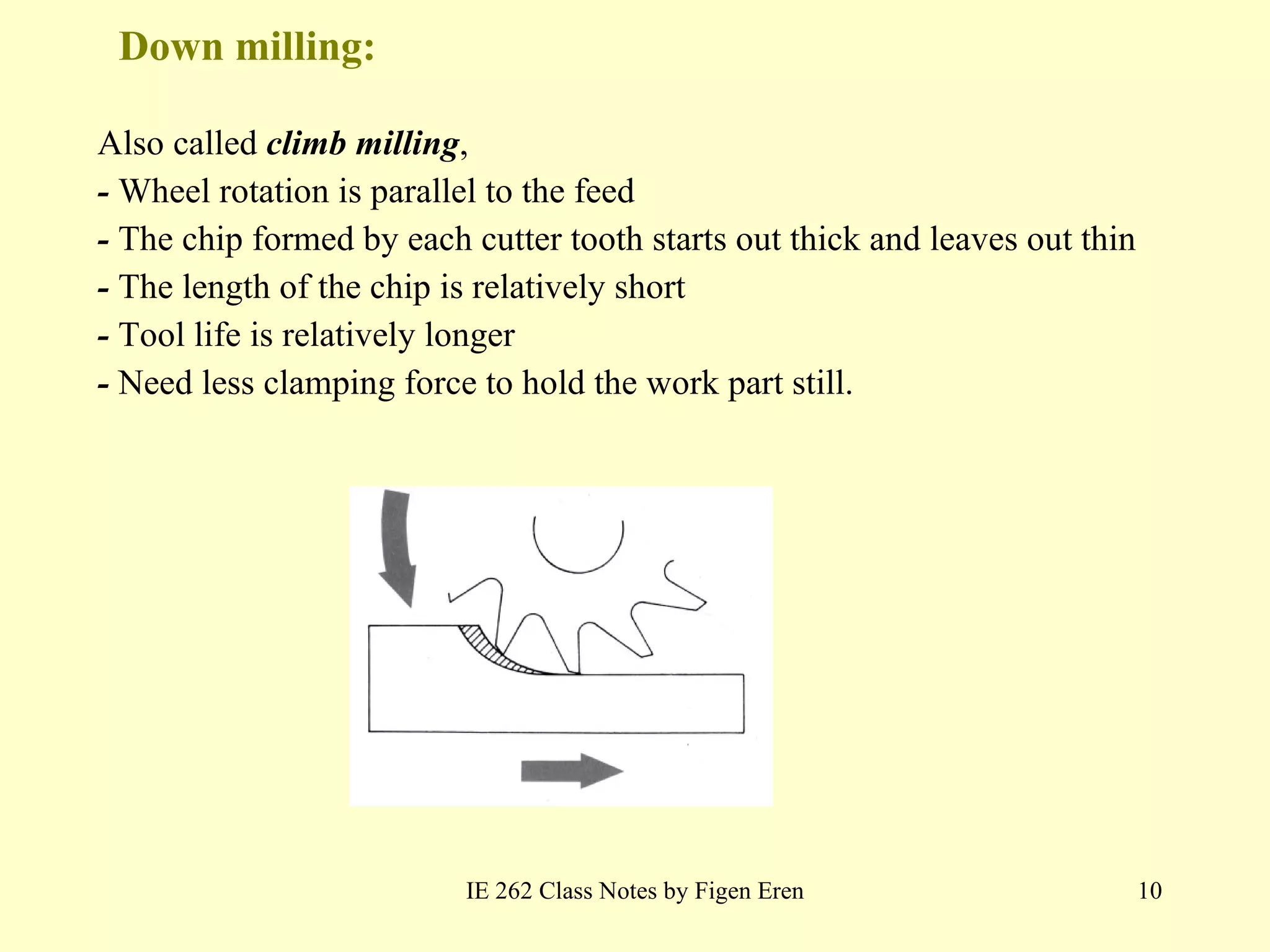
Down milling:  Also called  climb milling , -  Wheel rotation is parallel to the feed -  The chip formed by each cutter tooth starts out thick and leaves out thin -  The length of the chip is relatively short -  Tool life is relatively longer -  Need less clamping force to hold the work part still. IE 262 Class Notes by Figen Eren
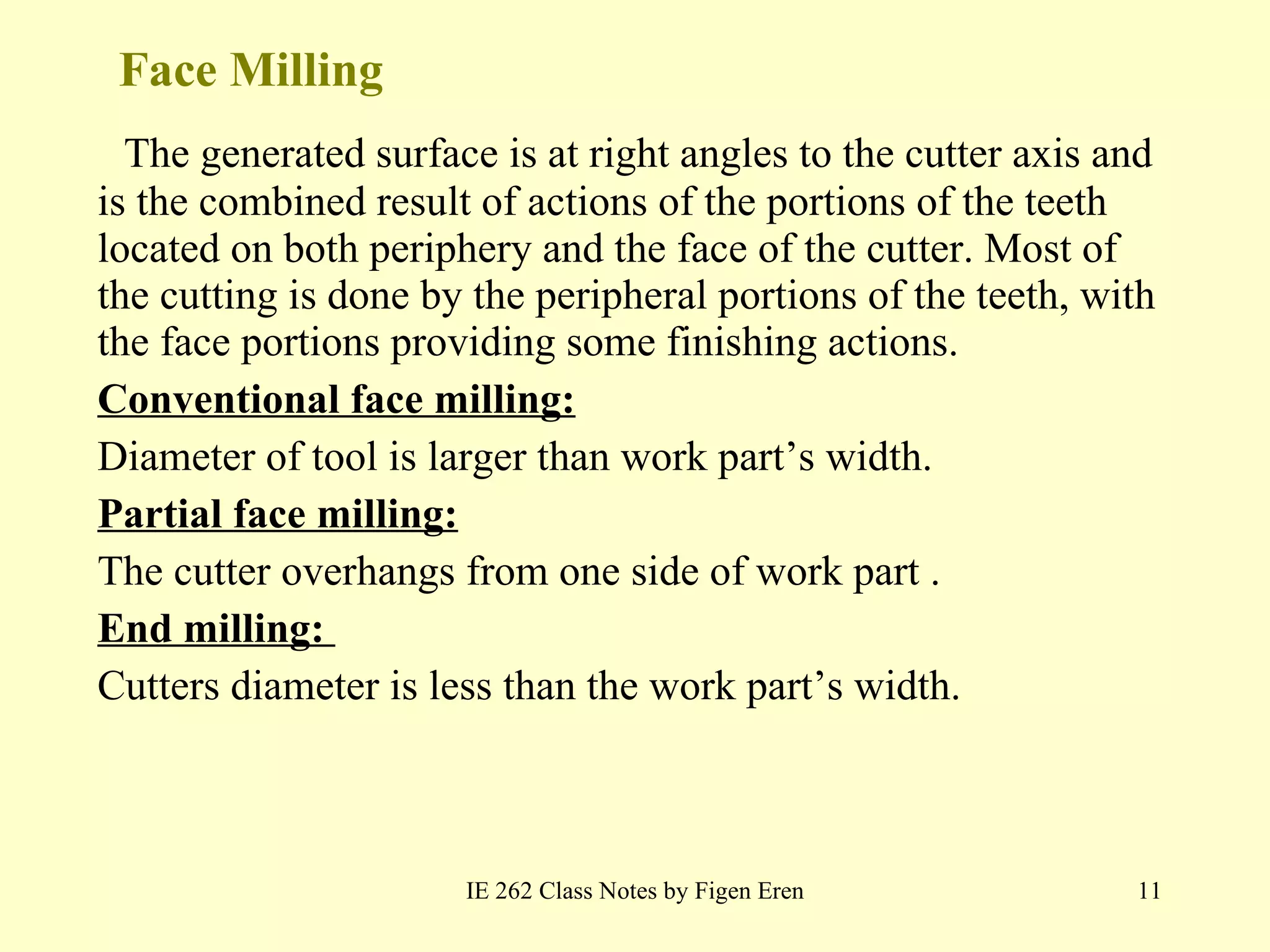
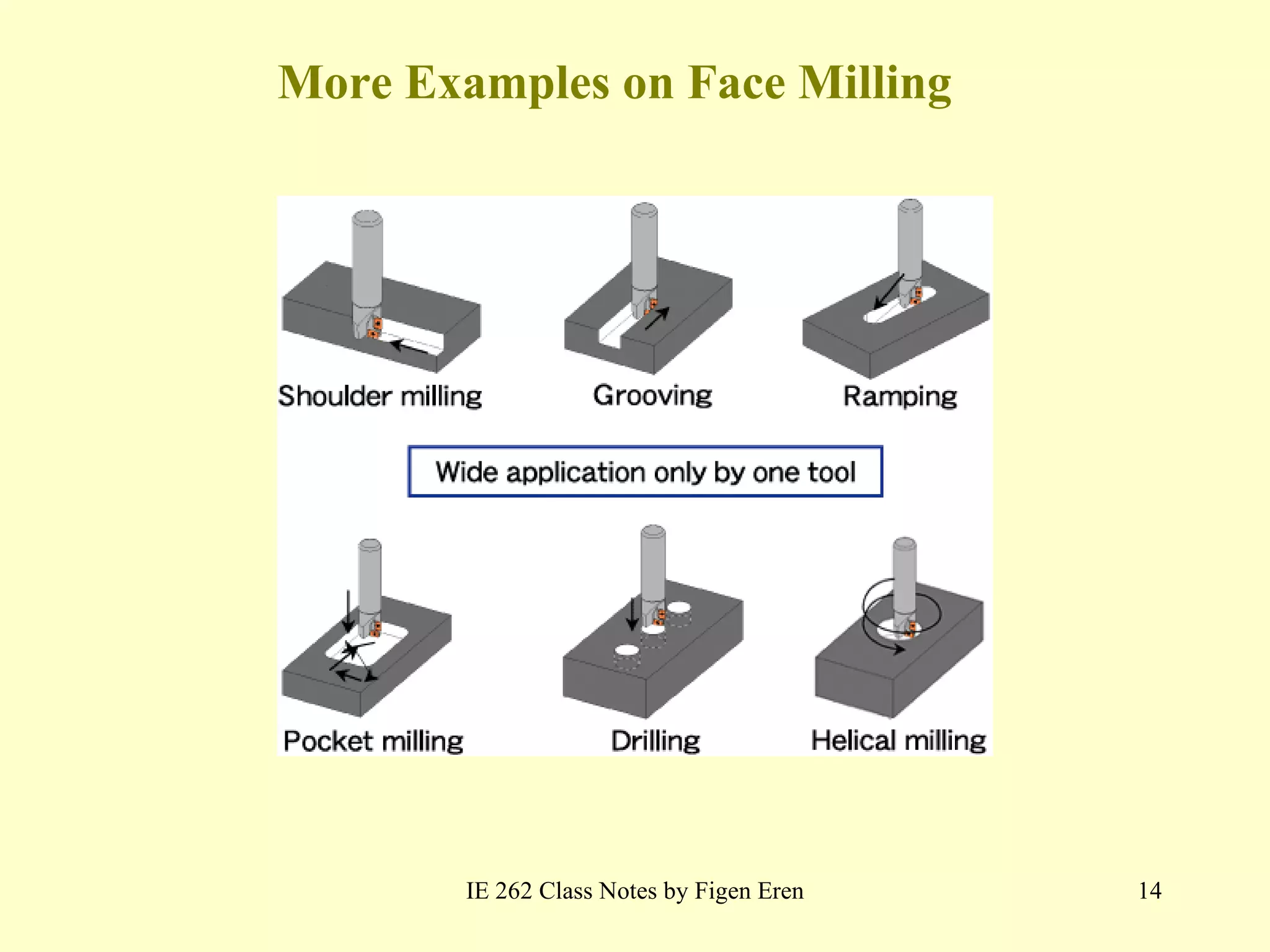
Face Milling The generated surface is at right angles to the cutter axis and is the combined result of actions of the portions of the teeth located on both periphery and the face of the cutter. Most of the cutting is done by the peripheral portions of the teeth, with the face portions providing some finishing actions. Conventional face milling: Diameter of tool is larger than work part’s width. Partial face milling: The cutter overhangs from one side of work part . End milling:  Cutters diameter is less than the work part’s width. IE 262 Class Notes by Figen Eren
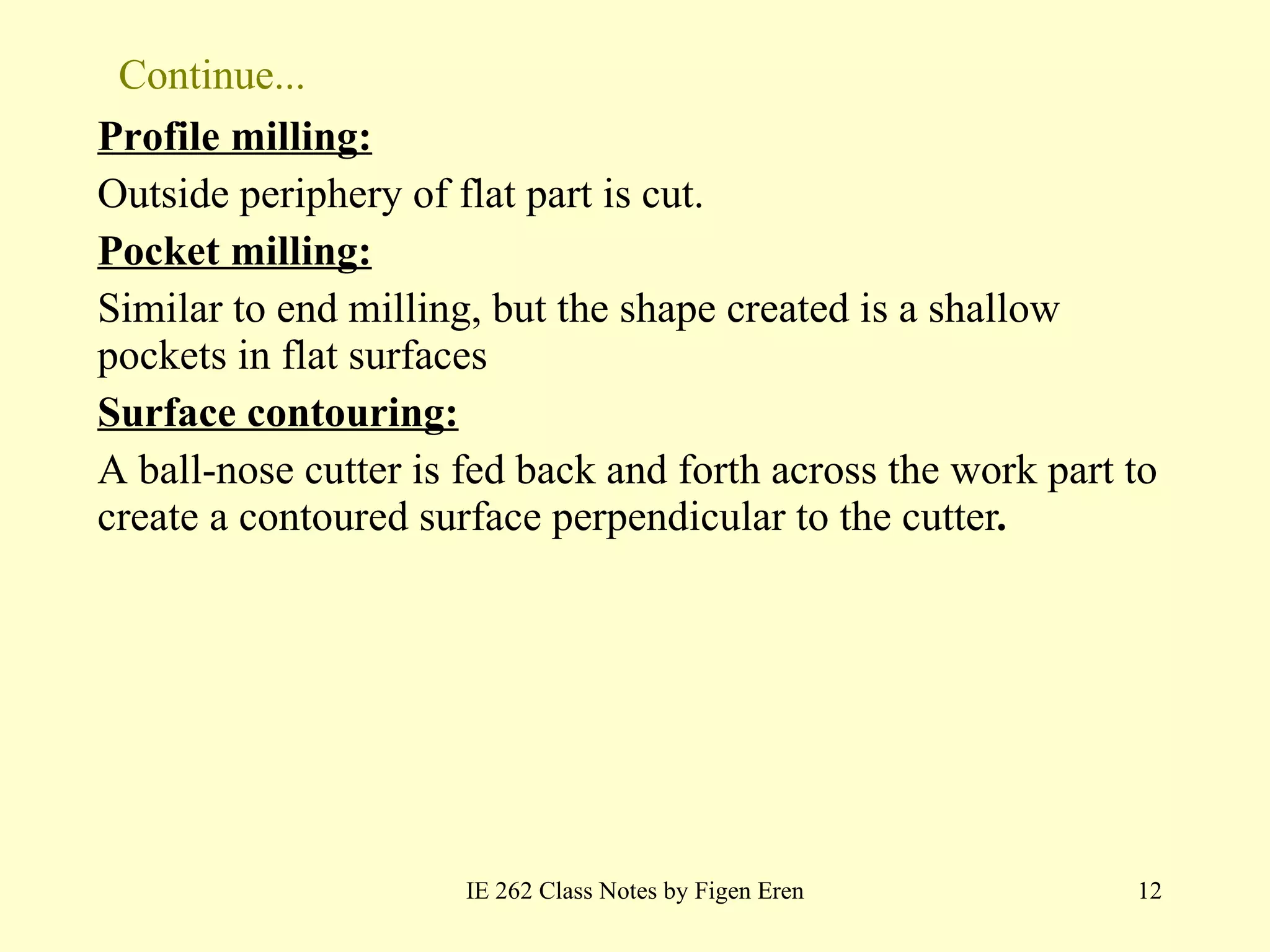
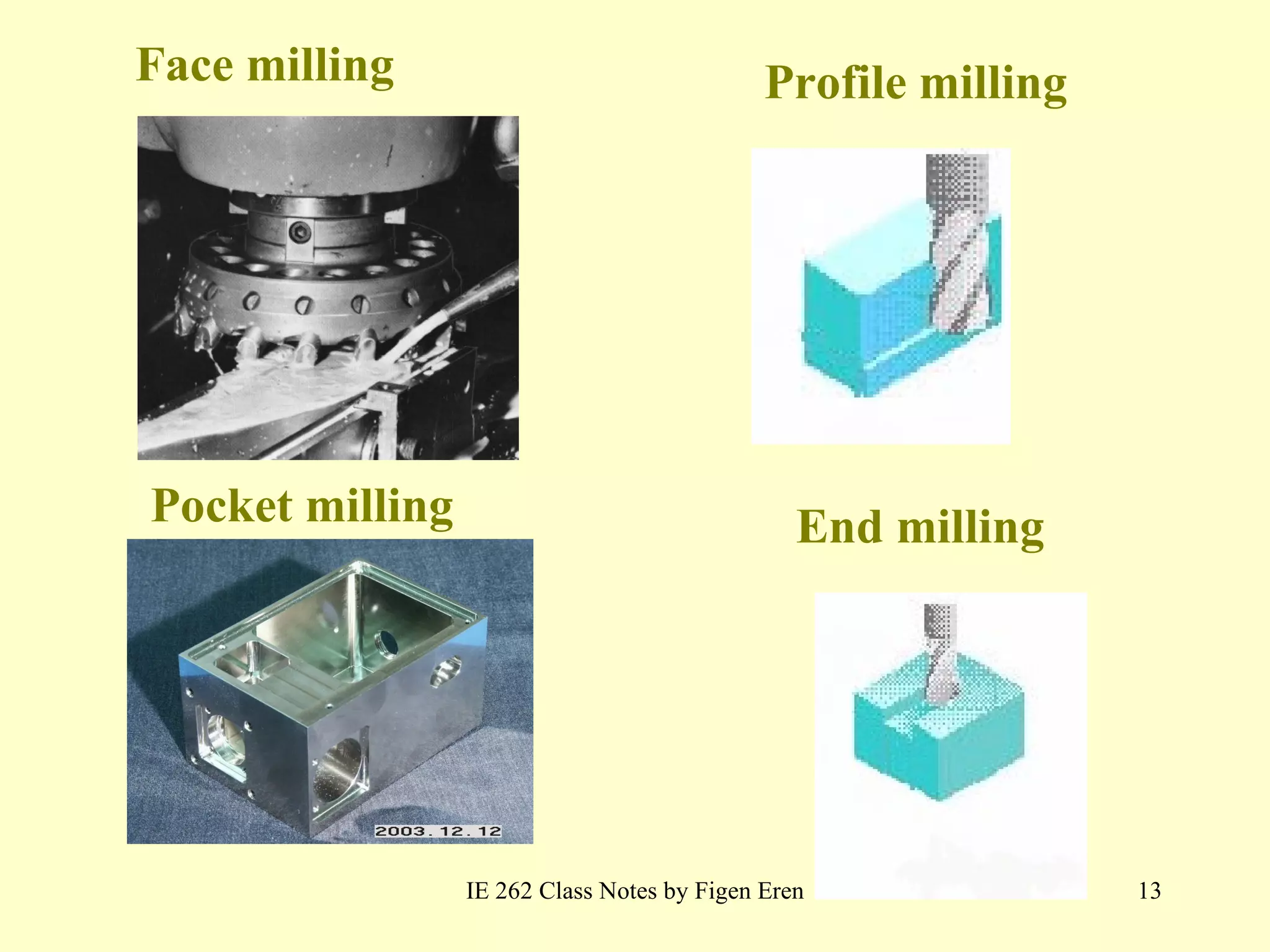
Continue... Profile milling: Outside periphery of flat part is cut. Pocket milling: Similar to end milling, but the shape created is a shallow pockets in flat surfaces Surface contouring: A ball-nose cutter is fed back and forth across the work part to create a contoured surface perpendicular to the cutter . IE 262 Class Notes by Figen Eren
Face  milling IE 262 Class Notes by Figen Eren Pocket  milling End  milling Profile  milling
IE 262 Class Notes by Figen Eren More Examples on Face Milling
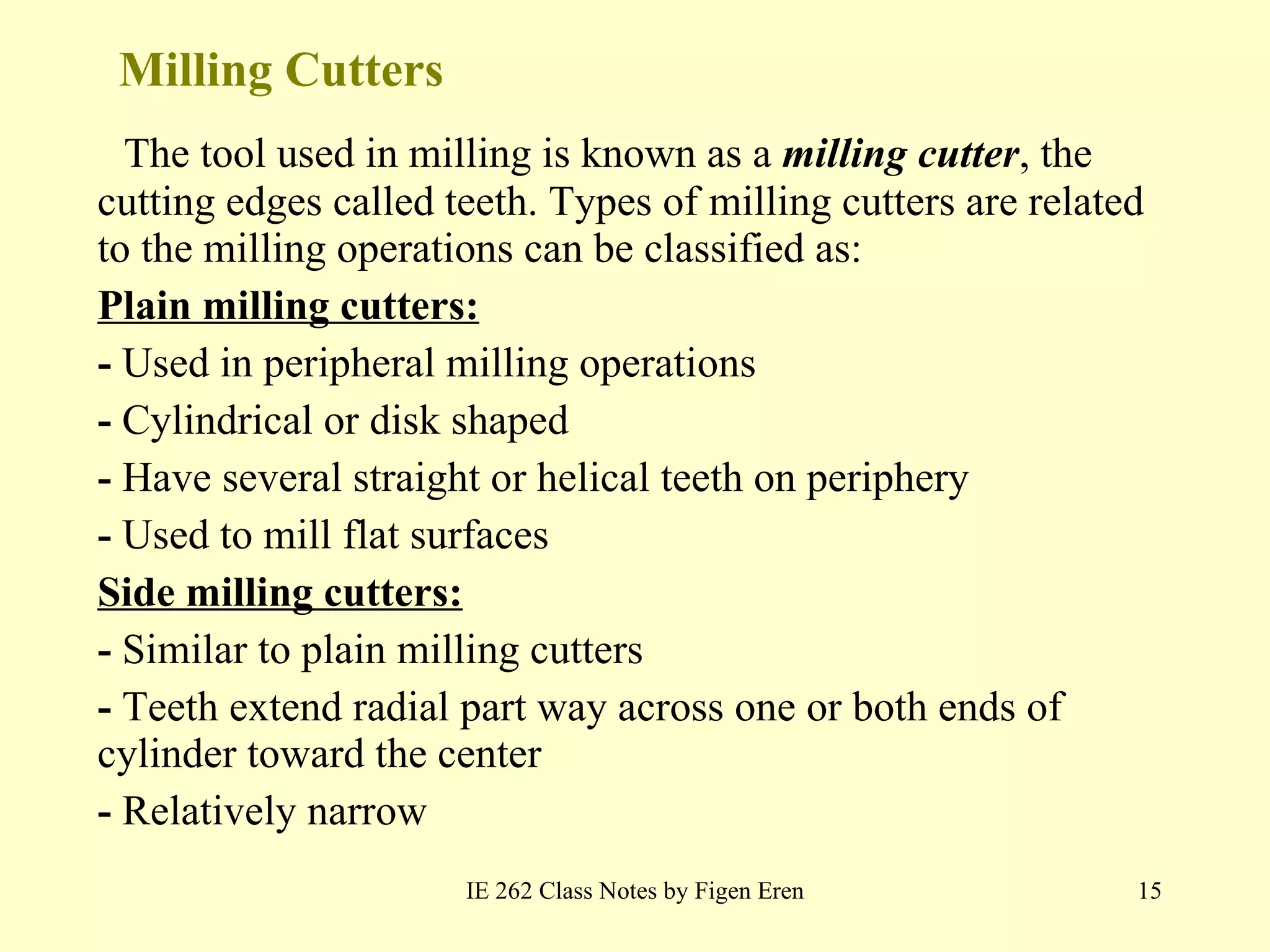
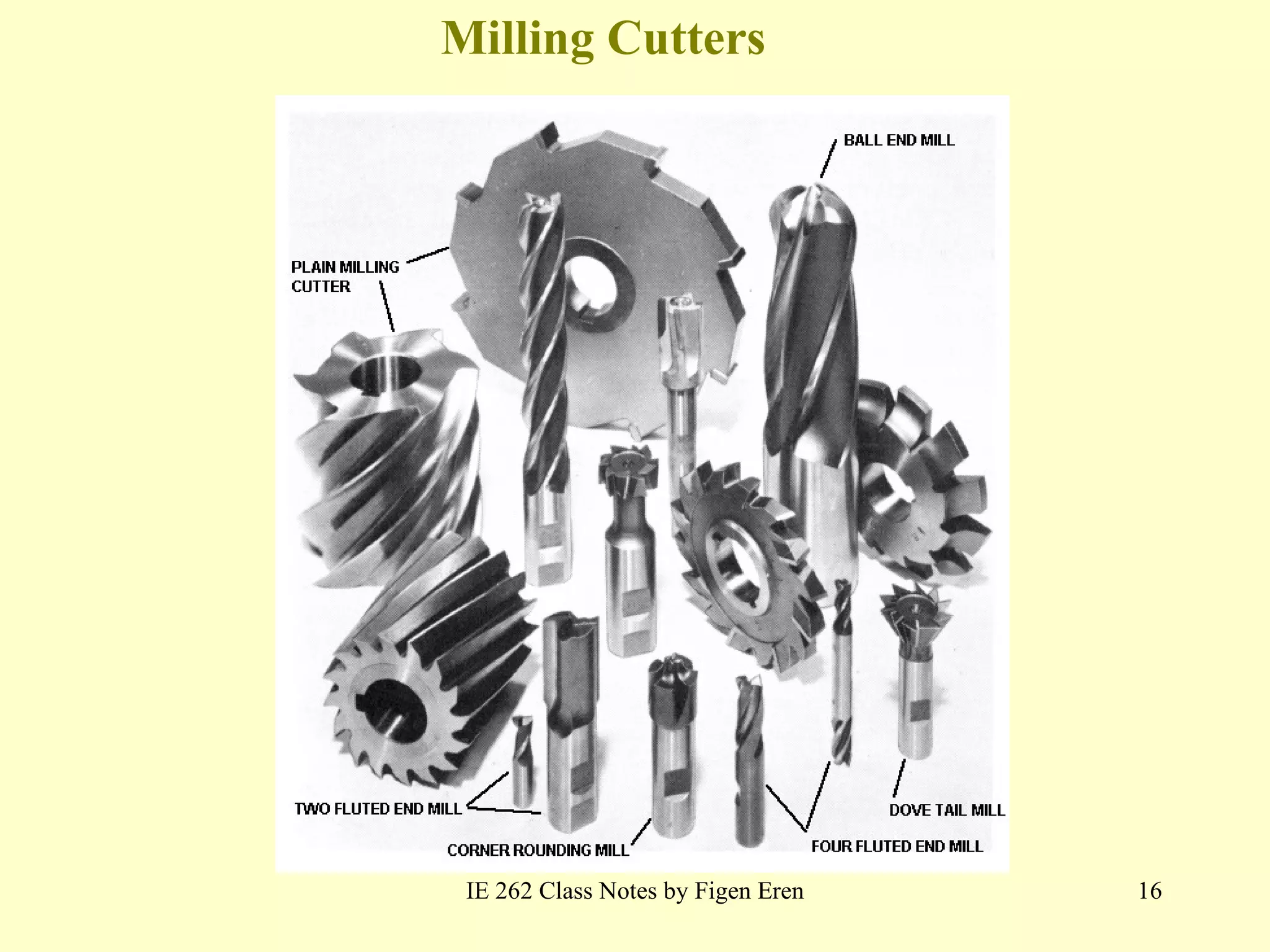
Milling Cutters The tool used in milling is known as a  milling cutter , the cutting edges called teeth. Types of milling cutters are related to the milling operations can be classified as : Plain milling cutters: -  Used in peripheral milling operations -  Cylindrical or disk shaped -  Have several straight or helical teeth on periphery  -  Used to mill flat surfaces Side milling cutters: -  Similar to plain milling cutters -  Teeth extend radial part way across one or both ends of cylinder toward the center -  Relatively narrow IE 262 Class Notes by Figen Eren
Milling Cutters IE 262 Class Notes by Figen Eren
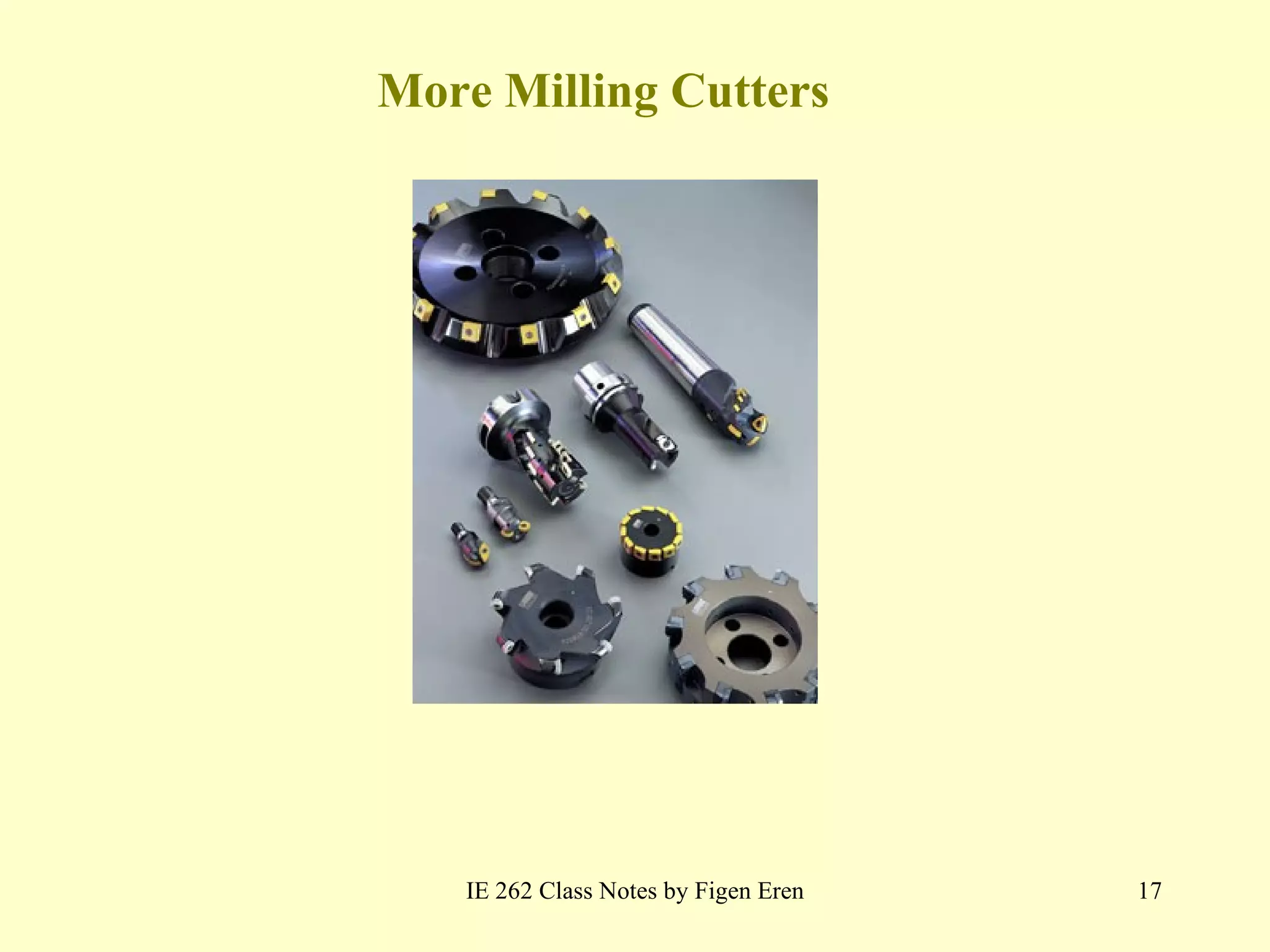
More Milling Cutters IE 262 Class Notes by Figen Eren
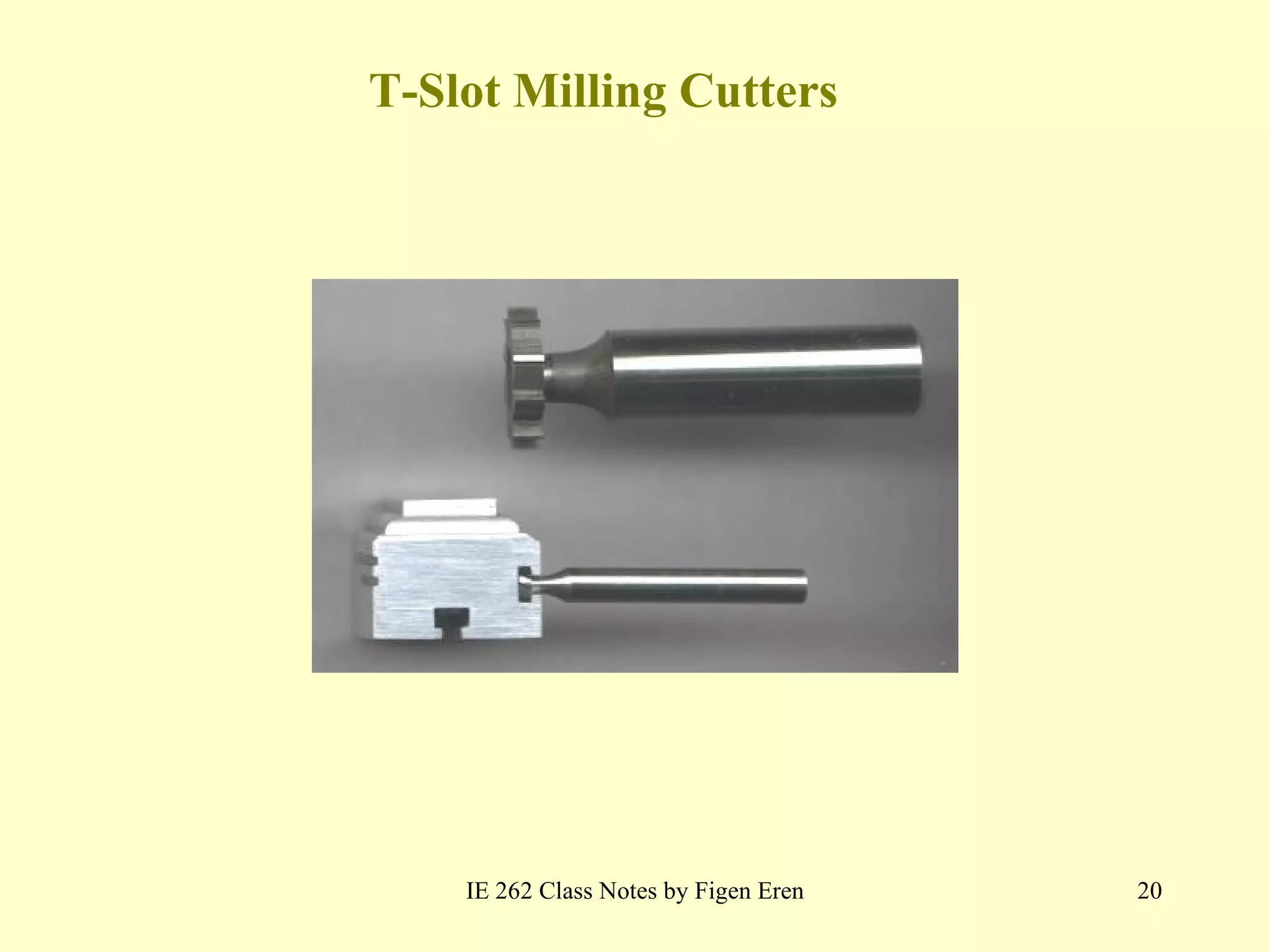
Continue... Form milling cutters:  -  Another peripheral milling cutter - Teeth ground to a special shape to produce a surface having a desired transverse contour, convex, concave shape. End milling cutters: -  Looks like a drill bit, but it cuts with peripheral teeth instead of it ’ s end.   -  Have multiple teeth -  Used in milling slots, profiling and facing narrow surfaces . IE 262 Class Notes by Figen Eren
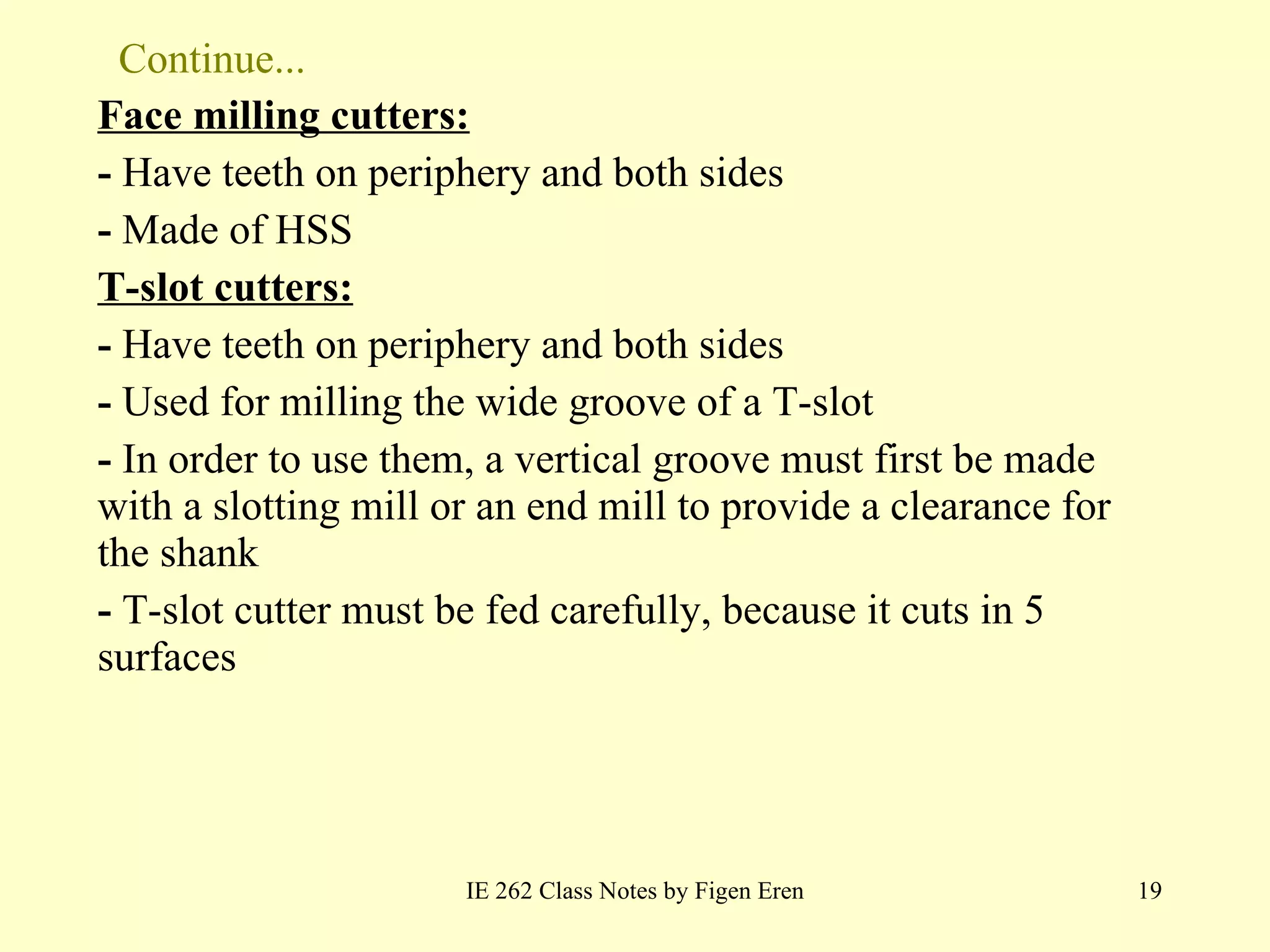
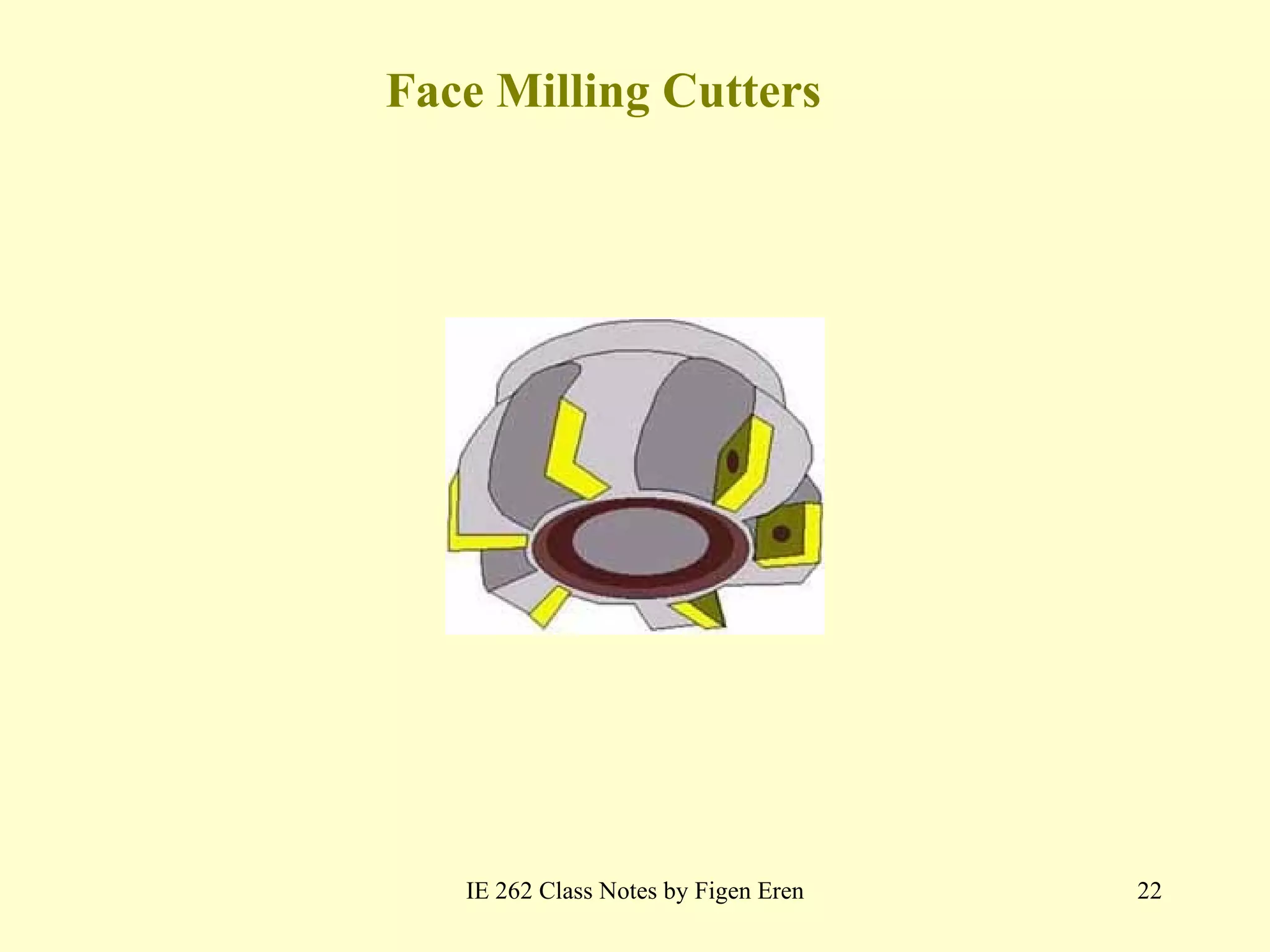
Continue... Face milling cutters: -  Have teeth on periphery and both sides -  Made of HSS T-slot cutters: -  Have teeth on periphery and both sides -  Used for milling the wide groove of a T-slot -  In order to use them, a vertical groove must first be made with a slotting mill or an end mill to provide a clearance for the shank -  T-slot cutter must be fed carefully, because it cuts in 5 surfaces IE 262 Class Notes by Figen Eren
T-Slot Milling Cutters IE 262 Class Notes by Figen Eren
End Milling Cutters IE 262 Class Notes by Figen Eren
Face Milling Cutters IE 262 Class Notes by Figen Eren
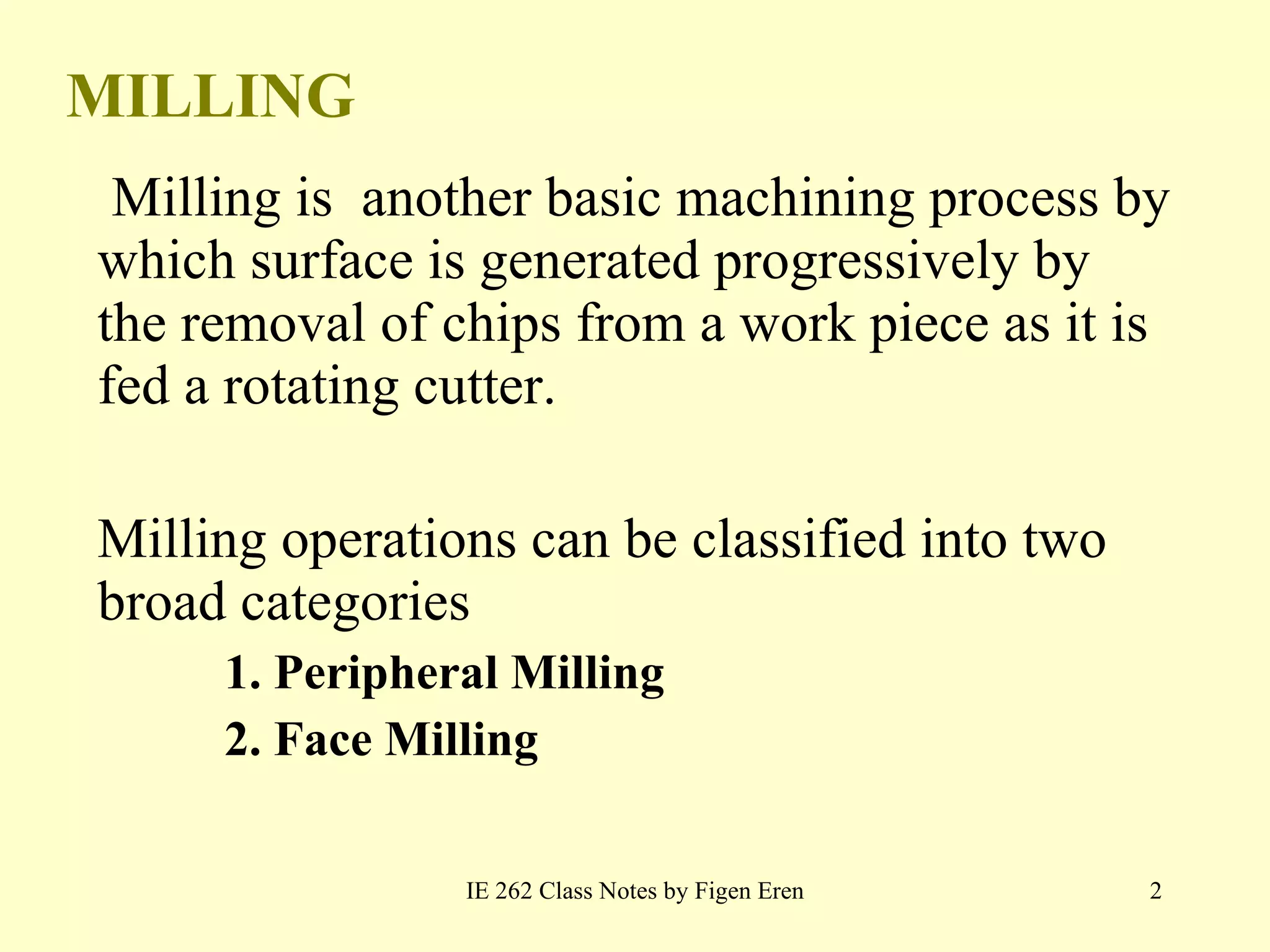
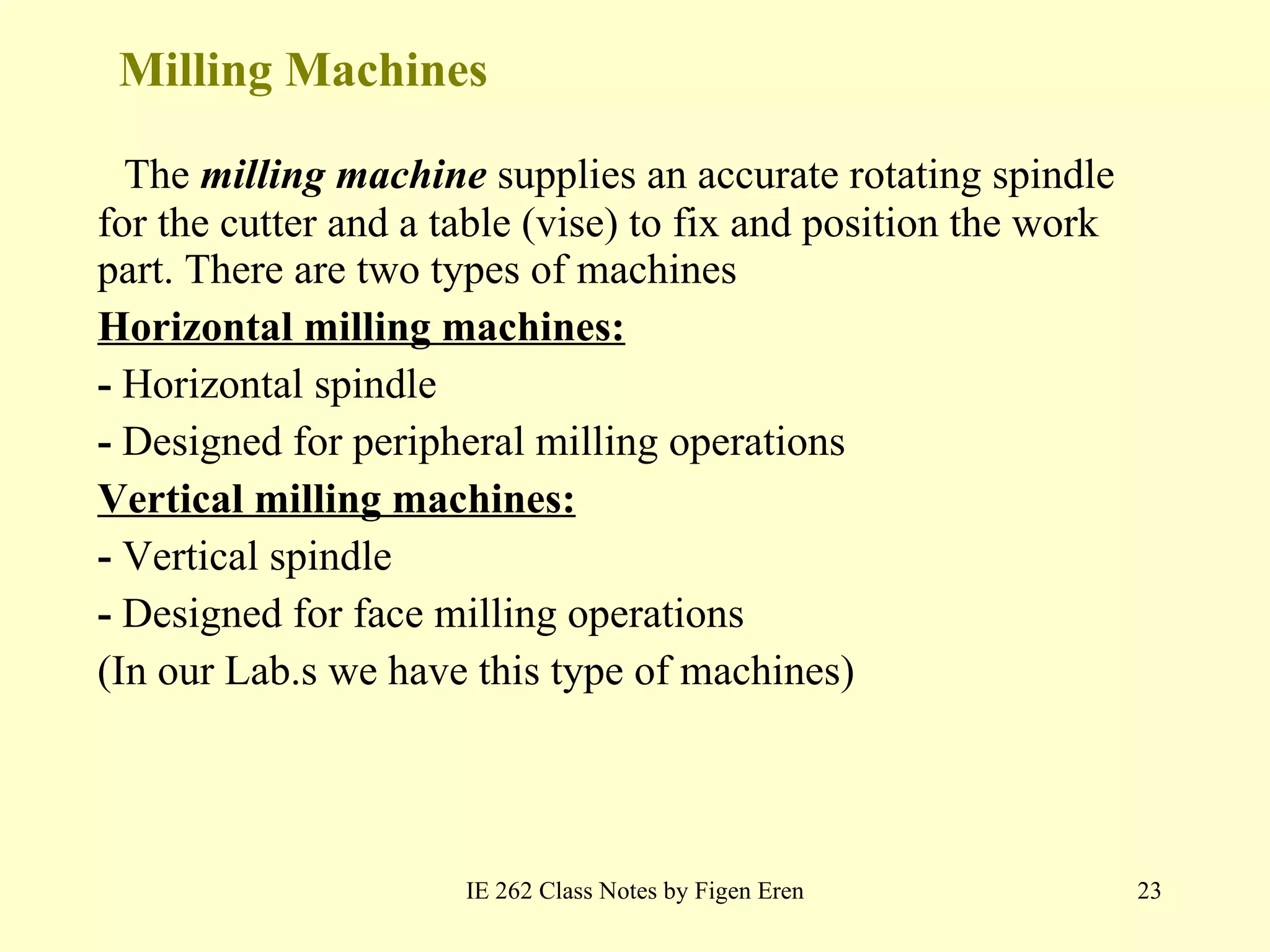
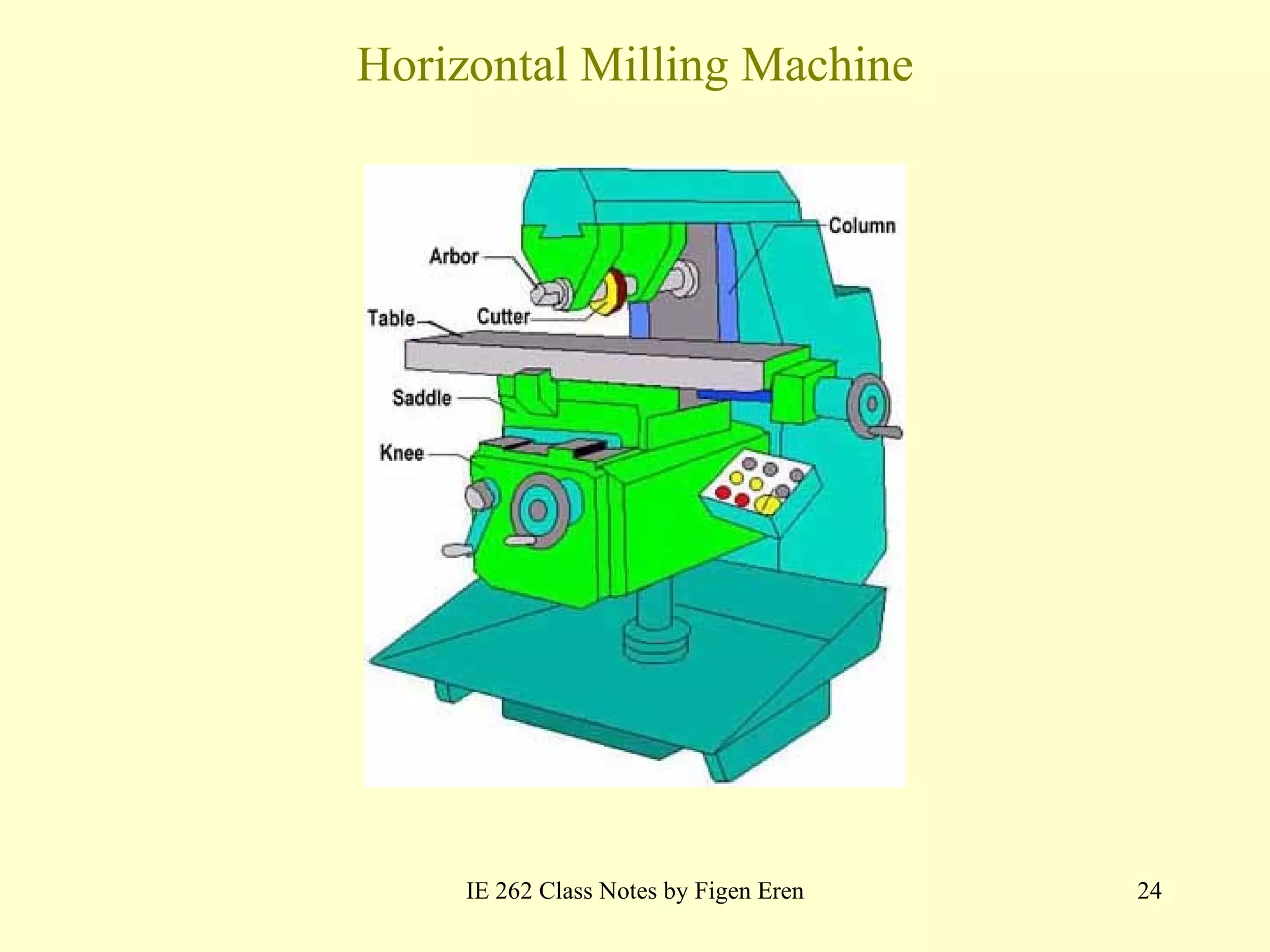
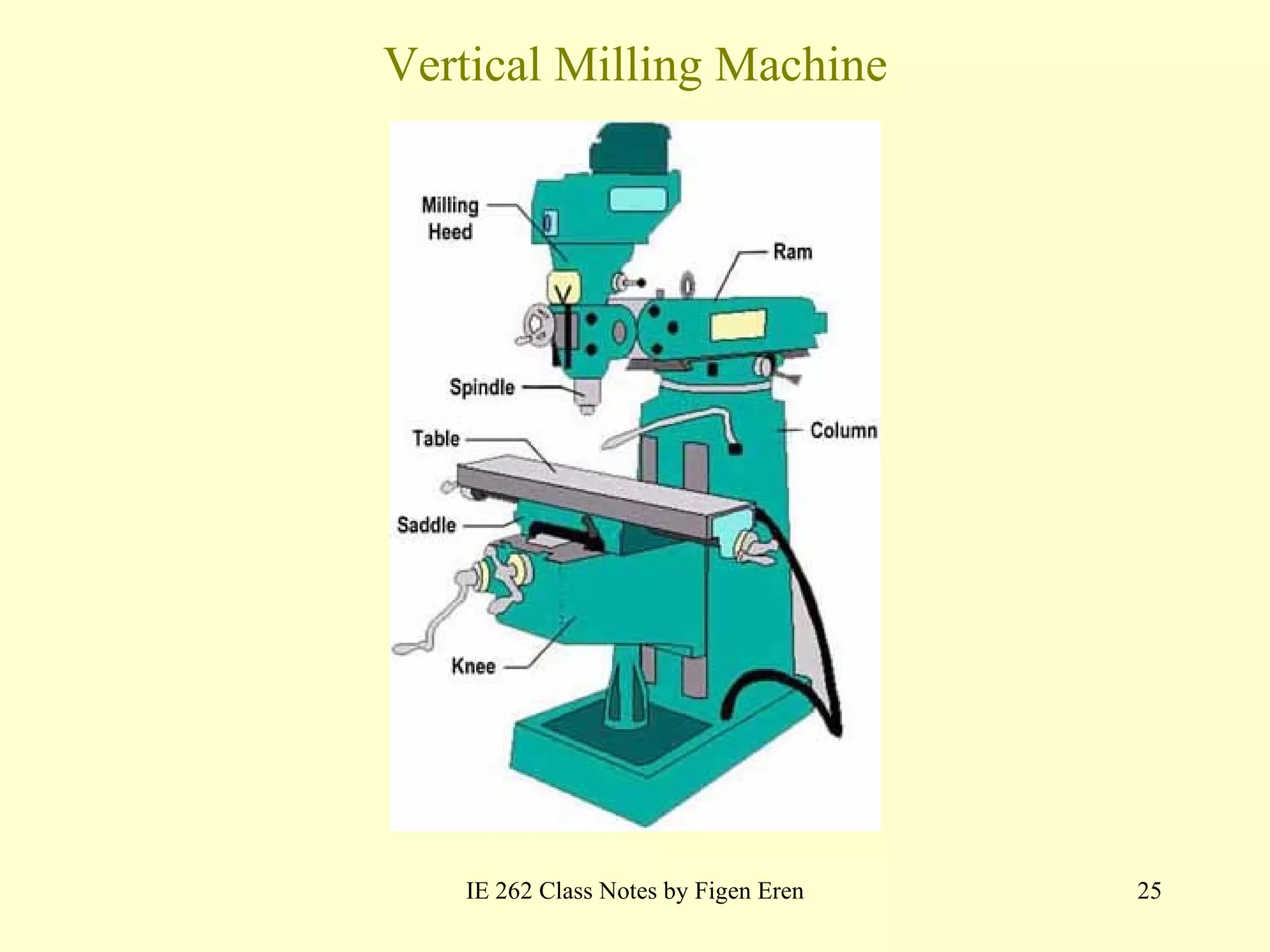
Milling Machines The  milling machine  supplies an accurate rotating spindle for the cutter and a table (vise) to fix and position the work part. There are two types of machines Horizontal milling machines: -  Horizontal spindle -  Designed for peripheral milling operations Vertical milling machines: -  Vertical spindle -  Designed for face milling operations (In our Lab.s we have this type of machines) IE 262 Class Notes by Figen Eren
Horizontal Milling Machine IE 262 Class Notes by Figen Eren
Vertical Milling Machine IE 262 Class Notes by Figen Eren
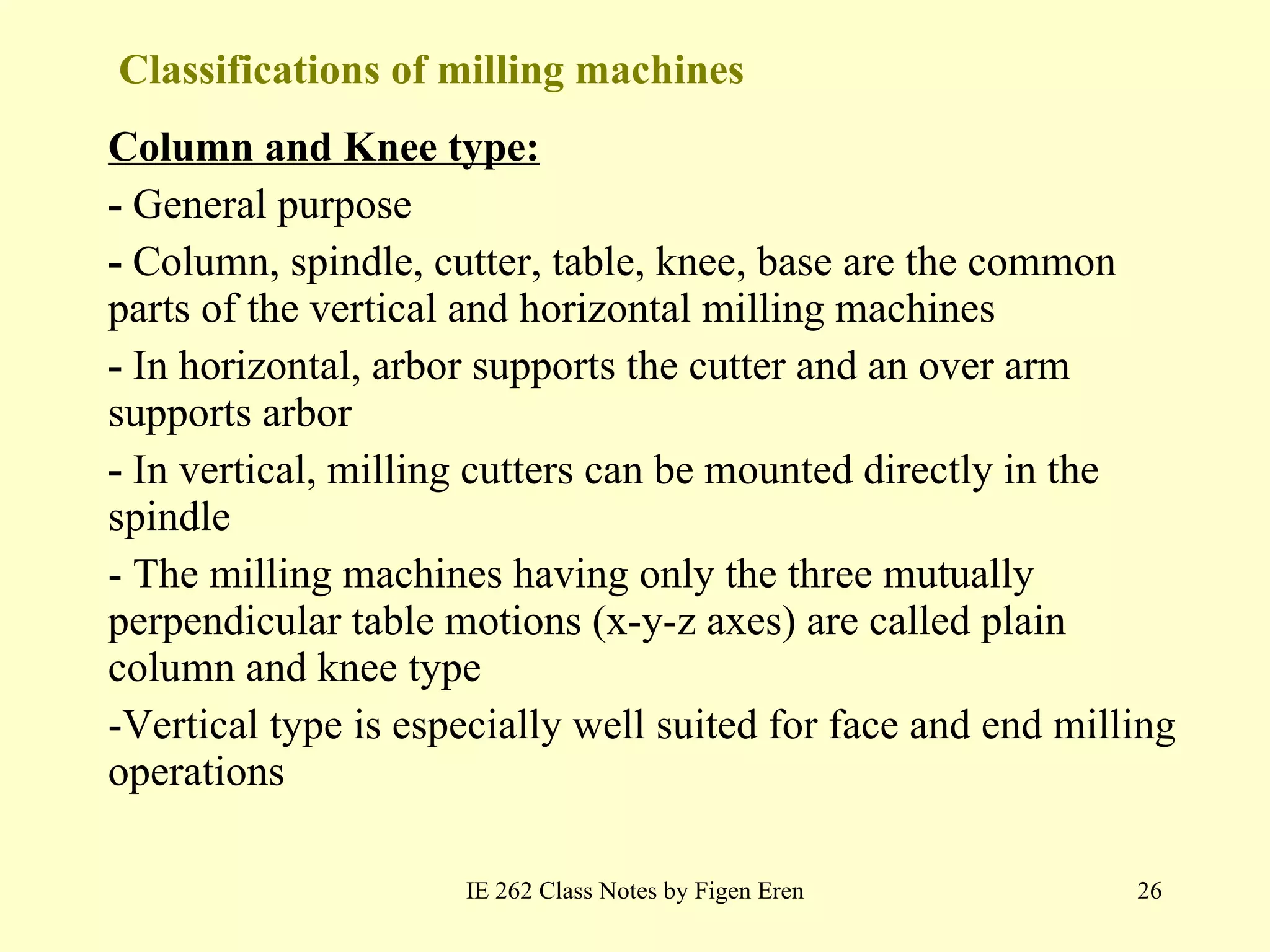
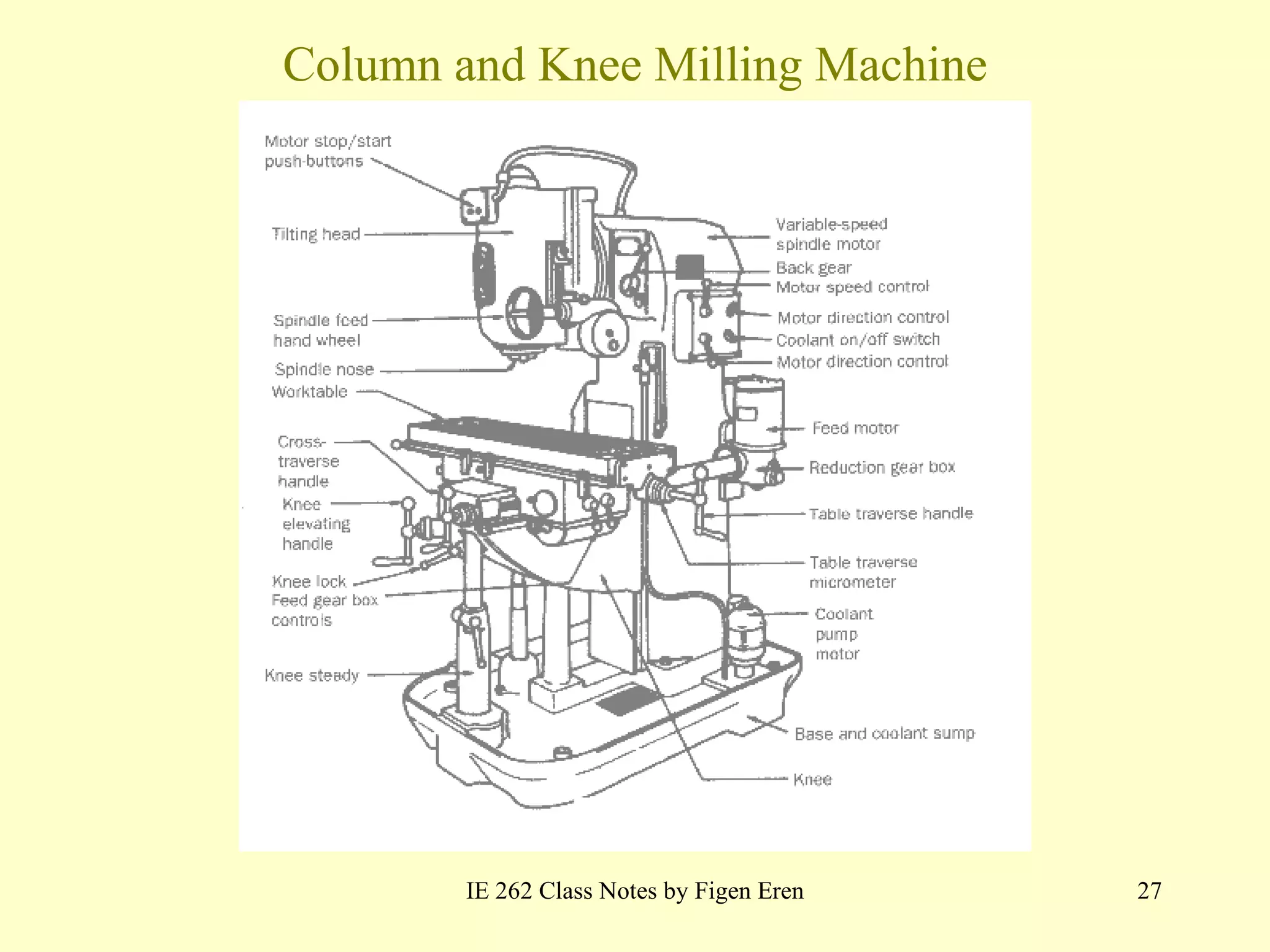
Classifications of milling machines Column and Knee type: -  General purpose -  Column, spindle, cutter, table, knee, base are the common parts of the vertical and horizontal milling machines -  In horizontal, arbor supports the cutter and an over arm supports arbor  -  In vertical, milling cutters can be mounted directly in the spindle  - The milling machines having only the three mutually perpendicular table motions (x-y-z axes) are called plain column and knee type -Vertical type is especially well suited for face and end milling operations IE 262 Class Notes by Figen Eren
Column and Knee Milling Machine IE 262 Class Notes by Figen Eren
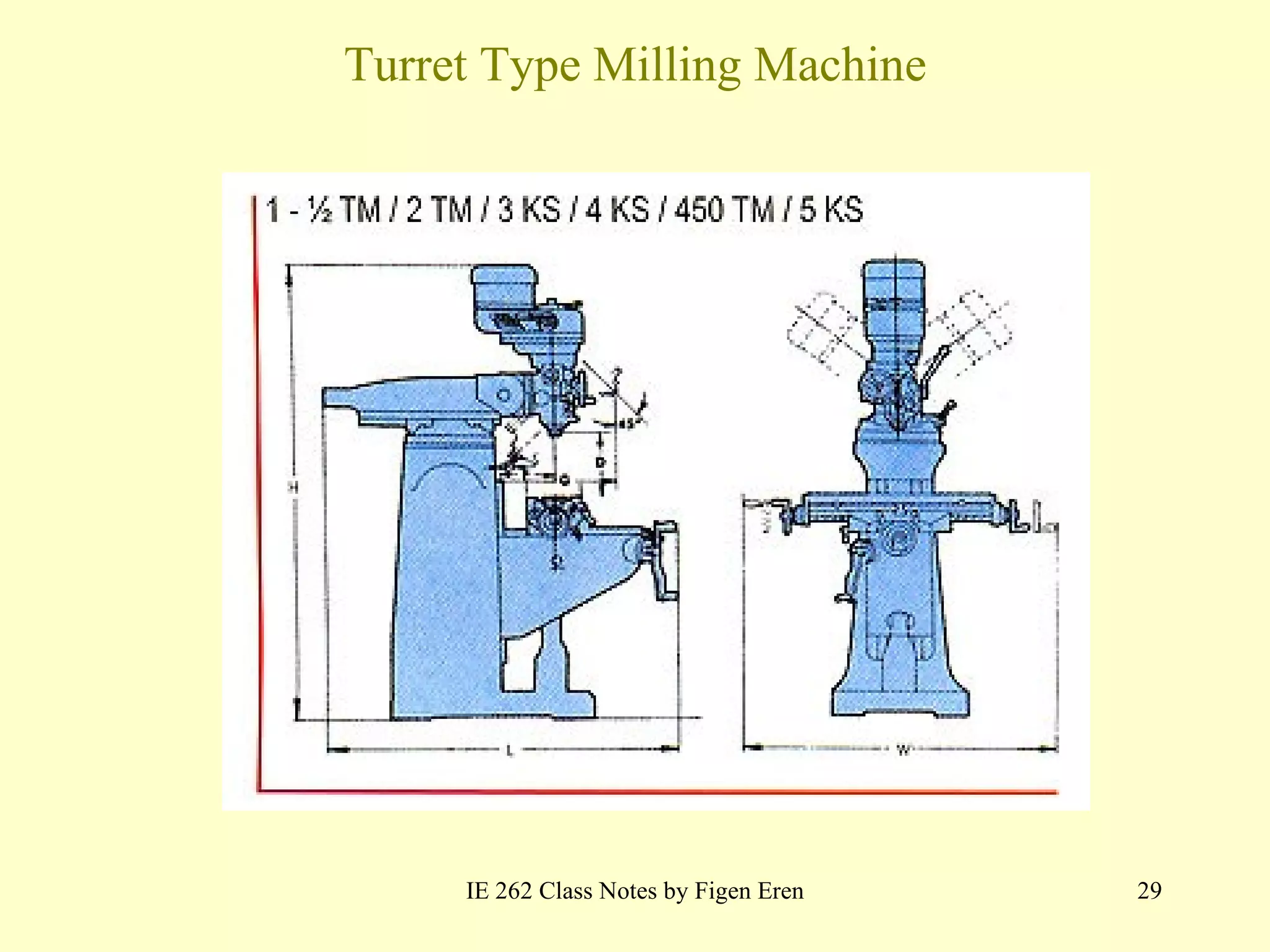
Continue... -Two more special column and knee machines are called  universal  and  turret type.   Universal type:   Has a table that can be rotate in a horizontal plane to any specified angle Turret type:   Has duel heads that can be rotated about a horizontal axis. This permits milling to be done horizontally, vertically or at any angle.  IE 262 Class Notes by Figen Eren
Turret Type Milling Machine IE 262 Class Notes by Figen Eren
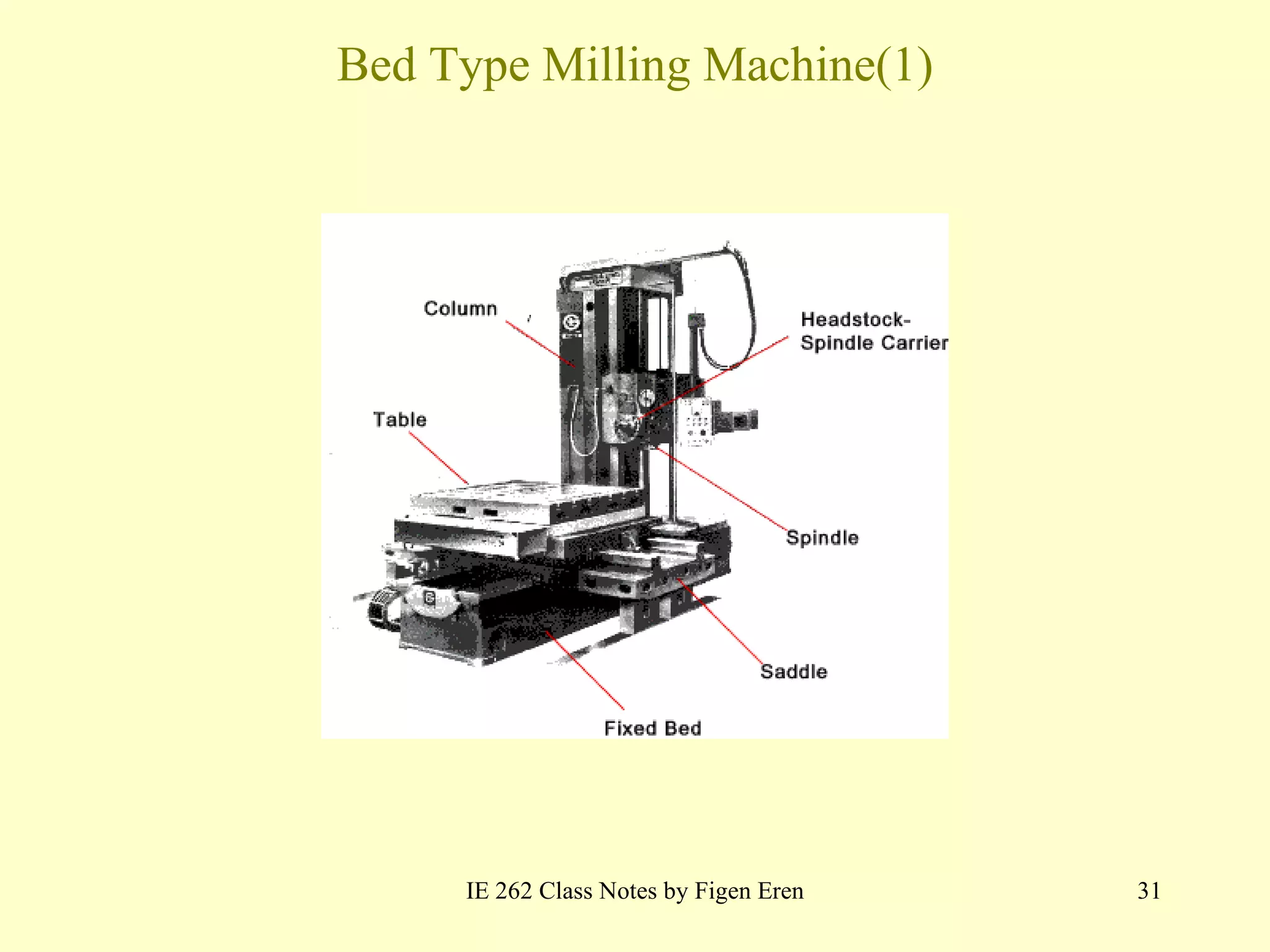
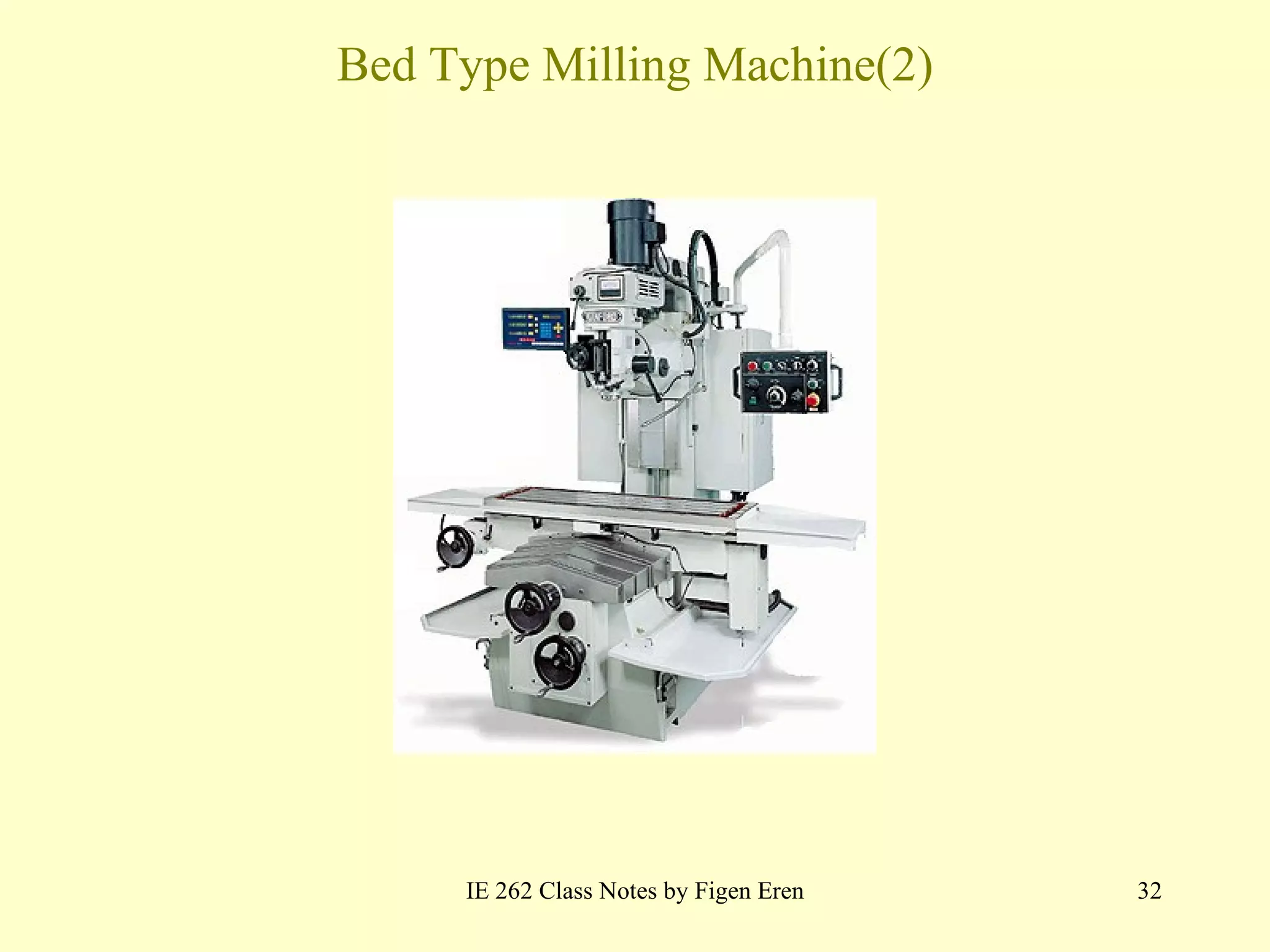
Continue... Bed type milling machines: -  Designed for mass production -  Greater rigidity -  Achieves heavier feed rates and depth of cuts, high MRR -Work table is directly fixed on the bed of the machine tool  The cutter mounted in a spindle head that can be adjusted vertically along the machine column After machine set-up, little skill required to operate them, therefore semi-skill operators can us this type of machines Three types are available w.r.t. the count of spindles available   Simplex :   Has single spindle IE 262 Class Notes by Figen Eren
Bed Type Milling Machine(1) IE 262 Class Notes by Figen Eren
Bed Type Milling Machine(2) IE 262 Class Notes by Figen Eren
Continue... -  Duplex:   Has two spindles, permitting simultaneous milling of two surfaces at a single pass Triplex:   Has three spindles, permitting simultaneous milling of three surfaces at a single pass Planer type milling machines: -  Utilize several milling heads -  Can remove large amount of metal while permitting the table and work piece to move quite slowly  -  Often, only single pass is required - Good for heavy pieces IE 262 Class Notes by Figen Eren
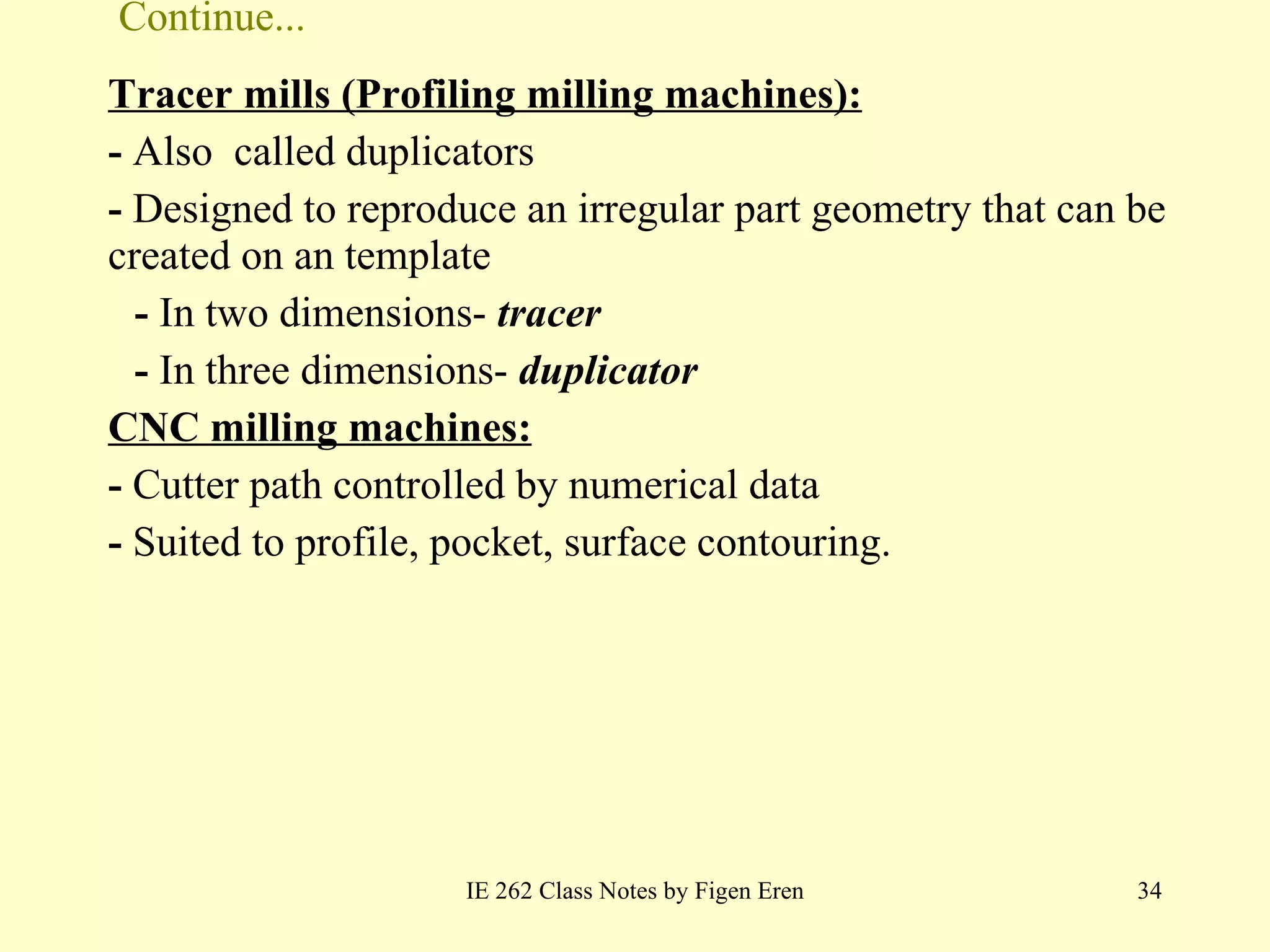
Continue... Tracer mills (Profiling milling machines): -  Also  called duplicators -  Designed to reproduce an irregular part geometry that can be created on an template -  In two dimensions-  tracer -  In three dimensions-  duplicator CNC milling machines: -  Cutter path controlled by numerical data  -  Suited to profile, pocket, surface contouring. IE 262 Class Notes by Figen Eren
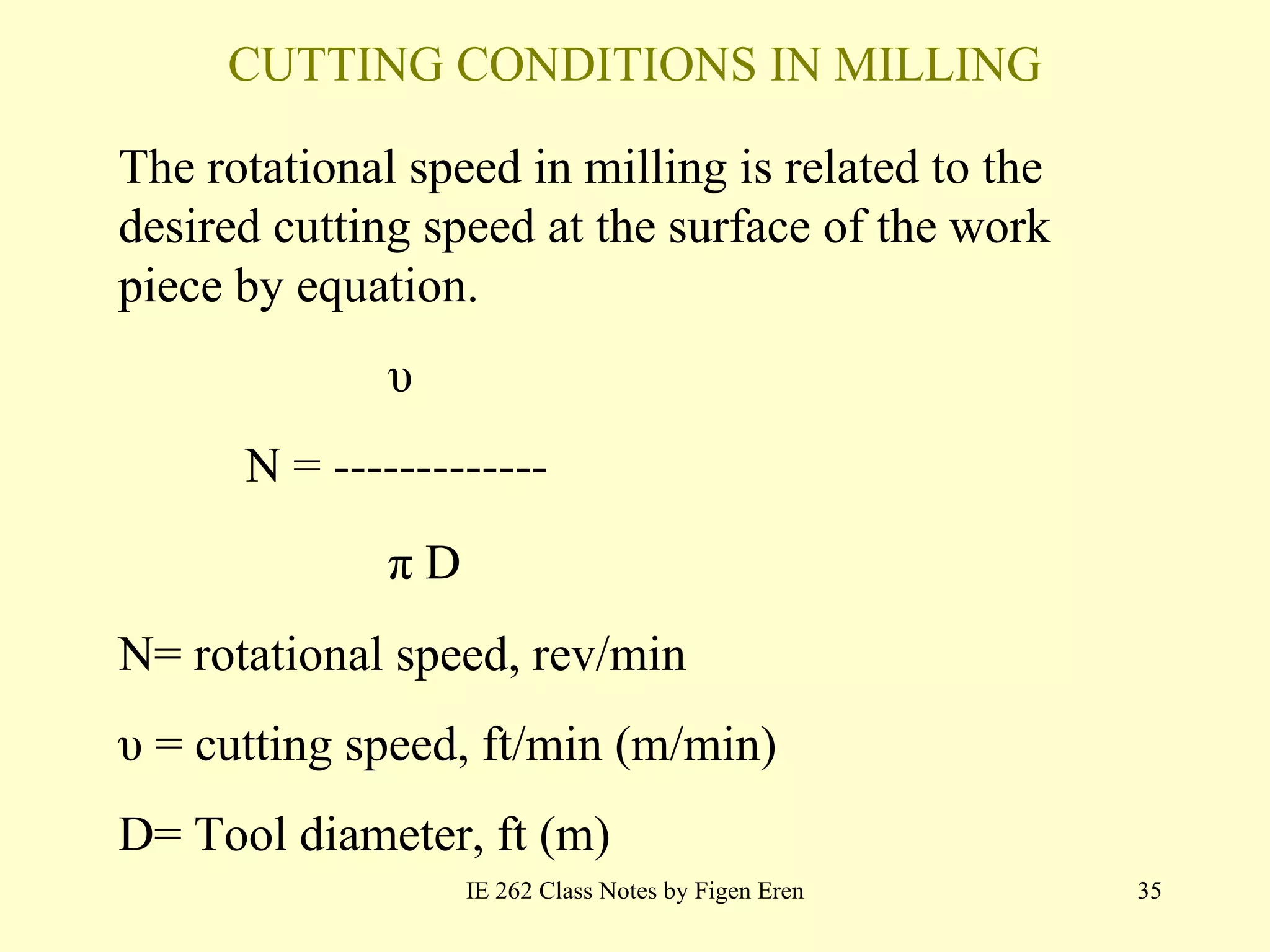
CUTTING CONDITIONS IN MILLING IE 262 Class Notes by Figen Eren The rotational speed in  milling  is related to the desired cutting speed at the surface of the work   piece by equation. υ N =  ------------- π D N= rotational speed, rev/min υ = cutting speed, ft/min (m/min) D=  Tool  diameter, ft (m)
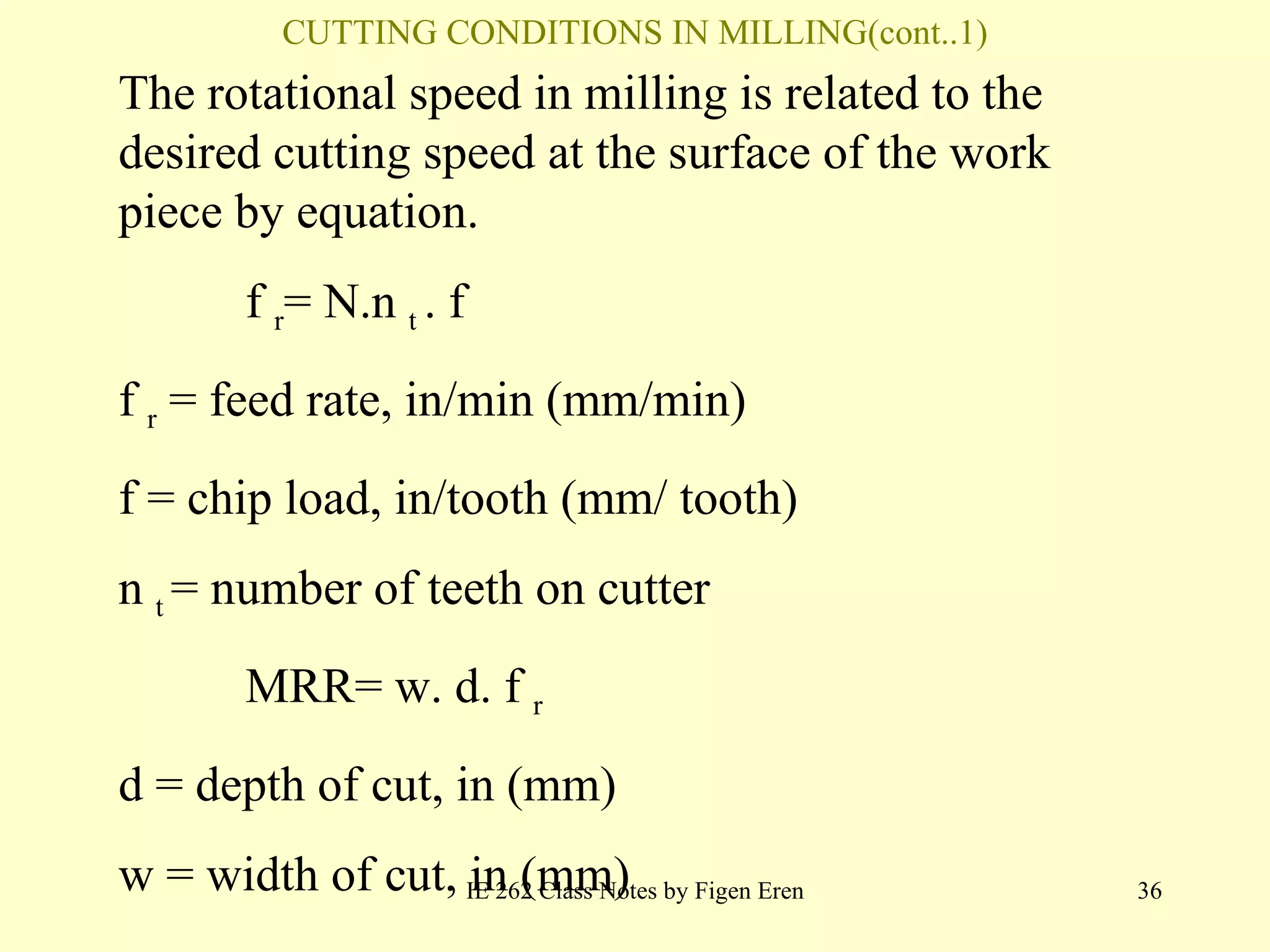
CUTTING CONDITIONS IN MILLING(cont..1) IE 262 Class Notes by Figen Eren The rotational speed in  milling  is related to the desired cutting speed at the surface of the work   piece by equation. f   r =  N.n  t  . f f   r  =  feed rate ,  in /min (m m /min) f  =  chip load ,  in / tooth  (m m /  tooth ) n  t  =  number of teeth on cutter MRR= w. d. f   r d  =  depth of cut ,  in  (m m ) w  =  width of cut ,  in  (m m )
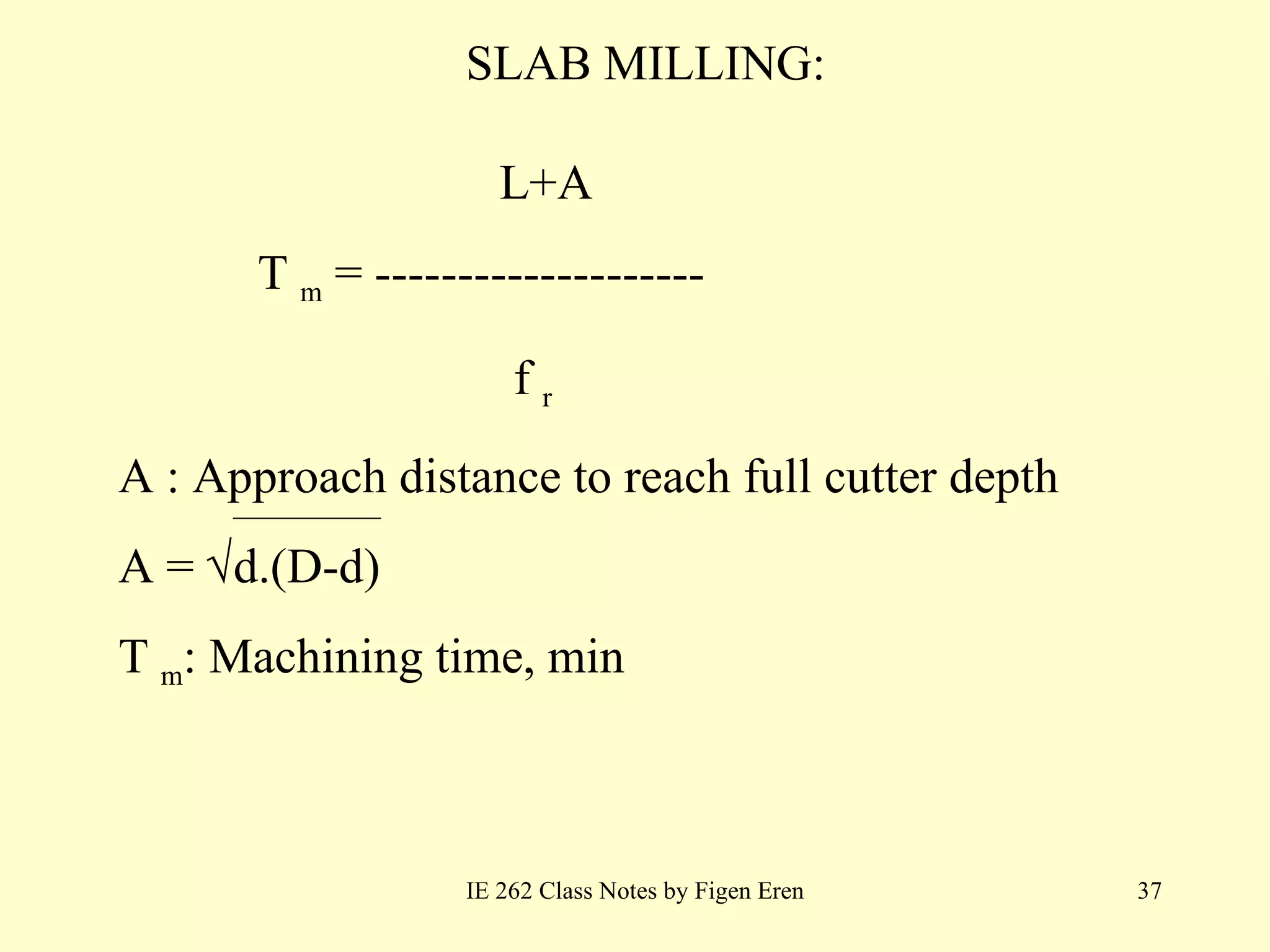
SLAB MILLING: IE 262 Class Notes by Figen Eren L+A   T   m  =  --------------------    f   r   A :   Approach distance to reach full cutter depth A  =   d.(D-d) T   m :   Machining time, min
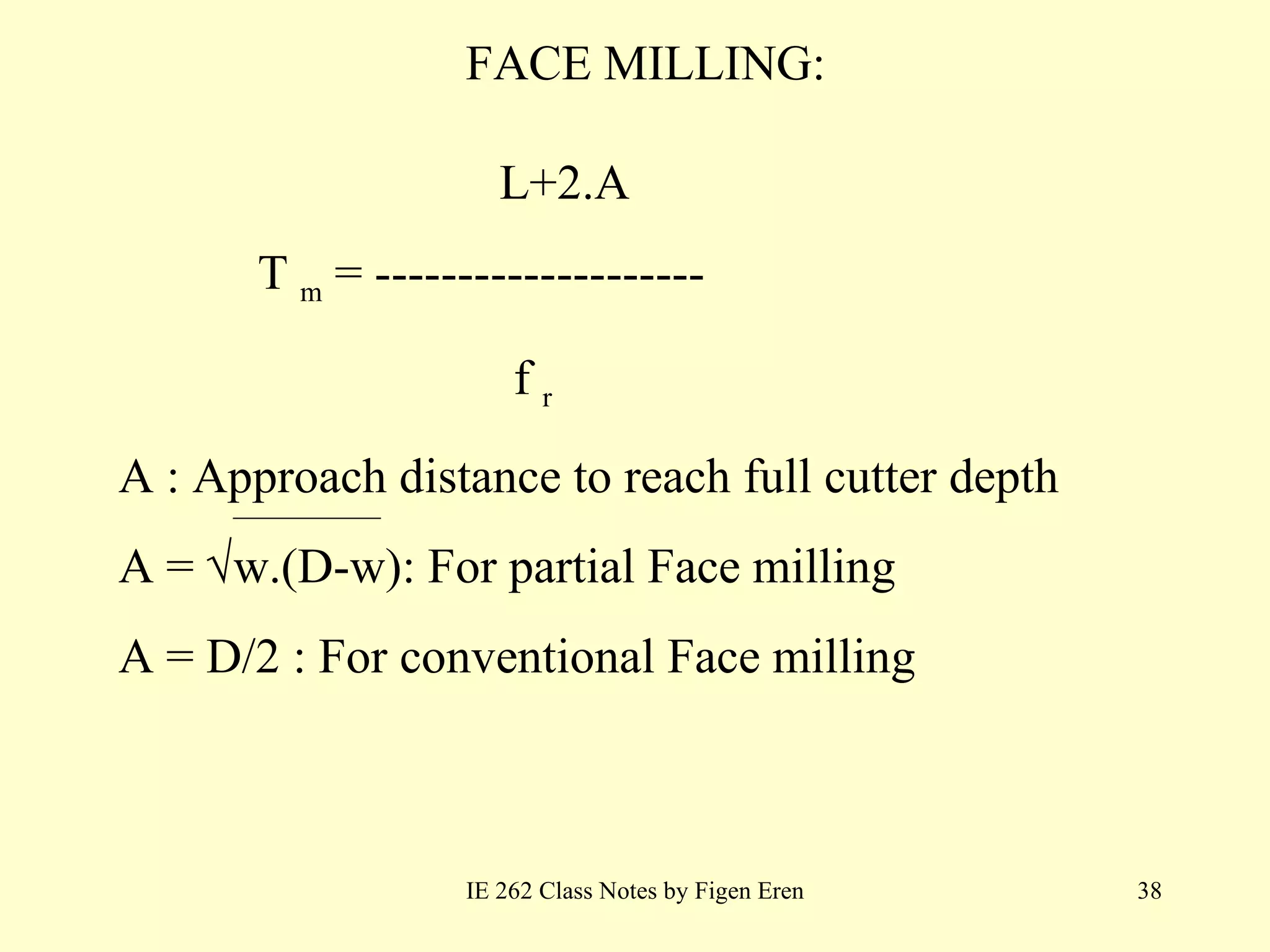
FACE MILLING: IE 262 Class Notes by Figen Eren L+2.A   T   m  =  --------------------   f   r   A :   Approach distance to reach full cutter depth A  =   w.(D-w): For partial Face milling A = D/2 : For conventional Face milling

MIlling 1

  • 1.
    MILLING IE 262Class Notes by Figen Eren
  • 2.
    MILLING Milling is another basic machining process by which surface is generated progressively by the removal of chips from a work piece as it is fed a rotating cutter. Milling operations can be classified into two broad categories 1. Peripheral Milling 2. Face Milling IE 262 Class Notes by Figen Eren
  • 3.
    Peripheral Milling IE 262 Class Notes by Figen Eren
  • 4.
    Face Milling IE262 Class Notes by Figen Eren
  • 5.
    Peripheral Milling Theaxis of the cutter rotation is parallel to the work piece surface to be machined in peripheral milling. Slab milling: Cutter width extends beyond the work piece on both sides Slotting (Slot milling): Cutter width is less than the work piece width, creating a slot. If the cutter is very thin, it can be used to cut a work part into two, called saw milling. Side milling: Cutter, machines the side of the work piece. Straddle milling: Similar to side milling, but cutting takes on both sides of the work part simultaneously. IE 262 Class Notes by Figen Eren
  • 6.
    Slab milling IE262 Class Notes by Figen Eren
  • 7.
    Slot millingIE 262 Class Notes by Figen Eren S ide milling S traddle milling Form milling
  • 8.
    More Examples IE262 Class Notes by Figen Eren
  • 9.
    Up milling Alsocalled conventional milling, - Wheel rotation opposite of the feed - The chip formed by each cutter tooth starts out very thin and increases its thickness - The length of the chip is relatively longer - Tool life is relatively shorter - Need more clamping force to hold the work part still. IE 262 Class Notes by Figen Eren
  • 10.
    Down milling: Also called climb milling , - Wheel rotation is parallel to the feed - The chip formed by each cutter tooth starts out thick and leaves out thin - The length of the chip is relatively short - Tool life is relatively longer - Need less clamping force to hold the work part still. IE 262 Class Notes by Figen Eren
  • 11.
    Face Milling Thegenerated surface is at right angles to the cutter axis and is the combined result of actions of the portions of the teeth located on both periphery and the face of the cutter. Most of the cutting is done by the peripheral portions of the teeth, with the face portions providing some finishing actions. Conventional face milling: Diameter of tool is larger than work part’s width. Partial face milling: The cutter overhangs from one side of work part . End milling: Cutters diameter is less than the work part’s width. IE 262 Class Notes by Figen Eren
  • 12.
    Continue... Profile milling:Outside periphery of flat part is cut. Pocket milling: Similar to end milling, but the shape created is a shallow pockets in flat surfaces Surface contouring: A ball-nose cutter is fed back and forth across the work part to create a contoured surface perpendicular to the cutter . IE 262 Class Notes by Figen Eren
  • 13.
    Face millingIE 262 Class Notes by Figen Eren Pocket milling End milling Profile milling
  • 14.
    IE 262 ClassNotes by Figen Eren More Examples on Face Milling
  • 15.
    Milling Cutters Thetool used in milling is known as a milling cutter , the cutting edges called teeth. Types of milling cutters are related to the milling operations can be classified as : Plain milling cutters: - Used in peripheral milling operations - Cylindrical or disk shaped - Have several straight or helical teeth on periphery - Used to mill flat surfaces Side milling cutters: - Similar to plain milling cutters - Teeth extend radial part way across one or both ends of cylinder toward the center - Relatively narrow IE 262 Class Notes by Figen Eren
  • 16.
    Milling Cutters IE262 Class Notes by Figen Eren
  • 17.
    More Milling CuttersIE 262 Class Notes by Figen Eren
  • 18.
    Continue... Form millingcutters: - Another peripheral milling cutter - Teeth ground to a special shape to produce a surface having a desired transverse contour, convex, concave shape. End milling cutters: - Looks like a drill bit, but it cuts with peripheral teeth instead of it ’ s end. - Have multiple teeth - Used in milling slots, profiling and facing narrow surfaces . IE 262 Class Notes by Figen Eren
  • 19.
    Continue... Face millingcutters: - Have teeth on periphery and both sides - Made of HSS T-slot cutters: - Have teeth on periphery and both sides - Used for milling the wide groove of a T-slot - In order to use them, a vertical groove must first be made with a slotting mill or an end mill to provide a clearance for the shank - T-slot cutter must be fed carefully, because it cuts in 5 surfaces IE 262 Class Notes by Figen Eren
  • 20.
    T-Slot Milling CuttersIE 262 Class Notes by Figen Eren
  • 21.
    End Milling CuttersIE 262 Class Notes by Figen Eren
  • 22.
    Face Milling CuttersIE 262 Class Notes by Figen Eren
  • 23.
    Milling Machines The milling machine supplies an accurate rotating spindle for the cutter and a table (vise) to fix and position the work part. There are two types of machines Horizontal milling machines: - Horizontal spindle - Designed for peripheral milling operations Vertical milling machines: - Vertical spindle - Designed for face milling operations (In our Lab.s we have this type of machines) IE 262 Class Notes by Figen Eren
  • 24.
    Horizontal Milling MachineIE 262 Class Notes by Figen Eren
  • 25.
    Vertical Milling MachineIE 262 Class Notes by Figen Eren
  • 26.
    Classifications of millingmachines Column and Knee type: - General purpose - Column, spindle, cutter, table, knee, base are the common parts of the vertical and horizontal milling machines - In horizontal, arbor supports the cutter and an over arm supports arbor - In vertical, milling cutters can be mounted directly in the spindle - The milling machines having only the three mutually perpendicular table motions (x-y-z axes) are called plain column and knee type -Vertical type is especially well suited for face and end milling operations IE 262 Class Notes by Figen Eren
  • 27.
    Column and KneeMilling Machine IE 262 Class Notes by Figen Eren
  • 28.
    Continue... -Two morespecial column and knee machines are called universal and turret type. Universal type: Has a table that can be rotate in a horizontal plane to any specified angle Turret type: Has duel heads that can be rotated about a horizontal axis. This permits milling to be done horizontally, vertically or at any angle. IE 262 Class Notes by Figen Eren
  • 29.
    Turret Type MillingMachine IE 262 Class Notes by Figen Eren
  • 30.
    Continue... Bed typemilling machines: - Designed for mass production - Greater rigidity - Achieves heavier feed rates and depth of cuts, high MRR -Work table is directly fixed on the bed of the machine tool The cutter mounted in a spindle head that can be adjusted vertically along the machine column After machine set-up, little skill required to operate them, therefore semi-skill operators can us this type of machines Three types are available w.r.t. the count of spindles available Simplex : Has single spindle IE 262 Class Notes by Figen Eren
  • 31.
    Bed Type MillingMachine(1) IE 262 Class Notes by Figen Eren
  • 32.
    Bed Type MillingMachine(2) IE 262 Class Notes by Figen Eren
  • 33.
    Continue... - Duplex: Has two spindles, permitting simultaneous milling of two surfaces at a single pass Triplex: Has three spindles, permitting simultaneous milling of three surfaces at a single pass Planer type milling machines: - Utilize several milling heads - Can remove large amount of metal while permitting the table and work piece to move quite slowly - Often, only single pass is required - Good for heavy pieces IE 262 Class Notes by Figen Eren
  • 34.
    Continue... Tracer mills(Profiling milling machines): - Also called duplicators - Designed to reproduce an irregular part geometry that can be created on an template - In two dimensions- tracer - In three dimensions- duplicator CNC milling machines: - Cutter path controlled by numerical data - Suited to profile, pocket, surface contouring. IE 262 Class Notes by Figen Eren
  • 35.
    CUTTING CONDITIONS INMILLING IE 262 Class Notes by Figen Eren The rotational speed in milling is related to the desired cutting speed at the surface of the work piece by equation. υ N = ------------- π D N= rotational speed, rev/min υ = cutting speed, ft/min (m/min) D= Tool diameter, ft (m)
  • 36.
    CUTTING CONDITIONS INMILLING(cont..1) IE 262 Class Notes by Figen Eren The rotational speed in milling is related to the desired cutting speed at the surface of the work piece by equation. f r = N.n t . f f r = feed rate , in /min (m m /min) f = chip load , in / tooth (m m / tooth ) n t = number of teeth on cutter MRR= w. d. f r d = depth of cut , in (m m ) w = width of cut , in (m m )
  • 37.
    SLAB MILLING: IE262 Class Notes by Figen Eren L+A T m = -------------------- f r A : Approach distance to reach full cutter depth A =  d.(D-d) T m : Machining time, min
  • 38.
    FACE MILLING: IE262 Class Notes by Figen Eren L+2.A T m = -------------------- f r A : Approach distance to reach full cutter depth A =  w.(D-w): For partial Face milling A = D/2 : For conventional Face milling