Cryptography and Network
Security
Dr.S.Santhi
Professor
Department of ECE
KIT-Kalaignarkarunanidhi Institute of Technology
Agenda
What Is Cryptography?
Types of Cryptographic Functions.
Network Security Models.
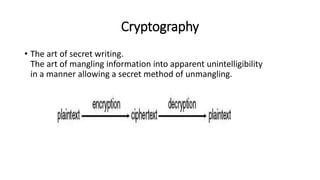
Cryptography
• The art of secret writing.
The art of mangling information into apparent unintelligibility
in a manner allowing a secret method of unmangling.
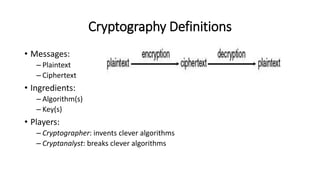
Cryptography Definitions
• Messages:
– Plaintext
– Ciphertext
• Ingredients:
– Algorithm(s)
– Key(s)
• Players:
– Cryptographer: invents clever algorithms
– Cryptanalyst: breaks clever algorithms
Basic Terminology
• Plaintext: original message to be encrypted
• Ciphertext: the encrypted message
• Enciphering or encryption: the process of converting plaintext into
ciphertext
• Encryption algorithm: performs encryption
• Two inputs: a plaintext and a secret key
Symmetric Key Cryptography
• This private/secret/single key cryptography uses one key
• This key is shared by both sender and receiver
• if this key is disclosed communications are compromised
• It is also called symmetric, parties are equal
• It does not protect sender from receiver forging a message &
claiming is sent by sender
Asymmetric Key Cryptography
• It uses two keys – Private and Public key
• Asymmetric – Both sender and receiver use different keys
• It works by the clever use of number theory problems
• It complements rather than replaces private key cryptography
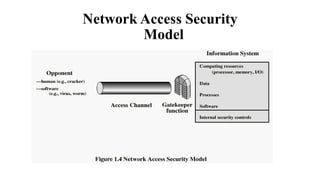
MODELS FOR NETWORK SECURITY
• Model for Network Security
• Network Access Security Model
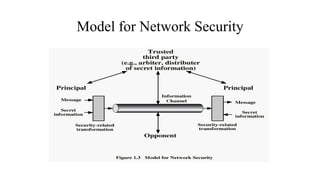
Model for Network Security
Network Access Security
Model
Thank You

Cryptography and network security