PEPLAU’S
INTERPERSONAL
THEORY
INTRODUCTION HILDEGARD PEPLAU
• Early life
• Name: Hildegard Elizabeth Peplau Nickname: Hilda
• Birthday: September 1, 1909
• Died: March 17, 1999 in Sherman Oaks, California
• Birthplace: Reading, Pennsylvania
• Parents: immigrants of German descent
• Father: Gustav Peplau (illiterate but hard-working)
• Mother: Otyllie Peplau (oppressive and perfectionist)
• Birth Order: She was the second daughter born of six children
Mother of Psychiatric Nursing
• Nursing was one of few
career choices for women
in her day. As a child, she
witnessed the devastating
flu epidemic of 1918, a
personal experience that
greatly influenced her
understanding of the
impact of illness and
death on families.
Career Timeline
1. 1931 - Diploma program in Pottstown, Pennsylvania 1943 - BA in
interpersonal psychology – Bennington College
2. 1947 - MA in Psychiatric nursing from Colombia University, New York
3. 1952 - Published Interpersonal Relations in Nursing
4. 1953 - EdD in curriculum development in 1953
5. Professor emeritus from Rutgers university Started first post
baccalaureate program in psychiatric nursing
6. 1968 - interpersonal techniques - the crux of Psychiatric Nursing
• Worked as executive director for ANA
• President of ANA from 1970-1972
• Vice-President of ANA from 1972-1974
• Worked with W.H.O., NIMH and Nurse
Corps.
• She was the first published nursing
theorist since Florence Nightingale
• Created the middle-range nursing theory
of interpersonal relations, which helped
to revolutionize the scholarly work of
nurses
• Staff Nurse in Pennsylvania and New York
City
• School Nurse at Bennington College.
• Certified in Psychoanalysis at the
William Alanson White Institute of
New York City
• Faculty of the College of Nursing at
Rutgers University
• Created first graduate level program for
the preparation of clinical specialists in
Psychiatric Nursing
• Therapeutic Care vs Custodial Care in
mental hospitals
• Strong advocate for graduate education
and research in nursing
• She is the primary contributor to
mental health law reform, leading the
way towards humane treatment of
patients with behavior and personality
disorders
Interpersonal Relations Theory
• Emphasized the nurse-client relationship as the
foundation of nursing practice
• The interpersonal model emphasizes the need
for a partnership between nurse and client as
opposed to the client passively receiving
treatment (and the nurse passively acting out
doctor's orders).
• Shared experience - Nurses could facilitate this
through observation, description, formulation,
interpretation, validation, and intervention
Major Concepts
• The theory explains the purpose of
nursing is to help others identify their felt
difficulties.
• Nurses should apply principles of human
relations to the problems that arise at all
levels of experience.
• Peplau's theory explains the phases of
interpersonal process, roles in nursing
situations and methods for studying
nursing as an interpersonal process.
• Nursing is therapeutic in that it is a
healing art, assisting an individual who is
sick or in need of health care.
• Nursing is an interpersonal process
because it involves interaction between
two or more individuals with a common
goal.
• The attainment of goal is achieved through
the use of a series of steps following a
series of pattern.
• The nurse and patient work together so
both become mature and knowledgeable
in the process.
• Theory of interpersonal relations is a
middle range descriptive classification
theory
• The theory was influenced by Harry Stack
Sullivan's theory of inter personal
relations (1953)
• The theorist was also influenced by
Percival Symonds, Abraham Maslow's and
Neal Elger Miller
• Peplau's theory is also referred as
psychodynamic nursing, which is the
understanding of ones own behavior
Metaparadigm
Person:
• An individual
• A developing organism that tries
to reduce anxiety caused by
needs.
• Lives in stable equilibrium
Environment:
• Existing forces outside the
organism and in the context of
culture
Health:
• A word symbol that implies
forward movement of
personality and other ongoing
human processes in the
direction of
• Creative, constructive,
productive, personal and
community living
Nursing
• A significant therapeutic
interpersonal process.
• It functions cooperatively with
other human process that make
health possible for individuals in
communities.
• Involves problem-solving
Peplau’s Seven Roles of a Nurse
• Surrogate: helps to clarify domains of dependence
interdependence and independence and acts on clients
behalf as an advocate.
• Leader : helps client assume maximum responsibility
for meeting treatment goals in a mutually satisfying way
• Technical Expert: provides physical care by displaying
clinical skills and operates equipment
Additional Roles
• Consultant
• Health teacher
• Tutor
• Socializing agent
• Safety agent
• Manager of environment
• Mediator
• Administrator
• Recorder observer
• Researcher
Four Sequential Phases in the
Interpersonal Relationship
1. Orientation
2. Identification
3. Exploitation
4. Resolution
Orientation Phase
• Problem defining phase
• Starts when client meets nurse as stranger
• Defining problem and deciding type of service
needed
• Client seeks assistance, conveys needs, asks
questions, shares preconceptions and
expectations of past experiences
• Nurse responds, explains roles to client, helps
to identify problems and to use available
resources and services
Orientation Phase
• Get acquainted phase of the nurse-patient
relationship.
• Preconceptions are worked through
• Parameters are established and met
• Early levels of trust are developed
• Roles begin to be understood
Factors Affecting the Orientation Phase
Identification Phase
• Selection of appropriate professional assistance
• Patient begins to have a feeling of belonging and a
capability of dealing with the problem which
decreases the feeling of helplessness and
hopelessness
• The client begins to identify problems to be worked
on within relationship
• The goal of the nurse: help the patient to recognize
his/her own interdependent/participation role and
promote responsibility for self
Exploitation Phase
• Use of professional assistance for problem solving
alternatives
• Advantages of services are used is based on the
needs and interests of the patients
• Individual feels as an integral part of the helping
environment
• They may make minor requests or attention getting
techniques
• The principles of interview techniques must be
used in order to explore, understand and
adequately deal with the underlying problem
Exploitation Phase
• Patient may fluctuates on independence
• Nurse must be aware about the various phases of
communication
• Nurse aids the patient in exploiting all avenues of
help and progress is made towards the final step
• Client’s trust of nurse reached full potential
• Client making full use of nursing services
• Solving immediate problems
• Identifying and orienting self to [discharge] goals
Resolution Phase
• Termination of professional relationship
• The patients needs have already been met by the
collaborative effect of patient and nurse
• Now they need to terminate their therapeutic
relationship and dissolve the links between them.
• Sometimes may be difficult for both as
psychological dependence persists
• Patient drifts away and breaks bond with nurse and
healthier emotional balance is demonstrated and
both becomes mature individuals
Resolution Phase
• Client met needs
• Mutual termination of relationship
• Sense of security is formed
• Patient is less reliant on nurse
• Increased self reliance to deal with own
problems.
• The patient gradually puts aside old goals and
adopts new goals. This is a process in which the
patient frees himself from identification with the
nurse.
Interpersonal Theory and Nursing Process
• Both are sequential and focus on therapeutic
relationship
• Both use problem solving techniques for the nurse
and patient to collaborate on, with the end purpose
of meeting the patients needs
• Both use observation communication and recording
as basic tools utilized by nursing
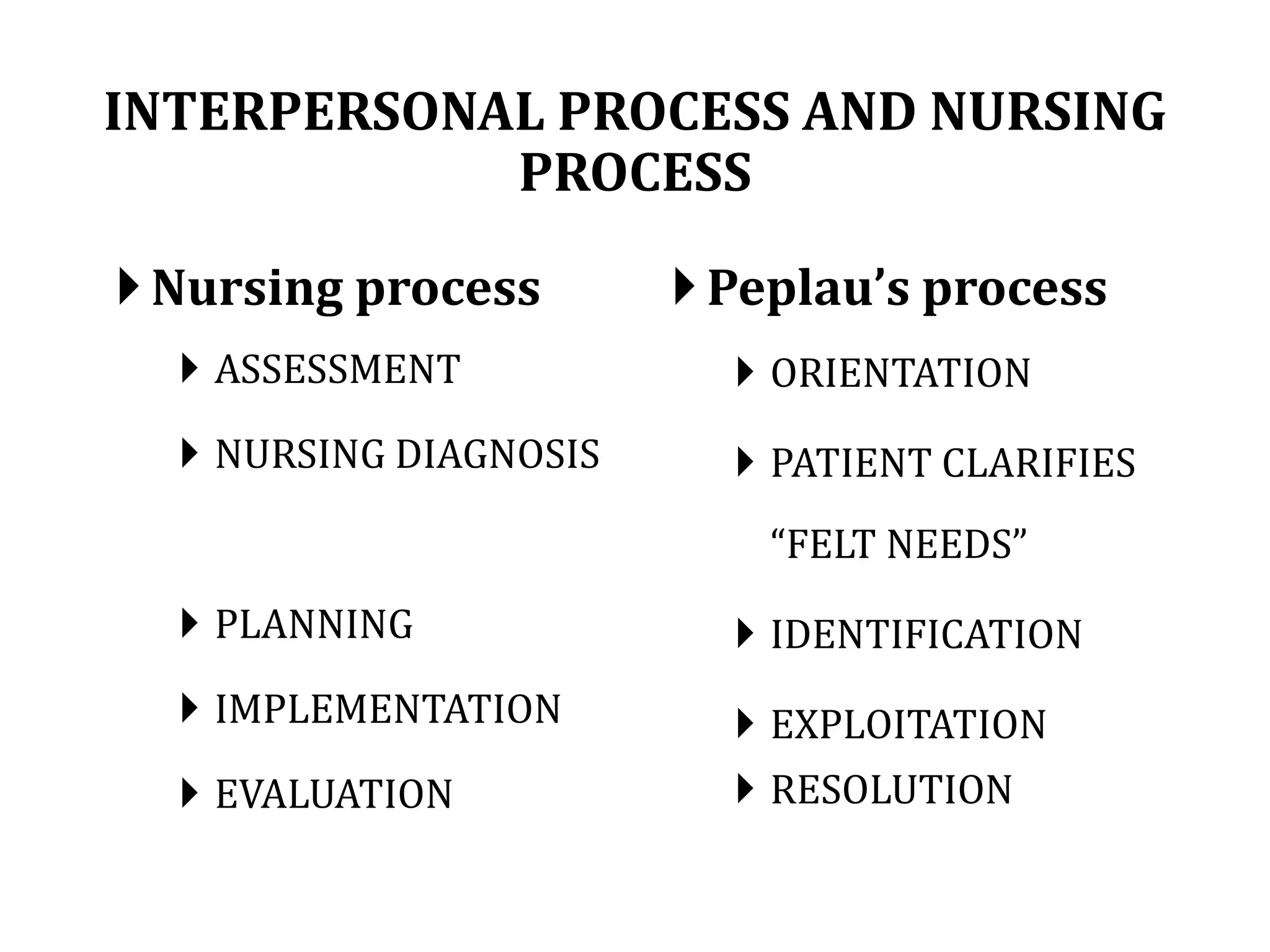
INTERPERSONAL PROCESS AND NURSING
PROCESS
Nursing process
 ASSESSMENT
 NURSING DIAGNOSIS
 PLANNING
 IMPLEMENTATION
 EVALUATION
Peplau’s process
 ORIENTATION
 PATIENT CLARIFIES
“FELT NEEDS”
 IDENTIFICATION
 EXPLOITATION
 RESOLUTION
Assessment
Data collection and analysis
[continuous]
May not be a felt need
Orientation
Non continuous data collection
Felt need
Define needs
Nursing diagnosis Planning
Mutually set goals
Identification
Interdependent goal setting
Implementation
Plans initiated towards
achievement of mutually set
goals
May be accomplished by patient,
nurse or family
Exploitation
Patient actively seeking and
drawing help Patient initiated
Evaluation
Based on mutually expected
behaviors
May led to termination and
initiation of new plans
Resolution
Occurs after other phases are
completed successfully
Leads to termination a
Application of Theory to Areas in
Nursing
Nursing education
• Has an impact on the psychiatric nursing
especially in the baccalaureate program in
nursing teaching care of clients with
maladaptive patterns of behavior
Application of Theory to Areas in
Nursing
Practice
• Focuses on the interpersonal processes and therapeutic
relationship that develops between the nurse & client.
• It requires that the nurse attends to the interpersonal
processes that occur between the nurse and client.
• Interpersonal process is maturing force for personality.
• It includes the nurse- client
• relationship, communication, pattern integration and the
roles of the nurse.
• Psychodynamic nursing is understanding one’s own
behavior to help others identify felt and perceived
difficulties and to apply principles of human relations to
the problems that arise at all levels of experience.
Summary of Application
Orientation phase
• Client is initially reluctant to talk due to pain.
• Client is expressing that while standing she is having much
pain.
• Client expressed without movement and supine position gave
her relief from pain.
Identification
• The client participates and interdependent with the nurse
• Expresses the need for measure to get relief from pain
• Expresses need for improving the mobility
• Expresses need to know more about prognosis, discharge and
home care and follow up
Exploitation
• Client explains that she gets relief of pain when lying
down supine.
• Cooperates and participates actively in performing
exercises.
• Client mobilizes changes position and cooperates during
position changes.
Resolution
• Client expressed that pain has reduced a lot and she is
able to tolerate it now
• She has agreed upon to continue the exercises at home
• She also expressed that she would come for regular
follow up after discharge.
ASSUMPTIONS
• Nurse and patient can interact.
• Peplau stresses that both the patient and nurse
mature as the result of therapeutic interaction.
• Communication and interviewing skills remain
fundamental nursing tools.
STRENGHTS
• The phases provide simplicity regarding the
natural progression of the nurse- patient
relationship.
• This simplicity leads to adaptability in any nurse
patient interaction, thus providing
generalizability.
LIMITATIONS
• Its use is limited in working with the comatose,
senile or newborn patient.
• The lack of emphasis on health promotion and
maintenance; that intra-family dynamics,
personal space consideration and community
social service resources are less considered.
• Even Peplau admits, “Understanding of the
meaning of the patient is required in order for
nursing to function as an educative, therapeutic,
maturing force.”
REFERENCE
1. Martha Raile Alligood. Nursing theory :
utilization & application. 5th ed. St. Louis,
Missouri: Elsevier Mosby; 2014.
2. Basavanthappa BT. Nursing theories. New
Delhi: Jaypee Brothers; 2007.
3. George JB. Nursing theories : the base for
professional nursing practice. 6th ed. Boston:
Pearson; 2014.
Thank you

PEPLAU’S THEORY 1.pptx

  • 1.
  • 2.
    INTRODUCTION HILDEGARD PEPLAU •Early life • Name: Hildegard Elizabeth Peplau Nickname: Hilda • Birthday: September 1, 1909 • Died: March 17, 1999 in Sherman Oaks, California • Birthplace: Reading, Pennsylvania • Parents: immigrants of German descent • Father: Gustav Peplau (illiterate but hard-working) • Mother: Otyllie Peplau (oppressive and perfectionist) • Birth Order: She was the second daughter born of six children
  • 3.
    Mother of PsychiatricNursing • Nursing was one of few career choices for women in her day. As a child, she witnessed the devastating flu epidemic of 1918, a personal experience that greatly influenced her understanding of the impact of illness and death on families.
  • 4.
    Career Timeline 1. 1931- Diploma program in Pottstown, Pennsylvania 1943 - BA in interpersonal psychology – Bennington College 2. 1947 - MA in Psychiatric nursing from Colombia University, New York 3. 1952 - Published Interpersonal Relations in Nursing 4. 1953 - EdD in curriculum development in 1953 5. Professor emeritus from Rutgers university Started first post baccalaureate program in psychiatric nursing 6. 1968 - interpersonal techniques - the crux of Psychiatric Nursing
  • 5.
    • Worked asexecutive director for ANA • President of ANA from 1970-1972 • Vice-President of ANA from 1972-1974 • Worked with W.H.O., NIMH and Nurse Corps. • She was the first published nursing theorist since Florence Nightingale • Created the middle-range nursing theory of interpersonal relations, which helped to revolutionize the scholarly work of nurses • Staff Nurse in Pennsylvania and New York City • School Nurse at Bennington College. • Certified in Psychoanalysis at the William Alanson White Institute of New York City • Faculty of the College of Nursing at Rutgers University • Created first graduate level program for the preparation of clinical specialists in Psychiatric Nursing • Therapeutic Care vs Custodial Care in mental hospitals • Strong advocate for graduate education and research in nursing • She is the primary contributor to mental health law reform, leading the way towards humane treatment of patients with behavior and personality disorders
  • 6.
    Interpersonal Relations Theory •Emphasized the nurse-client relationship as the foundation of nursing practice • The interpersonal model emphasizes the need for a partnership between nurse and client as opposed to the client passively receiving treatment (and the nurse passively acting out doctor's orders). • Shared experience - Nurses could facilitate this through observation, description, formulation, interpretation, validation, and intervention
  • 7.
    Major Concepts • Thetheory explains the purpose of nursing is to help others identify their felt difficulties. • Nurses should apply principles of human relations to the problems that arise at all levels of experience. • Peplau's theory explains the phases of interpersonal process, roles in nursing situations and methods for studying nursing as an interpersonal process. • Nursing is therapeutic in that it is a healing art, assisting an individual who is sick or in need of health care. • Nursing is an interpersonal process because it involves interaction between two or more individuals with a common goal. • The attainment of goal is achieved through the use of a series of steps following a series of pattern. • The nurse and patient work together so both become mature and knowledgeable in the process. • Theory of interpersonal relations is a middle range descriptive classification theory • The theory was influenced by Harry Stack Sullivan's theory of inter personal relations (1953) • The theorist was also influenced by Percival Symonds, Abraham Maslow's and Neal Elger Miller • Peplau's theory is also referred as psychodynamic nursing, which is the understanding of ones own behavior
  • 8.
    Metaparadigm Person: • An individual •A developing organism that tries to reduce anxiety caused by needs. • Lives in stable equilibrium Environment: • Existing forces outside the organism and in the context of culture Health: • A word symbol that implies forward movement of personality and other ongoing human processes in the direction of • Creative, constructive, productive, personal and community living Nursing • A significant therapeutic interpersonal process. • It functions cooperatively with other human process that make health possible for individuals in communities. • Involves problem-solving
  • 9.
    Peplau’s Seven Rolesof a Nurse • Surrogate: helps to clarify domains of dependence interdependence and independence and acts on clients behalf as an advocate. • Leader : helps client assume maximum responsibility for meeting treatment goals in a mutually satisfying way • Technical Expert: provides physical care by displaying clinical skills and operates equipment
  • 10.
    Additional Roles • Consultant •Health teacher • Tutor • Socializing agent • Safety agent • Manager of environment • Mediator • Administrator • Recorder observer • Researcher
  • 11.
    Four Sequential Phasesin the Interpersonal Relationship 1. Orientation 2. Identification 3. Exploitation 4. Resolution
  • 12.
    Orientation Phase • Problemdefining phase • Starts when client meets nurse as stranger • Defining problem and deciding type of service needed • Client seeks assistance, conveys needs, asks questions, shares preconceptions and expectations of past experiences • Nurse responds, explains roles to client, helps to identify problems and to use available resources and services
  • 13.
    Orientation Phase • Getacquainted phase of the nurse-patient relationship. • Preconceptions are worked through • Parameters are established and met • Early levels of trust are developed • Roles begin to be understood
  • 14.
    Factors Affecting theOrientation Phase
  • 15.
    Identification Phase • Selectionof appropriate professional assistance • Patient begins to have a feeling of belonging and a capability of dealing with the problem which decreases the feeling of helplessness and hopelessness • The client begins to identify problems to be worked on within relationship • The goal of the nurse: help the patient to recognize his/her own interdependent/participation role and promote responsibility for self
  • 16.
    Exploitation Phase • Useof professional assistance for problem solving alternatives • Advantages of services are used is based on the needs and interests of the patients • Individual feels as an integral part of the helping environment • They may make minor requests or attention getting techniques • The principles of interview techniques must be used in order to explore, understand and adequately deal with the underlying problem
  • 17.
    Exploitation Phase • Patientmay fluctuates on independence • Nurse must be aware about the various phases of communication • Nurse aids the patient in exploiting all avenues of help and progress is made towards the final step • Client’s trust of nurse reached full potential • Client making full use of nursing services • Solving immediate problems • Identifying and orienting self to [discharge] goals
  • 18.
    Resolution Phase • Terminationof professional relationship • The patients needs have already been met by the collaborative effect of patient and nurse • Now they need to terminate their therapeutic relationship and dissolve the links between them. • Sometimes may be difficult for both as psychological dependence persists • Patient drifts away and breaks bond with nurse and healthier emotional balance is demonstrated and both becomes mature individuals
  • 19.
    Resolution Phase • Clientmet needs • Mutual termination of relationship • Sense of security is formed • Patient is less reliant on nurse • Increased self reliance to deal with own problems. • The patient gradually puts aside old goals and adopts new goals. This is a process in which the patient frees himself from identification with the nurse.
  • 20.
    Interpersonal Theory andNursing Process • Both are sequential and focus on therapeutic relationship • Both use problem solving techniques for the nurse and patient to collaborate on, with the end purpose of meeting the patients needs • Both use observation communication and recording as basic tools utilized by nursing
  • 21.
    INTERPERSONAL PROCESS ANDNURSING PROCESS Nursing process  ASSESSMENT  NURSING DIAGNOSIS  PLANNING  IMPLEMENTATION  EVALUATION Peplau’s process  ORIENTATION  PATIENT CLARIFIES “FELT NEEDS”  IDENTIFICATION  EXPLOITATION  RESOLUTION
  • 22.
    Assessment Data collection andanalysis [continuous] May not be a felt need Orientation Non continuous data collection Felt need Define needs Nursing diagnosis Planning Mutually set goals Identification Interdependent goal setting Implementation Plans initiated towards achievement of mutually set goals May be accomplished by patient, nurse or family Exploitation Patient actively seeking and drawing help Patient initiated Evaluation Based on mutually expected behaviors May led to termination and initiation of new plans Resolution Occurs after other phases are completed successfully Leads to termination a
  • 23.
    Application of Theoryto Areas in Nursing Nursing education • Has an impact on the psychiatric nursing especially in the baccalaureate program in nursing teaching care of clients with maladaptive patterns of behavior
  • 24.
    Application of Theoryto Areas in Nursing Practice • Focuses on the interpersonal processes and therapeutic relationship that develops between the nurse & client. • It requires that the nurse attends to the interpersonal processes that occur between the nurse and client. • Interpersonal process is maturing force for personality. • It includes the nurse- client • relationship, communication, pattern integration and the roles of the nurse. • Psychodynamic nursing is understanding one’s own behavior to help others identify felt and perceived difficulties and to apply principles of human relations to the problems that arise at all levels of experience.
  • 25.
    Summary of Application Orientationphase • Client is initially reluctant to talk due to pain. • Client is expressing that while standing she is having much pain. • Client expressed without movement and supine position gave her relief from pain. Identification • The client participates and interdependent with the nurse • Expresses the need for measure to get relief from pain • Expresses need for improving the mobility • Expresses need to know more about prognosis, discharge and home care and follow up
  • 26.
    Exploitation • Client explainsthat she gets relief of pain when lying down supine. • Cooperates and participates actively in performing exercises. • Client mobilizes changes position and cooperates during position changes. Resolution • Client expressed that pain has reduced a lot and she is able to tolerate it now • She has agreed upon to continue the exercises at home • She also expressed that she would come for regular follow up after discharge.
  • 27.
    ASSUMPTIONS • Nurse andpatient can interact. • Peplau stresses that both the patient and nurse mature as the result of therapeutic interaction. • Communication and interviewing skills remain fundamental nursing tools.
  • 28.
    STRENGHTS • The phasesprovide simplicity regarding the natural progression of the nurse- patient relationship. • This simplicity leads to adaptability in any nurse patient interaction, thus providing generalizability.
  • 29.
    LIMITATIONS • Its useis limited in working with the comatose, senile or newborn patient. • The lack of emphasis on health promotion and maintenance; that intra-family dynamics, personal space consideration and community social service resources are less considered. • Even Peplau admits, “Understanding of the meaning of the patient is required in order for nursing to function as an educative, therapeutic, maturing force.”
  • 30.
    REFERENCE 1. Martha RaileAlligood. Nursing theory : utilization & application. 5th ed. St. Louis, Missouri: Elsevier Mosby; 2014. 2. Basavanthappa BT. Nursing theories. New Delhi: Jaypee Brothers; 2007. 3. George JB. Nursing theories : the base for professional nursing practice. 6th ed. Boston: Pearson; 2014.
  • 31.