PATHOLOGY FOR NURSES
WOUND HEALING
Dr. Binu Babu
Ph.D (N)
Professor
Mrs. Jincy Ealias
M.Sc (N)
Professor
WOUND HEALING
• Wound healing is the physiological process by which the body repairs
damaged or injured tissue. It involves a series of complex and
coordinated events aimed at restoring the structural and functional
integrity of the affected area.
• The ultimate goal of wound healing is to restore the barrier function of
the skin or synthesis and deposition of extracellular matrix
components, such as collagen, to strengthen the wound.
• In pathology, wound healing refers to the study of the biological
processes that occur in response to tissue injury or damage.
• Understanding wound healing in pathology involves examining the
cellular and molecular mechanisms involved in repairing and
restoring the integrity of damaged tissues.
PHASES OF WOUND HEALING
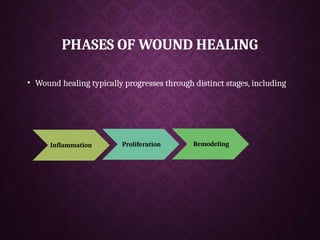
• Wound healing typically progresses through distinct stages, including
Proliferation Remodeling
Inflammation
Inflammatory Phase:
• Initiated immediately after injury.
• Characterized by releasing inflammatory mediators, such as histamine, prostaglandins, and
cytokines.
• Neutrophils and macrophages migrate to the injury site to remove debris and pathogens.
Proliferative Phase:
• Begins within a few days of injury.
• Involves the proliferation and migration of various cell types, including fibroblasts,
endothelial cells, and keratinocytes.
• Formation of granulation tissue provides a scaffold for cell migration and angiogenesis.
• Synthesis and deposition of extracellular matrix components, such as collagen, to strengthen
the wound.
Remodeling Phase:
• Begins several weeks after injury and can last for months to years.
• Characterized by the remodeling of the extracellular matrix and the maturation of scar tissue.
• Collagen fibers undergo reorganization and cross-linking to increase tissue strength.
• Reduction in vascularity and cellularity of the scar tissue.
FACTORS INFLUENCING WOUND
HEALING
• Local Factors:
• Size, depth, and location of the wound.
• Presence of infection or foreign bodies.
• Blood supply to the injured area.
• Degree of tissue damage and inflammation.
• Systemic Factors:
• Age: Wound healing tends to be slower in elderly individuals.
• Nutrition: Adequate intake of nutrients, especially proteins and vitamins, is essential for
optimal wound healing.
• Chronic diseases: Conditions such as diabetes, vascular disease,and immunodeficiency
can impair wound healing.
DISORDERS OF WOUND HEALING
Impaired Healing:
• Delayed wound heating: Prolonged inflammatory phase or impaired proliferation and
remodelling.
• Chronic wounds: Fail to progress through the normal phases of healing, often due to
underlying systemic or local factors.
• Excessive scarring: Hypertrophic scars or keloids, characterized by excessive deposition of
collagen.
Pathological Healing:
• Fibrosis: Excessive deposition of collagen leading to tissue fibrosis and loss of function.
• Contractures: Abnormal wound contraction resulting in deformity and restricted movement.
• Chronic non-healing ulcers: Persistent wounds that fail to heal despite appropriate treatment.
DIAGNOSTIC TECHNIQUES:
Histological Examination:
• Assessment of tissue sections to evaluate the progression of wound
healing and identify any abnormalities.
• Staining techniques to visualize cell types, extracellular matrix
components, and inflammatory infiltrates.
CLINICAL IMPLICATIONS
Treatment Strategies:
• Surgical interventions to debride wounds, close tissue defects, or promote healing,
• Topical treatments, dressings, and wound care techniques to optimize wound healing,
• Pharmacological interventions to modulate inflammation, promote angiogenesis, or
enhance collagen synthesis.
Prevention and Management of Complications:
• Identification and management of factors that impair wound healing, such as infection,
poor nutrition, or underlying chronic diseases.
• Monitoring and management of chronic wounds to prevent complications such as
infection or amputation.
SUMMARY
• Wound healing in pathology involves a complex interplay of cellular
and molecular processes targeted to restore tissue integrity followed by
an injury.
• Recognizing different phases, factors influencing healing, and
disorders of wound healing, diagnosing, managing, and preventing
complications associated with impaired or pathological wound healing.
REFERENCES
• Suresh K Sharma. Textbook of Pharmacology, Pathology and Genetics for Nurses
(Vol-I) Jaypee Brothers Medical Publishers.
• Swaminathan K, Pathology and Genetics for Nurses, Jaypee Brothers Medical
Publishers.
• Ramdas Nayak, Sharada Rai & Astha Gupta. Textbook of Pathology and Genetics
for Nurses, Jaypee Brothers Medical Publishers.
• Mandal AK & Shramana Choudhary. Comprehensive textbook of Pathology for
Nursing, Avichal Publishers.
• Vinay Kumar, Abbas A K, Aster C J, Robbins & Cotran Pathologic Basis of Disease,
ELSEVIER.

Pathology for Nurses - Wound Healing.pptx

  • 1.
    PATHOLOGY FOR NURSES WOUNDHEALING Dr. Binu Babu Ph.D (N) Professor Mrs. Jincy Ealias M.Sc (N) Professor
  • 2.
    WOUND HEALING • Woundhealing is the physiological process by which the body repairs damaged or injured tissue. It involves a series of complex and coordinated events aimed at restoring the structural and functional integrity of the affected area. • The ultimate goal of wound healing is to restore the barrier function of the skin or synthesis and deposition of extracellular matrix components, such as collagen, to strengthen the wound.
  • 3.
    • In pathology,wound healing refers to the study of the biological processes that occur in response to tissue injury or damage. • Understanding wound healing in pathology involves examining the cellular and molecular mechanisms involved in repairing and restoring the integrity of damaged tissues.
  • 4.
    PHASES OF WOUNDHEALING • Wound healing typically progresses through distinct stages, including Proliferation Remodeling Inflammation
  • 5.
    Inflammatory Phase: • Initiatedimmediately after injury. • Characterized by releasing inflammatory mediators, such as histamine, prostaglandins, and cytokines. • Neutrophils and macrophages migrate to the injury site to remove debris and pathogens. Proliferative Phase: • Begins within a few days of injury. • Involves the proliferation and migration of various cell types, including fibroblasts, endothelial cells, and keratinocytes. • Formation of granulation tissue provides a scaffold for cell migration and angiogenesis. • Synthesis and deposition of extracellular matrix components, such as collagen, to strengthen the wound.
  • 6.
    Remodeling Phase: • Beginsseveral weeks after injury and can last for months to years. • Characterized by the remodeling of the extracellular matrix and the maturation of scar tissue. • Collagen fibers undergo reorganization and cross-linking to increase tissue strength. • Reduction in vascularity and cellularity of the scar tissue.
  • 7.
    FACTORS INFLUENCING WOUND HEALING •Local Factors: • Size, depth, and location of the wound. • Presence of infection or foreign bodies. • Blood supply to the injured area. • Degree of tissue damage and inflammation. • Systemic Factors: • Age: Wound healing tends to be slower in elderly individuals. • Nutrition: Adequate intake of nutrients, especially proteins and vitamins, is essential for optimal wound healing. • Chronic diseases: Conditions such as diabetes, vascular disease,and immunodeficiency can impair wound healing.
  • 8.
    DISORDERS OF WOUNDHEALING Impaired Healing: • Delayed wound heating: Prolonged inflammatory phase or impaired proliferation and remodelling. • Chronic wounds: Fail to progress through the normal phases of healing, often due to underlying systemic or local factors. • Excessive scarring: Hypertrophic scars or keloids, characterized by excessive deposition of collagen. Pathological Healing: • Fibrosis: Excessive deposition of collagen leading to tissue fibrosis and loss of function. • Contractures: Abnormal wound contraction resulting in deformity and restricted movement. • Chronic non-healing ulcers: Persistent wounds that fail to heal despite appropriate treatment.
  • 9.
    DIAGNOSTIC TECHNIQUES: Histological Examination: •Assessment of tissue sections to evaluate the progression of wound healing and identify any abnormalities. • Staining techniques to visualize cell types, extracellular matrix components, and inflammatory infiltrates.
  • 10.
    CLINICAL IMPLICATIONS Treatment Strategies: •Surgical interventions to debride wounds, close tissue defects, or promote healing, • Topical treatments, dressings, and wound care techniques to optimize wound healing, • Pharmacological interventions to modulate inflammation, promote angiogenesis, or enhance collagen synthesis. Prevention and Management of Complications: • Identification and management of factors that impair wound healing, such as infection, poor nutrition, or underlying chronic diseases. • Monitoring and management of chronic wounds to prevent complications such as infection or amputation.
  • 11.
    SUMMARY • Wound healingin pathology involves a complex interplay of cellular and molecular processes targeted to restore tissue integrity followed by an injury. • Recognizing different phases, factors influencing healing, and disorders of wound healing, diagnosing, managing, and preventing complications associated with impaired or pathological wound healing.
  • 12.
    REFERENCES • Suresh KSharma. Textbook of Pharmacology, Pathology and Genetics for Nurses (Vol-I) Jaypee Brothers Medical Publishers. • Swaminathan K, Pathology and Genetics for Nurses, Jaypee Brothers Medical Publishers. • Ramdas Nayak, Sharada Rai & Astha Gupta. Textbook of Pathology and Genetics for Nurses, Jaypee Brothers Medical Publishers. • Mandal AK & Shramana Choudhary. Comprehensive textbook of Pathology for Nursing, Avichal Publishers. • Vinay Kumar, Abbas A K, Aster C J, Robbins & Cotran Pathologic Basis of Disease, ELSEVIER.