Evidence-Based Practice
EBPis a process used to review, analyze, and translate
the latest scientific evidence.
Or
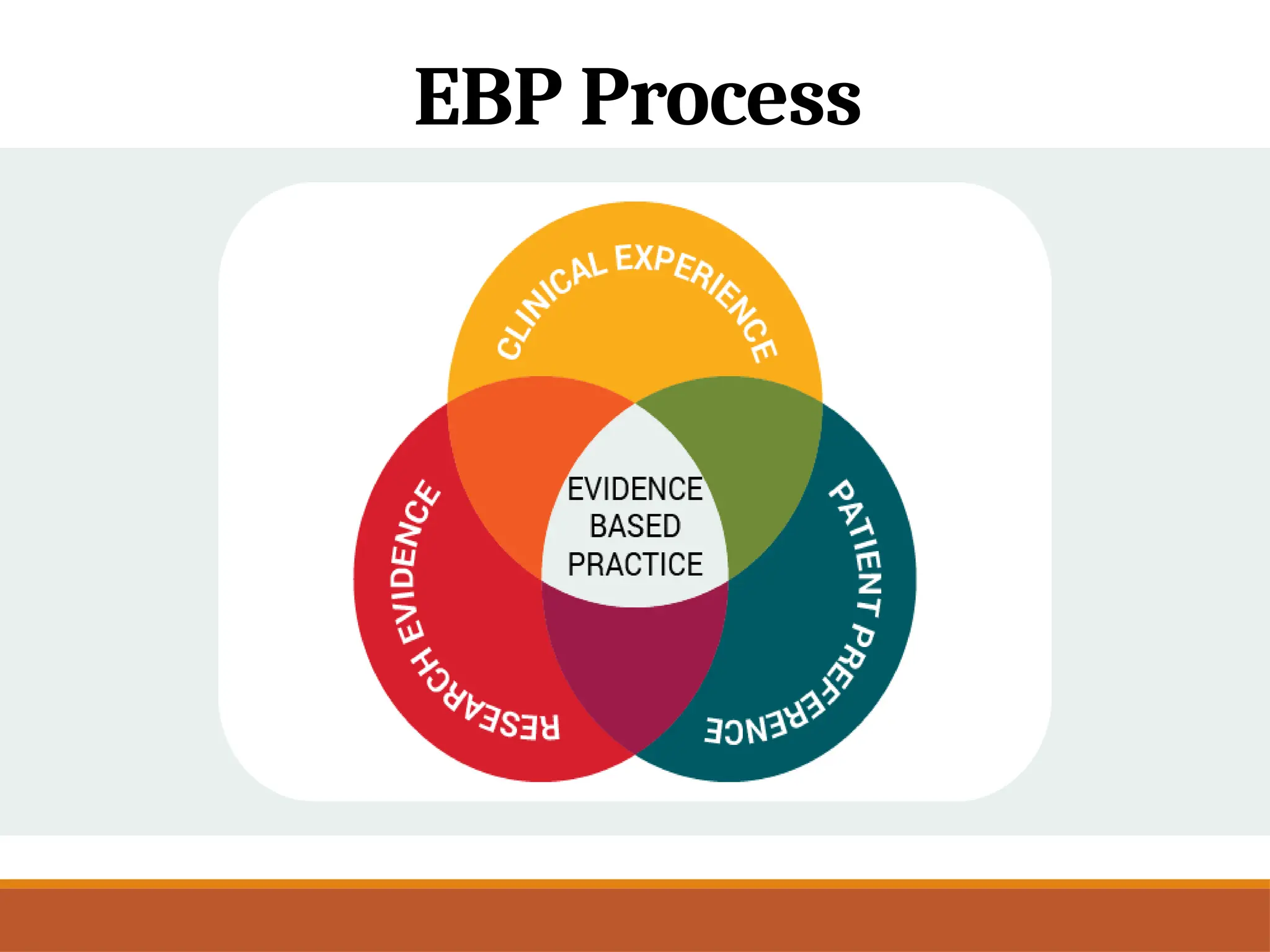
EBP is a process that combines research evidence,
clinical expertise, and patient values.
Or
EBP aims to improve patient outcomes by replacing
outdated practices with more effective ones.
3.
Components of EBP
Research evidence: The best available research
Clinical expertise: The experience of the health
professional
Patient preference: The patient's values and
circumstances
4.
How can achieveEBP
Stay in touch with the research literature
Develop and support patient-centred approaches
to care
Incorporate the four principles of healthcare
ethics: beneficence, non-maleficence, autonomy,
and justice
5.
EBP Process
Evidence-basedpractice (EBP) is the integration of
Clinical expertise/expert opinion
The knowledge, judgment, and critical reasoning acquired through
training and professional experiences
Evidence (external and internal)
The best available information gathered from the scientific literature
(external evidence) and from data and observations collected from
individual client (internal evidence)
Client/patient/caregiver perspectives
The unique set of personal and cultural circumstances, values, priorities,
and expectations identified from patient and their caregivers
Outcomes of EBP
Bridges the gap between research and practice
Encourages the use of empirically supported interventions
Elevates patient preferences in the decision-making process
Increases case study research
Awareness of need to know, ability to find, analyze and interpret the
information.
To practice EBP, needs both information and health literacy
Capacity to obtain, process, and understand health information and
services to make appropriate health decisions.
8.
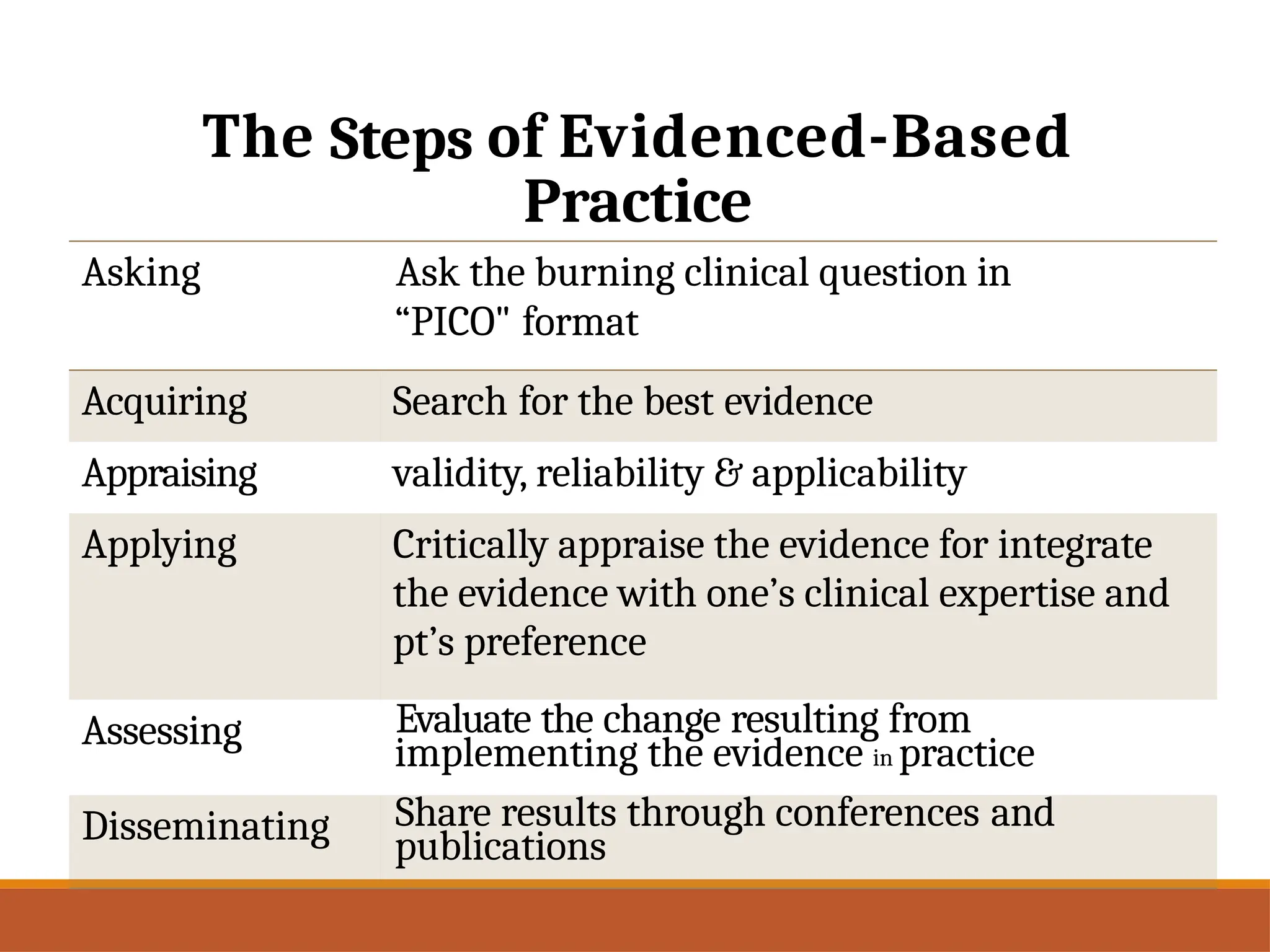
The Steps ofEvidenced-Based
Practice
Asking Ask the burning clinical question in
“PICO" format
Acquiring Search for the best evidence
Appraising validity, reliability & applicability
Applying Critically appraise the evidence for integrate
the evidence with one’s clinical expertise and
pt’s preference
Assessing Evaluate the change resulting from
implementing the evidence in practice
Disseminating Share results through conferences and
publications
9.
Step 1: Askingthe Question
• Most important step and most challenging.
• If the question is not searchable, EBP is off to a
faulty start.
• Motivation for the question is what a clinician
is to do or how to conduct patient care.
• PICO question drives the entire EBP process
10.
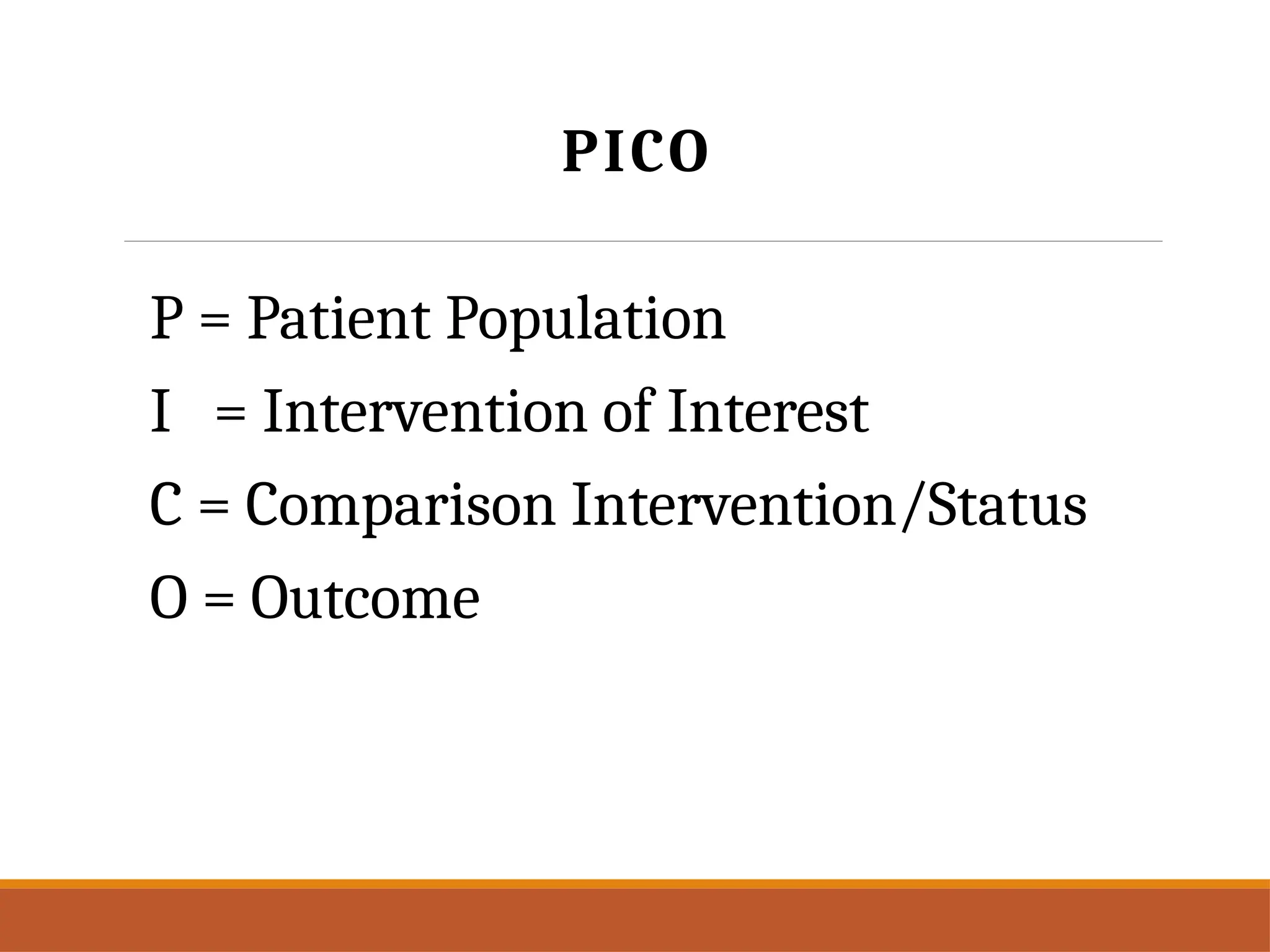
PICO
P = PatientPopulation
I = Intervention of Interest
C = Comparison Intervention/Status
O = Outcome
11.
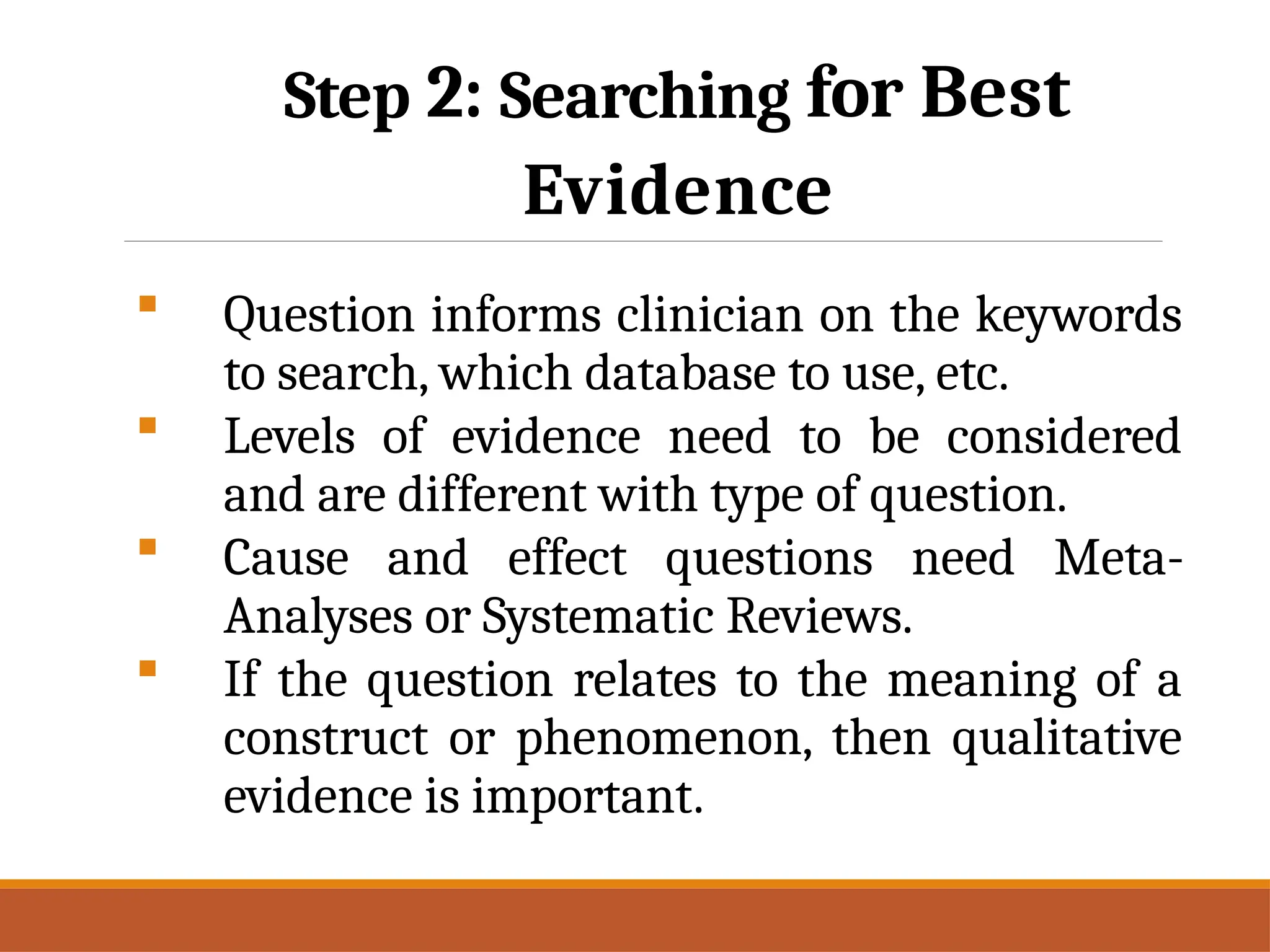
Step 2: Searchingfor Best
Evidence
Question informs clinician on the keywords
to search, which database to use, etc.
Levels of evidence need to be considered
and are different with type of question.
Cause and effect questions need Meta-
Analyses or Systematic Reviews.
If the question relates to the meaning of a
construct or phenomenon, then qualitative
evidence is important.
12.
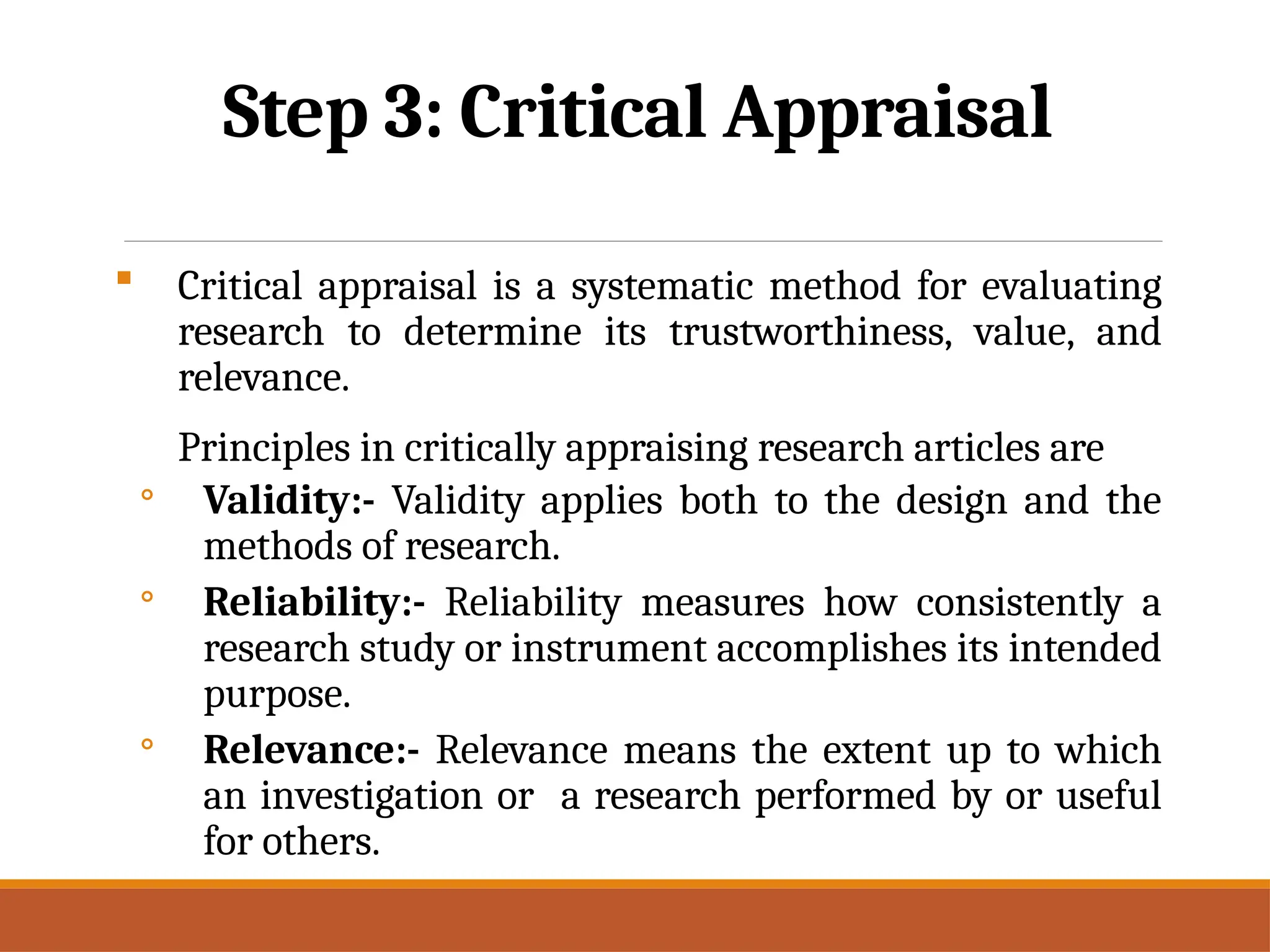
Step 3: CriticalAppraisal
Critical appraisal is a systematic method for evaluating
research to determine its trustworthiness, value, and
relevance.
Principles in critically appraising research articles are
◦ Validity:- Validity applies both to the design and the
methods of research.
◦ Reliability:- Reliability measures how consistently a
research study or instrument accomplishes its intended
purpose.
◦ Relevance:- Relevance means the extent up to which
an investigation or a research performed by or useful
for others.
13.
How to appraisea paper
critically
Is the study question relevant to my field?
Does the study add anything new to the evidence in my
field?
What type of research question is being asked?
Was the study design appropriate for the research
question?
Did the methodology address important potential
sources of bias?
14.
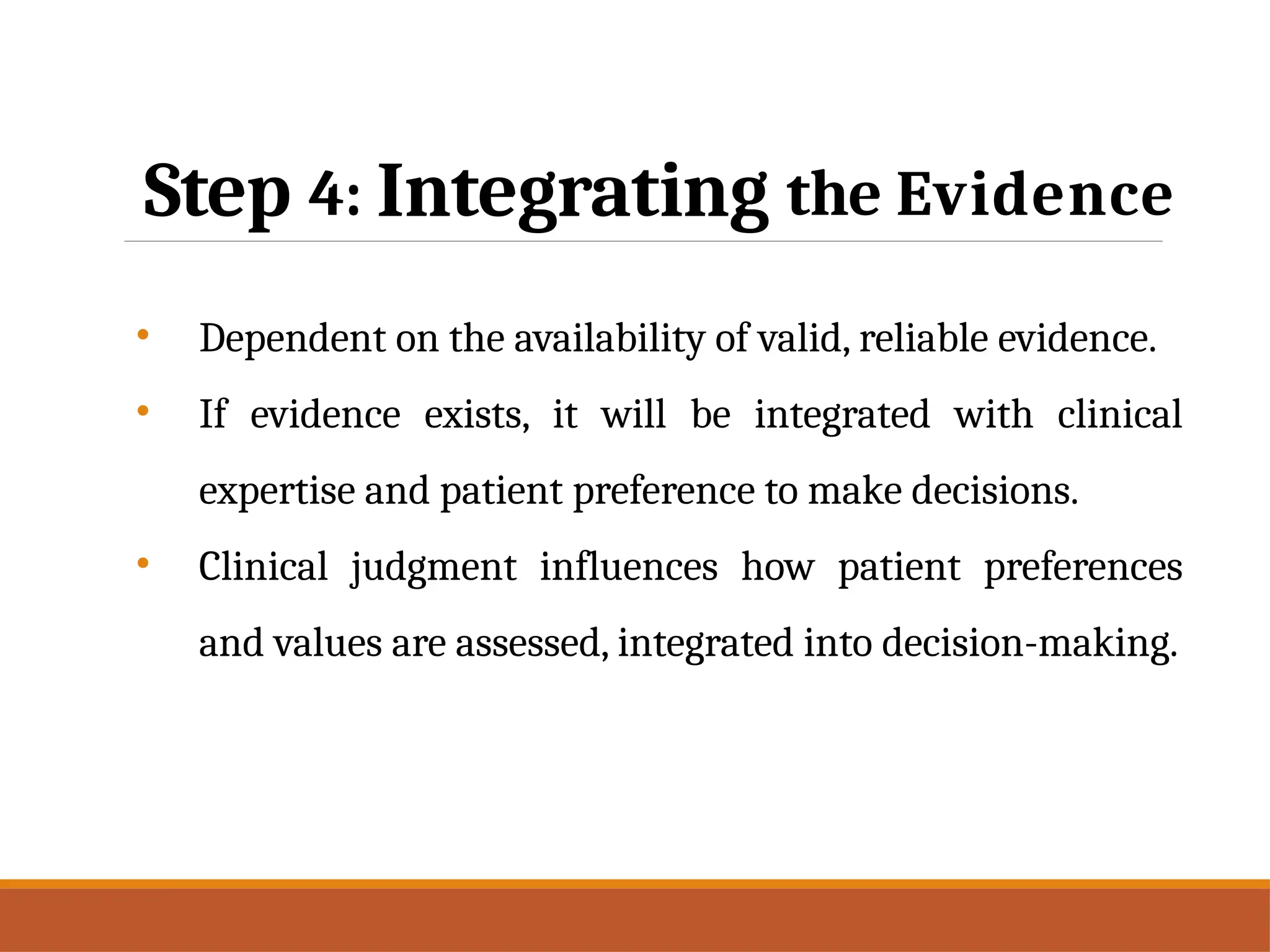
Step 4: Integratingthe Evidence
• Dependent on the availability of valid, reliable evidence.
• If evidence exists, it will be integrated with clinical
expertise and patient preference to make decisions.
• Clinical judgment influences how patient preferences
and values are assessed, integrated into decision-making.
15.
Step 5: Evaluatingthe Outcome
Evaluating outcomes in health care providers’
own setting.
It is important to consider bias introduction and
confounding influences.
Patient evaluations of experiences as well as
nurses’ evaluation must be considered.
Interdisciplinary collaboration is essential.
The Problem withEBP
The evidence-based “quality mark” has been misappropriated
by vested interests
The volume of evidence, especially clinical guidelines, has
become unmanageable
Statistically significant benefits may be marginal in clinical
practice
Inflexible rules and technology-driven prompts may produce
care that is management-driven rather than patient-centred
Evidence based guidelines often map poorly to complex
multimorbidity
18.
Summary
EBP processis about making clinical decisions
considering patient values, available evidences &
clinician expertise.
The EBP process promotes critical thinking skills.
EBP process requires computer literacy skills and critical
appraisal skills.
19.
References
1. Polit .DF & Beck C T, Essentials of Nursing Research-
Appraising evidence for Nursing practice, Lippincott
Williams and Wilkins
2. Burns N. & Susan K Groove. Understanding Nursing
Research building an Evidenced Based Practice. W.B.
Saunders, St. Louis.
3. Wood GL & Haber J. Nursing research methods and
Critical Appraisal for Evidenced Based Practice. Elsevier.
4. Suresh Sharma. Nursing research and statistics. Elsevier