PRESENTED BY:MADHAVEE BORADE
UDER GUIDANCE OF: MADHURI GITE
SHRI R.D.BHAKT COLLEGE OF
PHARMACY,JALNA
Review On:Solubility
Enhancement & Cosolvancy
CONTENTS
 INTRODUCTION
 REVIEW LITERATURE
 METHOD OF SOLUBLITY ENHANCEMENT
 STUDY OF COSOLVENCY
 THEORY OF COSOLVENCY
 CONCLUSION
 REFERENCE
INTRODUCTION
STUDY OF COSOLVENCY
DEFINITION:
The solubility of weak electrolytes and nonpolar molecules can be increased by the addition of water-
miscible solvents. This process is known as co-solvency or solvent blending, and the solvents used in
combination to increase the solubility of the solute are called co-solvents.
COSOLVENTS:
Co solvents have some degree of hydrogen bond donating and or hydrogen bond accepting ability as well
as small hydrocarbon regions.
The resulting solution will have physical properties that are intermediate to that of the pure organic
solvent and water through the reduction of water-water interaction
Example: Ethanol, propylene glycol, glycerin, sorbitol and polyethylene glycol.
Mechanism:
1) change the dielectric constant.
DC of a good co-solvent: 25-80.
2) hydrogen bonding in two solvents
REVIEW LITERATURE
 1. S.K. dash et al(2012) [12] : solubility enhancement of poorly poorly water
drugs. Crit Rev Ther Drug Carrier Syst. 2002; 19:553-585.
2. Chellos N.et al(2012)[13]: “cosolvency and soluility enhancement”
Pharmatech 2003, 160-166. They had developed simultaneous determination of
sitagliptin phospate monohydrate and metformin by ultra performance liquid
chromatographic (uplc)method. the chromographic sepreation was achieved on
aquity uplc BEH C8 100 X 2.1mm,1.7 m, colunm using a buffer consisting of 10
mM potassium dihydrogen phosphate and 2 nm hexane 1-sufonic acid sodiun,
salt(PH adjusted to 5.50 with diluted phosphoric acid) and acetonitrile as organic
solvent in a gradient program. The flow rate was 0.2 ml min-1 and the detection
wavelength was 210nm.the limit of detection (LOD) was 0.2 and 0.06 g ml-
1,respectively.the limit of quantification (LOD)was 0.7 and 0.2g ml-
1,respectively.this method was validated with respect to linearity,
accuracy,precision ,specificity,and robustnes soluble drugs . . Crit Rev Ther Drug
Carrier Syst. 2002; 19:553-585.
Properties of co-solvents
 co-solvent increases the solubility of a drugs.
 An ideal co-solvents should provide values of dielectric
constant between 25 to 80.
 The most widely used system that will cover this range is a
water.
 It should not cause toxicity or irritancy when administrated for
oral or parental use.
Selection of co-solvent
 Some characteristics of co-solvent which are considered at selection:
 1. Biocompatible
 2. It must be non-toxic. Non-irritating.
 3. It should be able to solubilize the drug in given solvent.
 4. It should be able to cross the membrane.
 5. does not have potential systemic effects.
Applications
1. Ultimate role in solubility enhancement of
poorly water soluble drugs.
2. Improvement in absorption and bioavailability.
3. Apart from increasing solubility, it have
importance in improvement solubility of
volatile constituents used to impart a desirable
flavor and odour to the product.
4. Solubility considerations at dosage form design.
Commonly used co-solvent
 Glycerol
 PEG400
 Dimethyl Acetamide
 N-Octanol
 Glycerol
 Dimethyl Sulfoxide
 Propylene Glycol
Co-solvent used in Drugs
 Diazepam
 Benzocaine
Advantages
 Simple and rapid to formulate and produce.
 Solvents may be combined with other solubilization techniques
and and pH adjustment to further increase solubility of
poorly soluble compounds.
Disadvantage:
 As with all excipients, the toxicity and tolerability related with the
level of solvent administer not to be considered.
 Uncontrolled precipitation occurs upon dilution with aqueous
media. The precipitates may be amorphous or crystalline and can
vary in size.
 Many of the insoluble compounds shares works which are
unsuited to co-solvents alone, particularly for intravenous
administration.
 This is because the drug are extremely insoluble in water and do
not readily re-dissolve after precipitation from the co-solvent
mixture.
 In these situations there is potential risk for embolism and local
adverse effects at the injection site.
SOLUBILITY ENHANCEMENT BY VARIOUS
TECHNIQUES: AN OVERVIEW
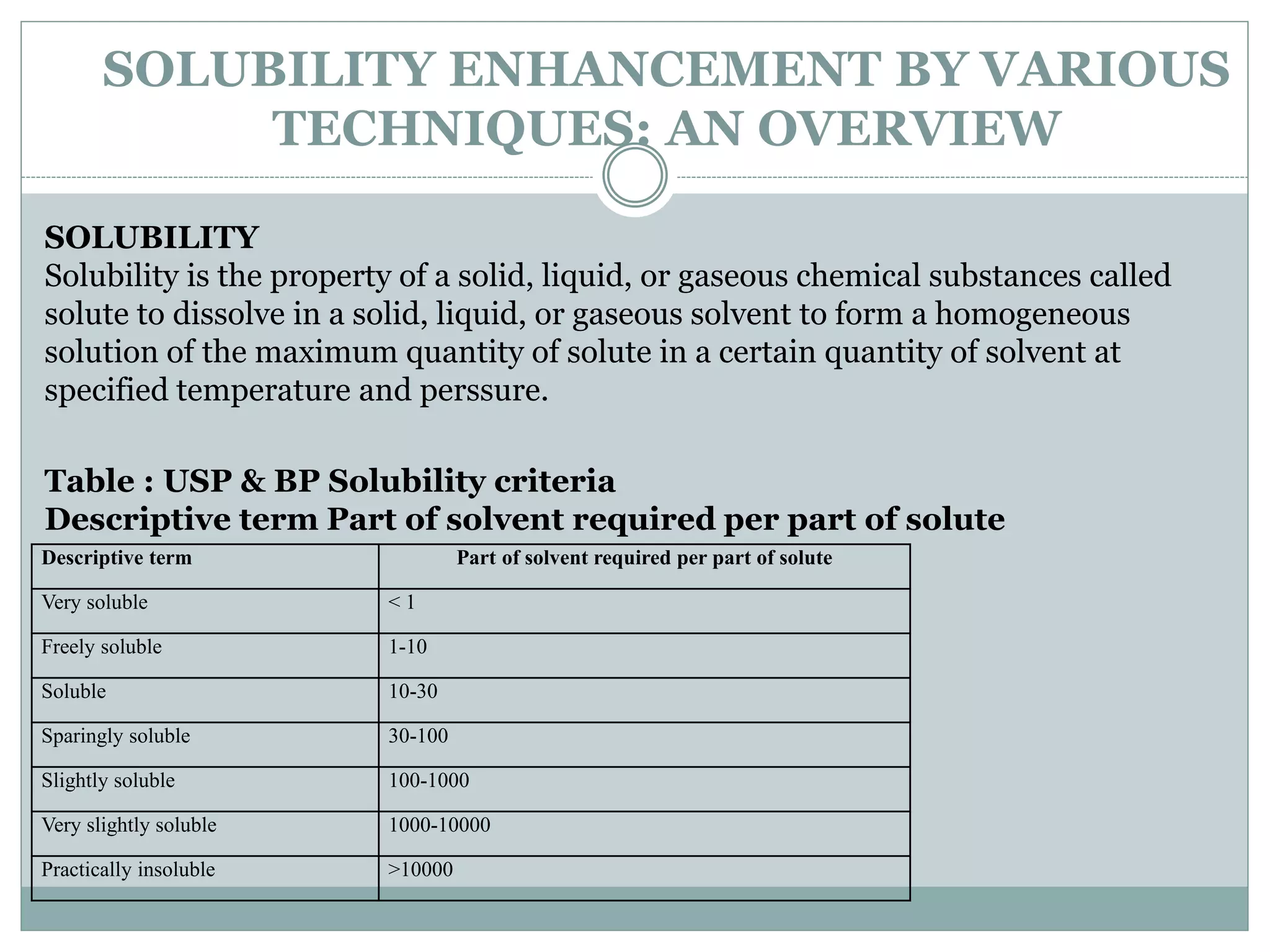
Descriptive term Part of solvent required per part of solute
Very soluble < 1
Freely soluble 1-10
Soluble 10-30
Sparingly soluble 30-100
Slightly soluble 100-1000
Very slightly soluble 1000-10000
Practically insoluble >10000
Table : USP & BP Solubility criteria
Descriptive term Part of solvent required per part of solute
SOLUBILITY
Solubility is the property of a solid, liquid, or gaseous chemical substances called
solute to dissolve in a solid, liquid, or gaseous solvent to form a homogeneous
solution of the maximum quantity of solute in a certain quantity of solvent at
specified temperature and perssure.
 PROCESS OF SOLUBILISATION
 The process of solubilisation contains three steps:
 • The separation of the molecule of the solvent to
provide space in the solvent for solute.
 • The breaking of intermolecular ionic bonds in the
solute.
 • The interaction between the solvent and the solute
molecule or ion
FACTORS AFFECTING SOLUBILISATION
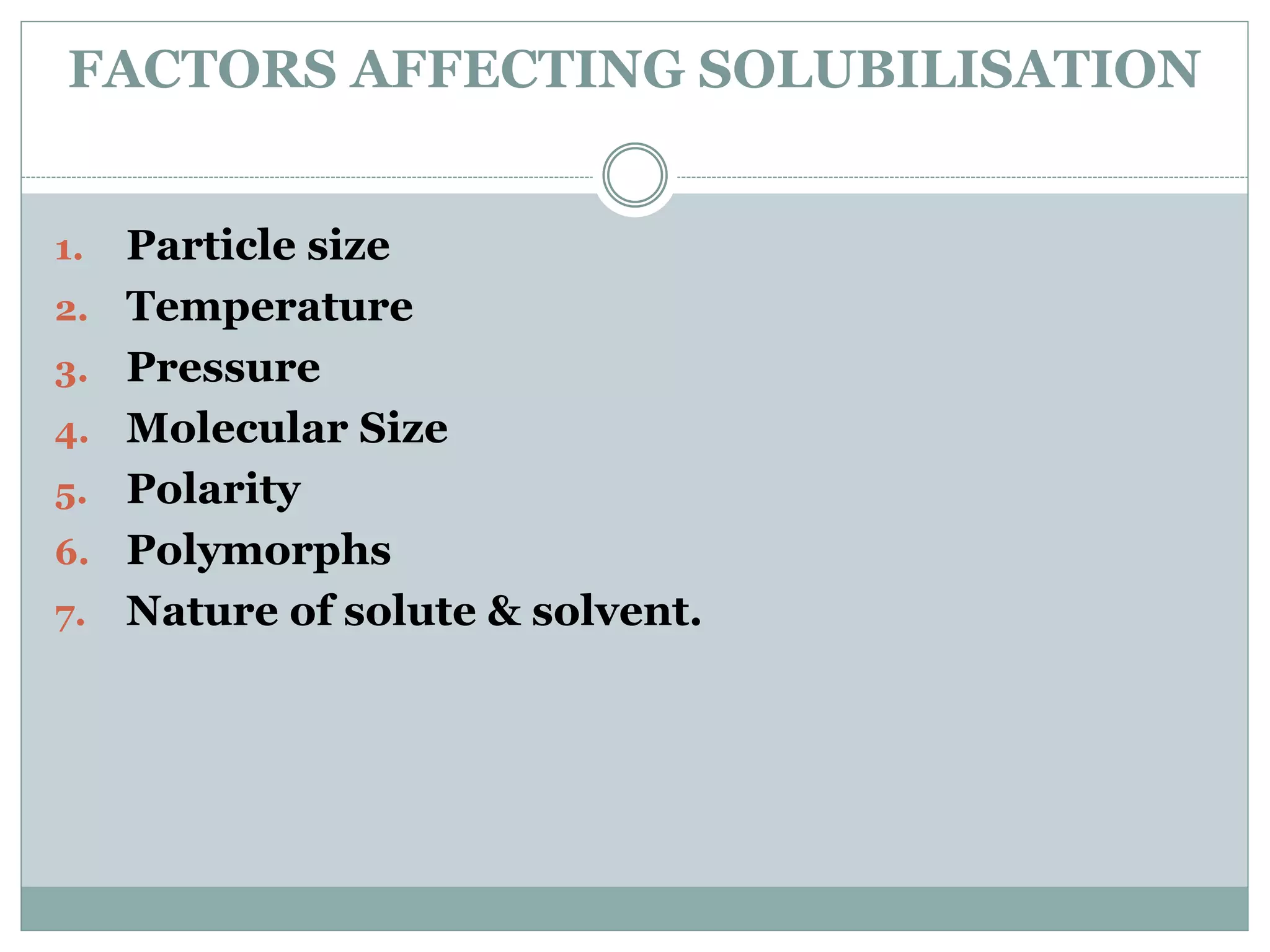
1. Particle size
2. Temperature
3. Pressure
4. Molecular Size
5. Polarity
6. Polymorphs
7. Nature of solute & solvent.
NEED FOR SOLUBILITY
ENHANCEMENT
Class I Class II
High permeability
High solubility
High permeability
Low solubility
Class III Class IV
Low permeability
High solubility
Low permeability
Low solubility
Fig 1: BCS classification
METHODS OF SOLUBILITY
ENHANCEMENT
• Particle Size Reduction
Conventional methods
Micronization
Nano suspension
• Hydrotropic
• Co-solvency
• Solubilization by Surfactants
• Solid Dispersion
The fusion (melt) method
The solvent method
Dropping method
• pH adjustment
• High Pressure Homogenization
• Supercritical fluid recrystallization(SCF)
• Sonocrystallisation
• Complexion
Physical Mixture
Kneading method
Co-precipitate method
• Spray Drying
• Inclusion Complex Formation-Based Techniques
Kneading Method
Lyophilization Freeze-Drying Technique
Microwave Irradiation Method
• Liquid solid technique
• Micro-emulsion
• Self-Emulsifying Drug Delivery Systems
• Neutralization
• Cryogenic Method
Spray Freezing onto Cryogenic Fluids
Spray Freezing into Cryogenic Liquids (SFL)
Spray Freezing into Vapor over Liquid (SFV/L)
Ultra-Rapid Freezing (URF)
• Polymeric Alteration
• Salt formation
CONCLUSION
The various techniques enlisted in this article are used in combination
for solubility enhancement of poorly water soluble drugs, but the
solubility improvement mainly depends on the selection of proper
method. The selection of suitable method for solubility enhancement is
depends on drug properties like melting point, solubility, chemical
nature, physical nature, pharmacokinetic behavior and so on. The
article concludes that solubility of poorly water soluble drugs is an
important concept to reach into systemic circulation to show its
pharmacological response.
Solubility enhancement by co-solvent system gives new approaches for
design and formulation of new dosage forms of poor aq. Soluble drugs.
It also helps in improving:
 Bioavailability of drugs
 Stability of drugs
REFERENCES
1. Lachman L, Lieberman HA, The Theory and Practice of Industrial Pharmacy, CBS
Publication & Distributors Pvt. Ltd. Special Indian Edition 2009: 221.
2. Sharma D, Soni M, Kumar S, Gupta GD, Solubility Enhancement-Eminent Role in
Poorly Soluble Drugs, Research Journal of Pharmacy and Technology.2(2);April-
June.2009:220-224.
3. Nikam SP, A Review: Increasing Solubility of Poorly Soluble Drugs, by Solid Dispersion
Technique. Research Journal of Pharmacy and Technology.4(12);Dec.2011:1933-1940.
4. Chauhan NN, Patel NV, Suthar SJ, Patel JK, Patel MP. Micronization of BCS-II Drugs
By Various Approaches For Solubility Enhancement-A Review. Research Journal of
Pharmacy and Technology.5(8);Aug.2012:999-1005.
5. Pardhi D, Shivhare U, Suruse P, Chabra G. Lquid solid Technique For Solubility
Enhancement of Poorly Water Soluble Drugs. Research Journal Pharmaceutical Dosage
Forms and Technology.2(5);Sept-Oct.2010:314-322
6.Md. Sajid A, Choudhary V. Solubility Enhancement Methods With Importance of
Hydrotropy. Journal of Drug Delivery and Therapeutics(6);2012:96-101..
THANK YOU…

solubility enhancement and cosolvency by madhavi

  • 1.
    PRESENTED BY:MADHAVEE BORADE UDERGUIDANCE OF: MADHURI GITE SHRI R.D.BHAKT COLLEGE OF PHARMACY,JALNA Review On:Solubility Enhancement & Cosolvancy
  • 2.
    CONTENTS  INTRODUCTION  REVIEWLITERATURE  METHOD OF SOLUBLITY ENHANCEMENT  STUDY OF COSOLVENCY  THEORY OF COSOLVENCY  CONCLUSION  REFERENCE
  • 3.
    INTRODUCTION STUDY OF COSOLVENCY DEFINITION: Thesolubility of weak electrolytes and nonpolar molecules can be increased by the addition of water- miscible solvents. This process is known as co-solvency or solvent blending, and the solvents used in combination to increase the solubility of the solute are called co-solvents. COSOLVENTS: Co solvents have some degree of hydrogen bond donating and or hydrogen bond accepting ability as well as small hydrocarbon regions. The resulting solution will have physical properties that are intermediate to that of the pure organic solvent and water through the reduction of water-water interaction Example: Ethanol, propylene glycol, glycerin, sorbitol and polyethylene glycol. Mechanism: 1) change the dielectric constant. DC of a good co-solvent: 25-80. 2) hydrogen bonding in two solvents
  • 4.
    REVIEW LITERATURE  1.S.K. dash et al(2012) [12] : solubility enhancement of poorly poorly water drugs. Crit Rev Ther Drug Carrier Syst. 2002; 19:553-585. 2. Chellos N.et al(2012)[13]: “cosolvency and soluility enhancement” Pharmatech 2003, 160-166. They had developed simultaneous determination of sitagliptin phospate monohydrate and metformin by ultra performance liquid chromatographic (uplc)method. the chromographic sepreation was achieved on aquity uplc BEH C8 100 X 2.1mm,1.7 m, colunm using a buffer consisting of 10 mM potassium dihydrogen phosphate and 2 nm hexane 1-sufonic acid sodiun, salt(PH adjusted to 5.50 with diluted phosphoric acid) and acetonitrile as organic solvent in a gradient program. The flow rate was 0.2 ml min-1 and the detection wavelength was 210nm.the limit of detection (LOD) was 0.2 and 0.06 g ml- 1,respectively.the limit of quantification (LOD)was 0.7 and 0.2g ml- 1,respectively.this method was validated with respect to linearity, accuracy,precision ,specificity,and robustnes soluble drugs . . Crit Rev Ther Drug Carrier Syst. 2002; 19:553-585.
  • 5.
    Properties of co-solvents co-solvent increases the solubility of a drugs.  An ideal co-solvents should provide values of dielectric constant between 25 to 80.  The most widely used system that will cover this range is a water.  It should not cause toxicity or irritancy when administrated for oral or parental use. Selection of co-solvent  Some characteristics of co-solvent which are considered at selection:  1. Biocompatible  2. It must be non-toxic. Non-irritating.  3. It should be able to solubilize the drug in given solvent.  4. It should be able to cross the membrane.  5. does not have potential systemic effects.
  • 6.
    Applications 1. Ultimate rolein solubility enhancement of poorly water soluble drugs. 2. Improvement in absorption and bioavailability. 3. Apart from increasing solubility, it have importance in improvement solubility of volatile constituents used to impart a desirable flavor and odour to the product. 4. Solubility considerations at dosage form design.
  • 7.
    Commonly used co-solvent Glycerol  PEG400  Dimethyl Acetamide  N-Octanol  Glycerol  Dimethyl Sulfoxide  Propylene Glycol Co-solvent used in Drugs  Diazepam  Benzocaine
  • 8.
    Advantages  Simple andrapid to formulate and produce.  Solvents may be combined with other solubilization techniques and and pH adjustment to further increase solubility of poorly soluble compounds. Disadvantage:  As with all excipients, the toxicity and tolerability related with the level of solvent administer not to be considered.  Uncontrolled precipitation occurs upon dilution with aqueous media. The precipitates may be amorphous or crystalline and can vary in size.  Many of the insoluble compounds shares works which are unsuited to co-solvents alone, particularly for intravenous administration.  This is because the drug are extremely insoluble in water and do not readily re-dissolve after precipitation from the co-solvent mixture.  In these situations there is potential risk for embolism and local adverse effects at the injection site.
  • 9.
    SOLUBILITY ENHANCEMENT BYVARIOUS TECHNIQUES: AN OVERVIEW Descriptive term Part of solvent required per part of solute Very soluble < 1 Freely soluble 1-10 Soluble 10-30 Sparingly soluble 30-100 Slightly soluble 100-1000 Very slightly soluble 1000-10000 Practically insoluble >10000 Table : USP & BP Solubility criteria Descriptive term Part of solvent required per part of solute SOLUBILITY Solubility is the property of a solid, liquid, or gaseous chemical substances called solute to dissolve in a solid, liquid, or gaseous solvent to form a homogeneous solution of the maximum quantity of solute in a certain quantity of solvent at specified temperature and perssure.
  • 10.
     PROCESS OFSOLUBILISATION  The process of solubilisation contains three steps:  • The separation of the molecule of the solvent to provide space in the solvent for solute.  • The breaking of intermolecular ionic bonds in the solute.  • The interaction between the solvent and the solute molecule or ion
  • 11.
    FACTORS AFFECTING SOLUBILISATION 1.Particle size 2. Temperature 3. Pressure 4. Molecular Size 5. Polarity 6. Polymorphs 7. Nature of solute & solvent.
  • 12.
    NEED FOR SOLUBILITY ENHANCEMENT ClassI Class II High permeability High solubility High permeability Low solubility Class III Class IV Low permeability High solubility Low permeability Low solubility Fig 1: BCS classification
  • 13.
    METHODS OF SOLUBILITY ENHANCEMENT •Particle Size Reduction Conventional methods Micronization Nano suspension • Hydrotropic • Co-solvency • Solubilization by Surfactants • Solid Dispersion The fusion (melt) method The solvent method Dropping method • pH adjustment • High Pressure Homogenization • Supercritical fluid recrystallization(SCF) • Sonocrystallisation
  • 14.
    • Complexion Physical Mixture Kneadingmethod Co-precipitate method • Spray Drying • Inclusion Complex Formation-Based Techniques Kneading Method Lyophilization Freeze-Drying Technique Microwave Irradiation Method • Liquid solid technique • Micro-emulsion • Self-Emulsifying Drug Delivery Systems • Neutralization • Cryogenic Method Spray Freezing onto Cryogenic Fluids Spray Freezing into Cryogenic Liquids (SFL) Spray Freezing into Vapor over Liquid (SFV/L) Ultra-Rapid Freezing (URF) • Polymeric Alteration • Salt formation
  • 15.
    CONCLUSION The various techniquesenlisted in this article are used in combination for solubility enhancement of poorly water soluble drugs, but the solubility improvement mainly depends on the selection of proper method. The selection of suitable method for solubility enhancement is depends on drug properties like melting point, solubility, chemical nature, physical nature, pharmacokinetic behavior and so on. The article concludes that solubility of poorly water soluble drugs is an important concept to reach into systemic circulation to show its pharmacological response. Solubility enhancement by co-solvent system gives new approaches for design and formulation of new dosage forms of poor aq. Soluble drugs. It also helps in improving:  Bioavailability of drugs  Stability of drugs
  • 16.
    REFERENCES 1. Lachman L,Lieberman HA, The Theory and Practice of Industrial Pharmacy, CBS Publication & Distributors Pvt. Ltd. Special Indian Edition 2009: 221. 2. Sharma D, Soni M, Kumar S, Gupta GD, Solubility Enhancement-Eminent Role in Poorly Soluble Drugs, Research Journal of Pharmacy and Technology.2(2);April- June.2009:220-224. 3. Nikam SP, A Review: Increasing Solubility of Poorly Soluble Drugs, by Solid Dispersion Technique. Research Journal of Pharmacy and Technology.4(12);Dec.2011:1933-1940. 4. Chauhan NN, Patel NV, Suthar SJ, Patel JK, Patel MP. Micronization of BCS-II Drugs By Various Approaches For Solubility Enhancement-A Review. Research Journal of Pharmacy and Technology.5(8);Aug.2012:999-1005. 5. Pardhi D, Shivhare U, Suruse P, Chabra G. Lquid solid Technique For Solubility Enhancement of Poorly Water Soluble Drugs. Research Journal Pharmaceutical Dosage Forms and Technology.2(5);Sept-Oct.2010:314-322 6.Md. Sajid A, Choudhary V. Solubility Enhancement Methods With Importance of Hydrotropy. Journal of Drug Delivery and Therapeutics(6);2012:96-101..
  • 17.