22 
WWhhaatt iiss PPoollyymmeerr?? 
• “Polymer” word is derived from Greek roots 
“Poly” meaning many and “Meros” 
meaning parts. 
• Definition : 
Polymers are long chain organic 
molecules assembled from many smaller 
molecules called as monomers.
33 
• Copolymer : 
Polymers formed from two or 
more different monomers are called as 
copolymers. 
- [A – B – A – B – A – B] – 
• Homopolymer : 
Polymers formed from bonding of 
identical monomers are called as 
homopolymers. 
- [A – A – A – A – A] -
44 
CCLLAASSSSIIFFIICCAATTIIOONN 
A. Based on origin : 
a) Natural Polymers : 
e.g. Proteins – Collagen, Keratin, Albumin 
Carbohydrates – starch, cellulose, 
glycogen. 
DNA, RNA 
b) Synthetic Polymers : 
e.g. polyesters, polyanhydrides, polyamides. 
B. Based on Bio-stability : 
a) Bio-degradable Polymers : 
e.g. polyesters, proteins, carbohydrates, etc 
b) Non – biodegradable Polymers : 
e.g. ethyl cellulose, HPMC, acrylic polymers, silicones.
55 
C. Based on Reaction mode of Polymerization : 
a) Addition Polymers : 
Here, the monomer molecules bond to 
each other without the loss of any other 
atoms. 
e.g. Alkene monomers 
b) Condensation Polymers : 
Usually two different monomers combine 
with the loss of small molecule, usually water. 
e.g. polyesters, polyamides.
66 
D. Based on Interaction with Water : 
a) Non – biodegradable Hydrophobic Polymers : 
These are inert compounds and are eliminated 
intact from the site of application. 
e.g. polyethylene – vinyl acetate, polyvinyl chloride. 
b) Hydrogels : 
They swell but do not dissolve when brought in 
contact with water. 
e.g. polyvinyl pyrrolidone 
c) Soluble Polymers : 
These are moderate mol. wt uncross-linked 
polymers that dissolve in water. 
e.g. HPMC, PEG 
d) Biodegradable Polymers : 
These slowly disappear from the site of 
administration in response to a chemical reaction such as 
hydrolysis. 
e.g. Polyacrylic acid. Polyglycolic acid.
77 
AApppplliiccaattiioonnss iinn CCoonnvveennttiioonnaall 
DDoossaaggee FFoorrmmss 
• Tablets : 
- As binders 
- To mask unpleasant taste 
- For enteric coated tablets 
• Liquids : 
- Viscosity enhancers 
- For controlling the flow 
• Semisolids : 
- In the gel preparation 
- In ointments 
• In transdermal Patches
88 
AApppplliiccaattiioonnss IInn CCoonnttrroolllleedd 
DDrruugg DDeelliivveerryy 
• Reservoir Systems 
- Ocusert System 
- Progestasert System 
- Reservoir Designed Transdermal Patches 
• Matrix Systems 
• Swelling Controlled Release Systems 
• Biodegradable Systems 
• Osmotically controlled Drug Delivery
99 
A. Reservoir System : 
 Ocusert System : 
- Novel means of controlled ocular drug delivery 
- Used for max 7 days treatment of Glaucoma 
- Consists of core reservoir of pilocarpine & 
alginic acid sandwiched between two sheets 
of transparent, lipophillic, rate controlling 
membrane of ethylene-vinyl acetate 
copolymer. 
- Inserted in cul-de-sac, lachrymal fluid enters the 
system and the dissolved drug slowly gets 
released through polymeric membrane.
1100 
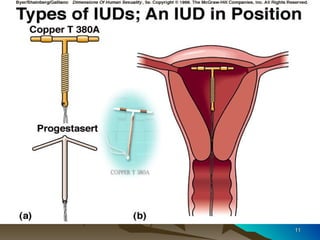
 Progestasert system : 
- Used for once-a-year contraception 
- Consists of drug saturated liquid medium 
encapsulated in a polymeric 
membrane. 
- Progesterone is released at a constant 
rate of 65 μg/day. 
- Polymers used are : 
Silicone elastomers, polyethylene, 
ethylene-vinyl acetate.
1111
1122 
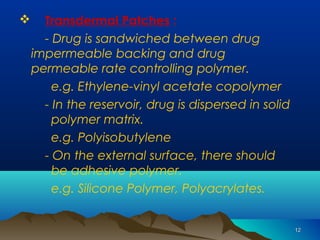
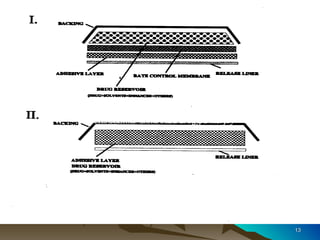
 Transdermal Patches : 
- Drug is sandwiched between drug 
impermeable backing and drug 
permeable rate controlling polymer. 
e.g. Ethylene-vinyl acetate copolymer 
- In the reservoir, drug is dispersed in solid 
polymer matrix. 
e.g. Polyisobutylene 
- On the external surface, there should 
be adhesive polymer. 
e.g. Silicone Polymer, Polyacrylates.
1133 
TrTarnasndsedremrmaal lC Coonnttrroolllleedd DDrurug gD Deleivleivreyry
1144 
BB.. OOssmmoottiiccaallllyy CCoonnttrroolllleedd DDrruugg 
DDeelliivveerryy SSyysstteemm 
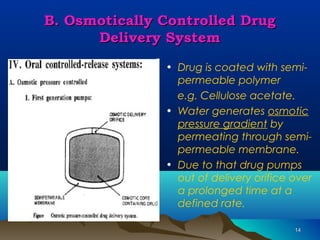
• Drug is coated with semi-permeable 
polymer 
e.g. Cellulose acetate. 
• Water generates osmotic 
pressure gradient by 
permeating through semi-permeable 
membrane. 
• Due to that drug pumps 
out of delivery orifice over 
a prolonged time at a 
defined rate.
1155 
CC.. BBiiooddeeggrraaddaabbllee SSyysstteemm 
• Mainly used for parenteral controlled drug 
delivery. 
• Drug is encapsulated in biodegradable 
microcapsules which are suspended in 
aqueous / oleaginous medium and injected 
subcutaneously or intra-muscularly. 
• Polymers used for microcapsules are : 
Gelatin, dextran, polylactate, lactide – 
glycolide copolymer. 
• The release of drug is controlled by the rate 
of bio-degradation of polymer.
1166 
DD.. MMaattrriixx SSyysstteemmss 
• Drug particles are enclosed in a matrix 
environment formed by cross-linking of 
polymer chains. 
• For the drug to get released, it has to be first 
dissolved in surrounding polymer and then 
diffuse through the polymer structure. 
• Polymers used are : 
polyalkyls, polyvinyls, etc. 
• Example – Nitroglycerine releasing system for 
prophylaxis or treatment of angina pectoris.
1177 
EE.. SSwweelllliinngg CCoonnttrroolllleedd RReelleeaassee 
SSyysstteemmss 
• Drug is enclosed in a collapsible drug 
compartment inside a rigid, shape-retaining 
housing. 
• The shape between external housing and drug 
compartment contains laminate of swellable, 
hydrophillic cross-linked polymer. 
e.g. polyhydroxyalkyl methacrylate. 
• This polymer absorbs GI fluid through annular 
openings in the bottom of housing.
1188 
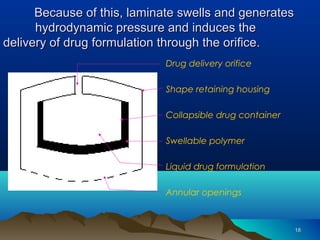
BBeeccaauussee ooff tthhiiss,, llaammiinnaattee sswweellllss aanndd ggeenneerraatteess 
hhyyddrrooddyynnaammiicc pprreessssuurree aanndd iinndduucceess tthhee 
ddeelliivveerryy ooff ddrruugg ffoorrmmuullaattiioonn tthhrroouugghh tthhee oorriiffiiccee.. 
Drug delivery orifice 
Shape retaining housing 
Collapsible drug container 
Swellable polymer 
Liquid drug formulation 
Annular openings

Polymer sciencefordrugdelivery

  • 2.
    22 WWhhaatt iissPPoollyymmeerr?? • “Polymer” word is derived from Greek roots “Poly” meaning many and “Meros” meaning parts. • Definition : Polymers are long chain organic molecules assembled from many smaller molecules called as monomers.
  • 3.
    33 • Copolymer: Polymers formed from two or more different monomers are called as copolymers. - [A – B – A – B – A – B] – • Homopolymer : Polymers formed from bonding of identical monomers are called as homopolymers. - [A – A – A – A – A] -
  • 4.
    44 CCLLAASSSSIIFFIICCAATTIIOONN A.Based on origin : a) Natural Polymers : e.g. Proteins – Collagen, Keratin, Albumin Carbohydrates – starch, cellulose, glycogen. DNA, RNA b) Synthetic Polymers : e.g. polyesters, polyanhydrides, polyamides. B. Based on Bio-stability : a) Bio-degradable Polymers : e.g. polyesters, proteins, carbohydrates, etc b) Non – biodegradable Polymers : e.g. ethyl cellulose, HPMC, acrylic polymers, silicones.
  • 5.
    55 C. Basedon Reaction mode of Polymerization : a) Addition Polymers : Here, the monomer molecules bond to each other without the loss of any other atoms. e.g. Alkene monomers b) Condensation Polymers : Usually two different monomers combine with the loss of small molecule, usually water. e.g. polyesters, polyamides.
  • 6.
    66 D. Basedon Interaction with Water : a) Non – biodegradable Hydrophobic Polymers : These are inert compounds and are eliminated intact from the site of application. e.g. polyethylene – vinyl acetate, polyvinyl chloride. b) Hydrogels : They swell but do not dissolve when brought in contact with water. e.g. polyvinyl pyrrolidone c) Soluble Polymers : These are moderate mol. wt uncross-linked polymers that dissolve in water. e.g. HPMC, PEG d) Biodegradable Polymers : These slowly disappear from the site of administration in response to a chemical reaction such as hydrolysis. e.g. Polyacrylic acid. Polyglycolic acid.
  • 7.
    77 AApppplliiccaattiioonnss iinnCCoonnvveennttiioonnaall DDoossaaggee FFoorrmmss • Tablets : - As binders - To mask unpleasant taste - For enteric coated tablets • Liquids : - Viscosity enhancers - For controlling the flow • Semisolids : - In the gel preparation - In ointments • In transdermal Patches
  • 8.
    88 AApppplliiccaattiioonnss IInnCCoonnttrroolllleedd DDrruugg DDeelliivveerryy • Reservoir Systems - Ocusert System - Progestasert System - Reservoir Designed Transdermal Patches • Matrix Systems • Swelling Controlled Release Systems • Biodegradable Systems • Osmotically controlled Drug Delivery
  • 9.
    99 A. ReservoirSystem :  Ocusert System : - Novel means of controlled ocular drug delivery - Used for max 7 days treatment of Glaucoma - Consists of core reservoir of pilocarpine & alginic acid sandwiched between two sheets of transparent, lipophillic, rate controlling membrane of ethylene-vinyl acetate copolymer. - Inserted in cul-de-sac, lachrymal fluid enters the system and the dissolved drug slowly gets released through polymeric membrane.
  • 10.
    1100  Progestasertsystem : - Used for once-a-year contraception - Consists of drug saturated liquid medium encapsulated in a polymeric membrane. - Progesterone is released at a constant rate of 65 μg/day. - Polymers used are : Silicone elastomers, polyethylene, ethylene-vinyl acetate.
  • 11.
  • 12.
    1122  TransdermalPatches : - Drug is sandwiched between drug impermeable backing and drug permeable rate controlling polymer. e.g. Ethylene-vinyl acetate copolymer - In the reservoir, drug is dispersed in solid polymer matrix. e.g. Polyisobutylene - On the external surface, there should be adhesive polymer. e.g. Silicone Polymer, Polyacrylates.
  • 13.
    1133 TrTarnasndsedremrmaal lCCoonnttrroolllleedd DDrurug gD Deleivleivreyry
  • 14.
    1144 BB.. OOssmmoottiiccaallllyyCCoonnttrroolllleedd DDrruugg DDeelliivveerryy SSyysstteemm • Drug is coated with semi-permeable polymer e.g. Cellulose acetate. • Water generates osmotic pressure gradient by permeating through semi-permeable membrane. • Due to that drug pumps out of delivery orifice over a prolonged time at a defined rate.
  • 15.
    1155 CC.. BBiiooddeeggrraaddaabblleeSSyysstteemm • Mainly used for parenteral controlled drug delivery. • Drug is encapsulated in biodegradable microcapsules which are suspended in aqueous / oleaginous medium and injected subcutaneously or intra-muscularly. • Polymers used for microcapsules are : Gelatin, dextran, polylactate, lactide – glycolide copolymer. • The release of drug is controlled by the rate of bio-degradation of polymer.
  • 16.
    1166 DD.. MMaattrriixxSSyysstteemmss • Drug particles are enclosed in a matrix environment formed by cross-linking of polymer chains. • For the drug to get released, it has to be first dissolved in surrounding polymer and then diffuse through the polymer structure. • Polymers used are : polyalkyls, polyvinyls, etc. • Example – Nitroglycerine releasing system for prophylaxis or treatment of angina pectoris.
  • 17.
    1177 EE.. SSwweelllliinnggCCoonnttrroolllleedd RReelleeaassee SSyysstteemmss • Drug is enclosed in a collapsible drug compartment inside a rigid, shape-retaining housing. • The shape between external housing and drug compartment contains laminate of swellable, hydrophillic cross-linked polymer. e.g. polyhydroxyalkyl methacrylate. • This polymer absorbs GI fluid through annular openings in the bottom of housing.
  • 18.
    1188 BBeeccaauussee oofftthhiiss,, llaammiinnaattee sswweellllss aanndd ggeenneerraatteess hhyyddrrooddyynnaammiicc pprreessssuurree aanndd iinndduucceess tthhee ddeelliivveerryy ooff ddrruugg ffoorrmmuullaattiioonn tthhrroouugghh tthhee oorriiffiiccee.. Drug delivery orifice Shape retaining housing Collapsible drug container Swellable polymer Liquid drug formulation Annular openings