Salt Selection in Pharmaceutical
Product Development
By
Tanpula Dilip Kumar
M.S.(pharm.) Pharmaceutics
NIPER
Rae Bareli
6th dec,2014
Contents
• Introduction.
• The importance of salt formation.
• Criteria of salt selection.
• Salt selection strategies.
– Selection of chemical forms of salts.
– Selection of physical forms of salts.
• Salt selection timing.
• Salt selection team.
• Case study.
• Conclusion.
• References.
2
Introduction
• During the past ten years the pharmaceutical industry has led
to an evolutionary change in the way it is discovering and
developing drugs.
• In the search of more potent and highly specific drug
molecules, more lipophilic and water insoluble compounds are
being selected.
• The salt formation is thus considered critical in solving this
problem.
• The suitable choice of the most desirable salt form is an
important step in the development process since it has an
impact on physico-chemical and biopharmaceutical properties.
3
The Importance of salt formation
• Salt formation can improve solubility, permeability and
dissolution rate etc.
• Berge et al. (1977) reviewed various advantages of using salt
forms of drugs in pharmaceutical formulations which include
improved dissolution rate and bioavailability of poorly water-
soluble compounds.
• Salt forms of drugs have a large effect on the drugs quality,
safety, and performance.
4
Criteria of salt selection
• The following parameters are often considered essential
criteria for the selection of a particular form:
Aqueous solubility measured at various pH values.
High degree of crystallinity.
Low hygroscopicity which gives consistent performance.
Optimal chemical and solid-state stability under accelerated
conditions.
Limited number of polymorphs.
Ease of synthesis, handling, or formulation development.
5
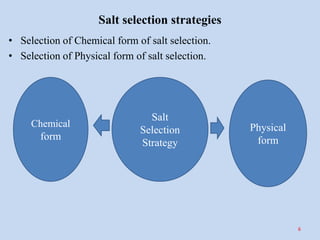
Salt selection strategies
• Selection of Chemical form of salt selection.
• Selection of Physical form of salt selection.
6
Salt
Selection
Strategy
Physical
form
Chemical
form
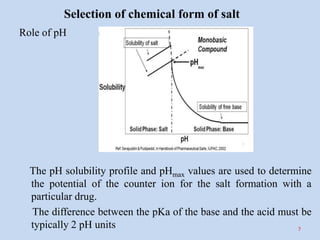
Selection of chemical form of salt
7
Role of pH
The pH solubility profile and pHmax values are used to determine
the potential of the counter ion for the salt formation with a
particular drug.
The difference between the pKa of the base and the acid must be
typically 2 pH units
Selection of physical form of salt
Tier 1-Crystallinity (visual, microscopy)
~Crystallization from different solvents.
~Aqueous solubility including microscopic examination of
suspended solids.
Tier 2-Evaluation of crystalline form
(Powder X-ray diffraction, hot-stage microscopy)
~Thermal properties (DSC, TG).
~Hygroscopicity.
Tier 3-Humidity/temperature-dependent changes in crystal form
(Powder X-ray, DSC, TG, VT-XRD, etc.)
Tier 4-Bioavailability (optional)
~Stress stability.
~Scale-up considerations.
Final form.
Multi tier approach of salt selection
8
Salt selection timing
• Salt selection must be done at an early stage of drug
development.
• Ideally, the salt form should be chosen before long-term
toxicology studies are performed
• Changing the salt form at a later stage may force a repetition
of toxicological, formulation, and stability studies.
9
Salt selection team
• The selection of optimal salt- multi disciplinary team
approach.
• The team -representative from pharmaceutics, chemical
process development, and analytical research.
• Inputs from drug safety and marketing are also considered.
• The team decides whether to form salt for a particular weak
acid/base or use them in free form.
10
Case study
Case Study: RPR127963
• RPR 127963 -treatment of cardiovascular diseases.
• It is crystalline, very weak base with a pKa of 4.10.
• 5 salt forms hydrochloride, mesylate, citrate, tartrate, and
sulfate are produced.
• The properties of these salts and the free base were then
studied and compared.
11
12
Case study contd..
• The citrate, tartrate, and hydrochloride salts were poorly
soluble and low melting point.
• Mesylate and sulfate were highly soluble and have high
melting point and no polymorphism.
• Sulfate salt was preferable over mesylate.
13
Conclusion
• Proper strategies for salt selection is very important for the
process of drug development.
• The strategies selected should also balance and minimize
resources and risks.
• When the appropriate screening strategies are engaged, then
selection of salt form can be made with a minimum amount of
drug substance, and within a short period of time.
14
References
1.Heinrich Stahl P., Wermuth C.G. (editors), Handbook of
Pharmaceutical Salts: properties selection and use, IUPAC,
WILEY-VCH, 2002.
2.Wei-Qin (Tony) Tong, Salt Screening and Selection: New
Challenges and Considerations in the Modern Pharmaceutical
Research and Development Paradigm. In: Developing Solid Oral
Dosage Forms, Eds: Yihong Qui, Yisheng Chan, Geoff.G.Z.Zang,
Academic Press,2009, 1st edition, pg no:75-86
3. Richard J. Bastin, Michael J. Bowker, and Bryan J. Slater. Salt
Selection and Optimisation Procedures for Pharmaceutical New
Chemical Entities. Organic Process Research & Development
2000, 4, 427-435.
15
16

salt selection in pharmaceutical product development

  • 1.
    Salt Selection inPharmaceutical Product Development By Tanpula Dilip Kumar M.S.(pharm.) Pharmaceutics NIPER Rae Bareli 6th dec,2014
  • 2.
    Contents • Introduction. • Theimportance of salt formation. • Criteria of salt selection. • Salt selection strategies. – Selection of chemical forms of salts. – Selection of physical forms of salts. • Salt selection timing. • Salt selection team. • Case study. • Conclusion. • References. 2
  • 3.
    Introduction • During thepast ten years the pharmaceutical industry has led to an evolutionary change in the way it is discovering and developing drugs. • In the search of more potent and highly specific drug molecules, more lipophilic and water insoluble compounds are being selected. • The salt formation is thus considered critical in solving this problem. • The suitable choice of the most desirable salt form is an important step in the development process since it has an impact on physico-chemical and biopharmaceutical properties. 3
  • 4.
    The Importance ofsalt formation • Salt formation can improve solubility, permeability and dissolution rate etc. • Berge et al. (1977) reviewed various advantages of using salt forms of drugs in pharmaceutical formulations which include improved dissolution rate and bioavailability of poorly water- soluble compounds. • Salt forms of drugs have a large effect on the drugs quality, safety, and performance. 4
  • 5.
    Criteria of saltselection • The following parameters are often considered essential criteria for the selection of a particular form: Aqueous solubility measured at various pH values. High degree of crystallinity. Low hygroscopicity which gives consistent performance. Optimal chemical and solid-state stability under accelerated conditions. Limited number of polymorphs. Ease of synthesis, handling, or formulation development. 5
  • 6.
    Salt selection strategies •Selection of Chemical form of salt selection. • Selection of Physical form of salt selection. 6 Salt Selection Strategy Physical form Chemical form
  • 7.
    Selection of chemicalform of salt 7 Role of pH The pH solubility profile and pHmax values are used to determine the potential of the counter ion for the salt formation with a particular drug. The difference between the pKa of the base and the acid must be typically 2 pH units
  • 8.
    Selection of physicalform of salt Tier 1-Crystallinity (visual, microscopy) ~Crystallization from different solvents. ~Aqueous solubility including microscopic examination of suspended solids. Tier 2-Evaluation of crystalline form (Powder X-ray diffraction, hot-stage microscopy) ~Thermal properties (DSC, TG). ~Hygroscopicity. Tier 3-Humidity/temperature-dependent changes in crystal form (Powder X-ray, DSC, TG, VT-XRD, etc.) Tier 4-Bioavailability (optional) ~Stress stability. ~Scale-up considerations. Final form. Multi tier approach of salt selection 8
  • 9.
    Salt selection timing •Salt selection must be done at an early stage of drug development. • Ideally, the salt form should be chosen before long-term toxicology studies are performed • Changing the salt form at a later stage may force a repetition of toxicological, formulation, and stability studies. 9
  • 10.
    Salt selection team •The selection of optimal salt- multi disciplinary team approach. • The team -representative from pharmaceutics, chemical process development, and analytical research. • Inputs from drug safety and marketing are also considered. • The team decides whether to form salt for a particular weak acid/base or use them in free form. 10
  • 11.
    Case study Case Study:RPR127963 • RPR 127963 -treatment of cardiovascular diseases. • It is crystalline, very weak base with a pKa of 4.10. • 5 salt forms hydrochloride, mesylate, citrate, tartrate, and sulfate are produced. • The properties of these salts and the free base were then studied and compared. 11
  • 12.
  • 13.
    Case study contd.. •The citrate, tartrate, and hydrochloride salts were poorly soluble and low melting point. • Mesylate and sulfate were highly soluble and have high melting point and no polymorphism. • Sulfate salt was preferable over mesylate. 13
  • 14.
    Conclusion • Proper strategiesfor salt selection is very important for the process of drug development. • The strategies selected should also balance and minimize resources and risks. • When the appropriate screening strategies are engaged, then selection of salt form can be made with a minimum amount of drug substance, and within a short period of time. 14
  • 15.
    References 1.Heinrich Stahl P.,Wermuth C.G. (editors), Handbook of Pharmaceutical Salts: properties selection and use, IUPAC, WILEY-VCH, 2002. 2.Wei-Qin (Tony) Tong, Salt Screening and Selection: New Challenges and Considerations in the Modern Pharmaceutical Research and Development Paradigm. In: Developing Solid Oral Dosage Forms, Eds: Yihong Qui, Yisheng Chan, Geoff.G.Z.Zang, Academic Press,2009, 1st edition, pg no:75-86 3. Richard J. Bastin, Michael J. Bowker, and Bryan J. Slater. Salt Selection and Optimisation Procedures for Pharmaceutical New Chemical Entities. Organic Process Research & Development 2000, 4, 427-435. 15
  • 16.