SMALL AND LARGE
VOLUMES OF PARENTERAL
PREPARATIONS
Presented by-
INNO SUTNGA
M. PHARM, 1ST SEMESTER (PHARMACEUTICS)
DEPARTMENT OF PHARMACEUTICAL SCIENCES
DIBRUGARH UNIVERSITY
1
INTRODUCTION
PARENTERALS
The term derived from Greek word ‛Para’ outside
& ‛Enterone’ intestine.
Parenterals are sterile solutions or suspension of
drug in aqueous or oily vehicle.
Parenteral drugs are administered directly in to
the veins, muscles or under the skin, or more
specialized tissues such as spinal cord.
Term parenteral used for any drug/fluid whose
delivery doesn’t utilize the alimentary canal for
entering in to the body tissues.
2
General requirements for parenteral
dosage forms
Stability
Sterility
Free from pyrogens & toxins
Free from foreign particles
Isotonic
Chemical purity
3
PARENTERAL ROUTES
The term parenteral literally means to avoid the gut (gastrointestinal
tract) and refers to any route of administration outside of or beside
the alimentary tract.
Thus, parenteral are injectable drugs that enter the body directly and
are not required to be absorbed in the gastrointestinal tract before
they show their effect.
Parenteral routes of administration usually have a more rapid onset
of action than other routes of administration.
1. Intravenous
2. Intramuscular
3. Subcutaneous
4. intradermal
5. Intra-arterial
4
6. Intracardiac
7. Intrathecal
8. Peridural
9.Intraarticular
10.Intracerebral
Advantages
 Useful for patients who cannot take drugs orally
 Rapid onset of action
 Useful for emergency situations
 Avoid first pass metabolism
 Can inject drug directly in to a tissue (target drug
delivery)
 Useful for delivering fluids, electrolytes, or nutrients
(TPN)
 Can be done in hospitals, ambulatory infusion centers
and home health care centres
 Complete bioavailability.
5
Disadvantages
 Pain on injection
 Difficult to reverse an administered drug’s effect.
 Sensitivity or allergic reaction at the site of
injection.
 Requires strict control of sterility & non-
pyrogenicity than other formulation.
 Trained person is required.
 Require specialized equipment, devices, and
techniques to prepare and administer drugs.
 More expensive and costly to produce.
6
CLASSIFICATION
Based on volume they are classified into two
types:
 Small volume parenterals (SVP’s)
 Large volume parenterals (LVP’s)
7
Small volume parenterals (SVP’s)
The volume is generally less than or equal to
100ml.
They are supplied in single or multiple doses.
They are used to dispense most of the drugs.
Examples: Ampoules, Vials, etc
Types of small volumes parenteral
1. Solution
2. Suspension
3. Emulsion
4. Dry Powders
8
Solutions
 Typically used for delivering medications at a
controlled infusion rate
 Most commonly solutions of 5% dextrose,
normal saline, 45% normal saline, or 5%
dextrose with normal saline.
 Dextrose contributes glucose to meet energy
needs and saline contributes sodium, an
electrolyte that maintains fluid balance and
cellular functions.
9
Suspension
 They should be sterile, pyrogen free, stable,
re‐suspendable, syringeable, injectable, isotonic &
non‐irritating.
 They are usually administered by either
subcutaneous (S.C.) or intramuscular (I.M.)
route.
 These suspensions usually contain between 0.5%
and 5.0% solids & should have particle size less
than 5 micrometer for I.M. or S.C. administration.
 Certain antibiotic preparations (For example
procaine, Penicillin G) may contain up to 30% solids
10
Advantages of Parental suspension
 It is better for the therapeutic use of drugs that are
insoluble in convention solvents.
 In this dosage from there is increased resistance to
hydrolysis & oxidation as drug is present in the solid
form.
 Formulation of controlled released drug is possible in
this dosage form.
 There is elimination of hepatic first pass effect.
11
Injectable Emulsion
 An emulsion is a heterogenous dispersion of one
immiscible liquid in another.
 This inherently unstable system is made possible
through the use of an emulsifying agent, which
prevent coalescence of the dispersed droplet.
 Parenteral emulsion are rare because it is necessary
(and difficult) to achieve stable droplet of less than
1 micron to prevent emboli in blood vessels and it is
not usually necessary to achieve an emulsion for
drug administration.
12
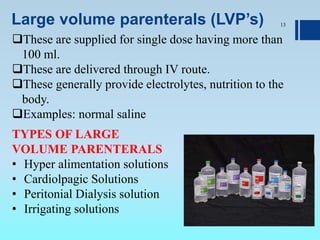
Large volume parenterals (LVP’s) 13
These are supplied for single dose having more than
100 ml.
These are delivered through IV route.
These generally provide electrolytes, nutrition to the
body.
Examples: normal saline
TYPES OF LARGE
VOLUME PARENTERALS
• Hyper alimentation solutions
• Cardiolpagic Solutions
• Peritonial Dialysis solution
• Irrigating solutions
HYPERALIMENTATION SOLUTION
Admin. of large amount of nutrients to patients who unable to
take food orally.
Formulation: mix. Of dextrose, amino acids , lipids, electrolytes,
& vitamines. TOTAL PARENTERAL NUTRITION
Def. : A method of feeding patients by infusing a mixture of all
necessary nutrients into the circulatory system, thus bypassing the
GIT.
14
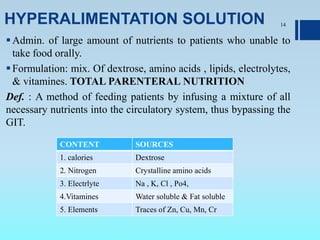
CONTENT SOURCES
1. calories Dextrose
2. Nitrogen Crystalline amino acids
3. Electrlyte Na , K, Cl , Po4,
4.Vitamines Water soluble & Fat soluble
5. Elements Traces of Zn, Cu, Mn, Cr
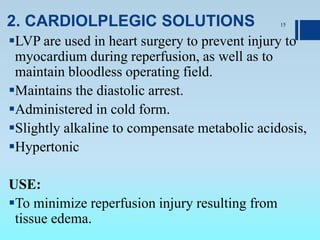
2. CARDIOLPLEGIC SOLUTIONS
LVP are used in heart surgery to prevent injury to
myocardium during reperfusion, as well as to
maintain bloodless operating field.
Maintains the diastolic arrest.
Administered in cold form.
Slightly alkaline to compensate metabolic acidosis,
Hypertonic
USE:
To minimize reperfusion injury resulting from
tissue edema.
15
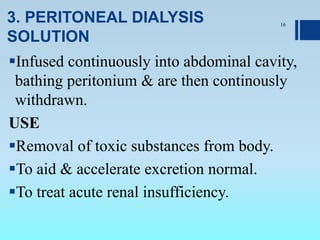
3. PERITONEAL DIALYSIS
SOLUTION
Infused continuously into abdominal cavity,
bathing peritonium & are then continously
withdrawn.
USE
Removal of toxic substances from body.
To aid & accelerate excretion normal.
To treat acute renal insufficiency.
16
4. IRRIGATING SOLUTIONS
To irrigate ,flush, & aid in cleaning body
activities & wounds.
Certain IV solution ( normal saline ) may be used
as irrigating solution , but solution designed as
irrigating solution should not be used
parenterally.
USE:
Treatment of serious wounds infused in to blood
stream.
17
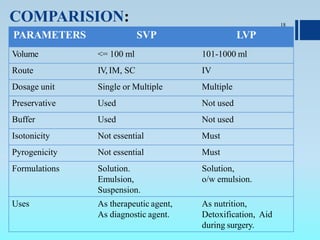
COMPARISION: 18
PARAMETERS SVP LVP
Volume <= 100 ml 101-1000 ml
Route IV, IM, SC IV
Dosage unit Single or Multiple Multiple
Preservative Used Not used
Buffer Used Not used
Isotonicity Not essential Must
Pyrogenicity Not essential Must
Formulations Solution.
Emulsion,
Suspension.
Solution,
o/w emulsion.
Uses As therapeutic agent,
As diagnostic agent.
As nutrition,
Detoxification, Aid
during surgery.
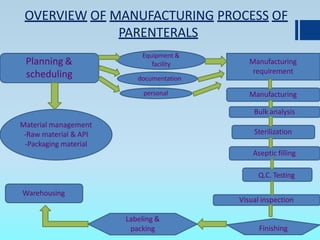
OVERVIEW OF MANUFACTURING PROCESS OF
PARENTERALS
Planning &
scheduling
Material management
-Raw material & API
-Packaging material
Warehousing
Equipment &
facility Manufacturing
requirement
documentation
personal
Finishing
Manufacturing
Bulk analysis
Sterilization
Aseptic filling
Q.C. Testing
Visual inspection
Labeling &
packing
20
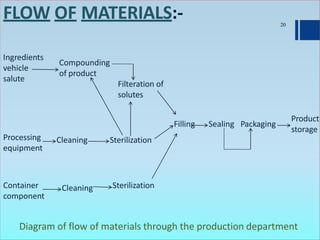
FLOW OF MATERIALS:-
Ingredients
vehicle
salute
Processing
equipment
Container
component
Compounding
of product
Cleaning
Cleaning
Filteration of
solutes
Sterilization
Sterilization
Filling PackagingSealing
Product
storage
Diagram of flow of materials through the production department
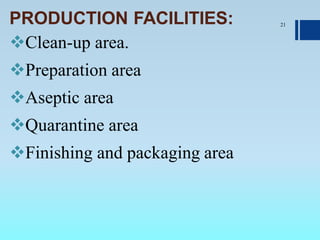
PRODUCTION FACILITIES:
Clean-up area.
Preparation area
Aseptic area
Quarantine area
Finishing and packaging area
21
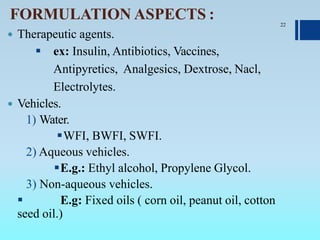
FORMULATION ASPECTS :
 Therapeutic agents.
 ex: Insulin, Antibiotics, Vaccines,
Antipyretics, Analgesics, Dextrose, Nacl,
Electrolytes.
 Vehicles.
1) Water.
WFI, BWFI, SWFI.
2) Aqueous vehicles.
E.g.: Ethyl alcohol, Propylene Glycol.
3) Non-aqueous vehicles.
 E.g: Fixed oils ( corn oil, peanut oil, cotton
seed oil.)
22
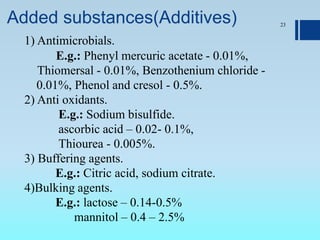
Added substances(Additives) 23
1) Antimicrobials.
E.g.: Phenyl mercuric acetate - 0.01%,
Thiomersal - 0.01%, Benzothenium chloride -
0.01%, Phenol and cresol - 0.5%.
2) Anti oxidants.
E.g.: Sodium bisulfide.
ascorbic acid – 0.02- 0.1%,
Thiourea - 0.005%.
3) Buffering agents.
E.g.: Citric acid, sodium citrate.
4)Bulking agents.
E.g.: lactose – 0.14-0.5%
mannitol – 0.4 – 2.5%
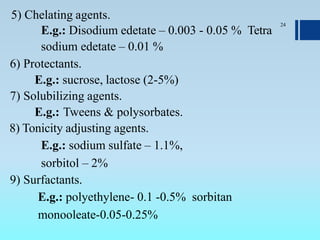
5) Chelating agents.
E.g.: Disodium edetate – 0.003 - 0.05 % Tetra
sodium edetate – 0.01 %
6) Protectants.
E.g.: sucrose, lactose (2-5%)
7) Solubilizing agents.
E.g.: Tweens & polysorbates.
8) Tonicity adjusting agents.
E.g.: sodium sulfate – 1.1%,
sorbitol – 2%
9) Surfactants.
E.g.: polyethylene- 0.1 -0.5% sorbitan
monooleate-0.05-0.25%
24
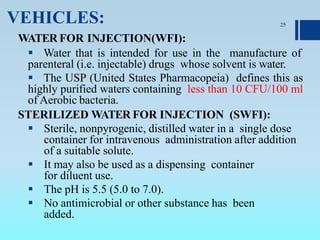
VEHICLES:
WATER FOR INJECTION(WFI):
 Water that is intended for use in the manufacture of
parenteral (i.e. injectable) drugs whose solvent is water.
 The USP (United States Pharmacopeia) defines this as
highly purified waters containing less than 10 CFU/100 ml
of Aerobic bacteria.
STERILIZED WATER FOR INJECTION (SWFI):
 Sterile, nonpyrogenic, distilled water in a single dose
container for intravenous administration after addition
of a suitable solute.
 It may also be used as a dispensing container
for diluent use.
 The pH is 5.5 (5.0 to 7.0).
 No antimicrobial or other substance has been
added.
25
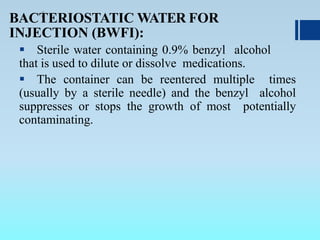
.BACTERIOSTATIC WATER FOR
INJECTION (BWFI):
 Sterile water containing 0.9% benzyl alcohol
that is used to dilute or dissolve medications.
 The container can be reentered multiple times
(usually by a sterile needle) and the benzyl alcohol
suppresses or stops the growth of most potentially
contaminating.
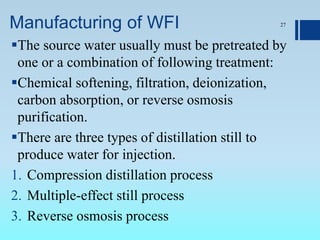
Manufacturing of WFI 27
The source water usually must be pretreated by
one or a combination of following treatment:
Chemical softening, filtration, deionization,
carbon absorption, or reverse osmosis
purification.
There are three types of distillation still to
produce water for injection.
1. Compression distillation process
2. Multiple-effect still process
3. Reverse osmosis process
Containers:
1. Glass:
• Type-I: Highly Resistant Borosilicate Glass
• Type II: Treated Soda lime Glass
• Type III: Regular Soda Lime Glass
• Type IV: N.P (Non-parenteral) Glass
Type 4 is not used for parenteral packaging,
others all are used for parenteral packaging.
28
2. Plastic:
Plastic containers are used but they face following problems
Permeation
Sorption
Leaching
Softening
3. Rubber:
To provide closure for multiple dose vials, IV fluid bottles, plugs for
disposable syringes and bulbs for ophthalmic pipettes, rubber is the
material of choice. Problems associated with rubber closures are
Incompatibility
Chemical instability
Physical instability
29
EVALUATION OF PARENTERAL
PREPARATIONS
The finished parenteral products are subjected to
following tests in order to maintain quality
controls:
A)Sterility test
B)Clarity test
C) Leakage test
D) Pyrogen test
E) Assay
30
A) Sterility test
It is a procedure carried out to detect and
conform absence of any viable form of
microbes in or on pharmacopeia
preparation or product.
Method of sterility testing
i ) METHOD 1: Membrane filtration method
ii) METHOD 2: Direct inoculation method
31
Membrane filtration method
 Membrane filtration Appropriate for : (advantage)
o Filterable aqueous preparations
o Alcoholic preparations
o Oily preparations
o Preparations miscible with or soluble in aqueous or
oily (solvents with no antimicrobial effect)
 All stepsof this procedure are performed aseptically in a
Class100 Laminar Flow Hood.
32
(METHOD 1):
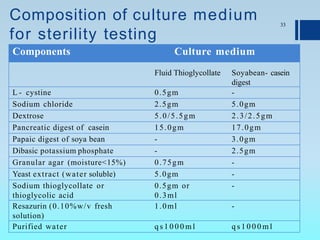
Composition of culture medium
for sterility testing
33
Components Culture medium
Fluid Thioglycollate Soyabean- casein
digest
L - cystine 0.5gm -
Sodium chloride 2.5gm 5.0gm
Dextrose 5.0/5.5gm 2.3/2.5gm
Pancreatic digest of casein 15.0gm 17.0gm
Papaic digest of soya bean - 3.0gm
Dibasic potassium phosphate - 2.5gm
Granular agar (moisture<15%) 0.75gm -
Yeast extract (water soluble) 5.0gm -
Sodium thioglycollate or
thioglycolic acid
0.5gm or
0.3ml
-
Resazurin (0.10%w/v fresh
solution)
1.0ml -
Purified water q s 1 0 0 0 m l q s 1 0 0 0 m l
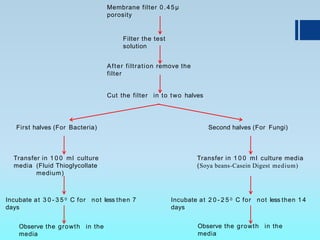
Membrane filter 0.45μ
porosity
Filter the test
solution
After filtration remove the
filter
Cut the filter in to two halves
First halves (For Bacteria) Second halves (For Fungi)
Transfer in 1 0 0 ml culture
media (Fluid Thioglycollate
medium)
Incubate at 3 0 - 3 5 0 C for not less then 7
days
Transfer in 1 0 0 ml culture media
(Soya beans-Casein Digest medium)
Incubate at 2 0 - 2 5 0 C for not less then 1 4
days
Observe the growth in the
media
Observe the growth in the
media
Direct inoculation method
(METHOD 2):
 Suitable for samples with small volumes
 Volume of the product is not more than 10%
of the volume of the medium
 Suitable method for aqueous solutions, oily
liquids, ointments and creams
 Direct inoculation of the culture medium
suitable quantity of the preparation to be
examined is transferred directly into the
appropriate culture medium & incubate for not
less than 14 days.
35
B)Clarity test
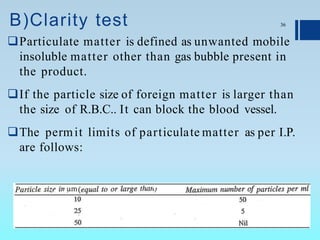
Particulate matter is defined as unwanted mobile
insoluble matter other than gas bubble present in
the product.
If the particle size of foreign matter is larger than
the size of R.B.C.. It can block the blood vessel.
The permit limits of particulate matter as per I.P.
are follows:
36
C) Leakage test
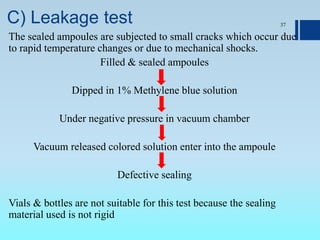
The sealed ampoules are subjected to small cracks which occur due
to rapid temperature changes or due to mechanical shocks.
Filled & sealed ampoules
Dipped in 1% Methylene blue solution
Under negative pressure in vacuum chamber
Vacuum released colored solution enter into the ampoule
Defective sealing
Vials & bottles are not suitable for this test because the sealing
material used is not rigid
37
D) Pyrogen test
Pyrogen = “Pyro” (Greek = Fire) + “gen” (Greek
= beginning).
Fever producing, metabolic by-products of
microbial growth and death.
Bacterial pyrogens are called “Endotoxins”.
Gram negative bacteria produce more potent
endotoxins than gram + bacteria and fungi.
Endotoxins are heat stable lipopolysaccharides
(LPS) present in bacterial cell walls, not present
in cell-free bacterial filtrates.
38
Types of Pyrogen test
a. Rabbit test
b. Limulus amebocyte lysate
[LAL] test
39
Rabbit test method
 Dissolve the subs being examined in, or dilute it with a pyrogenic free
saline solution.
 Warm the liquid being examined to approx. 38.5o C temp before injection.
 The volume of injection is NLT 0.5ml/kg & NMT 10ml/kg of body weight
 Withhold water during test.
 Clinical thermometer is inserted into the rectum of rabbit to record body
temperature.
 2 normal reading of rectal temp are should be taken prior to the test
injection at an interval of half an hours & its mean is calculated- initial
temperature.
 The solution under test is injected through an ear vein.
 Record the temp of each rabbit in an interval of 30 min for 3 hrs.
 The difference between initial temp & maximum temp is recorded- taken
as response.
40
Limulus amebocyte lysate [LAL]
test
• Limulus amebocyte lysate [LAL] test another
method for the determination of pyrogenic
endotoxins.
• In this method the test solution is combined with
a cell lysate from the ameabocyte [blood cells] of
horse shoe crab.
• Any endotoxin that might be present will be
coagulated with protein fraction of the amebocyte
and results in the formation of a gel.
• This consider to be simple, rapid and of greater
sensitivity that the rabbit test.
41
E) Assay
Assay is performed to standardize
according to the method given in the
monograph of that parenteral preparation in
the pharmacopoeia.
Assay is done to check the quantity of
medicament present in the parenteral
preparation.
42
Reference
Lachman/Lieberman’s “The Theory and Practice Of
Industrial Pharmacy” Fourth Edition 2013, Edited by:
Roop K Khar, SP Vyas, Farhan J Ahmad, Gaurav K Jain,
CBS Publishers and Distributors Pvt Ltd, New Delhi.
Doornbos C and Hann P. Optimization Techniques in
Formulation and Processing. In Encyclopedia of
Pharmaceutical Technology. Swarbrick J and Boylan JC,
Eds., Vol. II, Marcel Dekker, New York. 199
Modern Pharmaceutics Fourth Edition, Revised and
Expanded, Edited By G.S.Banker & C.T.Rhodes, Marcel
Dekker pg387-389.
43
Thank you