1
1
review
on
Physicochemical
factors
Under
PreformUlation stUdy
Deepak Chandra Sharma
Research Associate
(Formulation Research & Development)
PreformUlation
2
 What it is?
It is defined as phase of research and development
in which preformulation scientist characterize
physical & chemical properties of new drug molecule
in order to develop safe, effective, and stable dosage
form.
2
direct Benefits
3
Gives direction for development of formulation in choice of
dosage form,excipients,composition,physical structure.
Helps in adjustment of Pharmacokinetics and biopharmaceutical
properties.
Support for process development of drug substance
(yield,filtration..).
Produce necessary and useful data for development of analytical
methods.
3
4
4
Receive new drug
substance
Obtain all available
information
If not available, do the
literature search.
Determine physical
property of the new API.
Macroscopic and
Microscopic examination
Determine polymorphs,
solvates and hydrates.
Stability testing at
normal and
exaggerated
condition.
Determine their
solubility, partition co-
efficient, pKa,
dissolution rate.
If poor bioavailability test results due to
solubility, pKa, P, etc. make new salt or ester
If satisfactory
Check lot to lot
uniformity
Select most stable,
active form for
bioavailability testing.
Check API stability
with excipients
Prepare worksheet and final
preformulation report and issue
to product development dept.
methods for determination
of Physicochemical
ProPerties
5
According to USFDA it can be characterized as:-
 Melting point (hot stage microscopy).
 IR spectroscopy.
 XRD.
 Thermal analytical technique.
 Solid state Raman spectroscopy.
 Crystalline index of refraction.
 Phase solution analysis.
 Solution calorimetery.
 Comparative intrinsic dissolution rate.
5
6
6
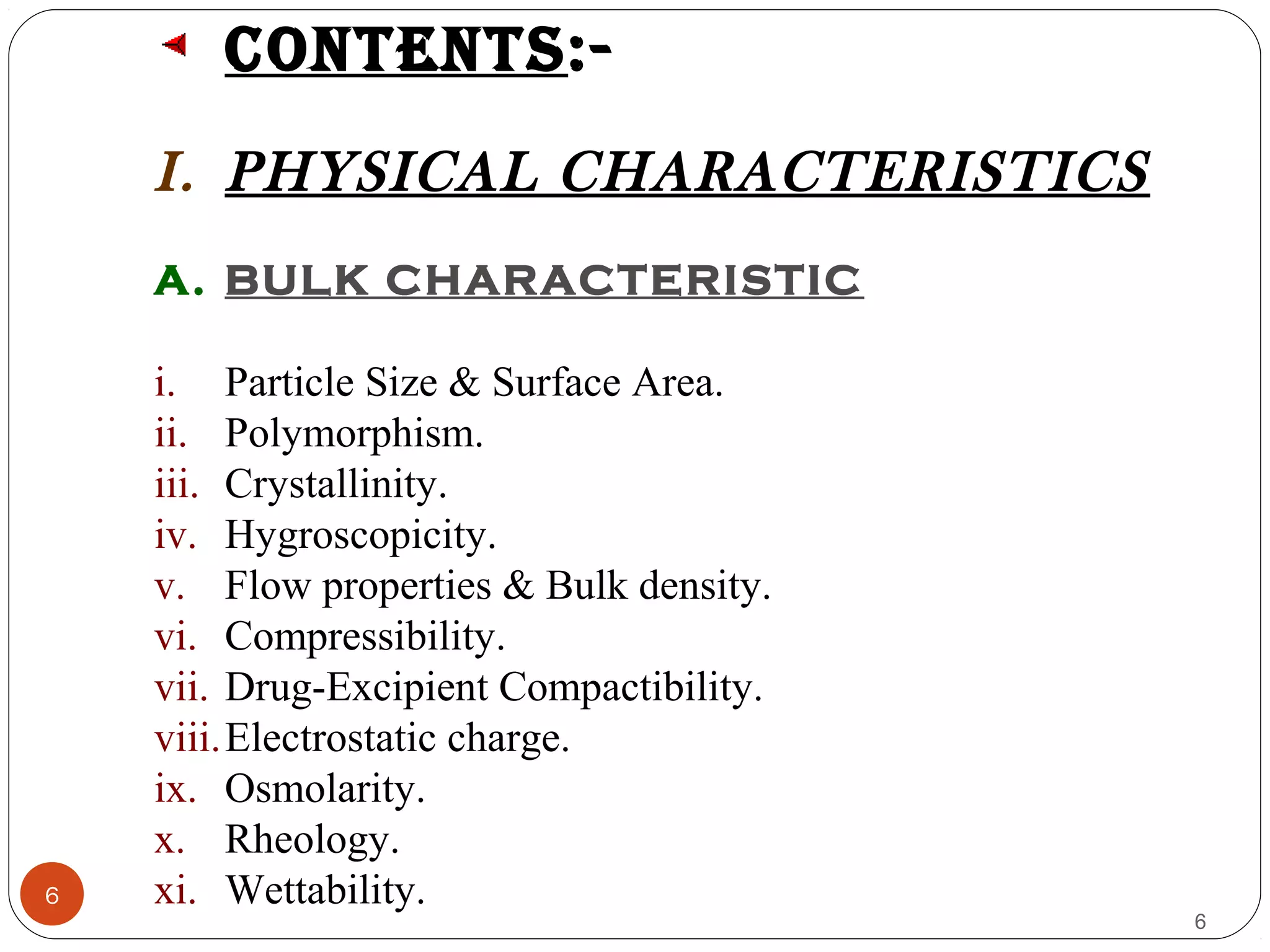
contents:-
I. PHYSICAL CHARACTERISTICS
A. BULK CHARACTERISTIC
i. Particle Size & Surface Area.
ii. Polymorphism.
iii. Crystallinity.
iv. Hygroscopicity.
v. Flow properties & Bulk density.
vi. Compressibility.
vii. Drug-Excipient Compactibility.
viii.Electrostatic charge.
ix. Osmolarity.
x. Rheology.
xi. Wettability.
7
7
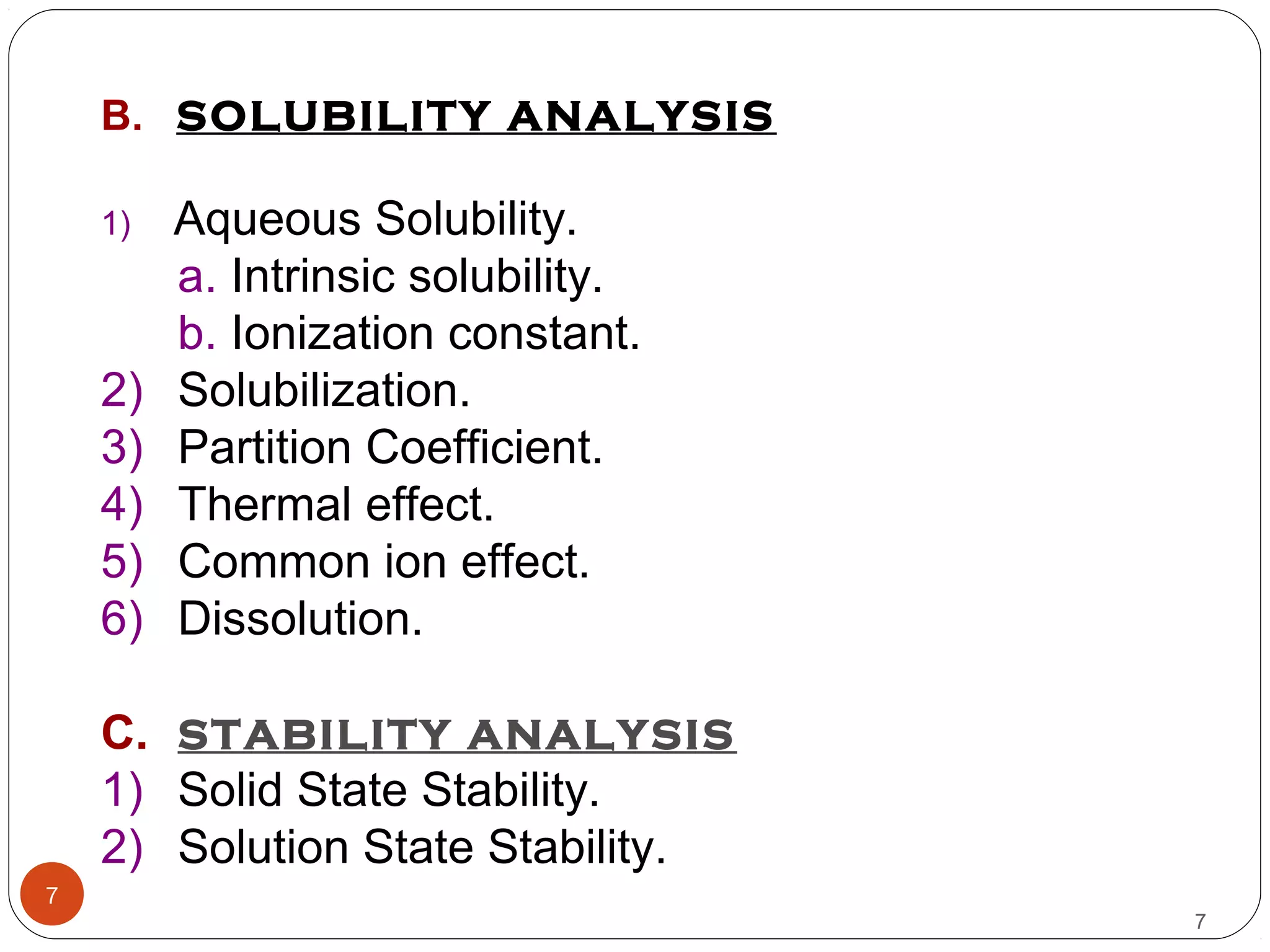
B. SOLUBILITY ANALYSIS
1) Aqueous Solubility.
a. Intrinsic solubility.
b. Ionization constant.
2) Solubilization.
3) Partition Coefficient.
4) Thermal effect.
5) Common ion effect.
6) Dissolution.
C. STABILITY ANALYSIS
1) Solid State Stability.
2) Solution State Stability.
8
8
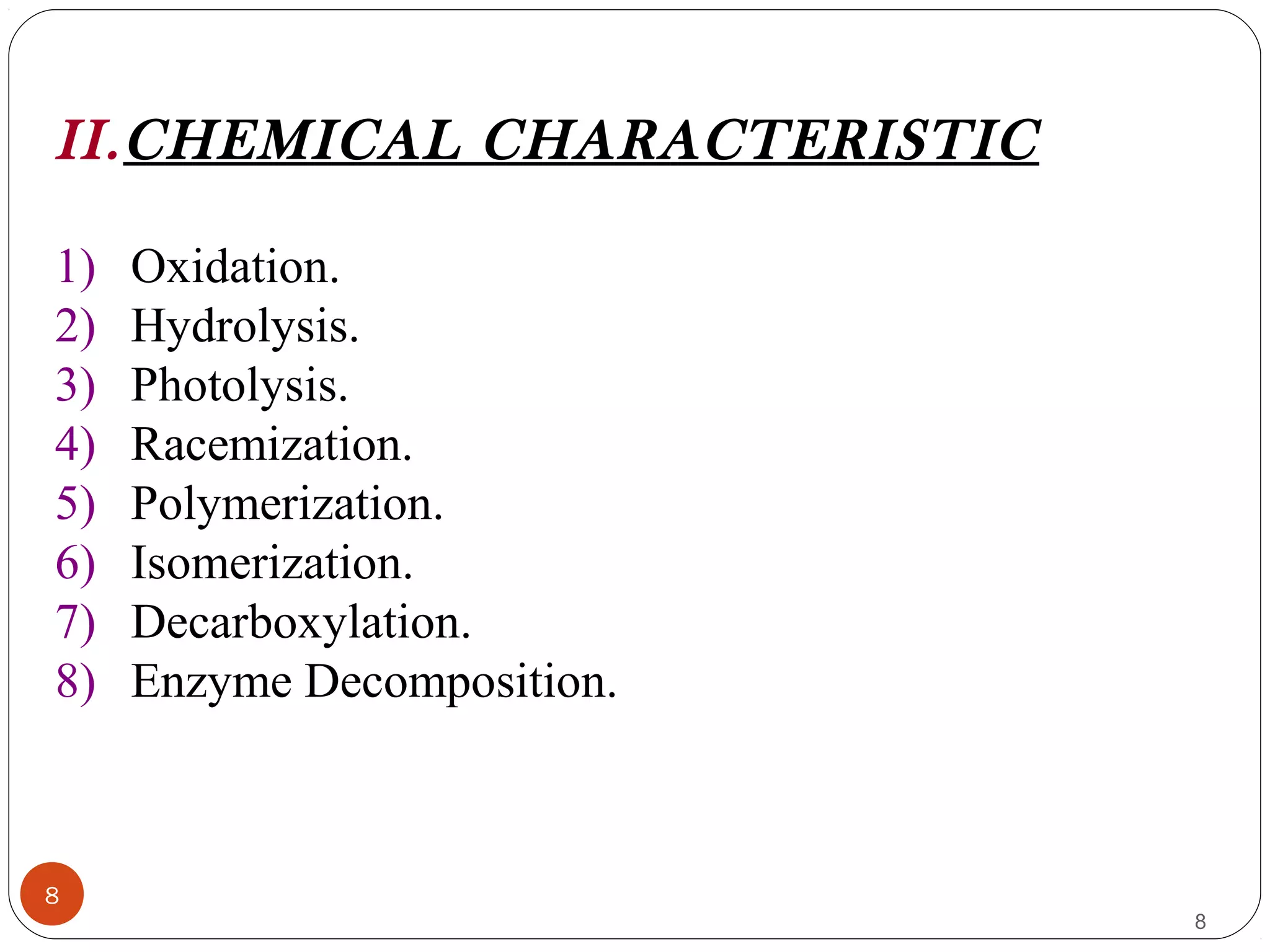
II.CHEMICAL CHARACTERISTIC
1) Oxidation.
2) Hydrolysis.
3) Photolysis.
4) Racemization.
5) Polymerization.
6) Isomerization.
7) Decarboxylation.
8) Enzyme Decomposition.
aQUeoUs solUBility:-
There are two fundamental properties mandatory for a new
compound.
(A) INTRINSIC SOLUBILITY (CO) :-
9
S = So {1 + (K1 / [H+])} ------ for weak acids.
S = So {1 + ([H+] / K2)} ------ for weak bases.
where, S = Solubility at a given pH.
So = Intrinsic solubility of the neutral form.
K1 = Dissociation constant of weak acid.
K2= Dissociation constant of weak base.
9Contd…
The intrinsic solubility should ideally be measured at two
temperatures
(1) 4 °C To Ensure Physical And Chemical Stability.
(2) 37°C To Support Biopharmaceutical Evaluation.
10
Method to determine solubility
(1) Equilibrium solubility method
(2) Turbidometric solubility method
(3) Nephlometric solubility method
(4) Ultrafiltration LC/MS solubility method
(5) Direct solubility method
(6) NRTL – SAC method
(7) COSMO SAC method
)
10
(B) Ionization constant (pKa):-
11
 75 % of all drugs are weak bases,
 20 % are weak acids and only,
 5 % are nonionic amphoteric or alcohol.
 Henderson-Hasselbalch equation:-
pH = pKa + log [ionized form] / [unionized form] --- for acids.
pH = pKa + log [unionized form] / [ionized form] --- for bases.
 Uses of these equations:-
To determine pKa.
To predict solubility at any pH provided that Co & pKa are
known.
To facilitate the selection of suitable salt forming compounds.
To predict the solubility & pH properties of the salts.
11
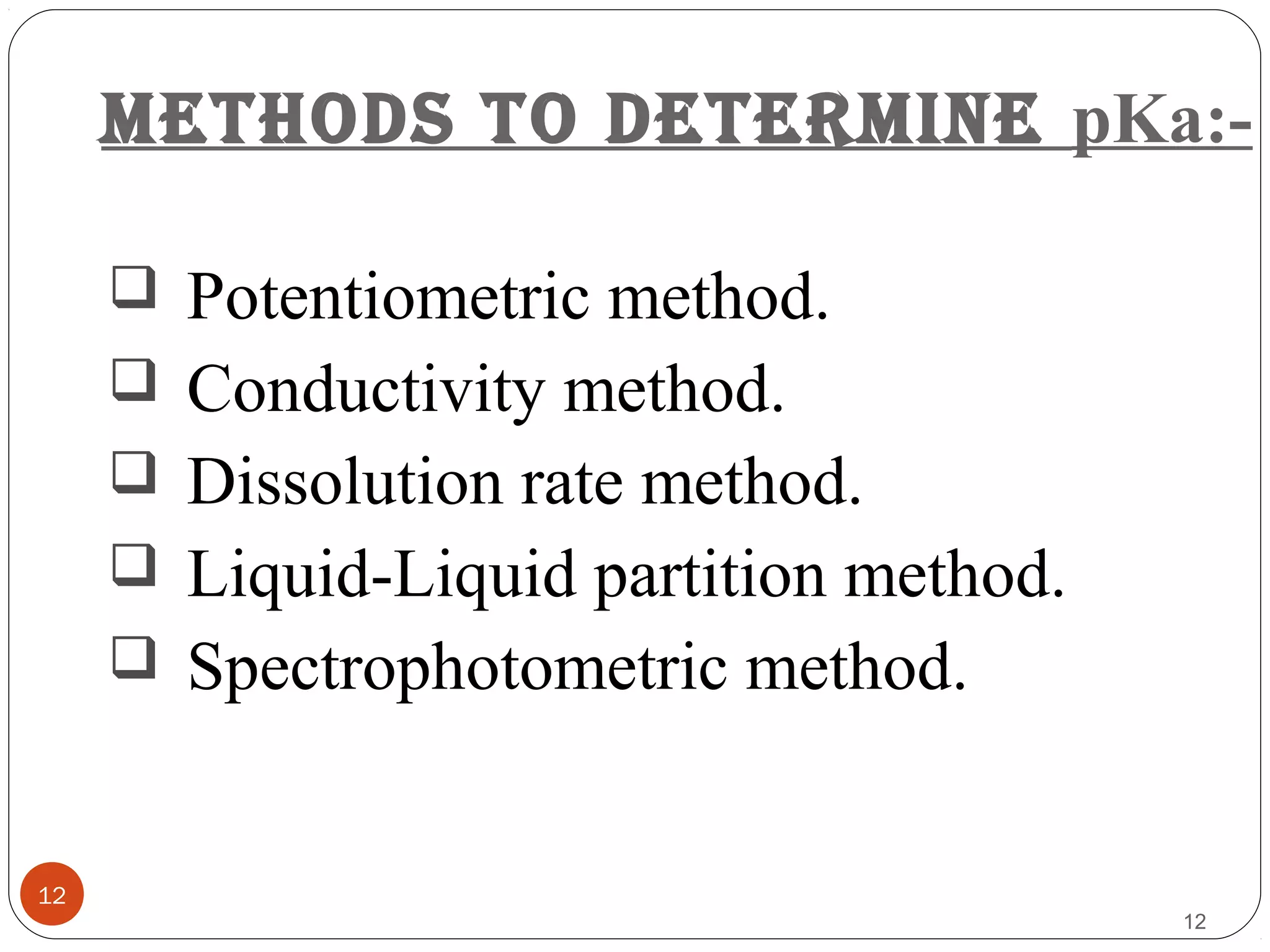
methods to determine pKa:-
12
 Potentiometric method.
 Conductivity method.
 Dissolution rate method.
 Liquid-Liquid partition method.
 Spectrophotometric method.
12
13
13
SOLUBILIZATION
Many different approaches have been developed to improve
drug solubility:
Micronization:-
Eg. Griseofulvin shows increased solubility by reducing
particle size.
Change in pH:-
Eg. Solubility of Nimesulide increases as pH is increased.
Eg.Arginine increases solubility of coumarins.
Eg. Etoposide formulation is difficult because of its poor
solubility & labile chemical stability so Etoposide loaded
emulsion (ELE) is formulated most stable at pH 4-5.
14
14
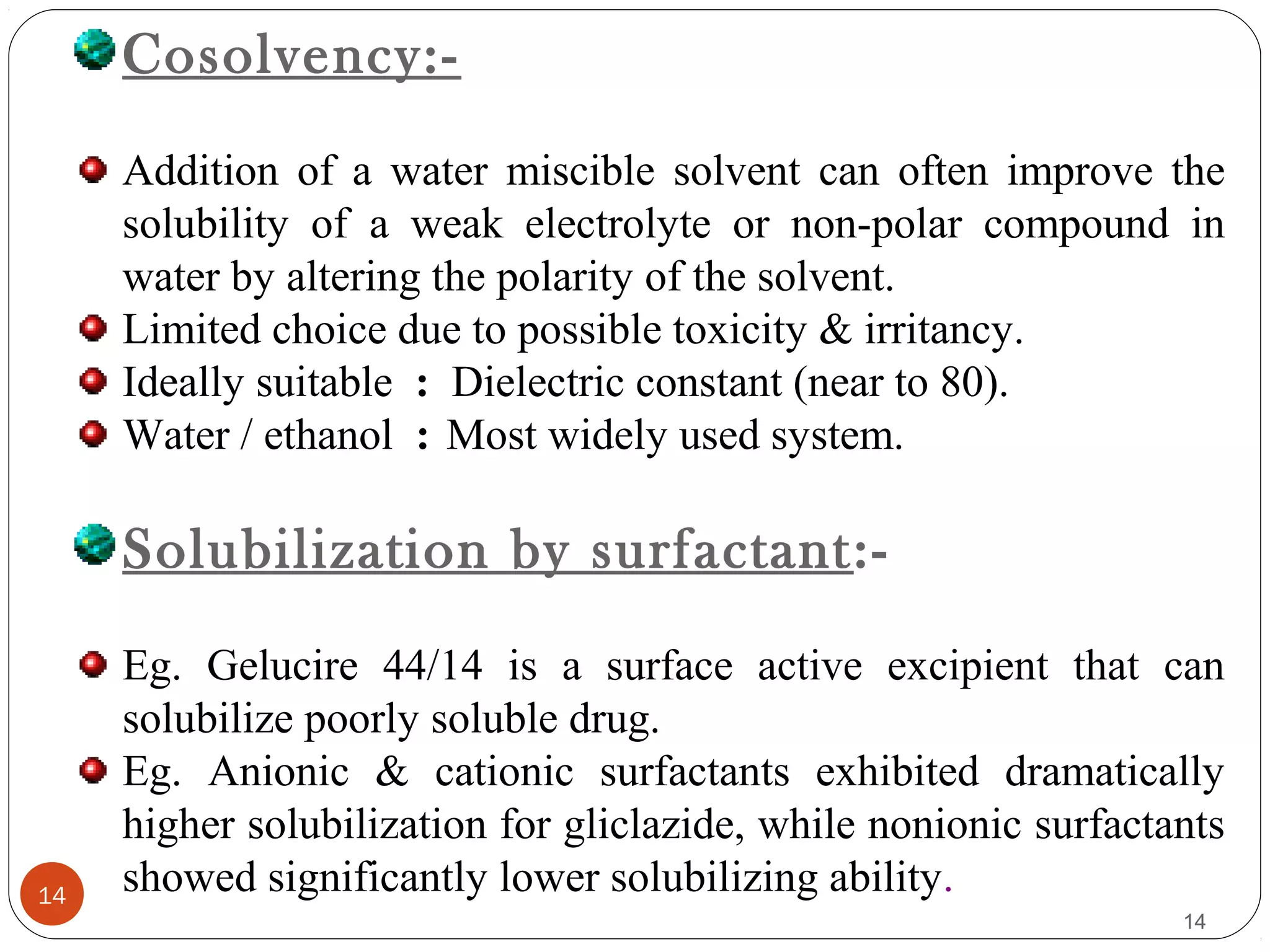
Cosolvency:-
Addition of a water miscible solvent can often improve the
solubility of a weak electrolyte or non-polar compound in
water by altering the polarity of the solvent.
Limited choice due to possible toxicity & irritancy.
Ideally suitable : Dielectric constant (near to 80).
Water / ethanol : Most widely used system.
Solubilization by surfactant:-
Eg. Gelucire 44/14 is a surface active excipient that can
solubilize poorly soluble drug.
Eg. Anionic & cationic surfactants exhibited dramatically
higher solubilization for gliclazide, while nonionic surfactants
showed significantly lower solubilizing ability.
15
15
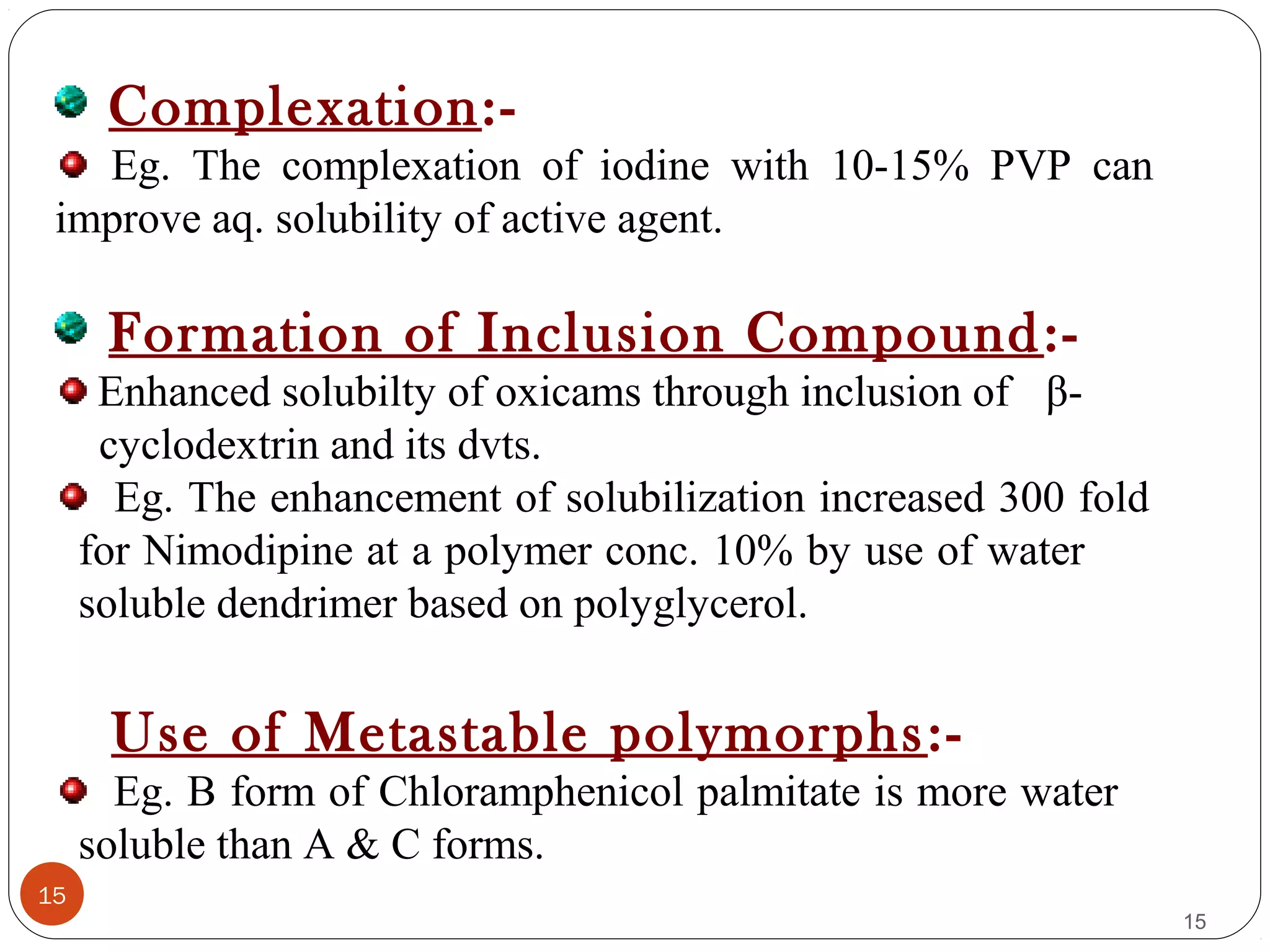
Complexation:-
Eg. The complexation of iodine with 10-15% PVP can
improve aq. solubility of active agent.
Formation of Inclusion Compound:-
Enhanced solubilty of oxicams through inclusion of β-
cyclodextrin and its dvts.
Eg. The enhancement of solubilization increased 300 fold
for Nimodipine at a polymer conc. 10% by use of water
soluble dendrimer based on polyglycerol.
Use of Metastable polymorphs:-
Eg. B form of Chloramphenicol palmitate is more water
soluble than A & C forms.
16
16
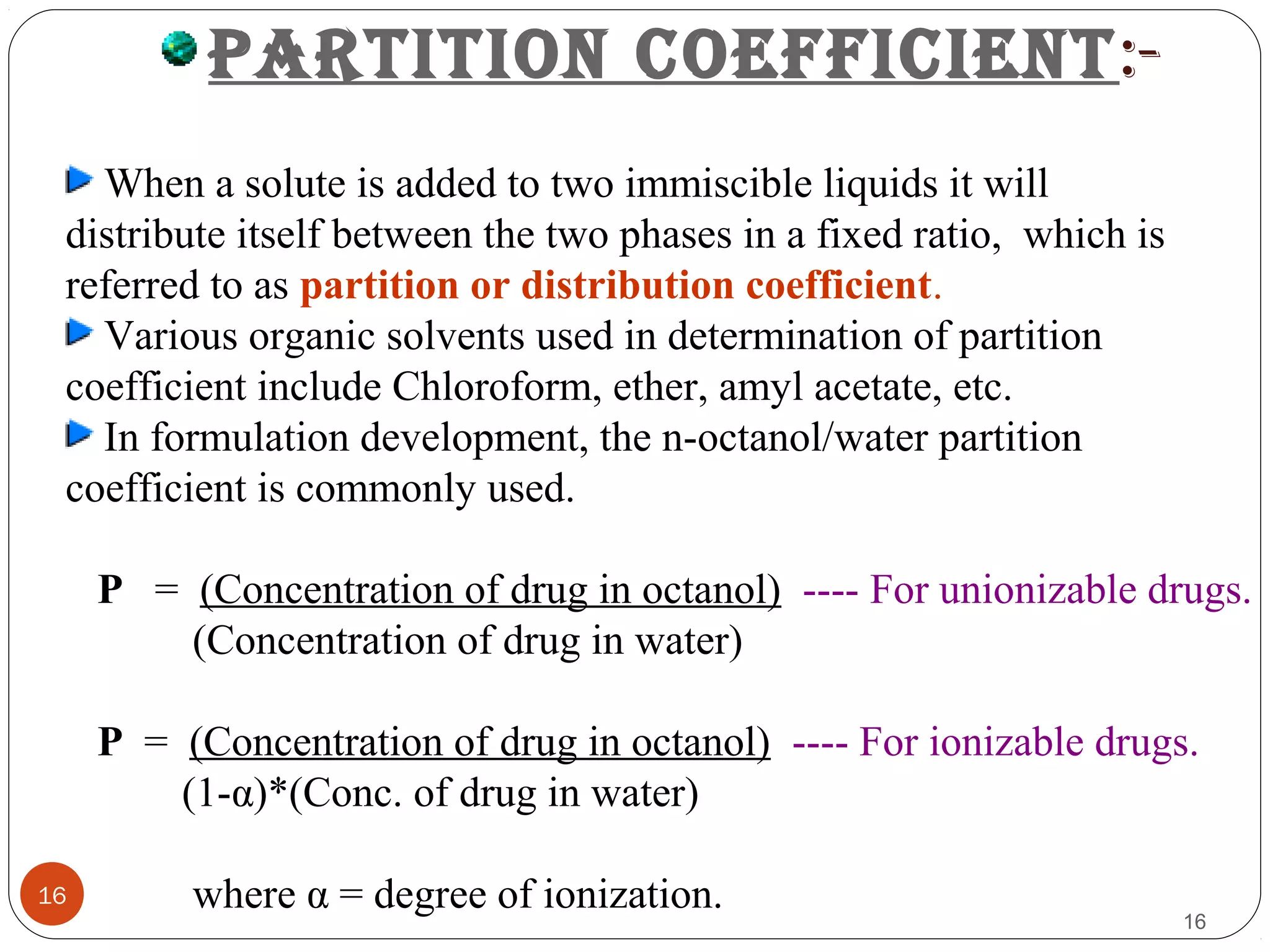
PARTITION COEFFICIENT:-
When a solute is added to two immiscible liquids it will
distribute itself between the two phases in a fixed ratio, which is
referred to as partition or distribution coefficient.
Various organic solvents used in determination of partition
coefficient include Chloroform, ether, amyl acetate, etc.
In formulation development, the n-octanol/water partition
coefficient is commonly used.
P = (Concentration of drug in octanol) ---- For unionizable drugs.
(Concentration of drug in water)
P = (Concentration of drug in octanol) ---- For ionizable drugs.
(1-α)*(Conc. of drug in water)
where α = degree of ionization.
17
17
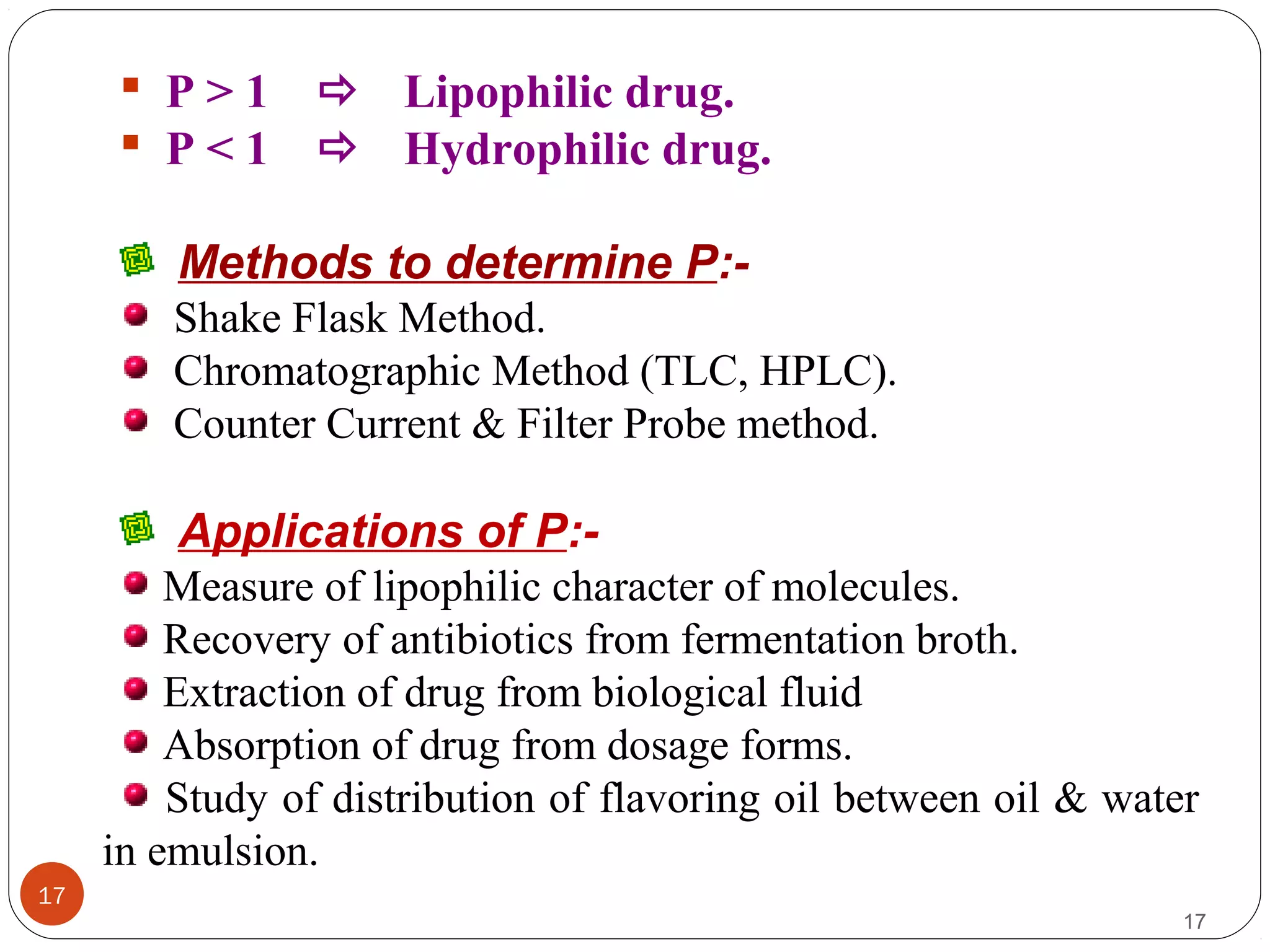
 P > 1  Lipophilic drug.
 P < 1  Hydrophilic drug.
Methods to determine P:-
Shake Flask Method.
Chromatographic Method (TLC, HPLC).
Counter Current & Filter Probe method.
Applications of P:-
Measure of lipophilic character of molecules.
Recovery of antibiotics from fermentation broth.
Extraction of drug from biological fluid
Absorption of drug from dosage forms.
Study of distribution of flavoring oil between oil & water
in emulsion.
18
18
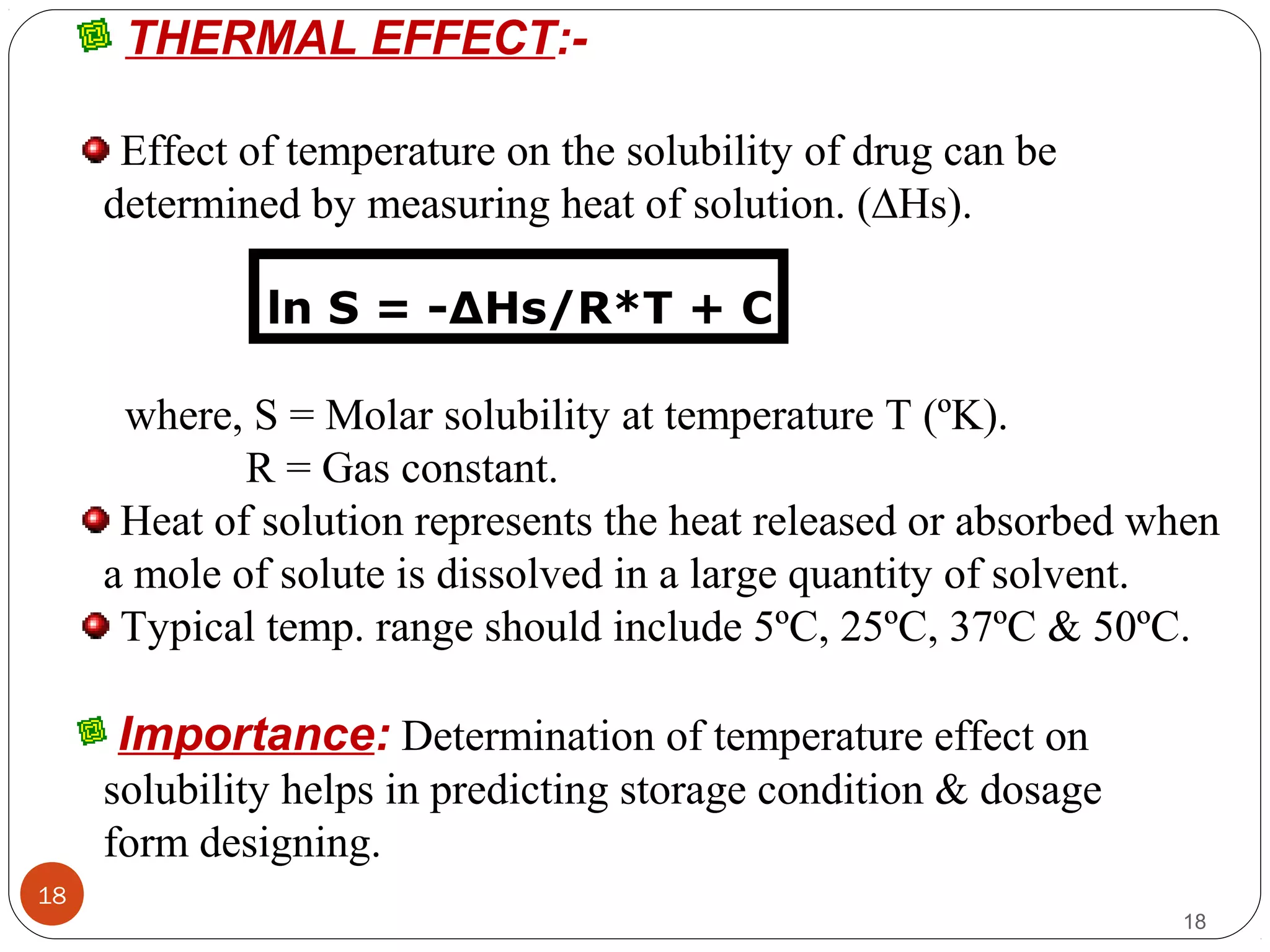
THERMAL EFFECT:-
Effect of temperature on the solubility of drug can be
determined by measuring heat of solution. (∆Hs).
ln S = -∆Hs/R*T + C
where, S = Molar solubility at temperature T (ºK).
R = Gas constant.
Heat of solution represents the heat released or absorbed when
a mole of solute is dissolved in a large quantity of solvent.
Typical temp. range should include 5ºC, 25ºC, 37ºC & 50ºC.
Importance: Determination of temperature effect on
solubility helps in predicting storage condition & dosage
form designing.
19
19
COMMON ION EFFECT:-
 To identify a common ion interaction the IDR of HCl salt
should be compared between
a) Water & water containing 1.2% W/V NaCl.
b) 0.05 M HCl & 0.9% NaCl in 0.05 M HCl.
 Both saline media contains 0.2 M Cl which is typically
encountered in fluids in vivo.
DISSOLUTION
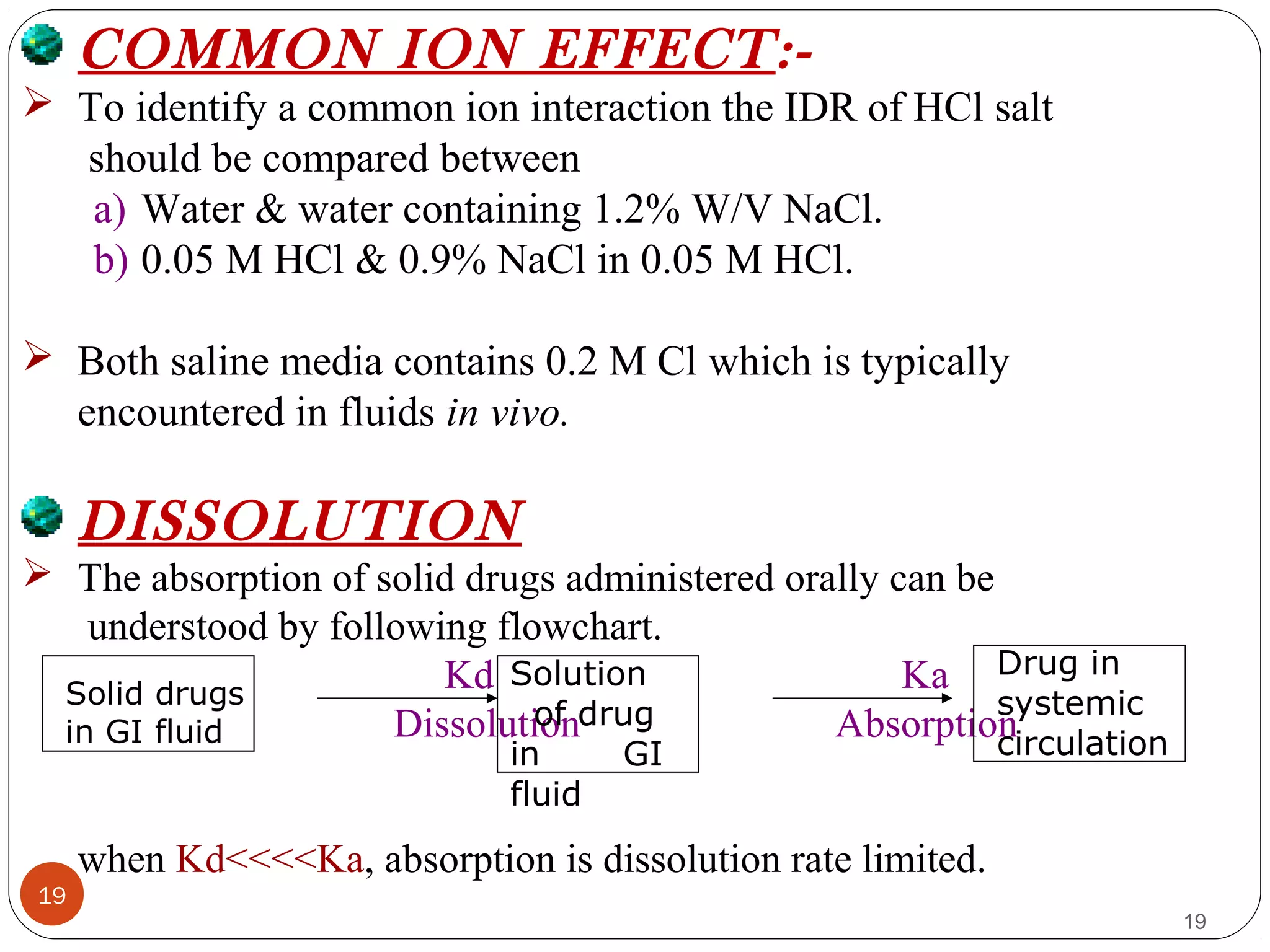
 The absorption of solid drugs administered orally can be
understood by following flowchart.
Kd Ka
Dissolution Absorption
when Kd<<<<Ka, absorption is dissolution rate limited.
Solid drugs
in GI fluid
Solution
of drug
in GI
fluid
Drug in
systemic
circulation
20
20
Dissolution rate can affect:-
• Onset of action
• Intensity of action.
• Duration of response.
• Control the overall Bioavailability of drug form.
 Dissolution is to be considered of 2 types:
Intrinsic dissolution
 Noyes-Whitney equation:
To predict if absorption would be dissolution rate limited or
not.
dC/dt = AD(Cs-C) / hv
Method to determine intrinsic dissolution:-
 Rotating disk method or Wood’s apparatus:
For determination of dissolution from constant surface area.
21
21
Particulate dissolution
 Determine the dissolution of solids at different surface area.
 It is used to study the influence on dissolution of particle size,
surface area & mixing with excipients.
STABILITY ANALYSIS
 Development of a drug substance into a suitable dosage form
requires the preformulation stability studies as:
[1] Solid state stability.
[2] Solution state stability.
 SOLID STATE STABILITY:-
 Solid state reactions are much slower & more difficult to
interpret than solution state reactions because of reduced no.
of molecular contacts between drug & excipient molecules &
occurrence of multiple reactions.
22
22
Techniques for solid state stability
studies:
 Solid State NMR Spectroscopy. (SSNMR)
 Powder X-ray diffraction. (PXRD)
 Fourier Transform IR. (FTIR)
 Raman Spectroscopy.
 Differential Scanning Calorimetry. (DSC).
 Thermo gravimetric Analysis. (TGA).
 Dynamic Vapor Sorption. (DSV).
 SOLUTION STATE STABILITY:-
The primary objective is identification of conditions
necessary to form a stable solution.
These studies include the effects of
- pH. - Oxygen.
- Light. - Temperature.
23
23
• If the results of this solution stability studies dictate the
compound as sufficiently stable, liquid formulation can be
developed.
Eg:
• Aq. Solution for injection pH 3 containing Irinotecan HCl,
phosphate buffer & WFI was stably prepared by dissolving
camptothecins without resorting to heating in the course of
production.
23/09/2009
PAPER-90101 NITU/M.PHARM/2009-
10/LMCP24
24
STRESS CONdITIONS uSEd IN
PREFORmuLATION STABILITY
ASSESSmENT:
TEST CONdITION
SOLID
Heat (°C) 4,20,30,40,40/75 % RH, 50 & 75.
Moisture uptake 30,45,60,75&90% RH at RT.
Physical stress Ball milling
AQUEOUS SOLUTION
pH 1,3,7,9 & 11 at RT & 37ºC.
Reflux in 1M HCl & 1M NaOH.
Light UV (254 & 366 nm) & Visible at RT.
Oxidation Sparing with oxygen at RT, UV may
accelerate breakdown.
25
25
CHEMICAL CHARACTERISTICS
OXIDATION
It is a very common pathway for drug degradation in
both liquid & solid formulation.
Oxidation occurs in two ways:-
1.Auto oxidation.
2.Free radical chain process.
Functional groups having high susceptibility
towards oxidation:-
 Alkenes.
 Substituted aromatic groups. (Toluene, phenols, anisole).
 Ethers.
 Thioethers.
 Amines.
26
26
AUTO
OXIDATION
FREE RADICAL
SCAVENGER
It is defined as a
reaction of any material
with
molecular oxygen which
produces free radicals
by homolytic bond
fission of a covalent
bond.
These radicals are
highly unsaturated &
readily take electron
from other substance
causing oxidation.
1) Initiation
RH R•
+ H•
2) Propogation
R•
+ O2 RO2
•
RO2
•
+ RH ROOH + R•
3) Decomposition
ROOH RO•
+ OH•
4) Termination
RO2
•
+ X Inactive product
RO2. + RO2 Inactive product
OXIDATION
27
27
FACTORS AFFECTINg OXIDATION
pROCESS:-
1)Oxygen concentration.
2)Light.
3)Heavy metals particularly those having two or more valence
state.
4)Hydrogen & Hydroxyl ion.
5)Temperature.
28
28
pREvENTION OF OXIDATION:-
1)Reducing oxygen content.
2)Storage in a dark & cool condition.
3)Addition of chelating agent. [Eg. EDTA, Citric acid, Tartaric
acid].
4)Adjustment of pH.
5)Changing solvent. [Eg. Aldehydes, ethers, ketones may
influence free radical reaction].
6)Addition of an antioxidant.
a.Reducing agent.
b.Chain inhibitors of radical induced decomposition
29
29
ANTIOXIDANT
OIL
SOLUBLE
WATER
SOLUBLE
Free radical acceptor
& inhibit free
radical chain process.
Examples
α-Tocopherol,
Hydroquinone,
Propyl gallate,
Butylated Hydroxy
Anisole (BHA),
Butylated Hydroxy
Toluene (BHT),
Lecithin.
Oxidized itself &
prevent oxidation of
drug.
Examples
Sodium
metabisulphate, Sodium
bisulphite, Acetyl
cysteine, Ascorbic
acid, Sodium
thiosulfate, Sulphur
dioxide, Thioglycolic
acid, Thioglycerol.
30
30
HYDROLYSIS
 It involves nucleophilic attack of labile groups.
 Eg. Lactam > Ester > Amide > Imide.
 When this attack is by a solvent other than water then
 it is known as solvolysis.
 It generally follows 2nd
order kinetics as there are 2 reacting species,
water and API.
 In aqueous solution, water is in excess, the reaction is 1st
order.
 Conditions that catalyze the breakdown:-
Presence of hydroxyl ion.
Presence of hydride ion.
Presence of divalent ion.
Heat.
Light.
Ionic hydrolysis.
Solution polarity & ionic strength.
High drug concentration.
31
31
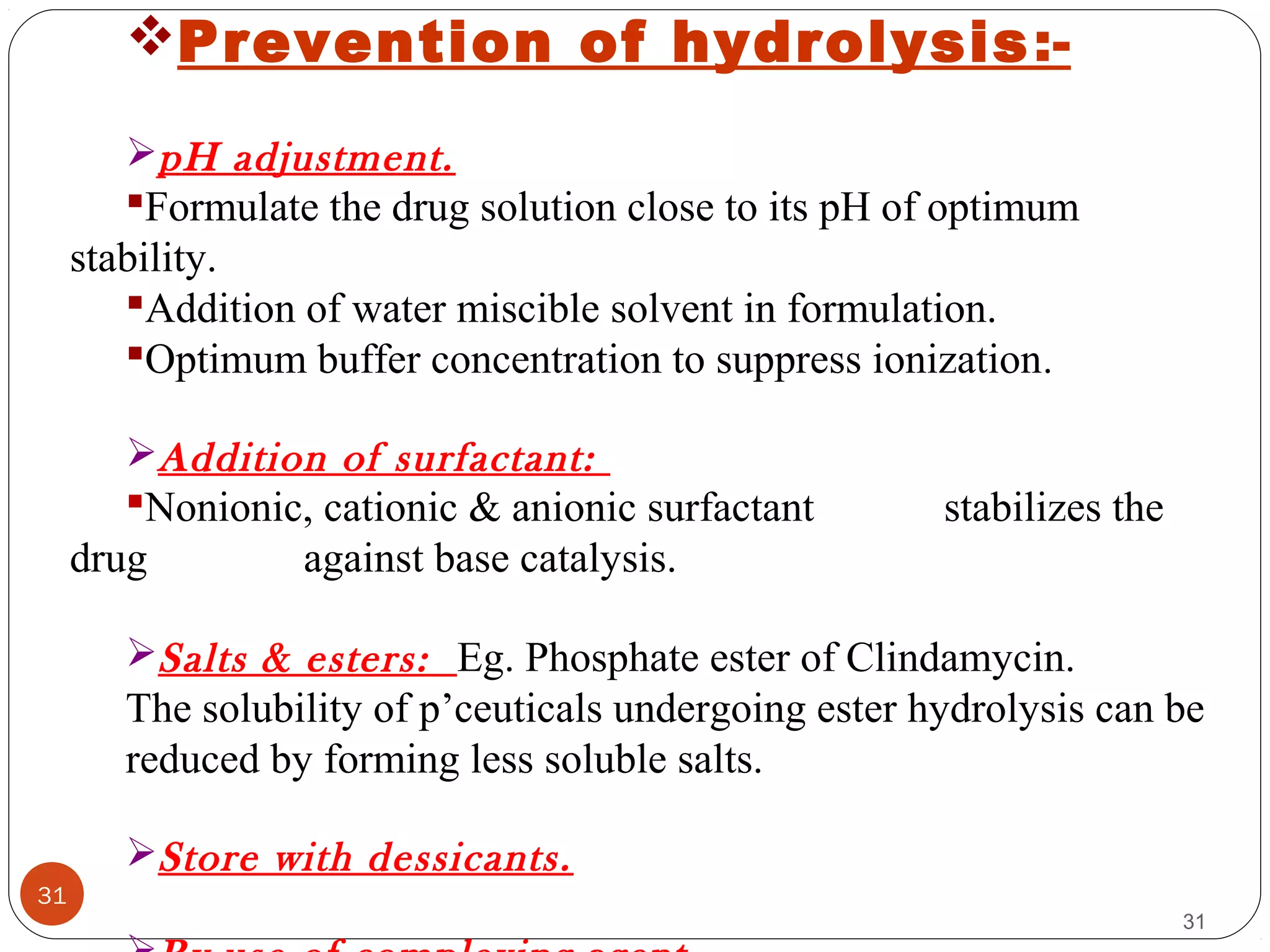
Prevention of hydrolysis:-
pH adjustment.
Formulate the drug solution close to its pH of optimum
stability.
Addition of water miscible solvent in formulation.
Optimum buffer concentration to suppress ionization.
Addition of surfactant:
Nonionic, cationic & anionic surfactant stabilizes the
drug against base catalysis.
Salts & esters: Eg. Phosphate ester of Clindamycin.
The solubility of p’ceuticals undergoing ester hydrolysis can be
reduced by forming less soluble salts.
Store with dessicants.
pHOTOLYSIS
32
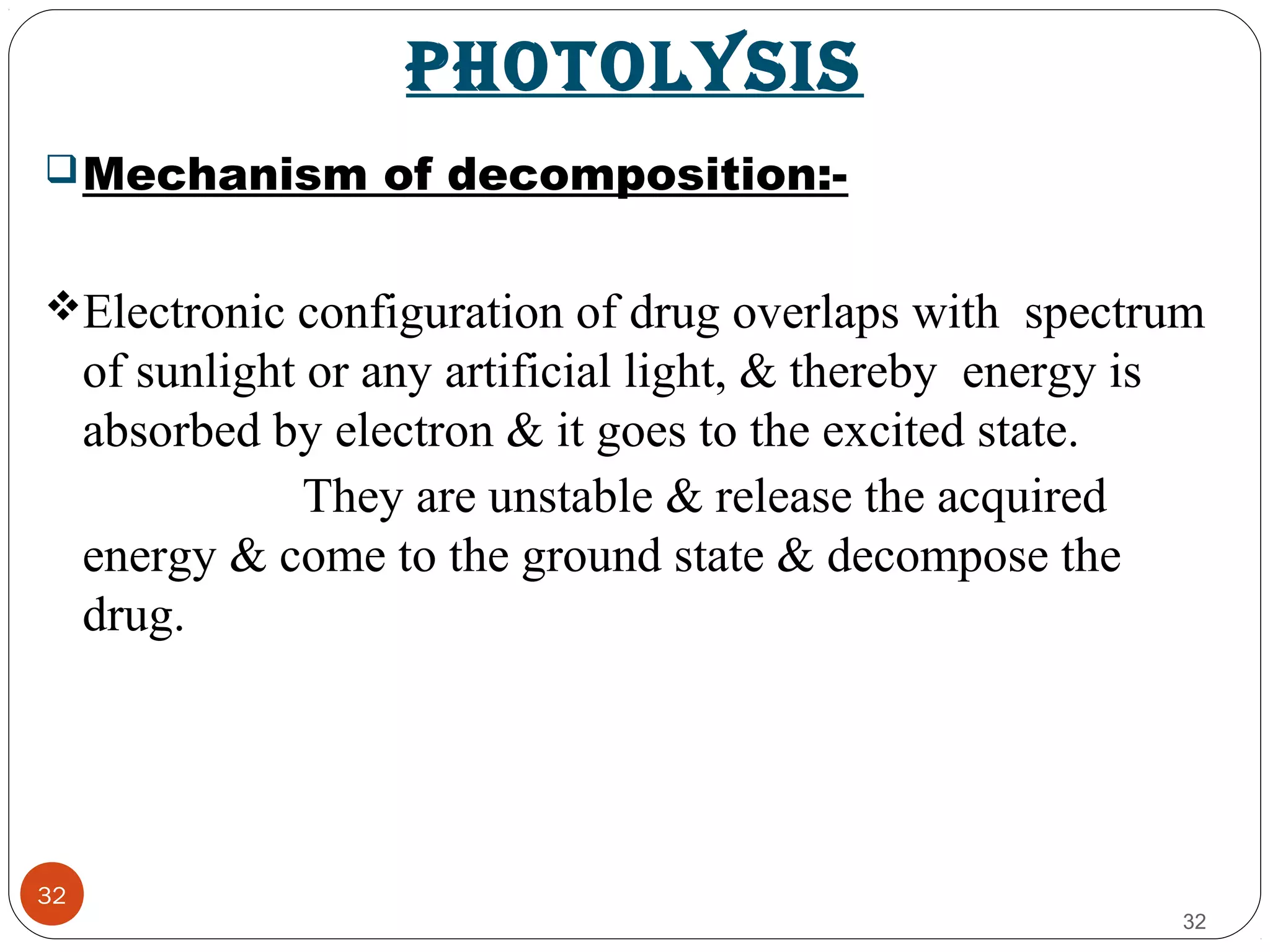
Mechanism of decomposition:-
Electronic configuration of drug overlaps with spectrum
of sunlight or any artificial light, & thereby energy is
absorbed by electron & it goes to the excited state.
They are unstable & release the acquired
energy & come to the ground state & decompose the
drug.
32
33
33
Photosensitization means molecule or
excipient which absorbs energy but do not
participate themselves directly in the
reaction but pass the energy to other that will
cause cellular damage by inducing radical
formation.
Photosensitizer
Energy transfer Electron transfer
Convert oxygen
from its ground state
to singlet excited
state.
Generate superoxide
molecule, which is an
anion radical & acts as a
powerful oxidizing
agent.
34
34
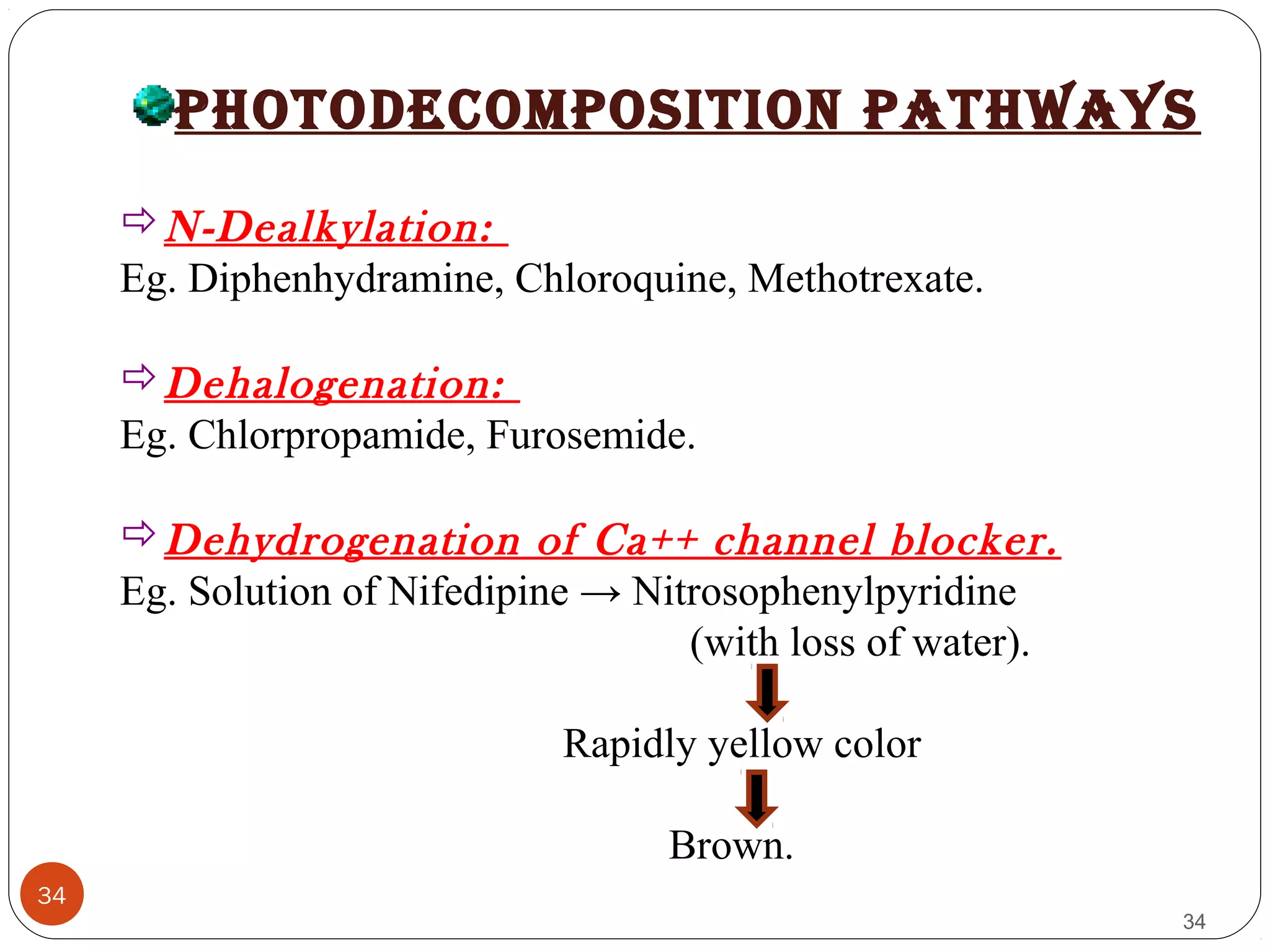
pHOTODECOMpOSITION pATHWAYS
N-Dealkylation:
Eg. Diphenhydramine, Chloroquine, Methotrexate.
Dehalogenation:
Eg. Chlorpropamide, Furosemide.
Dehydrogenation of Ca++ channel blocker.
Eg. Solution of Nifedipine → Nitrosophenylpyridine
(with loss of water).
Rapidly yellow color
Brown.
35
35
Decarboxylation in anti-inflammatory agents.
Eg. Naproxen, Flurbiprofen, Benzoxaprofen.
Oxidation.
Eg. Chlorpromazine & other phenothiazines give N- & S-
oxides in the presence of sunlight.
Isomerization & cyclization.
Eg. Noradrenaline, Doxepine.
Rearrangement.
Eg. Metronidazole → Oxidiazine → Yellow color.
Contd…
36
36
Aq. solution of Lincomycin was irradiated with UV light in
homogenous & heterogenous systems.
Lincomycin disappeared in both systems but the presence of TiO2
noticeably accelerated the degradation of antibiotic
in comparison with direct pyrolysis.
The degradation pathways involved S- & N- demethylation &
propyl dealkylation.
The photodegradation behaviour of bisphenol C studied in
monochromatic UV irradiation (λ= 254 nm) indicated that
phtotodegradation reaction rate constant of bisphenol C in
aq. soln. with β- cyclodextrin is higher than that wihtout
β- cyclodextrin, mainly due to lower bond energy
between some atoms in bisphenol C molecule after
inclusion interaction with β- cyclodextrin.
37
37
Prevention of
PhotodecomPosition:-
 Suitable packing.
Eg. Yellow-green glass gives the best protection in U.V.
region while Amber confers considerable protection against U.V.
radiation but little from I.R.
 Use of Anti-oxidant.
Eg. Photodegradation of Sulphacetamide solution may be
inhibited by an antioxidant such as sodium thiosulfate or sodium
metabisulphate.
 Protection of drug from light.
Eg. Nifedipine is manufactured under Na light.
38
38
 Avoiding sunbath.
Eg. Sparfloxacin.
 Photostabilizer [Light absorber].
• Colorant  Curcumine, Azorubine.
• Pigments  Iron oxide, Titanium dioxide.
 Coating:
Pigments like TiO2(IN NIFEDIPINE) / ZnO.
Eg. Photostabilization of Sulphasomidine Tab. by film
coating containing U.V. absorber (Oxybenzone) to protect
color & photolytic degradation.
39
39
rAcemiZAtion
The interconversion from one isomer to another can lead to
different P’cokinetic properties (ADME) as well as different
P’cological & toxicological effect.
Eg. l-epinephrine is 15 to 20 times more active than d-form,
while activity of racemic mixture is just one half of the l-form.
It follows first order kinetics.
It depends on temperature, solvent, catalyst & presence or
absence of light.
40
40
PoLYmeriZAtion
It is a continuous reaction between molecules.
More than one monomer reacts to form a polymer.
Eg. Darkening of glucose solution is attributed to polymerization
of breakdown product [5- (hydroxyl methyl) furfural].
Eg. Shellac on aging undergoes polymerization & hence
prolongs disintegration time &dissolution time.
41
41
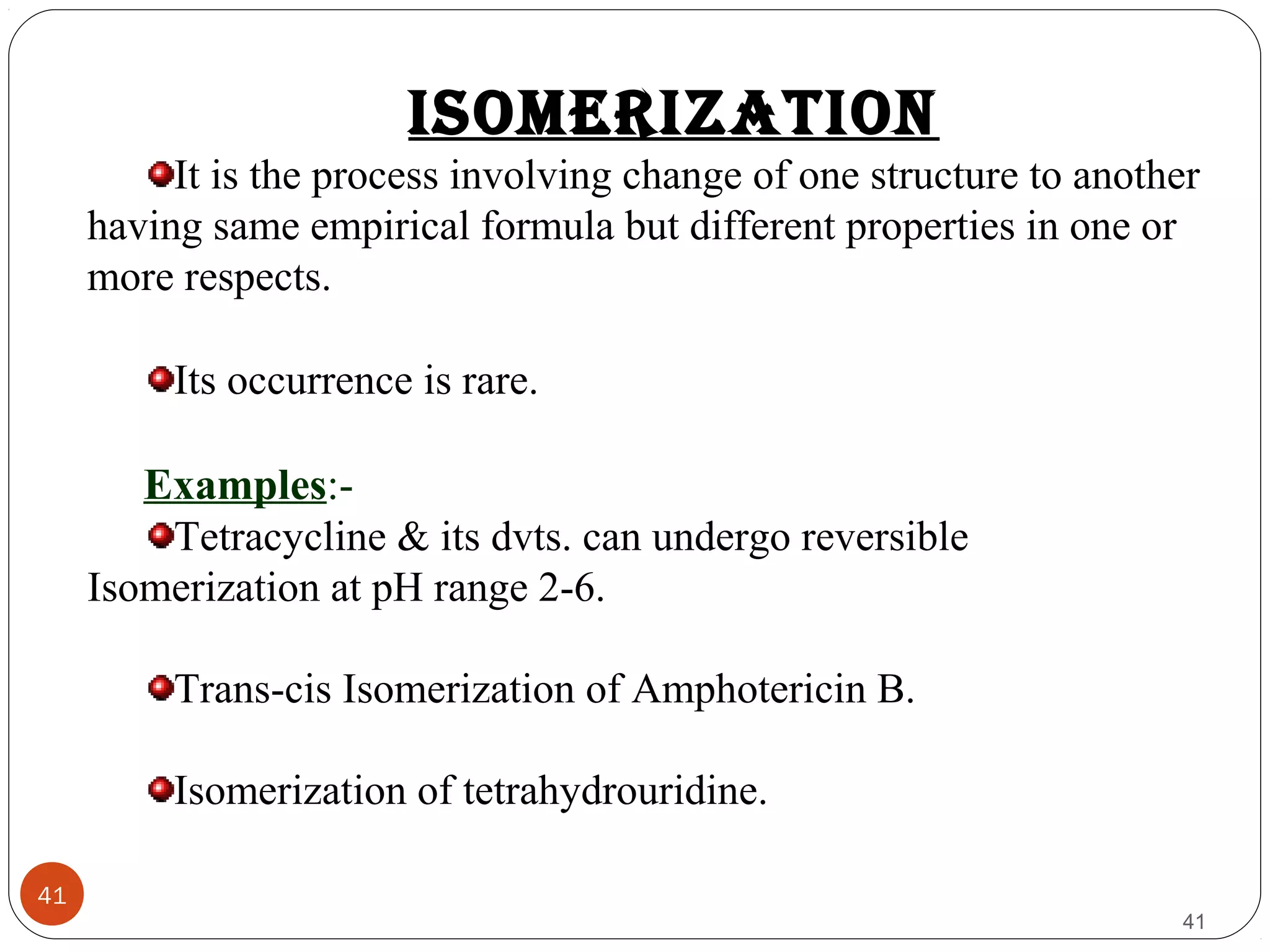
isomeriZAtion
It is the process involving change of one structure to another
having same empirical formula but different properties in one or
more respects.
Its occurrence is rare.
Examples:-
Tetracycline & its dvts. can undergo reversible
Isomerization at pH range 2-6.
Trans-cis Isomerization of Amphotericin B.
Isomerization of tetrahydrouridine.
42
42
decArBoXYLAtion
Evolution of CO2 gas from –COOH group containing drugs.
Eg. Solid PAS undergoes decarboxlation to m- aminophenol
& Carbondioxide.
enZYme decomPosition
Chemical degradation due to enzymes induced by drug results
into decomposition.
 Remedy:
Use of buccal tab.
Use of pro-drug. (L-dopa).
Improvement in physico chemical properties has been achieved
by structural optimization or prodrug approach – Enhancement
of occular penetration when given orally.(ORAL DRUG
DELIVERY SYSTEM).
43
43
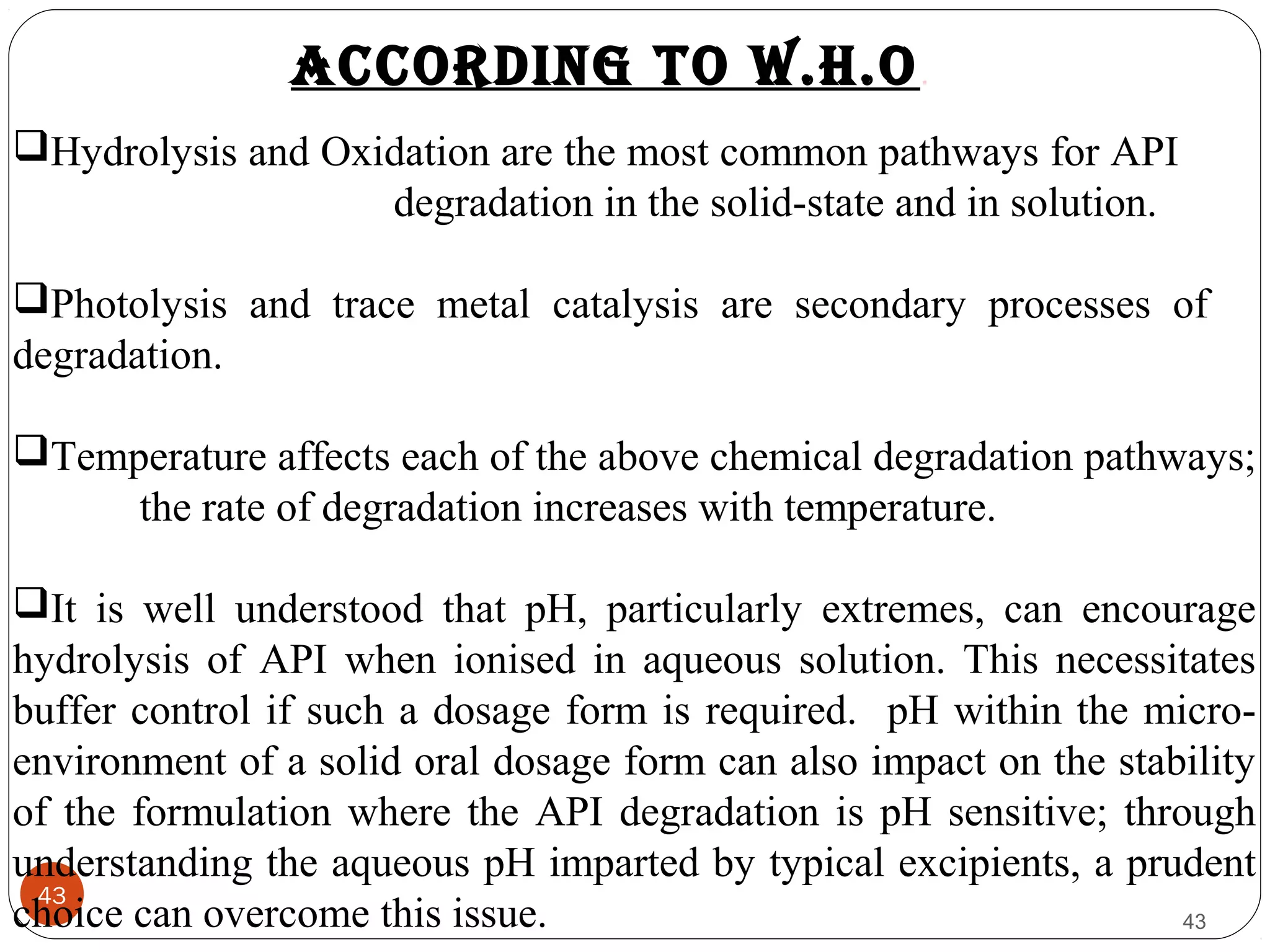
Hydrolysis and Oxidation are the most common pathways for API
degradation in the solid-state and in solution.
Photolysis and trace metal catalysis are secondary processes of
degradation.
Temperature affects each of the above chemical degradation pathways;
the rate of degradation increases with temperature.
It is well understood that pH, particularly extremes, can encourage
hydrolysis of API when ionised in aqueous solution. This necessitates
buffer control if such a dosage form is required. pH within the micro-
environment of a solid oral dosage form can also impact on the stability
of the formulation where the API degradation is pH sensitive; through
understanding the aqueous pH imparted by typical excipients, a prudent
choice can overcome this issue.
According to W.h.o.
44
44
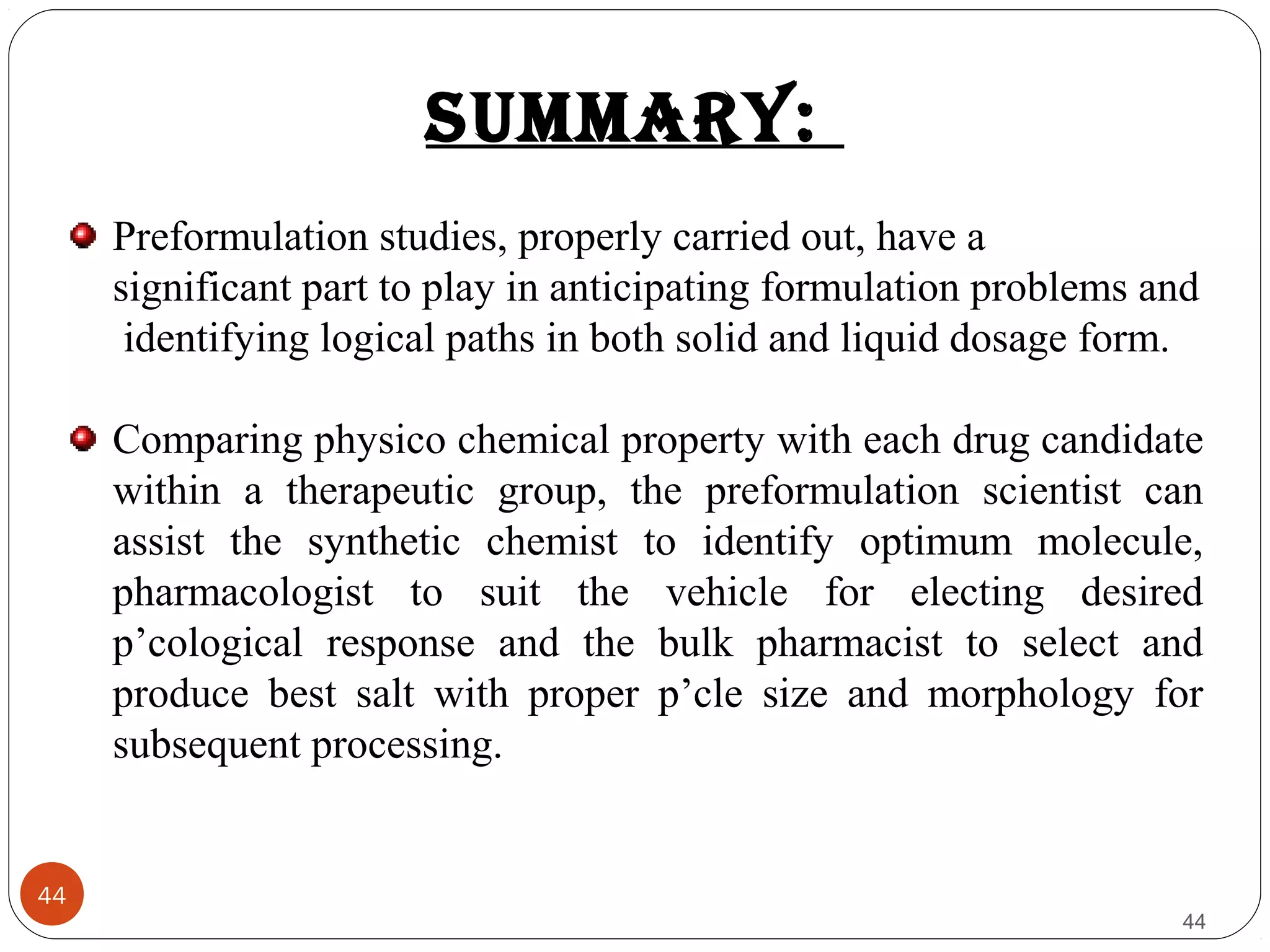
sUmmArY:
Preformulation studies, properly carried out, have a
significant part to play in anticipating formulation problems and
identifying logical paths in both solid and liquid dosage form.
Comparing physico chemical property with each drug candidate
within a therapeutic group, the preformulation scientist can
assist the synthetic chemist to identify optimum molecule,
pharmacologist to suit the vehicle for electing desired
p’cological response and the bulk pharmacist to select and
produce best salt with proper p’cle size and morphology for
subsequent processing.
45
45

preformulation study

  • 1.
    1 1 review on Physicochemical factors Under PreformUlation stUdy Deepak ChandraSharma Research Associate (Formulation Research & Development)
  • 2.
    PreformUlation 2  What itis? It is defined as phase of research and development in which preformulation scientist characterize physical & chemical properties of new drug molecule in order to develop safe, effective, and stable dosage form. 2
  • 3.
    direct Benefits 3 Gives directionfor development of formulation in choice of dosage form,excipients,composition,physical structure. Helps in adjustment of Pharmacokinetics and biopharmaceutical properties. Support for process development of drug substance (yield,filtration..). Produce necessary and useful data for development of analytical methods. 3
  • 4.
    4 4 Receive new drug substance Obtainall available information If not available, do the literature search. Determine physical property of the new API. Macroscopic and Microscopic examination Determine polymorphs, solvates and hydrates. Stability testing at normal and exaggerated condition. Determine their solubility, partition co- efficient, pKa, dissolution rate. If poor bioavailability test results due to solubility, pKa, P, etc. make new salt or ester If satisfactory Check lot to lot uniformity Select most stable, active form for bioavailability testing. Check API stability with excipients Prepare worksheet and final preformulation report and issue to product development dept.
  • 5.
    methods for determination ofPhysicochemical ProPerties 5 According to USFDA it can be characterized as:-  Melting point (hot stage microscopy).  IR spectroscopy.  XRD.  Thermal analytical technique.  Solid state Raman spectroscopy.  Crystalline index of refraction.  Phase solution analysis.  Solution calorimetery.  Comparative intrinsic dissolution rate. 5
  • 6.
    6 6 contents:- I. PHYSICAL CHARACTERISTICS A.BULK CHARACTERISTIC i. Particle Size & Surface Area. ii. Polymorphism. iii. Crystallinity. iv. Hygroscopicity. v. Flow properties & Bulk density. vi. Compressibility. vii. Drug-Excipient Compactibility. viii.Electrostatic charge. ix. Osmolarity. x. Rheology. xi. Wettability.
  • 7.
    7 7 B. SOLUBILITY ANALYSIS 1)Aqueous Solubility. a. Intrinsic solubility. b. Ionization constant. 2) Solubilization. 3) Partition Coefficient. 4) Thermal effect. 5) Common ion effect. 6) Dissolution. C. STABILITY ANALYSIS 1) Solid State Stability. 2) Solution State Stability.
  • 8.
    8 8 II.CHEMICAL CHARACTERISTIC 1) Oxidation. 2)Hydrolysis. 3) Photolysis. 4) Racemization. 5) Polymerization. 6) Isomerization. 7) Decarboxylation. 8) Enzyme Decomposition.
  • 9.
    aQUeoUs solUBility:- There aretwo fundamental properties mandatory for a new compound. (A) INTRINSIC SOLUBILITY (CO) :- 9 S = So {1 + (K1 / [H+])} ------ for weak acids. S = So {1 + ([H+] / K2)} ------ for weak bases. where, S = Solubility at a given pH. So = Intrinsic solubility of the neutral form. K1 = Dissociation constant of weak acid. K2= Dissociation constant of weak base. 9Contd…
  • 10.
    The intrinsic solubilityshould ideally be measured at two temperatures (1) 4 °C To Ensure Physical And Chemical Stability. (2) 37°C To Support Biopharmaceutical Evaluation. 10 Method to determine solubility (1) Equilibrium solubility method (2) Turbidometric solubility method (3) Nephlometric solubility method (4) Ultrafiltration LC/MS solubility method (5) Direct solubility method (6) NRTL – SAC method (7) COSMO SAC method ) 10
  • 11.
    (B) Ionization constant(pKa):- 11  75 % of all drugs are weak bases,  20 % are weak acids and only,  5 % are nonionic amphoteric or alcohol.  Henderson-Hasselbalch equation:- pH = pKa + log [ionized form] / [unionized form] --- for acids. pH = pKa + log [unionized form] / [ionized form] --- for bases.  Uses of these equations:- To determine pKa. To predict solubility at any pH provided that Co & pKa are known. To facilitate the selection of suitable salt forming compounds. To predict the solubility & pH properties of the salts. 11
  • 12.
    methods to determinepKa:- 12  Potentiometric method.  Conductivity method.  Dissolution rate method.  Liquid-Liquid partition method.  Spectrophotometric method. 12
  • 13.
    13 13 SOLUBILIZATION Many different approacheshave been developed to improve drug solubility: Micronization:- Eg. Griseofulvin shows increased solubility by reducing particle size. Change in pH:- Eg. Solubility of Nimesulide increases as pH is increased. Eg.Arginine increases solubility of coumarins. Eg. Etoposide formulation is difficult because of its poor solubility & labile chemical stability so Etoposide loaded emulsion (ELE) is formulated most stable at pH 4-5.
  • 14.
    14 14 Cosolvency:- Addition of awater miscible solvent can often improve the solubility of a weak electrolyte or non-polar compound in water by altering the polarity of the solvent. Limited choice due to possible toxicity & irritancy. Ideally suitable : Dielectric constant (near to 80). Water / ethanol : Most widely used system. Solubilization by surfactant:- Eg. Gelucire 44/14 is a surface active excipient that can solubilize poorly soluble drug. Eg. Anionic & cationic surfactants exhibited dramatically higher solubilization for gliclazide, while nonionic surfactants showed significantly lower solubilizing ability.
  • 15.
    15 15 Complexation:- Eg. The complexationof iodine with 10-15% PVP can improve aq. solubility of active agent. Formation of Inclusion Compound:- Enhanced solubilty of oxicams through inclusion of β- cyclodextrin and its dvts. Eg. The enhancement of solubilization increased 300 fold for Nimodipine at a polymer conc. 10% by use of water soluble dendrimer based on polyglycerol. Use of Metastable polymorphs:- Eg. B form of Chloramphenicol palmitate is more water soluble than A & C forms.
  • 16.
    16 16 PARTITION COEFFICIENT:- When asolute is added to two immiscible liquids it will distribute itself between the two phases in a fixed ratio, which is referred to as partition or distribution coefficient. Various organic solvents used in determination of partition coefficient include Chloroform, ether, amyl acetate, etc. In formulation development, the n-octanol/water partition coefficient is commonly used. P = (Concentration of drug in octanol) ---- For unionizable drugs. (Concentration of drug in water) P = (Concentration of drug in octanol) ---- For ionizable drugs. (1-α)*(Conc. of drug in water) where α = degree of ionization.
  • 17.
    17 17  P >1  Lipophilic drug.  P < 1  Hydrophilic drug. Methods to determine P:- Shake Flask Method. Chromatographic Method (TLC, HPLC). Counter Current & Filter Probe method. Applications of P:- Measure of lipophilic character of molecules. Recovery of antibiotics from fermentation broth. Extraction of drug from biological fluid Absorption of drug from dosage forms. Study of distribution of flavoring oil between oil & water in emulsion.
  • 18.
    18 18 THERMAL EFFECT:- Effect oftemperature on the solubility of drug can be determined by measuring heat of solution. (∆Hs). ln S = -∆Hs/R*T + C where, S = Molar solubility at temperature T (ºK). R = Gas constant. Heat of solution represents the heat released or absorbed when a mole of solute is dissolved in a large quantity of solvent. Typical temp. range should include 5ºC, 25ºC, 37ºC & 50ºC. Importance: Determination of temperature effect on solubility helps in predicting storage condition & dosage form designing.
  • 19.
    19 19 COMMON ION EFFECT:- To identify a common ion interaction the IDR of HCl salt should be compared between a) Water & water containing 1.2% W/V NaCl. b) 0.05 M HCl & 0.9% NaCl in 0.05 M HCl.  Both saline media contains 0.2 M Cl which is typically encountered in fluids in vivo. DISSOLUTION  The absorption of solid drugs administered orally can be understood by following flowchart. Kd Ka Dissolution Absorption when Kd<<<<Ka, absorption is dissolution rate limited. Solid drugs in GI fluid Solution of drug in GI fluid Drug in systemic circulation
  • 20.
    20 20 Dissolution rate canaffect:- • Onset of action • Intensity of action. • Duration of response. • Control the overall Bioavailability of drug form.  Dissolution is to be considered of 2 types: Intrinsic dissolution  Noyes-Whitney equation: To predict if absorption would be dissolution rate limited or not. dC/dt = AD(Cs-C) / hv Method to determine intrinsic dissolution:-  Rotating disk method or Wood’s apparatus: For determination of dissolution from constant surface area.
  • 21.
    21 21 Particulate dissolution  Determinethe dissolution of solids at different surface area.  It is used to study the influence on dissolution of particle size, surface area & mixing with excipients. STABILITY ANALYSIS  Development of a drug substance into a suitable dosage form requires the preformulation stability studies as: [1] Solid state stability. [2] Solution state stability.  SOLID STATE STABILITY:-  Solid state reactions are much slower & more difficult to interpret than solution state reactions because of reduced no. of molecular contacts between drug & excipient molecules & occurrence of multiple reactions.
  • 22.
    22 22 Techniques for solidstate stability studies:  Solid State NMR Spectroscopy. (SSNMR)  Powder X-ray diffraction. (PXRD)  Fourier Transform IR. (FTIR)  Raman Spectroscopy.  Differential Scanning Calorimetry. (DSC).  Thermo gravimetric Analysis. (TGA).  Dynamic Vapor Sorption. (DSV).  SOLUTION STATE STABILITY:- The primary objective is identification of conditions necessary to form a stable solution. These studies include the effects of - pH. - Oxygen. - Light. - Temperature.
  • 23.
    23 23 • If theresults of this solution stability studies dictate the compound as sufficiently stable, liquid formulation can be developed. Eg: • Aq. Solution for injection pH 3 containing Irinotecan HCl, phosphate buffer & WFI was stably prepared by dissolving camptothecins without resorting to heating in the course of production.
  • 24.
    23/09/2009 PAPER-90101 NITU/M.PHARM/2009- 10/LMCP24 24 STRESS CONdITIONSuSEd IN PREFORmuLATION STABILITY ASSESSmENT: TEST CONdITION SOLID Heat (°C) 4,20,30,40,40/75 % RH, 50 & 75. Moisture uptake 30,45,60,75&90% RH at RT. Physical stress Ball milling AQUEOUS SOLUTION pH 1,3,7,9 & 11 at RT & 37ºC. Reflux in 1M HCl & 1M NaOH. Light UV (254 & 366 nm) & Visible at RT. Oxidation Sparing with oxygen at RT, UV may accelerate breakdown.
  • 25.
    25 25 CHEMICAL CHARACTERISTICS OXIDATION It isa very common pathway for drug degradation in both liquid & solid formulation. Oxidation occurs in two ways:- 1.Auto oxidation. 2.Free radical chain process. Functional groups having high susceptibility towards oxidation:-  Alkenes.  Substituted aromatic groups. (Toluene, phenols, anisole).  Ethers.  Thioethers.  Amines.
  • 26.
    26 26 AUTO OXIDATION FREE RADICAL SCAVENGER It isdefined as a reaction of any material with molecular oxygen which produces free radicals by homolytic bond fission of a covalent bond. These radicals are highly unsaturated & readily take electron from other substance causing oxidation. 1) Initiation RH R• + H• 2) Propogation R• + O2 RO2 • RO2 • + RH ROOH + R• 3) Decomposition ROOH RO• + OH• 4) Termination RO2 • + X Inactive product RO2. + RO2 Inactive product OXIDATION
  • 27.
    27 27 FACTORS AFFECTINg OXIDATION pROCESS:- 1)Oxygenconcentration. 2)Light. 3)Heavy metals particularly those having two or more valence state. 4)Hydrogen & Hydroxyl ion. 5)Temperature.
  • 28.
    28 28 pREvENTION OF OXIDATION:- 1)Reducingoxygen content. 2)Storage in a dark & cool condition. 3)Addition of chelating agent. [Eg. EDTA, Citric acid, Tartaric acid]. 4)Adjustment of pH. 5)Changing solvent. [Eg. Aldehydes, ethers, ketones may influence free radical reaction]. 6)Addition of an antioxidant. a.Reducing agent. b.Chain inhibitors of radical induced decomposition
  • 29.
    29 29 ANTIOXIDANT OIL SOLUBLE WATER SOLUBLE Free radical acceptor &inhibit free radical chain process. Examples α-Tocopherol, Hydroquinone, Propyl gallate, Butylated Hydroxy Anisole (BHA), Butylated Hydroxy Toluene (BHT), Lecithin. Oxidized itself & prevent oxidation of drug. Examples Sodium metabisulphate, Sodium bisulphite, Acetyl cysteine, Ascorbic acid, Sodium thiosulfate, Sulphur dioxide, Thioglycolic acid, Thioglycerol.
  • 30.
    30 30 HYDROLYSIS  It involvesnucleophilic attack of labile groups.  Eg. Lactam > Ester > Amide > Imide.  When this attack is by a solvent other than water then  it is known as solvolysis.  It generally follows 2nd order kinetics as there are 2 reacting species, water and API.  In aqueous solution, water is in excess, the reaction is 1st order.  Conditions that catalyze the breakdown:- Presence of hydroxyl ion. Presence of hydride ion. Presence of divalent ion. Heat. Light. Ionic hydrolysis. Solution polarity & ionic strength. High drug concentration.
  • 31.
    31 31 Prevention of hydrolysis:- pHadjustment. Formulate the drug solution close to its pH of optimum stability. Addition of water miscible solvent in formulation. Optimum buffer concentration to suppress ionization. Addition of surfactant: Nonionic, cationic & anionic surfactant stabilizes the drug against base catalysis. Salts & esters: Eg. Phosphate ester of Clindamycin. The solubility of p’ceuticals undergoing ester hydrolysis can be reduced by forming less soluble salts. Store with dessicants.
  • 32.
    pHOTOLYSIS 32 Mechanism of decomposition:- Electronicconfiguration of drug overlaps with spectrum of sunlight or any artificial light, & thereby energy is absorbed by electron & it goes to the excited state. They are unstable & release the acquired energy & come to the ground state & decompose the drug. 32
  • 33.
    33 33 Photosensitization means moleculeor excipient which absorbs energy but do not participate themselves directly in the reaction but pass the energy to other that will cause cellular damage by inducing radical formation. Photosensitizer Energy transfer Electron transfer Convert oxygen from its ground state to singlet excited state. Generate superoxide molecule, which is an anion radical & acts as a powerful oxidizing agent.
  • 34.
    34 34 pHOTODECOMpOSITION pATHWAYS N-Dealkylation: Eg. Diphenhydramine,Chloroquine, Methotrexate. Dehalogenation: Eg. Chlorpropamide, Furosemide. Dehydrogenation of Ca++ channel blocker. Eg. Solution of Nifedipine → Nitrosophenylpyridine (with loss of water). Rapidly yellow color Brown.
  • 35.
    35 35 Decarboxylation in anti-inflammatoryagents. Eg. Naproxen, Flurbiprofen, Benzoxaprofen. Oxidation. Eg. Chlorpromazine & other phenothiazines give N- & S- oxides in the presence of sunlight. Isomerization & cyclization. Eg. Noradrenaline, Doxepine. Rearrangement. Eg. Metronidazole → Oxidiazine → Yellow color. Contd…
  • 36.
    36 36 Aq. solution ofLincomycin was irradiated with UV light in homogenous & heterogenous systems. Lincomycin disappeared in both systems but the presence of TiO2 noticeably accelerated the degradation of antibiotic in comparison with direct pyrolysis. The degradation pathways involved S- & N- demethylation & propyl dealkylation. The photodegradation behaviour of bisphenol C studied in monochromatic UV irradiation (λ= 254 nm) indicated that phtotodegradation reaction rate constant of bisphenol C in aq. soln. with β- cyclodextrin is higher than that wihtout β- cyclodextrin, mainly due to lower bond energy between some atoms in bisphenol C molecule after inclusion interaction with β- cyclodextrin.
  • 37.
    37 37 Prevention of PhotodecomPosition:-  Suitablepacking. Eg. Yellow-green glass gives the best protection in U.V. region while Amber confers considerable protection against U.V. radiation but little from I.R.  Use of Anti-oxidant. Eg. Photodegradation of Sulphacetamide solution may be inhibited by an antioxidant such as sodium thiosulfate or sodium metabisulphate.  Protection of drug from light. Eg. Nifedipine is manufactured under Na light.
  • 38.
    38 38  Avoiding sunbath. Eg.Sparfloxacin.  Photostabilizer [Light absorber]. • Colorant  Curcumine, Azorubine. • Pigments  Iron oxide, Titanium dioxide.  Coating: Pigments like TiO2(IN NIFEDIPINE) / ZnO. Eg. Photostabilization of Sulphasomidine Tab. by film coating containing U.V. absorber (Oxybenzone) to protect color & photolytic degradation.
  • 39.
    39 39 rAcemiZAtion The interconversion fromone isomer to another can lead to different P’cokinetic properties (ADME) as well as different P’cological & toxicological effect. Eg. l-epinephrine is 15 to 20 times more active than d-form, while activity of racemic mixture is just one half of the l-form. It follows first order kinetics. It depends on temperature, solvent, catalyst & presence or absence of light.
  • 40.
    40 40 PoLYmeriZAtion It is acontinuous reaction between molecules. More than one monomer reacts to form a polymer. Eg. Darkening of glucose solution is attributed to polymerization of breakdown product [5- (hydroxyl methyl) furfural]. Eg. Shellac on aging undergoes polymerization & hence prolongs disintegration time &dissolution time.
  • 41.
    41 41 isomeriZAtion It is theprocess involving change of one structure to another having same empirical formula but different properties in one or more respects. Its occurrence is rare. Examples:- Tetracycline & its dvts. can undergo reversible Isomerization at pH range 2-6. Trans-cis Isomerization of Amphotericin B. Isomerization of tetrahydrouridine.
  • 42.
    42 42 decArBoXYLAtion Evolution of CO2gas from –COOH group containing drugs. Eg. Solid PAS undergoes decarboxlation to m- aminophenol & Carbondioxide. enZYme decomPosition Chemical degradation due to enzymes induced by drug results into decomposition.  Remedy: Use of buccal tab. Use of pro-drug. (L-dopa). Improvement in physico chemical properties has been achieved by structural optimization or prodrug approach – Enhancement of occular penetration when given orally.(ORAL DRUG DELIVERY SYSTEM).
  • 43.
    43 43 Hydrolysis and Oxidationare the most common pathways for API degradation in the solid-state and in solution. Photolysis and trace metal catalysis are secondary processes of degradation. Temperature affects each of the above chemical degradation pathways; the rate of degradation increases with temperature. It is well understood that pH, particularly extremes, can encourage hydrolysis of API when ionised in aqueous solution. This necessitates buffer control if such a dosage form is required. pH within the micro- environment of a solid oral dosage form can also impact on the stability of the formulation where the API degradation is pH sensitive; through understanding the aqueous pH imparted by typical excipients, a prudent choice can overcome this issue. According to W.h.o.
  • 44.
    44 44 sUmmArY: Preformulation studies, properlycarried out, have a significant part to play in anticipating formulation problems and identifying logical paths in both solid and liquid dosage form. Comparing physico chemical property with each drug candidate within a therapeutic group, the preformulation scientist can assist the synthetic chemist to identify optimum molecule, pharmacologist to suit the vehicle for electing desired p’cological response and the bulk pharmacist to select and produce best salt with proper p’cle size and morphology for subsequent processing.
  • 45.