PRESENTED BY-
T N PURNIMA
18031S0315
M.Pharm 1st year (I-sem)
Department of Pharmaceutics
Center for Pharmaceutical Sciences, IST,JNTUH
1
 INTRODUCTION
 SOLUBILITY vs. DISSOLUTION
 FACTORS AFFECTING SOLUBILITY
 PROCESS OF SOLUBILIZATION
 SOLUBILIZATION OF NON-ELECTROLYTES
 TECHNIQUES OF SOLUBILIZATION
 OTHER TECHNIQUES
 REFERENCES
CONTENTS
2
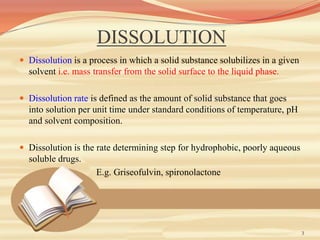
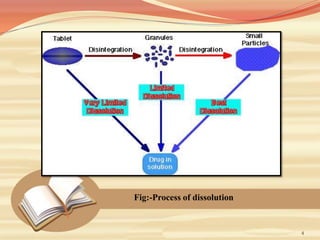
DISSOLUTION
 Dissolution is a process in which a solid substance solubilizes in a given
solvent i.e. mass transfer from the solid surface to the liquid phase.
 Dissolution rate is defined as the amount of solid substance that goes
into solution per unit time under standard conditions of temperature, pH
and solvent composition.
 Dissolution is the rate determining step for hydrophobic, poorly aqueous
soluble drugs.
E.g. Griseofulvin, spironolactone
3
4
Fig:-Process of dissolution
SOLUBILITY
DEFINITION: Solubility is defined in quantitative terms as the concentration
of solute in a saturated solution at certain temperature, and in qualitative
terms it can be defined as the spontaneous interaction of two or more
substances to form a homogeneous molecular dispersion.
 Solubility can be considered as the molecular dispersion of a solute in the
given solvent.
 Solubilization can be defined as the preparation of a thermodynamically
stable isotropic solution of a substance , normally insoluble or very slightly
soluble in a given solvent by the introduction of an additional components.
5
6
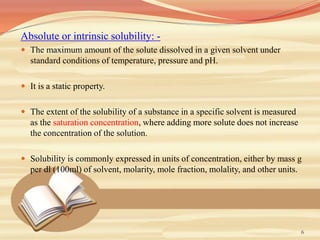
Absolute or intrinsic solubility: -
 The maximum amount of the solute dissolved in a given solvent under
standard conditions of temperature, pressure and pH.
 It is a static property.
 The extent of the solubility of a substance in a specific solvent is measured
as the saturation concentration, where adding more solute does not increase
the concentration of the solution.
 Solubility is commonly expressed in units of concentration, either by mass g
per dl (100ml) of solvent, molarity, mole fraction, molality, and other units.
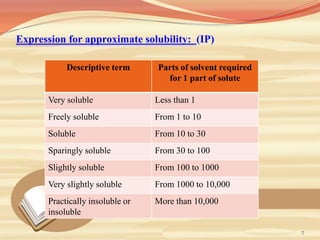
Expression for approximate solubility: (IP)
7
Descriptive term Parts of solvent required
for 1 part of solute
Very soluble Less than 1
Freely soluble From 1 to 10
Soluble From 10 to 30
Sparingly soluble From 30 to 100
Slightly soluble From 100 to 1000
Very slightly soluble From 1000 to 10,000
Practically insoluble or
insoluble
More than 10,000
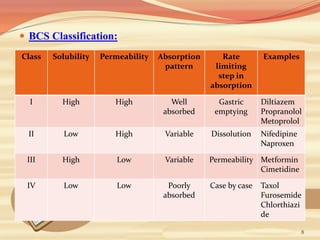
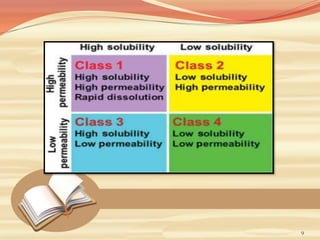
 BCS Classification:
8
Class Solubility Permeability Absorption
pattern
Rate
limiting
step in
absorption
Examples
I High High Well
absorbed
Gastric
emptying
Diltiazem
Propranolol
Metoprolol
II Low High Variable Dissolution Nifedipine
Naproxen
III High Low Variable Permeability Metformin
Cimetidine
IV Low Low Poorly
absorbed
Case by case Taxol
Furosemide
Chlorthiazi
de
9
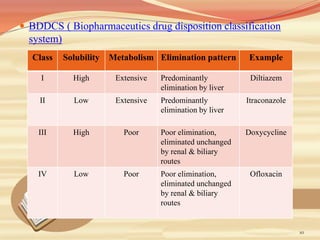
 BDDCS ( Biopharmaceutics drug disposition classification
system)
10
Class Solubility Metabolism Elimination pattern Example
I High Extensive Predominantly
elimination by liver
Diltiazem
II Low Extensive Predominantly
elimination by liver
Itraconazole
III High Poor Poor elimination,
eliminated unchanged
by renal & biliary
routes
Doxycycline
IV Low Poor Poor elimination,
eliminated unchanged
by renal & biliary
routes
Ofloxacin
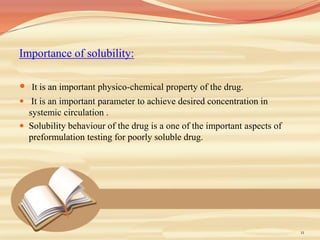
Importance of solubility:
 It is an important physico-chemical property of the drug.
 It is an important parameter to achieve desired concentration in
systemic circulation .
 Solubility behaviour of the drug is a one of the important aspects of
preformulation testing for poorly soluble drug.
11
Need of solubility
 To achieve desire concentration of drug in systemic circulation for
pharmacological response to be shown.
 Low aqueous solubility is major problem encountered with formulation
development of new chemical entities.
 Any drug to be absorbed must be present in the form of an aqueous
solution at the site of absorption.
12
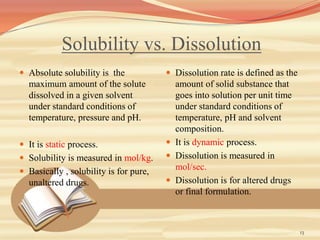
Solubility vs. Dissolution
 Absolute solubility is the
maximum amount of the solute
dissolved in a given solvent
under standard conditions of
temperature, pressure and pH.
 It is static process.
 Solubility is measured in mol/kg.
 Basically , solubility is for pure,
unaltered drugs.
 Dissolution rate is defined as the
amount of solid substance that
goes into solution per unit time
under standard conditions of
temperature, pH and solvent
composition.
 It is dynamic process.
 Dissolution is measured in
mol/sec.
 Dissolution is for altered drugs
or final formulation.
13
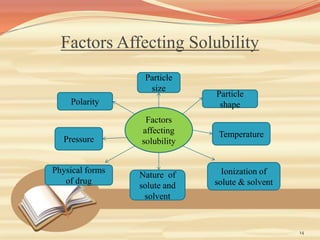
Factors Affecting Solubility
14
Factors
affecting
solubility
Particle
size
Temperature
Pressure
Nature of
solute and
solvent
Physical forms
of drug
Polarity
Ionization of
solute & solvent
Particle
shape
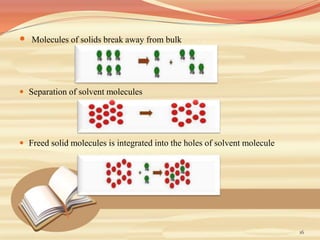
Process of Solubilization
 Breaking of inter-ionic or inter–molecular bonds in the
solute
 The separation of the molecules of the solvent to provide
space in the solvent for the solute
 Interaction between the solvent and solute molecule or ion
15
 Molecules of solids break away from bulk
 Separation of solvent molecules
 Freed solid molecules is integrated into the holes of solvent molecule
16
Solubilization of Non-Electrolytes
 Nonelectrolytes are substances that dissolve in water, but which
maintain their molecular integrity (do not dissociate into ions).
 Examples include sugar, urea, glycerol, ethanol, benzene, chloroform,
carbon tetrachloride, etc.
 The ability of a substance to dissolve in water is determined by whether
the substance can match or exceed the strong attractive forces that
water molecules generate between themselves . If a substance lacks this
ability, it forms a precipitate.
17
 Electrolytes react quickly because their reactions involve the simple
breaking and reforming of ionic bonds.
 On the other hand, Non electrolytes react more slowly because their
reactions involve covalent bonds, which are difficult to break and
reform.
 Non electrolytes exhibit, - Colligative properties
- Lowering of vapour pressure
- Elevation of the boiling point
- Depression of the freezing point
- Osmotic pressure
18
 Solubilization of non electrolytes can be achieved by employing
Chaotropic agents . These agents favor the transfer of apolar groups to
water.
 Examples of chaotropic agents include
Guanidinium chloride,
Lithium perchlorate,
Magnesium chloride,
Sodium dodecyl sulfate, etc.
 The probable mechanism by which chaotropic agents act:
water structure is broken down, or melted, or depolymerized as
compared to ordinary water.
19
Techniques of solubilization
Solubilization by cosolvents
Solubilization in surfactant systems
Solubilization through complexation process
Drug derivatisation
20
Solubilization by Co-solvents
 Substances like weak electrolytes and non-polar molecules are poorly
soluble in water.
 The solubility of these substances can be enhanced by the addition of
water miscible solvents in which the drug has good solubility. This
process of improving solubility is called as co-solvency and the solvents
used are known as co-solvents.
 Commonly used co-solvents are Ethanol
Sorbitol
Glycerin
Propylene glycol
Polyethylene glycol, etc
21
 The solubilizing effect by co-solvency is depends on the polarity of the drug
with respect to solvent and co-solvent. That means more non-polar the
solute the greater is the solubilization achieved by the added solvents.
Mechanism responsible for solubility enhancement through co-solvency is by-
 Reducing the interfacial tension the predominantly aqueous solution and
hydrophobic solutes
 Reduces the contact angle between the solid and liquid
 Co-solvents increases the solubility by reducing the difference between the
polarity of the drug and water system
22
For Example:
 The solubility of diazepam can be increased by using 10% ethanol and 40%
propylene glycol.
 Phenobarbitone is relatively insoluble in water but it solubility can be
increased by using mixture of solvents like water, alcohol and glycerin.
 The solubility of benzocaine can be increased by using 70% ethanol as a
cosolvent.
23
Solubilization by addition of surfactants
 Surfactants are termed as surface-active agents also wetting agents,
emulsifying agents or suspending agents depending on its properties and
use
 Surface-active agents are substances which, at low concentrations,
adsorb onto the surfaces or interfaces of a system and alter the surface
or interfacial free energy and the surface or interfacial tension
24
 Surfactants are monomers, it has a characteristic structure possessing both
hydrophobic groups / non-polar regions (their "tails") usually contain a
C12–C18 hydrocarbon chain and hydrophilic groups / Polar Regions(their
heads) .
 Therefore, they are soluble in both organic solvents and water, so they
called amphiphilic.
25
Hydrophilic head
Hydrophobic tail
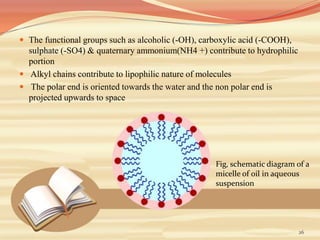
 The functional groups such as alcoholic (-OH), carboxylic acid (-COOH),
sulphate (-SO4) & quaternary ammonium(NH4 +) contribute to hydrophilic
portion
 Alkyl chains contribute to lipophilic nature of molecules
 The polar end is oriented towards the water and the non polar end is
projected upwards to space
26
Fig, schematic diagram of a
micelle of oil in aqueous
suspension
PROPERTIES OF SURFACTANT
 Wetting of Solids
 Solubilization
 Emulsification
 Dispersion of solid in solution
 Micellization
 Detergency
27
Classification of surfactants:
 Surfactant can be classified based on charge groups present in their
head.
 A non-ionic surfactant do not have any charge groups over its head.
 The head of an ionic surfactant carries a net charge. If the charge is
negative, the surfactant is more specifically called anionic and if the
charge is positive, it is called cationic.
 If a surfactant contains a head with two oppositely charged groups, it is
termed zwitter ion.
Anionic surfactants
Cationic surfactants
Non-ionic surfactants
Zwitterionic/ amphoteric surfactants
28
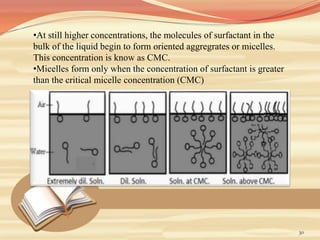
Micellization/solubilization:
Definition- A micelle is an aggregate of surfactant molecules dispersed in a
liquid colloid. The process of forming micelle is known as
micellization.
 When surfactants are added to a liquid at low concentrations, they tend
to orient at the air-liquid interface.
 Upon further addition of surfactants, the interface becomes fully
occupied and the excess molecules are forced into the bulk of the liquid.
29
30
•At still higher concentrations, the molecules of surfactant in the
bulk of the liquid begin to form oriented aggregrates or micelles.
This concentration is know as CMC.
•Micelles form only when the concentration of surfactant is greater
than the critical micelle concentration (CMC)
31
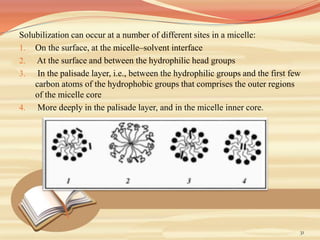
Solubilization can occur at a number of different sites in a micelle:
1. On the surface, at the micelle–solvent interface
2. At the surface and between the hydrophilic head groups
3. In the palisade layer, i.e., between the hydrophilic groups and the first few
carbon atoms of the hydrophobic groups that comprises the outer regions
of the micelle core
4. More deeply in the palisade layer, and in the micelle inner core.
Examples:
 The solubilization of phenolic compounds such as cresol, chlorocresol,
chloroxylenol and thymol with soap to form clear solutions for use in
disinfection.
 Solubilized solutions of iodine in non-ionic surfactant micelles
(iodophors) for use in instrument sterilization.
 Solubilization of drugs (for example, steroids and water insoluble
vitamins), and essential oils by non-ionic surfactants (usually
polysorbates or polyoxyethylene sorbitan esters of fatty acids).
32
Solubilization by Complexation
 It is reversible association of a substrate and ligand molecule
 The most common complexing ligands are:
cyclodextrins, caffeine, urea, polyethylene glycol, N -methyl glucamide etc.
 The cyclodextrins have the ability to form molecular inclusion complexes
with hydrophobic drugs having poor aqueous solubility.
 Complexation relies on relatively weak forces such as vanderwaal forces,
hydrogen bonding and hydrophobic interactions
33
34
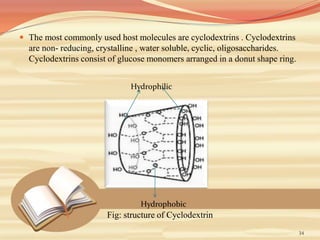
 The most commonly used host molecules are cyclodextrins . Cyclodextrins
are non- reducing, crystalline , water soluble, cyclic, oligosaccharides.
Cyclodextrins consist of glucose monomers arranged in a donut shape ring.
Hydrophilic
Hydrophobic
Fig: structure of Cyclodextrin
35
 The ring has a hydrophilic exterior and lipophilic core in which
appropriately sized organic molecules can form non covalent inclusion
complexes resulting in increased aqueous solubiliy and chemical stability.
 Complexation of drugs with cyclodextrins has been used to enhance
aqueous solubility and drug stability.
 Cyclodextrins of pharmaceutical relevance contain 6, 7 or 8 dextrose
molecules (α, β, γ-cyclodextrin) bound in a 1,4- configuration to form rings
of various diameters.
Two types of complexation:
 Self association and Stacking Complexation
• Stacking complexes are formed by the overlap of planar regions of
aromatic molecules.
Eg: Naphthalene • Pyrene • Benzoic acid • Methylene blue • Caffeine etc.
 Inclusion Complexation
• Inclusion complexes are formed by the insertion of the nonpolar region of
one molecule into the cavity of another molecule (or group of molecules).
Eg: Cyclodextrins
36
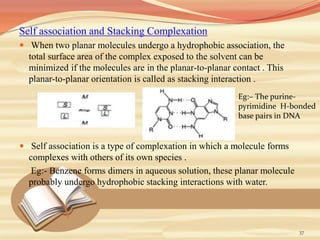
Self association and Stacking Complexation
 When two planar molecules undergo a hydrophobic association, the
total surface area of the complex exposed to the solvent can be
minimized if the molecules are in the planar-to-planar contact . This
planar-to-planar orientation is called as stacking interaction .
 Self association is a type of complexation in which a molecule forms
complexes with others of its own species .
Eg:- Benzene forms dimers in aqueous solution, these planar molecule
probably undergo hydrophobic stacking interactions with water.
37
Eg:– The purine-
pyrimidine H-bonded
base pairs in DNA
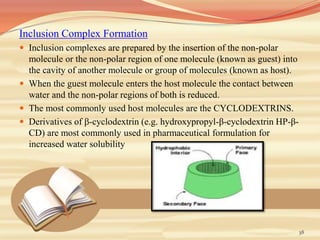
Inclusion Complex Formation
 Inclusion complexes are prepared by the insertion of the non-polar
molecule or the non-polar region of one molecule (known as guest) into
the cavity of another molecule or group of molecules (known as host).
 When the guest molecule enters the host molecule the contact between
water and the non-polar regions of both is reduced.
 The most commonly used host molecules are the CYCLODEXTRINS.
 Derivatives of β-cyclodextrin (e.g. hydroxypropyl-β-cyclodextrin HP-β-
CD) are most commonly used in pharmaceutical formulation for
increased water solubility
38
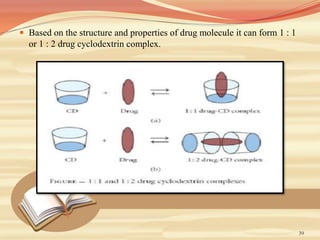
 Based on the structure and properties of drug molecule it can form 1 : 1
or 1 : 2 drug cyclodextrin complex.
39
Drug Derivatization
 Derivatization is a technique in which transform a chemical compound into
a product (the reaction's derivate) of similar chemical structure, called
a derivative.
 Generally, a specific functional group of the compound participates in the
derivatization reaction and transforms the educt to a derivate of
deviating reactivity, solubility , boiling point, melting point etc.
 Possible approaches to increase the solubility of poorly soluble drugs by the
process of derivatisation.
- Prodrug Approach
- Salt Formation
40
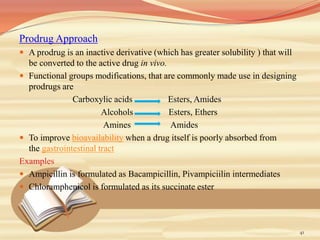
Prodrug Approach
 A prodrug is an inactive derivative (which has greater solubility ) that will
be converted to the active drug in vivo.
 Functional groups modifications, that are commonly made use in designing
prodrugs are
Carboxylic acids Esters, Amides
Alcohols Esters, Ethers
Amines Amides
 To improve bioavailability when a drug itself is poorly absorbed from
the gastrointestinal tract
Examples
 Ampicillin is formulated as Bacampicillin, Pivampiciilin intermediates
 Chloramphenicol is formulated as its succinate ester
41
Salt formation
 The dissolution rate of the salt form of a drug is greater than the unionized
form of the former due to a higher solubility.
 However , the solubility of a salt depends on the counterion with a smaller
counterion , greater the solubility of salt.
 The salt form of a drugs is usually more soluble than parent drug .
 An alkaloidal base is slightly soluble in water, But if the pH of medium is
reduced by addition of acid, the solubility of the base increases. The reason
for this increase in solubility: as the pH continues to reduce, the base is
converted to a salt, which is relatively more soluble in water.
 Examples include Atropine , Bupivacaine , etc.
 The solubility of slightly soluble acid is increased as the pH is increased by
addition of alkali, thus a salt is formed which have high solubility.
 Examples include Aspirin , Theophylline , Barbiturates .
42
Other Techniques
 Micronization
 Nanonization
 Supercritical fluid recrystallization
 Spray freezing into liquid (SFL)
 Evaporative precipitation into aqueous solution (EPAS)
 Use of precipitation inhibitors
 Selective adsorption on insoluble carriers
 Solvent deposition
43
Supercritical fluid recrystallization
 A supercritical fluids are dense non-condensable fluid whose temperature
and pressure are greater than its critical temperature (Tc ) and critical
pressure (Tp ) allowing it to assume the properties of both a liquid and a
gas.
 At near critical temperature , SCFs are highly compressible .
 Once the drug particles are solubilised within SCFs, they may be
recrystallised at greatly reduced particle sizes.
 A SCF process allows micronisation of drug particles within narrow range
of particle size, often to sub-micron levels.
44
Evaporative precipitation into aqueous solution
(EPAS)
 This technique involves dissolution of drug in a low boiling point organic
solvent .
 Then this solution is pumped through a tube where it is heated under
pressure to a temperature above the solvents boiling point.
 And this solution is sprayed through a fine atomizing nozzle into a heated
aqueous solution
 Surfactants are added to the organic solution and the aqueous solution to
optimize particle formation and stabilization.
45
References
1. International journal of pharmaceutical sciences review and
research,vol5,issue1, Varun Ra.j Vemula, article007 nov-dec2010.
2. Journal of global pharma technology techniques to enhance solubility of
poorly soluble drugs: a review available at www.Jgpt.Co.In
3. Joel.H.Hildebrand and Robert L Scott, The solubility if non-electrolytes,
third edition.
4. Pharmacie globale -international journal of comprehensive pharmacy-
review on solubility enhancement techniques for hydrophobic drugs
5. D. M. Brahmankar, sunit b. Jaiswal, Biopharmaceutics and
pharmacokinetics a treatise .
6. Lachman/Lieberman’s,The theory and practice of industrial pharmacy
,fourth edition .
46
47

Dissolution and solubility

  • 1.
    PRESENTED BY- T NPURNIMA 18031S0315 M.Pharm 1st year (I-sem) Department of Pharmaceutics Center for Pharmaceutical Sciences, IST,JNTUH 1
  • 2.
     INTRODUCTION  SOLUBILITYvs. DISSOLUTION  FACTORS AFFECTING SOLUBILITY  PROCESS OF SOLUBILIZATION  SOLUBILIZATION OF NON-ELECTROLYTES  TECHNIQUES OF SOLUBILIZATION  OTHER TECHNIQUES  REFERENCES CONTENTS 2
  • 3.
    DISSOLUTION  Dissolution isa process in which a solid substance solubilizes in a given solvent i.e. mass transfer from the solid surface to the liquid phase.  Dissolution rate is defined as the amount of solid substance that goes into solution per unit time under standard conditions of temperature, pH and solvent composition.  Dissolution is the rate determining step for hydrophobic, poorly aqueous soluble drugs. E.g. Griseofulvin, spironolactone 3
  • 4.
  • 5.
    SOLUBILITY DEFINITION: Solubility isdefined in quantitative terms as the concentration of solute in a saturated solution at certain temperature, and in qualitative terms it can be defined as the spontaneous interaction of two or more substances to form a homogeneous molecular dispersion.  Solubility can be considered as the molecular dispersion of a solute in the given solvent.  Solubilization can be defined as the preparation of a thermodynamically stable isotropic solution of a substance , normally insoluble or very slightly soluble in a given solvent by the introduction of an additional components. 5
  • 6.
    6 Absolute or intrinsicsolubility: -  The maximum amount of the solute dissolved in a given solvent under standard conditions of temperature, pressure and pH.  It is a static property.  The extent of the solubility of a substance in a specific solvent is measured as the saturation concentration, where adding more solute does not increase the concentration of the solution.  Solubility is commonly expressed in units of concentration, either by mass g per dl (100ml) of solvent, molarity, mole fraction, molality, and other units.
  • 7.
    Expression for approximatesolubility: (IP) 7 Descriptive term Parts of solvent required for 1 part of solute Very soluble Less than 1 Freely soluble From 1 to 10 Soluble From 10 to 30 Sparingly soluble From 30 to 100 Slightly soluble From 100 to 1000 Very slightly soluble From 1000 to 10,000 Practically insoluble or insoluble More than 10,000
  • 8.
     BCS Classification: 8 ClassSolubility Permeability Absorption pattern Rate limiting step in absorption Examples I High High Well absorbed Gastric emptying Diltiazem Propranolol Metoprolol II Low High Variable Dissolution Nifedipine Naproxen III High Low Variable Permeability Metformin Cimetidine IV Low Low Poorly absorbed Case by case Taxol Furosemide Chlorthiazi de
  • 9.
  • 10.
     BDDCS (Biopharmaceutics drug disposition classification system) 10 Class Solubility Metabolism Elimination pattern Example I High Extensive Predominantly elimination by liver Diltiazem II Low Extensive Predominantly elimination by liver Itraconazole III High Poor Poor elimination, eliminated unchanged by renal & biliary routes Doxycycline IV Low Poor Poor elimination, eliminated unchanged by renal & biliary routes Ofloxacin
  • 11.
    Importance of solubility: It is an important physico-chemical property of the drug.  It is an important parameter to achieve desired concentration in systemic circulation .  Solubility behaviour of the drug is a one of the important aspects of preformulation testing for poorly soluble drug. 11
  • 12.
    Need of solubility To achieve desire concentration of drug in systemic circulation for pharmacological response to be shown.  Low aqueous solubility is major problem encountered with formulation development of new chemical entities.  Any drug to be absorbed must be present in the form of an aqueous solution at the site of absorption. 12
  • 13.
    Solubility vs. Dissolution Absolute solubility is the maximum amount of the solute dissolved in a given solvent under standard conditions of temperature, pressure and pH.  It is static process.  Solubility is measured in mol/kg.  Basically , solubility is for pure, unaltered drugs.  Dissolution rate is defined as the amount of solid substance that goes into solution per unit time under standard conditions of temperature, pH and solvent composition.  It is dynamic process.  Dissolution is measured in mol/sec.  Dissolution is for altered drugs or final formulation. 13
  • 14.
    Factors Affecting Solubility 14 Factors affecting solubility Particle size Temperature Pressure Natureof solute and solvent Physical forms of drug Polarity Ionization of solute & solvent Particle shape
  • 15.
    Process of Solubilization Breaking of inter-ionic or inter–molecular bonds in the solute  The separation of the molecules of the solvent to provide space in the solvent for the solute  Interaction between the solvent and solute molecule or ion 15
  • 16.
     Molecules ofsolids break away from bulk  Separation of solvent molecules  Freed solid molecules is integrated into the holes of solvent molecule 16
  • 17.
    Solubilization of Non-Electrolytes Nonelectrolytes are substances that dissolve in water, but which maintain their molecular integrity (do not dissociate into ions).  Examples include sugar, urea, glycerol, ethanol, benzene, chloroform, carbon tetrachloride, etc.  The ability of a substance to dissolve in water is determined by whether the substance can match or exceed the strong attractive forces that water molecules generate between themselves . If a substance lacks this ability, it forms a precipitate. 17
  • 18.
     Electrolytes reactquickly because their reactions involve the simple breaking and reforming of ionic bonds.  On the other hand, Non electrolytes react more slowly because their reactions involve covalent bonds, which are difficult to break and reform.  Non electrolytes exhibit, - Colligative properties - Lowering of vapour pressure - Elevation of the boiling point - Depression of the freezing point - Osmotic pressure 18
  • 19.
     Solubilization ofnon electrolytes can be achieved by employing Chaotropic agents . These agents favor the transfer of apolar groups to water.  Examples of chaotropic agents include Guanidinium chloride, Lithium perchlorate, Magnesium chloride, Sodium dodecyl sulfate, etc.  The probable mechanism by which chaotropic agents act: water structure is broken down, or melted, or depolymerized as compared to ordinary water. 19
  • 20.
    Techniques of solubilization Solubilizationby cosolvents Solubilization in surfactant systems Solubilization through complexation process Drug derivatisation 20
  • 21.
    Solubilization by Co-solvents Substances like weak electrolytes and non-polar molecules are poorly soluble in water.  The solubility of these substances can be enhanced by the addition of water miscible solvents in which the drug has good solubility. This process of improving solubility is called as co-solvency and the solvents used are known as co-solvents.  Commonly used co-solvents are Ethanol Sorbitol Glycerin Propylene glycol Polyethylene glycol, etc 21
  • 22.
     The solubilizingeffect by co-solvency is depends on the polarity of the drug with respect to solvent and co-solvent. That means more non-polar the solute the greater is the solubilization achieved by the added solvents. Mechanism responsible for solubility enhancement through co-solvency is by-  Reducing the interfacial tension the predominantly aqueous solution and hydrophobic solutes  Reduces the contact angle between the solid and liquid  Co-solvents increases the solubility by reducing the difference between the polarity of the drug and water system 22
  • 23.
    For Example:  Thesolubility of diazepam can be increased by using 10% ethanol and 40% propylene glycol.  Phenobarbitone is relatively insoluble in water but it solubility can be increased by using mixture of solvents like water, alcohol and glycerin.  The solubility of benzocaine can be increased by using 70% ethanol as a cosolvent. 23
  • 24.
    Solubilization by additionof surfactants  Surfactants are termed as surface-active agents also wetting agents, emulsifying agents or suspending agents depending on its properties and use  Surface-active agents are substances which, at low concentrations, adsorb onto the surfaces or interfaces of a system and alter the surface or interfacial free energy and the surface or interfacial tension 24
  • 25.
     Surfactants aremonomers, it has a characteristic structure possessing both hydrophobic groups / non-polar regions (their "tails") usually contain a C12–C18 hydrocarbon chain and hydrophilic groups / Polar Regions(their heads) .  Therefore, they are soluble in both organic solvents and water, so they called amphiphilic. 25 Hydrophilic head Hydrophobic tail
  • 26.
     The functionalgroups such as alcoholic (-OH), carboxylic acid (-COOH), sulphate (-SO4) & quaternary ammonium(NH4 +) contribute to hydrophilic portion  Alkyl chains contribute to lipophilic nature of molecules  The polar end is oriented towards the water and the non polar end is projected upwards to space 26 Fig, schematic diagram of a micelle of oil in aqueous suspension
  • 27.
    PROPERTIES OF SURFACTANT Wetting of Solids  Solubilization  Emulsification  Dispersion of solid in solution  Micellization  Detergency 27
  • 28.
    Classification of surfactants: Surfactant can be classified based on charge groups present in their head.  A non-ionic surfactant do not have any charge groups over its head.  The head of an ionic surfactant carries a net charge. If the charge is negative, the surfactant is more specifically called anionic and if the charge is positive, it is called cationic.  If a surfactant contains a head with two oppositely charged groups, it is termed zwitter ion. Anionic surfactants Cationic surfactants Non-ionic surfactants Zwitterionic/ amphoteric surfactants 28
  • 29.
    Micellization/solubilization: Definition- A micelleis an aggregate of surfactant molecules dispersed in a liquid colloid. The process of forming micelle is known as micellization.  When surfactants are added to a liquid at low concentrations, they tend to orient at the air-liquid interface.  Upon further addition of surfactants, the interface becomes fully occupied and the excess molecules are forced into the bulk of the liquid. 29
  • 30.
    30 •At still higherconcentrations, the molecules of surfactant in the bulk of the liquid begin to form oriented aggregrates or micelles. This concentration is know as CMC. •Micelles form only when the concentration of surfactant is greater than the critical micelle concentration (CMC)
  • 31.
    31 Solubilization can occurat a number of different sites in a micelle: 1. On the surface, at the micelle–solvent interface 2. At the surface and between the hydrophilic head groups 3. In the palisade layer, i.e., between the hydrophilic groups and the first few carbon atoms of the hydrophobic groups that comprises the outer regions of the micelle core 4. More deeply in the palisade layer, and in the micelle inner core.
  • 32.
    Examples:  The solubilizationof phenolic compounds such as cresol, chlorocresol, chloroxylenol and thymol with soap to form clear solutions for use in disinfection.  Solubilized solutions of iodine in non-ionic surfactant micelles (iodophors) for use in instrument sterilization.  Solubilization of drugs (for example, steroids and water insoluble vitamins), and essential oils by non-ionic surfactants (usually polysorbates or polyoxyethylene sorbitan esters of fatty acids). 32
  • 33.
    Solubilization by Complexation It is reversible association of a substrate and ligand molecule  The most common complexing ligands are: cyclodextrins, caffeine, urea, polyethylene glycol, N -methyl glucamide etc.  The cyclodextrins have the ability to form molecular inclusion complexes with hydrophobic drugs having poor aqueous solubility.  Complexation relies on relatively weak forces such as vanderwaal forces, hydrogen bonding and hydrophobic interactions 33
  • 34.
    34  The mostcommonly used host molecules are cyclodextrins . Cyclodextrins are non- reducing, crystalline , water soluble, cyclic, oligosaccharides. Cyclodextrins consist of glucose monomers arranged in a donut shape ring. Hydrophilic Hydrophobic Fig: structure of Cyclodextrin
  • 35.
    35  The ringhas a hydrophilic exterior and lipophilic core in which appropriately sized organic molecules can form non covalent inclusion complexes resulting in increased aqueous solubiliy and chemical stability.  Complexation of drugs with cyclodextrins has been used to enhance aqueous solubility and drug stability.  Cyclodextrins of pharmaceutical relevance contain 6, 7 or 8 dextrose molecules (α, β, γ-cyclodextrin) bound in a 1,4- configuration to form rings of various diameters.
  • 36.
    Two types ofcomplexation:  Self association and Stacking Complexation • Stacking complexes are formed by the overlap of planar regions of aromatic molecules. Eg: Naphthalene • Pyrene • Benzoic acid • Methylene blue • Caffeine etc.  Inclusion Complexation • Inclusion complexes are formed by the insertion of the nonpolar region of one molecule into the cavity of another molecule (or group of molecules). Eg: Cyclodextrins 36
  • 37.
    Self association andStacking Complexation  When two planar molecules undergo a hydrophobic association, the total surface area of the complex exposed to the solvent can be minimized if the molecules are in the planar-to-planar contact . This planar-to-planar orientation is called as stacking interaction .  Self association is a type of complexation in which a molecule forms complexes with others of its own species . Eg:- Benzene forms dimers in aqueous solution, these planar molecule probably undergo hydrophobic stacking interactions with water. 37 Eg:– The purine- pyrimidine H-bonded base pairs in DNA
  • 38.
    Inclusion Complex Formation Inclusion complexes are prepared by the insertion of the non-polar molecule or the non-polar region of one molecule (known as guest) into the cavity of another molecule or group of molecules (known as host).  When the guest molecule enters the host molecule the contact between water and the non-polar regions of both is reduced.  The most commonly used host molecules are the CYCLODEXTRINS.  Derivatives of β-cyclodextrin (e.g. hydroxypropyl-β-cyclodextrin HP-β- CD) are most commonly used in pharmaceutical formulation for increased water solubility 38
  • 39.
     Based onthe structure and properties of drug molecule it can form 1 : 1 or 1 : 2 drug cyclodextrin complex. 39
  • 40.
    Drug Derivatization  Derivatizationis a technique in which transform a chemical compound into a product (the reaction's derivate) of similar chemical structure, called a derivative.  Generally, a specific functional group of the compound participates in the derivatization reaction and transforms the educt to a derivate of deviating reactivity, solubility , boiling point, melting point etc.  Possible approaches to increase the solubility of poorly soluble drugs by the process of derivatisation. - Prodrug Approach - Salt Formation 40
  • 41.
    Prodrug Approach  Aprodrug is an inactive derivative (which has greater solubility ) that will be converted to the active drug in vivo.  Functional groups modifications, that are commonly made use in designing prodrugs are Carboxylic acids Esters, Amides Alcohols Esters, Ethers Amines Amides  To improve bioavailability when a drug itself is poorly absorbed from the gastrointestinal tract Examples  Ampicillin is formulated as Bacampicillin, Pivampiciilin intermediates  Chloramphenicol is formulated as its succinate ester 41
  • 42.
    Salt formation  Thedissolution rate of the salt form of a drug is greater than the unionized form of the former due to a higher solubility.  However , the solubility of a salt depends on the counterion with a smaller counterion , greater the solubility of salt.  The salt form of a drugs is usually more soluble than parent drug .  An alkaloidal base is slightly soluble in water, But if the pH of medium is reduced by addition of acid, the solubility of the base increases. The reason for this increase in solubility: as the pH continues to reduce, the base is converted to a salt, which is relatively more soluble in water.  Examples include Atropine , Bupivacaine , etc.  The solubility of slightly soluble acid is increased as the pH is increased by addition of alkali, thus a salt is formed which have high solubility.  Examples include Aspirin , Theophylline , Barbiturates . 42
  • 43.
    Other Techniques  Micronization Nanonization  Supercritical fluid recrystallization  Spray freezing into liquid (SFL)  Evaporative precipitation into aqueous solution (EPAS)  Use of precipitation inhibitors  Selective adsorption on insoluble carriers  Solvent deposition 43
  • 44.
    Supercritical fluid recrystallization A supercritical fluids are dense non-condensable fluid whose temperature and pressure are greater than its critical temperature (Tc ) and critical pressure (Tp ) allowing it to assume the properties of both a liquid and a gas.  At near critical temperature , SCFs are highly compressible .  Once the drug particles are solubilised within SCFs, they may be recrystallised at greatly reduced particle sizes.  A SCF process allows micronisation of drug particles within narrow range of particle size, often to sub-micron levels. 44
  • 45.
    Evaporative precipitation intoaqueous solution (EPAS)  This technique involves dissolution of drug in a low boiling point organic solvent .  Then this solution is pumped through a tube where it is heated under pressure to a temperature above the solvents boiling point.  And this solution is sprayed through a fine atomizing nozzle into a heated aqueous solution  Surfactants are added to the organic solution and the aqueous solution to optimize particle formation and stabilization. 45
  • 46.
    References 1. International journalof pharmaceutical sciences review and research,vol5,issue1, Varun Ra.j Vemula, article007 nov-dec2010. 2. Journal of global pharma technology techniques to enhance solubility of poorly soluble drugs: a review available at www.Jgpt.Co.In 3. Joel.H.Hildebrand and Robert L Scott, The solubility if non-electrolytes, third edition. 4. Pharmacie globale -international journal of comprehensive pharmacy- review on solubility enhancement techniques for hydrophobic drugs 5. D. M. Brahmankar, sunit b. Jaiswal, Biopharmaceutics and pharmacokinetics a treatise . 6. Lachman/Lieberman’s,The theory and practice of industrial pharmacy ,fourth edition . 46
  • 47.