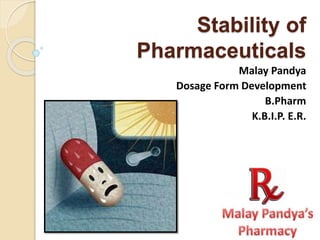

Stability of
Pharmaceuticals
Malay Pandya
Dosage Form Development
B.Pharm
K.B.I.P. E.R.
Introduction
 Pharmaceutical formulation is the means whereby a
drug is converted into a medicine, i.e., to a suitable
form for administration to a patient by a particular
route.
 The conversion of a drug into a medicine often involves
the addition of pharmaceutical adjuvants (excipients)
such as binding agents, disintegrating agents,
antioxidants, antimicrobial preservative and emulsifying
agents etc.
 The stability of a medicine relates to the various
changes that may occur in the medicine during
preparation and storage and to the impact of those
changes on its fitness for use.
2MALAY PANDYA
Some of the possible result of
product instability
 Loss of active drug (e.g. aspirin hydrolysis, oxidation of
adrenaline).
 Loss of vehicle (e.g. evaporation of water from o/w
creams, evaporation of alcohol from alcoholic
mixtures).
 Loss of content uniformity (e.g. creaming of emulsions,
impaction of suspensions).
 Loss of elegance (e.g. fading of tablets and colored
solutions).
 Reduction in bioavailability (e.g. ageing of tablets
resulting in a change in dissolution profile).
 Production of potential toxic materials (e.g. breakdown
products from drug degradation).
3MALAY PANDYA
Objective
 To provide evidence on how the quality of a drug
substance or drug product varies with the time under
the influence of variety of environmental factors such as
temperature, humidity and light.
 Stability testing permits the establishment of
recommended pack, storage condition, retest periods
and shelf life.
 Useful in development of the product
 Required for registration of application
 Then the FDA was contacted to relay this drug product
quality concern and to provide the necessary facts to
investigate this production lot.
MALAY PANDYA 4
Definition
 Stability is the capacity of a drug product to remain
within specifications established to ensure its identity,
strength quality and purity.
 Instability may cause
 Undesired change in performance, i.e.
dissolution/bioavailability
 Substantial changes in physical appearance of the
dosage form
 Causing product failures
5MALAY PANDYA
Types of stability studies
1. Physical
2. Chemical
3. Microbiological
MALAY PANDYA 6
Physical stability
 Physical stability implies that
The formulation is totally unchanged throughout
its shelf life and has not suffered any changes by way of
appearance, organoleptic properties, hardness,
brittleness, particle size etc.
 It is significant as it affects:
1. pharmaceutical elegance
2. drug content uniformity
3. drug release rate.
MALAY PANDYA 7
Chemical stability
 Chemical stability implies:
The lack of any decomposition in the chemical
moiety that is incorporated in the formulation as the
drug, preservatives or any other excipients.
This decomposition may influence the physical and
chemical stability of the drug
 Factors
 Temperature • pH • Buffers • Ionic strength •
Dielectric constant of solvent • Oxygen • Light •
Polymorphism • Moisture & Humidity • Excipients
MALAY PANDYA 8
Microbiological stability
 Microbiological stability implies that:
The formulation has not suffered from any
microbiological attack and is meeting the standards
with respect to lack of contamination/sterility.
MALAY PANDYA 9
MALAY PANDYA 10
Reaction rate and order
 Reaction rate is the velocity of reaction to convert the
reactants into its product.
 Reactions may be classified according to the order of
reaction, which is the number of reacting species whose
concentration determines the rate at which the reaction
occurs.
 The most important orders of reaction are zero-order
(breakdown rate is independent of the concentration of
any of the reactants), firstorder (reaction rate is
determined by one concentration term) and second-
order (rate is determined by the concentrations of two
reacting species).
MALAY PANDYA 11
Zero-order reactions
 As the name suggests the
decomposition proceeds at a
constant rate and is independent of
the concentrations of any of the
reactants.
 The rate equation is: dx/dt = ko
 Integrating this equation with respect
to time from t=0 to t=t, we get x = kot
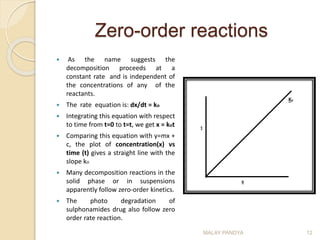
 Comparing this equation with y=mx +
c, the plot of concentration(x) vs
time (t) gives a straight line with the
slope ko
 Many decomposition reactions in the
solid phase or in suspensions
apparently follow zero-order kinetics.
 The photo degradation of
sulphonamides drug also follow zero
order rate reaction.
MALAY PANDYA 12
First-order reactions
 As the name suggests the rate depends on the
concentration of one reactant.
 The rate equation is
 Integrating this equation with respect to time from t=0 to t=t
 Where a is the amount of drug degraded at time t, x is the
initial amount of drug, k1 is the rate of reaction.
 The rate of decomposition of a drug A is the change of
concentration of A over a time interval, t, i.e., –d[A]/dt (note
that this is negative because the drug concentration is
decreasing). However, it is more usual to express the rate as
dx/dt, where x is amount of drug which has reacted in time t.
MALAY PANDYA 13
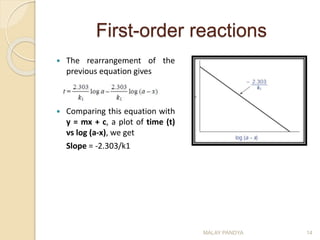
 The rearrangement of the
previous equation gives
 Comparing this equation with
y = mx + c, a plot of time (t)
vs log (a-x), we get
Slope = -2.303/k1
MALAY PANDYA 14
First-order reactions
Second-order reactions
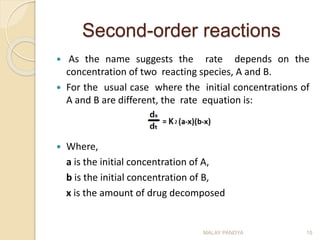
 As the name suggests the rate depends on the
concentration of two reacting species, A and B.
 For the usual case where the initial concentrations of
A and B are different, the rate equation is:
 Where,
a is the initial concentration of A,
b is the initial concentration of B,
x is the amount of drug decomposed
MALAY PANDYA 15
Second-order reactions
 Integrating this equation with
respect to time from t=0 to t=t,
 Rearrangement of the above
equation gives
 Comparing this equation with
y = mx + c, a plot of time (t) vs
log [(a-x)/(b-x)], would yield a
straight line with
slope = 2.303/k2(a – b).
MALAY PANDYA 16
MALAY PANDYA 17
Acid Base Catalysis
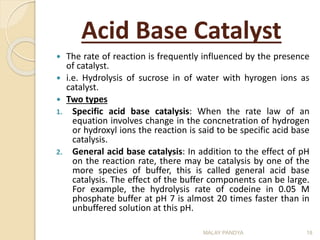
 The rate of reaction is frequently influenced by the presence
of catalyst.
 i.e. Hydrolysis of sucrose in of water with hyrogen ions as
catalyst.
 Two types
1. Specific acid base catalysis: When the rate law of an
equation involves change in the concnetration of hydrogen
or hydroxyl ions the reaction is said to be specific acid base
catalysis.
2. General acid base catalysis: In addition to the effect of pH
on the reaction rate, there may be catalysis by one of the
more species of buffer, this is called general acid base
catalysis. The effect of the buffer components can be large.
For example, the hydrolysis rate of codeine in 0.05 M
phosphate buffer at pH 7 is almost 20 times faster than in
unbuffered solution at this pH.
MALAY PANDYA 18
Acid Base Catalyst
MALAY PANDYA 19
Decomposition reactions
 The most causes of decomposition are :
◦ Hydrolysis
◦ Oxidation
◦ Isomerization
◦ Photochemical decomposition
◦ Polymerization
• It is possible to minimize breakdown by optimizing
the formulation and storing under carefully controlled
conditions.
MALAY PANDYA 20
Hydrolysis
 Drugs containing ester, amide, lactam, imide or
carbamate groups are susceptible to hydrolysis.
 Hydrolysis can be catalyzed by hydrogen ions (specific
acid catalysis) or hydroxyl ions (specific base catalysis).
 Solutions can be stabilized by formulating at the pH of
maximum stability or, in some cases, by altering the
dielectric constant by the addition of non-aqueous
solvents.
MALAY PANDYA 21
Oxidation
 Oxidation involves the removal of an electropositive atom, radical or
electron, or the addition of an electronegative atom or radical.
 Oxidative degradation can occur by auto- oxidation, in which reaction
is unanalyzed and proceeds quite slowly under the influence of
molecular oxygen, or may involve chain processes consisting of three
concurrent reactions: initiation, propagation and termination.
 Examples of drugs that are susceptible to oxidation include steroids
and sterols, polyunsaturated fatty acids, phenothiazines, and drugs
such as simvastatin and polyene antibiotics that contain conjugated
double bonds.
 Various precautions should be taken during manufacture and storage
to minimise oxidation:
 The oxygen in pharmaceutical containers should be replaced with
nitrogen or carbon dioxide.
 Contact of the drug with heavy-metal ions such as iron, cobalt or
nickel, which catalyse oxidation, should be avoided.
 Storage should be at reduced temperatures.
 Antioxidants should be included in the formulation.
MALAY PANDYA 22

Stability of Pharmaceuticals

  • 1.
    Stability of Pharmaceuticals Malay Pandya DosageForm Development B.Pharm K.B.I.P. E.R.
  • 2.
    Introduction  Pharmaceutical formulationis the means whereby a drug is converted into a medicine, i.e., to a suitable form for administration to a patient by a particular route.  The conversion of a drug into a medicine often involves the addition of pharmaceutical adjuvants (excipients) such as binding agents, disintegrating agents, antioxidants, antimicrobial preservative and emulsifying agents etc.  The stability of a medicine relates to the various changes that may occur in the medicine during preparation and storage and to the impact of those changes on its fitness for use. 2MALAY PANDYA
  • 3.
    Some of thepossible result of product instability  Loss of active drug (e.g. aspirin hydrolysis, oxidation of adrenaline).  Loss of vehicle (e.g. evaporation of water from o/w creams, evaporation of alcohol from alcoholic mixtures).  Loss of content uniformity (e.g. creaming of emulsions, impaction of suspensions).  Loss of elegance (e.g. fading of tablets and colored solutions).  Reduction in bioavailability (e.g. ageing of tablets resulting in a change in dissolution profile).  Production of potential toxic materials (e.g. breakdown products from drug degradation). 3MALAY PANDYA
  • 4.
    Objective  To provideevidence on how the quality of a drug substance or drug product varies with the time under the influence of variety of environmental factors such as temperature, humidity and light.  Stability testing permits the establishment of recommended pack, storage condition, retest periods and shelf life.  Useful in development of the product  Required for registration of application  Then the FDA was contacted to relay this drug product quality concern and to provide the necessary facts to investigate this production lot. MALAY PANDYA 4
  • 5.
    Definition  Stability isthe capacity of a drug product to remain within specifications established to ensure its identity, strength quality and purity.  Instability may cause  Undesired change in performance, i.e. dissolution/bioavailability  Substantial changes in physical appearance of the dosage form  Causing product failures 5MALAY PANDYA
  • 6.
    Types of stabilitystudies 1. Physical 2. Chemical 3. Microbiological MALAY PANDYA 6
  • 7.
    Physical stability  Physicalstability implies that The formulation is totally unchanged throughout its shelf life and has not suffered any changes by way of appearance, organoleptic properties, hardness, brittleness, particle size etc.  It is significant as it affects: 1. pharmaceutical elegance 2. drug content uniformity 3. drug release rate. MALAY PANDYA 7
  • 8.
    Chemical stability  Chemicalstability implies: The lack of any decomposition in the chemical moiety that is incorporated in the formulation as the drug, preservatives or any other excipients. This decomposition may influence the physical and chemical stability of the drug  Factors  Temperature • pH • Buffers • Ionic strength • Dielectric constant of solvent • Oxygen • Light • Polymorphism • Moisture & Humidity • Excipients MALAY PANDYA 8
  • 9.
    Microbiological stability  Microbiologicalstability implies that: The formulation has not suffered from any microbiological attack and is meeting the standards with respect to lack of contamination/sterility. MALAY PANDYA 9
  • 10.
  • 11.
    Reaction rate andorder  Reaction rate is the velocity of reaction to convert the reactants into its product.  Reactions may be classified according to the order of reaction, which is the number of reacting species whose concentration determines the rate at which the reaction occurs.  The most important orders of reaction are zero-order (breakdown rate is independent of the concentration of any of the reactants), firstorder (reaction rate is determined by one concentration term) and second- order (rate is determined by the concentrations of two reacting species). MALAY PANDYA 11
  • 12.
    Zero-order reactions  Asthe name suggests the decomposition proceeds at a constant rate and is independent of the concentrations of any of the reactants.  The rate equation is: dx/dt = ko  Integrating this equation with respect to time from t=0 to t=t, we get x = kot  Comparing this equation with y=mx + c, the plot of concentration(x) vs time (t) gives a straight line with the slope ko  Many decomposition reactions in the solid phase or in suspensions apparently follow zero-order kinetics.  The photo degradation of sulphonamides drug also follow zero order rate reaction. MALAY PANDYA 12
  • 13.
    First-order reactions  Asthe name suggests the rate depends on the concentration of one reactant.  The rate equation is  Integrating this equation with respect to time from t=0 to t=t  Where a is the amount of drug degraded at time t, x is the initial amount of drug, k1 is the rate of reaction.  The rate of decomposition of a drug A is the change of concentration of A over a time interval, t, i.e., –d[A]/dt (note that this is negative because the drug concentration is decreasing). However, it is more usual to express the rate as dx/dt, where x is amount of drug which has reacted in time t. MALAY PANDYA 13
  • 14.
     The rearrangementof the previous equation gives  Comparing this equation with y = mx + c, a plot of time (t) vs log (a-x), we get Slope = -2.303/k1 MALAY PANDYA 14 First-order reactions
  • 15.
    Second-order reactions  Asthe name suggests the rate depends on the concentration of two reacting species, A and B.  For the usual case where the initial concentrations of A and B are different, the rate equation is:  Where, a is the initial concentration of A, b is the initial concentration of B, x is the amount of drug decomposed MALAY PANDYA 15
  • 16.
    Second-order reactions  Integratingthis equation with respect to time from t=0 to t=t,  Rearrangement of the above equation gives  Comparing this equation with y = mx + c, a plot of time (t) vs log [(a-x)/(b-x)], would yield a straight line with slope = 2.303/k2(a – b). MALAY PANDYA 16
  • 17.
    MALAY PANDYA 17 AcidBase Catalysis
  • 18.
     The rateof reaction is frequently influenced by the presence of catalyst.  i.e. Hydrolysis of sucrose in of water with hyrogen ions as catalyst.  Two types 1. Specific acid base catalysis: When the rate law of an equation involves change in the concnetration of hydrogen or hydroxyl ions the reaction is said to be specific acid base catalysis. 2. General acid base catalysis: In addition to the effect of pH on the reaction rate, there may be catalysis by one of the more species of buffer, this is called general acid base catalysis. The effect of the buffer components can be large. For example, the hydrolysis rate of codeine in 0.05 M phosphate buffer at pH 7 is almost 20 times faster than in unbuffered solution at this pH. MALAY PANDYA 18 Acid Base Catalyst
  • 19.
  • 20.
    Decomposition reactions  Themost causes of decomposition are : ◦ Hydrolysis ◦ Oxidation ◦ Isomerization ◦ Photochemical decomposition ◦ Polymerization • It is possible to minimize breakdown by optimizing the formulation and storing under carefully controlled conditions. MALAY PANDYA 20
  • 21.
    Hydrolysis  Drugs containingester, amide, lactam, imide or carbamate groups are susceptible to hydrolysis.  Hydrolysis can be catalyzed by hydrogen ions (specific acid catalysis) or hydroxyl ions (specific base catalysis).  Solutions can be stabilized by formulating at the pH of maximum stability or, in some cases, by altering the dielectric constant by the addition of non-aqueous solvents. MALAY PANDYA 21
  • 22.
    Oxidation  Oxidation involvesthe removal of an electropositive atom, radical or electron, or the addition of an electronegative atom or radical.  Oxidative degradation can occur by auto- oxidation, in which reaction is unanalyzed and proceeds quite slowly under the influence of molecular oxygen, or may involve chain processes consisting of three concurrent reactions: initiation, propagation and termination.  Examples of drugs that are susceptible to oxidation include steroids and sterols, polyunsaturated fatty acids, phenothiazines, and drugs such as simvastatin and polyene antibiotics that contain conjugated double bonds.  Various precautions should be taken during manufacture and storage to minimise oxidation:  The oxygen in pharmaceutical containers should be replaced with nitrogen or carbon dioxide.  Contact of the drug with heavy-metal ions such as iron, cobalt or nickel, which catalyse oxidation, should be avoided.  Storage should be at reduced temperatures.  Antioxidants should be included in the formulation. MALAY PANDYA 22