GGROUP FROUP F
SS66FF 20132013
How bad you are, you are
a life changer in your life.
Life is too short to live with
regrets.
The theory of multiple intelligences is Howard Gardner’s theory
that proposes that people are not born with all of the intelligence they will
ever have. It says that intelligence can be learned throughout life.
we can improve education by addressing the multiple
intelligences of our students.
Also, it claims that everyone is intelligent in at least eight
different ways and can develop each aspect of intelligence to an
average level of competency. Intelligence, as defined by Gardner, is
the ability to solve problems or fashion products that are valuable
in one or more cultural settings.
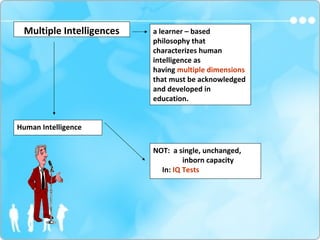
Multiple Intelligences
NOT: a single, unchanged,
inborn capacity
In: IQ Tests
a learner – based
philosophy that
characterizes human
intelligence as
having multiple dimensions
that must be acknowledged
and developed in
education.
Human Intelligence
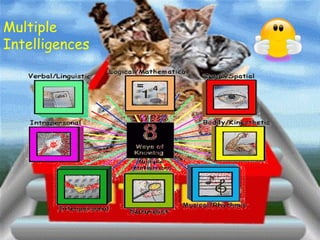
Multiple
Intelligences
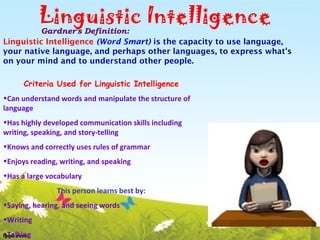
Linguistic Intelligence
Gardner's Definition:
Linguistic Intelligence (Word Smart) is the capacity to use language,
your native language, and perhaps other languages, to express what's
on your mind and to understand other people.
Criteria Used for Linguistic Intelligence
•Can understand words and manipulate the structure of
language
•Has highly developed communication skills including
writing, speaking, and story-telling
•Knows and correctly uses rules of grammar
•Enjoys reading, writing, and speaking
•Has a large vocabulary
This person learns best by:
•Saying, hearing, and seeing words
•Writing
•Talking
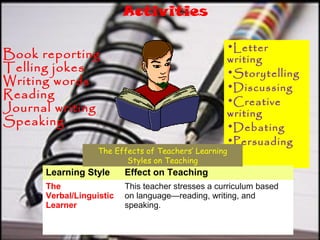
Activities
Book reporting
Telling jokes
Writing words
Reading
Journal writing
Speaking
•Letter
writing
•Storytelling
•Discussing
•Creative
writing
•Debating
•Persuading
Learning Style Effect on Teaching
The
Verbal/Linguistic
Learner
This teacher stresses a curriculum based
on language—reading, writing, and
speaking.
The Effects of Teachers’ Learning
Styles on Teaching
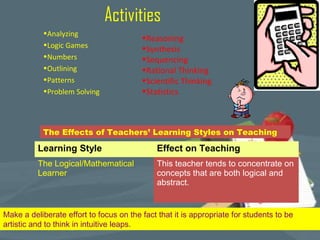
•Analyzing
•Logic Games
•Numbers
•Outlining
•Patterns
•Problem Solving
•Reasoning
•Synthesis
•Sequencing
•Rational Thinking
•Scientific Thinking
•Statistics
Activities
The Effects of Teachers’ Learning Styles on Teaching
Learning Style Effect on Teaching
The Logical/Mathematical
Learner
This teacher tends to concentrate on
concepts that are both logical and
abstract.
Make a deliberate effort to focus on the fact that it is appropriate for students to be
artistic and to think in intuitive leaps.
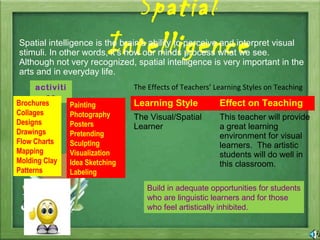
Spatial
IntelligenceSpatial intelligence is the brain’s ability to perceive and interpret visual
stimuli. In other words, it’s how our minds process what we see.
Although not very recognized, spatial intelligence is very important in the
arts and in everyday life.
activiti
es
Brochures
Collages
Designs
Drawings
Flow Charts
Mapping
Molding Clay
Patterns
The Effects of Teachers’ Learning Styles on Teaching
Painting
Photography
Posters
Pretending
Sculpting
Visualization
Idea Sketching
Labeling
Learning Style Effect on Teaching
The Visual/Spatial
Learner
This teacher will provide
a great learning
environment for visual
learners. The artistic
students will do well in
this classroom.
Build in adequate opportunities for students
who are linguistic learners and for those
who feel artistically inhibited.
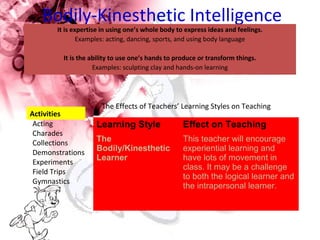
Bodily-Kinesthetic Intelligence
It is expertise in using one’s whole body to express ideas and feelings.
Examples: acting, dancing, sports, and using body language
It is the ability to use one’s hands to produce or transform things.
Examples: sculpting clay and hands-on learning
Acting
Charades
Collections
Demonstrations
Experiments
Field Trips
Gymnastics
Activities
Learning Style Effect on Teaching
The
Bodily/Kinesthetic
Learner
This teacher will encourage
experiential learning and
have lots of movement in
class. It may be a challenge
to both the logical learner and
the intrapersonal learner.
The Effects of Teachers’ Learning Styles on Teaching
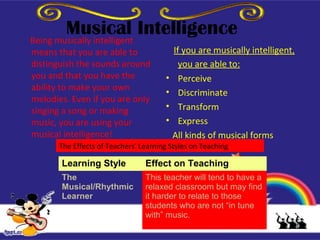
Musical IntelligenceBeing musically intelligent
means that you are able to
distinguish the sounds around
you and that you have the
ability to make your own
melodies. Even if you are only
singing a song or making
music, you are using your
musical intelligence!
If you are musically intelligent,
you are able to:
• Perceive
• Discriminate
• Transform
• Express
All kinds of musical forms
Learning Style Effect on Teaching
The
Musical/Rhythmic
Learner
This teacher will tend to have a
relaxed classroom but may find
it harder to relate to those
students who are not “in tune
with” music.
The Effects of Teachers’ Learning Styles on Teaching
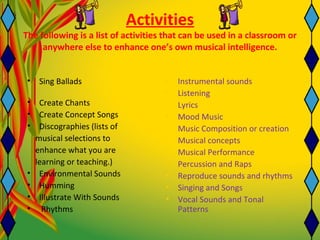
Activities
The following is a list of activities that can be used in a classroom or
anywhere else to enhance one’s own musical intelligence.
• Sing Ballads
• Create Chants
• Create Concept Songs
• Discographies (lists of
musical selections to
enhance what you are
learning or teaching.)
• Environmental Sounds
• Humming
• Illustrate With Sounds
• Rhythms
• Instrumental sounds
• Listening
• Lyrics
• Mood Music
• Music Composition or creation
• Musical concepts
• Musical Performance
• Percussion and Raps
• Reproduce sounds and rhythms
• Singing and Songs
• Vocal Sounds and Tonal
Patterns
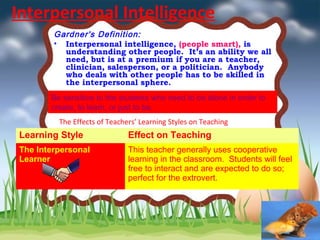
Interpersonal Intelligence
Gardner's Definition:
• Interpersonal intelligence, (people smart), is
understanding other people.  It’s an ability we all
need, but is at a premium if you are a teacher,
clinician, salesperson, or a politician.  Anybody
who deals with other people has to be skilled in
the interpersonal sphere.
Be sensitive to the students who need to be alone in order to
create, to learn, or just to be.
The Effects of Teachers’ Learning Styles on Teaching
Learning Style Effect on Teaching
The Interpersonal
Learner
This teacher generally uses cooperative
learning in the classroom. Students will feel
free to interact and are expected to do so;
perfect for the extrovert.
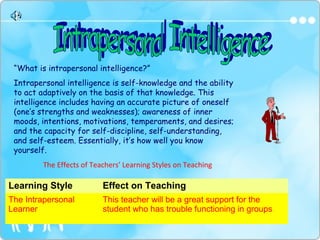
“What is intrapersonal intelligence?”
Intrapersonal intelligence is self-knowledge and the ability
to act adaptively on the basis of that knowledge. This
intelligence includes having an accurate picture of oneself
(one’s strengths and weaknesses); awareness of inner
moods, intentions, motivations, temperaments, and desires;
and the capacity for self-discipline, self-understanding,
and self-esteem. Essentially, it’s how well you know
yourself.
Learning Style Effect on Teaching
The Intrapersonal
Learner
This teacher will be a great support for the
student who has trouble functioning in groups.
The Effects of Teachers’ Learning Styles on Teaching
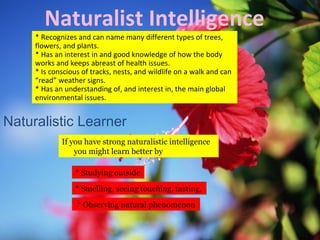
* Recognizes and can name many different types of trees,
flowers, and plants.
* Has an interest in and good knowledge of how the body
works and keeps abreast of health issues.
* Is conscious of tracks, nests, and wildlife on a walk and can
“read” weather signs.
* Has an understanding of, and interest in, the main global
environmental issues.
Naturalist Intelligence
Naturalistic Learner
If you have strong naturalistic intelligence
you might learn better by
* Studying outside
* Smelling, seeing touching, tasting,
* Observing natural phenomenon
As a teacher we must know and uderstand about
the talent of our student.
Everyone has inteligences,
But no one have all af them, maybe just three until five of
eight inteligences as we know.
Someone who succes in her/his life ,is not someone
who can do everything, but who focus to the one.
Mario Teguh.
ConclusionTHANK YOU for
your attention
Guys.!!!
See you next
time!!!
The Related Video: Introduction to Multiple
Intelligences

Multiple Intelligences by Howard Gardner

  • 1.
  • 3.
    How bad youare, you are a life changer in your life. Life is too short to live with regrets.
  • 4.
    The theory ofmultiple intelligences is Howard Gardner’s theory that proposes that people are not born with all of the intelligence they will ever have. It says that intelligence can be learned throughout life. we can improve education by addressing the multiple intelligences of our students. Also, it claims that everyone is intelligent in at least eight different ways and can develop each aspect of intelligence to an average level of competency. Intelligence, as defined by Gardner, is the ability to solve problems or fashion products that are valuable in one or more cultural settings.
  • 5.
    Multiple Intelligences NOT: asingle, unchanged, inborn capacity In: IQ Tests a learner – based philosophy that characterizes human intelligence as having multiple dimensions that must be acknowledged and developed in education. Human Intelligence
  • 6.
  • 7.
    Linguistic Intelligence Gardner's Definition: LinguisticIntelligence (Word Smart) is the capacity to use language, your native language, and perhaps other languages, to express what's on your mind and to understand other people. Criteria Used for Linguistic Intelligence •Can understand words and manipulate the structure of language •Has highly developed communication skills including writing, speaking, and story-telling •Knows and correctly uses rules of grammar •Enjoys reading, writing, and speaking •Has a large vocabulary This person learns best by: •Saying, hearing, and seeing words •Writing •Talking
  • 8.
    Activities Book reporting Telling jokes Writingwords Reading Journal writing Speaking •Letter writing •Storytelling •Discussing •Creative writing •Debating •Persuading Learning Style Effect on Teaching The Verbal/Linguistic Learner This teacher stresses a curriculum based on language—reading, writing, and speaking. The Effects of Teachers’ Learning Styles on Teaching
  • 10.
    •Analyzing •Logic Games •Numbers •Outlining •Patterns •Problem Solving •Reasoning •Synthesis •Sequencing •RationalThinking •Scientific Thinking •Statistics Activities The Effects of Teachers’ Learning Styles on Teaching Learning Style Effect on Teaching The Logical/Mathematical Learner This teacher tends to concentrate on concepts that are both logical and abstract. Make a deliberate effort to focus on the fact that it is appropriate for students to be artistic and to think in intuitive leaps.
  • 11.
    Spatial IntelligenceSpatial intelligence isthe brain’s ability to perceive and interpret visual stimuli. In other words, it’s how our minds process what we see. Although not very recognized, spatial intelligence is very important in the arts and in everyday life. activiti es Brochures Collages Designs Drawings Flow Charts Mapping Molding Clay Patterns The Effects of Teachers’ Learning Styles on Teaching Painting Photography Posters Pretending Sculpting Visualization Idea Sketching Labeling Learning Style Effect on Teaching The Visual/Spatial Learner This teacher will provide a great learning environment for visual learners. The artistic students will do well in this classroom. Build in adequate opportunities for students who are linguistic learners and for those who feel artistically inhibited.
  • 12.
    Bodily-Kinesthetic Intelligence It isexpertise in using one’s whole body to express ideas and feelings. Examples: acting, dancing, sports, and using body language It is the ability to use one’s hands to produce or transform things. Examples: sculpting clay and hands-on learning Acting Charades Collections Demonstrations Experiments Field Trips Gymnastics Activities Learning Style Effect on Teaching The Bodily/Kinesthetic Learner This teacher will encourage experiential learning and have lots of movement in class. It may be a challenge to both the logical learner and the intrapersonal learner. The Effects of Teachers’ Learning Styles on Teaching
  • 13.
    Musical IntelligenceBeing musicallyintelligent means that you are able to distinguish the sounds around you and that you have the ability to make your own melodies. Even if you are only singing a song or making music, you are using your musical intelligence! If you are musically intelligent, you are able to: • Perceive • Discriminate • Transform • Express All kinds of musical forms Learning Style Effect on Teaching The Musical/Rhythmic Learner This teacher will tend to have a relaxed classroom but may find it harder to relate to those students who are not “in tune with” music. The Effects of Teachers’ Learning Styles on Teaching
  • 14.
    Activities The following isa list of activities that can be used in a classroom or anywhere else to enhance one’s own musical intelligence. • Sing Ballads • Create Chants • Create Concept Songs • Discographies (lists of musical selections to enhance what you are learning or teaching.) • Environmental Sounds • Humming • Illustrate With Sounds • Rhythms • Instrumental sounds • Listening • Lyrics • Mood Music • Music Composition or creation • Musical concepts • Musical Performance • Percussion and Raps • Reproduce sounds and rhythms • Singing and Songs • Vocal Sounds and Tonal Patterns
  • 15.
    Interpersonal Intelligence Gardner's Definition: •Interpersonal intelligence, (people smart), is understanding other people.  It’s an ability we all need, but is at a premium if you are a teacher, clinician, salesperson, or a politician.  Anybody who deals with other people has to be skilled in the interpersonal sphere. Be sensitive to the students who need to be alone in order to create, to learn, or just to be. The Effects of Teachers’ Learning Styles on Teaching Learning Style Effect on Teaching The Interpersonal Learner This teacher generally uses cooperative learning in the classroom. Students will feel free to interact and are expected to do so; perfect for the extrovert.
  • 16.
    “What is intrapersonalintelligence?” Intrapersonal intelligence is self-knowledge and the ability to act adaptively on the basis of that knowledge. This intelligence includes having an accurate picture of oneself (one’s strengths and weaknesses); awareness of inner moods, intentions, motivations, temperaments, and desires; and the capacity for self-discipline, self-understanding, and self-esteem. Essentially, it’s how well you know yourself. Learning Style Effect on Teaching The Intrapersonal Learner This teacher will be a great support for the student who has trouble functioning in groups. The Effects of Teachers’ Learning Styles on Teaching
  • 17.
    * Recognizes andcan name many different types of trees, flowers, and plants. * Has an interest in and good knowledge of how the body works and keeps abreast of health issues. * Is conscious of tracks, nests, and wildlife on a walk and can “read” weather signs. * Has an understanding of, and interest in, the main global environmental issues. Naturalist Intelligence Naturalistic Learner If you have strong naturalistic intelligence you might learn better by * Studying outside * Smelling, seeing touching, tasting, * Observing natural phenomenon
  • 18.
    As a teacherwe must know and uderstand about the talent of our student. Everyone has inteligences, But no one have all af them, maybe just three until five of eight inteligences as we know. Someone who succes in her/his life ,is not someone who can do everything, but who focus to the one. Mario Teguh. ConclusionTHANK YOU for your attention Guys.!!! See you next time!!!
  • 19.
    The Related Video:Introduction to Multiple Intelligences