Subject : Teaching Method
Lecture : Miss Ade
Arranged : 1. Ani Istiana
2. Avi Marina
3. Supriyanti
An Informed Approach
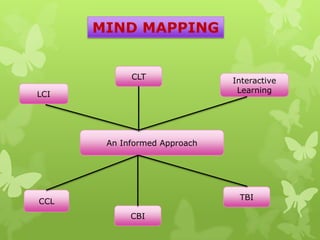
MIND MAPPING
An Informed Approach
CLT
LCI
CCL
Interactive
Learning
TBI
CBI
Communicative Language Teaching (CLT)
Communicative Language Teaching (CLT) Which is an approach to the
teaching of second and foreign languages, emphasizes interaction as both the
means and the ultimate goal of learning a language. It is also referred to as
“Communicative Approach”
Activity Types of CLT
• Role-play
• Interviews
• Games
• Language exchanges
• Surveys
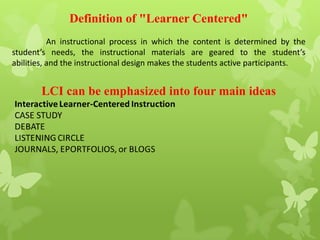
Definition of "Learner Centered"
An instructional process in which the content is determined by the
student’s needs, the instructional materials are geared to the student’s
abilities, and the instructional design makes the students active participants.
LCI can be emphasized into four main ideas
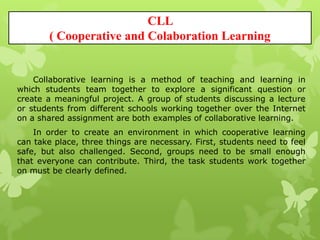
CLL
( Cooperative and Colaboration Learning
Collaborative learning is a method of teaching and learning in
which students team together to explore a significant question or
create a meaningful project. A group of students discussing a lecture
or students from different schools working together over the Internet
on a shared assignment are both examples of collaborative learning.
In order to create an environment in which cooperative learning
can take place, three things are necessary. First, students need to feel
safe, but also challenged. Second, groups need to be small enough
that everyone can contribute. Third, the task students work together
on must be clearly defined.
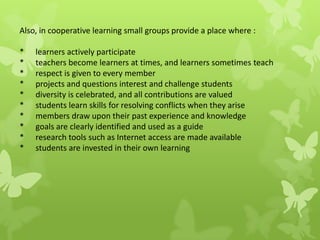
Also, in cooperative learning small groups provide a place where :
* learners actively participate
* teachers become learners at times, and learners sometimes teach
* respect is given to every member
* projects and questions interest and challenge students
* diversity is celebrated, and all contributions are valued
* students learn skills for resolving conflicts when they arise
* members draw upon their past experience and knowledge
* goals are clearly identified and used as a guide
* research tools such as Internet access are made available
* students are invested in their own learning
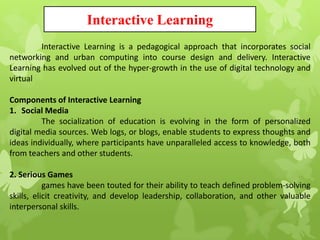
Interactive Learning
Interactive Learning is a pedagogical approach that incorporates social
networking and urban computing into course design and delivery. Interactive
Learning has evolved out of the hyper-growth in the use of digital technology and
virtual
Components of Interactive Learning
1. Social Media
The socialization of education is evolving in the form of personalized
digital media sources. Web logs, or blogs, enable students to express thoughts and
ideas individually, where participants have unparalleled access to knowledge, both
from teachers and other students.
2. Serious Games
games have been touted for their ability to teach defined problem-solving
skills, elicit creativity, and develop leadership, collaboration, and other valuable
interpersonal skills.
Applying Interactive Learning
In order to be effective, learning institutions must see computers
and associated technology as an essential part of the student.
The core concept of distance education is that the real world becomes the
learning environment; in this environment, the purpose of the instructor is
to help facilitate the absorption of knowledge through both real-world and
virtual learning experiences.[5] Historically, one of the obstacles to distance
education is the lack of face to face contact.
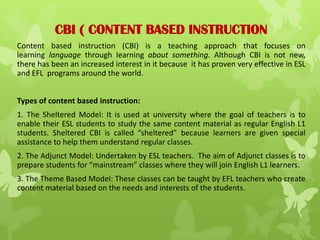
CBI ( CONTENT BASED INSTRUCTION
Content based instruction (CBI) is a teaching approach that focuses on
learning language through learning about something. Although CBI is not new,
there has been an increased interest in it because it has proven very effective in ESL
and EFL programs around the world.
Types of content based instruction:
1. The Sheltered Model: It is used at university where the goal of teachers is to
enable their ESL students to study the same content material as regular English L1
students. Sheltered CBI is called “sheltered” because learners are given special
assistance to help them understand regular classes.
2. The Adjunct Model: Undertaken by ESL teachers. The aim of Adjunct classes is to
prepare students for “mainstream” classes where they will join English L1 learners.
3. The Theme Based Model: These classes can be taught by EFL teachers who create
content material based on the needs and interests of the students.
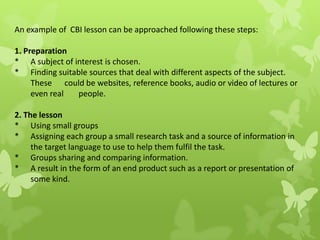
An example of CBI lesson can be approached following these steps:
1. Preparation
* A subject of interest is chosen.
* Finding suitable sources that deal with different aspects of the subject.
These could be websites, reference books, audio or video of lectures or
even real people.
2. The lesson
* Using small groups
* Assigning each group a small research task and a source of information in
the target language to use to help them fulfil the task.
* Groups sharing and comparing information.
* A result in the form of an end product such as a report or presentation of
some kind.
TBL Methodology . . . What is Task Based Learning ?
Task based learning is a different way to teach languages. It can help
the student by placing her in a situation like in the real world. A situation
where oral communication is essential for doing a specific task. Task based
learning has the advantage of getting the student to use her skills at her
current level. To help develop language through its use. It has the advantage of
getting the focus of the student toward achieving a goal where language
becomes a tool, making the use of language a neccissity.
Why choose TBL as language teaching method? We have to ask
ourselves that question, because if we, as language teachers, don’t know
which method we are teaching according to or if we do not think about
teaching methodology in relation to the different types of learners, to levels, to
materials and last but not least to the learning processes of the indi-vidual
learner, we might as well not teach!
Teaching Method

Teaching Method

  • 1.
    Subject : TeachingMethod Lecture : Miss Ade Arranged : 1. Ani Istiana 2. Avi Marina 3. Supriyanti An Informed Approach
  • 2.
    MIND MAPPING An InformedApproach CLT LCI CCL Interactive Learning TBI CBI
  • 3.
    Communicative Language Teaching(CLT) Communicative Language Teaching (CLT) Which is an approach to the teaching of second and foreign languages, emphasizes interaction as both the means and the ultimate goal of learning a language. It is also referred to as “Communicative Approach” Activity Types of CLT • Role-play • Interviews • Games • Language exchanges • Surveys
  • 4.
    Definition of "LearnerCentered" An instructional process in which the content is determined by the student’s needs, the instructional materials are geared to the student’s abilities, and the instructional design makes the students active participants. LCI can be emphasized into four main ideas
  • 5.
    CLL ( Cooperative andColaboration Learning Collaborative learning is a method of teaching and learning in which students team together to explore a significant question or create a meaningful project. A group of students discussing a lecture or students from different schools working together over the Internet on a shared assignment are both examples of collaborative learning. In order to create an environment in which cooperative learning can take place, three things are necessary. First, students need to feel safe, but also challenged. Second, groups need to be small enough that everyone can contribute. Third, the task students work together on must be clearly defined.
  • 6.
    Also, in cooperativelearning small groups provide a place where : * learners actively participate * teachers become learners at times, and learners sometimes teach * respect is given to every member * projects and questions interest and challenge students * diversity is celebrated, and all contributions are valued * students learn skills for resolving conflicts when they arise * members draw upon their past experience and knowledge * goals are clearly identified and used as a guide * research tools such as Internet access are made available * students are invested in their own learning
  • 7.
    Interactive Learning Interactive Learningis a pedagogical approach that incorporates social networking and urban computing into course design and delivery. Interactive Learning has evolved out of the hyper-growth in the use of digital technology and virtual Components of Interactive Learning 1. Social Media The socialization of education is evolving in the form of personalized digital media sources. Web logs, or blogs, enable students to express thoughts and ideas individually, where participants have unparalleled access to knowledge, both from teachers and other students. 2. Serious Games games have been touted for their ability to teach defined problem-solving skills, elicit creativity, and develop leadership, collaboration, and other valuable interpersonal skills.
  • 8.
    Applying Interactive Learning Inorder to be effective, learning institutions must see computers and associated technology as an essential part of the student. The core concept of distance education is that the real world becomes the learning environment; in this environment, the purpose of the instructor is to help facilitate the absorption of knowledge through both real-world and virtual learning experiences.[5] Historically, one of the obstacles to distance education is the lack of face to face contact.
  • 9.
    CBI ( CONTENTBASED INSTRUCTION Content based instruction (CBI) is a teaching approach that focuses on learning language through learning about something. Although CBI is not new, there has been an increased interest in it because it has proven very effective in ESL and EFL programs around the world. Types of content based instruction: 1. The Sheltered Model: It is used at university where the goal of teachers is to enable their ESL students to study the same content material as regular English L1 students. Sheltered CBI is called “sheltered” because learners are given special assistance to help them understand regular classes. 2. The Adjunct Model: Undertaken by ESL teachers. The aim of Adjunct classes is to prepare students for “mainstream” classes where they will join English L1 learners. 3. The Theme Based Model: These classes can be taught by EFL teachers who create content material based on the needs and interests of the students.
  • 10.
    An example ofCBI lesson can be approached following these steps: 1. Preparation * A subject of interest is chosen. * Finding suitable sources that deal with different aspects of the subject. These could be websites, reference books, audio or video of lectures or even real people. 2. The lesson * Using small groups * Assigning each group a small research task and a source of information in the target language to use to help them fulfil the task. * Groups sharing and comparing information. * A result in the form of an end product such as a report or presentation of some kind.
  • 11.
    TBL Methodology .. . What is Task Based Learning ? Task based learning is a different way to teach languages. It can help the student by placing her in a situation like in the real world. A situation where oral communication is essential for doing a specific task. Task based learning has the advantage of getting the student to use her skills at her current level. To help develop language through its use. It has the advantage of getting the focus of the student toward achieving a goal where language becomes a tool, making the use of language a neccissity. Why choose TBL as language teaching method? We have to ask ourselves that question, because if we, as language teachers, don’t know which method we are teaching according to or if we do not think about teaching methodology in relation to the different types of learners, to levels, to materials and last but not least to the learning processes of the indi-vidual learner, we might as well not teach!