Robert J. Dickey Keimyung University, S. Korea
Lesson Conceptualization Aims/Objectives –   Why are you teaching this class? Linguistic Content Other
Purpose of the Lesson Plan a clear working document, another teacher could pick up it and use Coverage of subject matter Comprehensive Organized Cohesion & Variety Inter-lesson consistency? Exploitation of materials
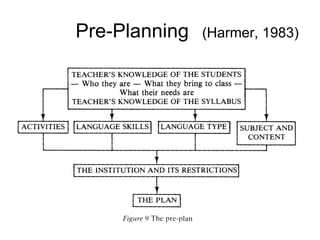
Pre-Planning  (Harmer, 1983)
Lesson Development Framework Identify the specific course & group of students to teach. Identify the content to be utilized. Identify why the students should care. Identify the specific “leaning ojective.” Develop/locate an exemplar text. Design student responses to the text. Students check their own work, and of their peers. Groupwork. Students create new stories / endings, and tell groupmates. Testing.
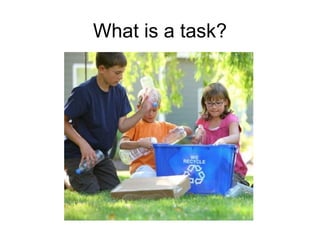
What is a task?
Task  =  Doing for a purpose
Language Learning Objective(s) Not just an activity or exercise Not just language practice Not “teaching time” Intimately connected to current language-learning syllabus objectives  (i.e., this is a language learning classroom)
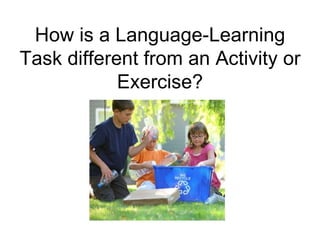
How is a Language-Learning Task different from an Activity or Exercise?
Task-based Defined - Willis Activities where the target language is used by the learner for a  communicative purpose  (goal) in order to achieve an outcome. is  central  to the methodological cycle learners are free chose  whatever language form  they wish
Task-based - Ellis A workplan (plan for learning) Primary focus on meaning  Real-world processes of language use  (even if task is artificial) Any of the 4 language skills Involves  cognitive processes Clearly-defined  communicative outcome
Task-based - Nunan Syllabus is centered  NOT  on an ordered list of  linguistic items  but on a collection of tasks Distinction between Real-world tasks Pedagogical tasks Mobilizing grammatical knowledge in order to express meaning
Pedagogical Task - Nunan a piece of classroom work that involves the learners in  comprehending ,  manipulating ,  producing  or  interacting  in the target language while their attention is focused on  mobilizing their grammatical knowledge in order to express meaning , and in which the  intention is to convey meaning  rather than to manipulate form.“ (Nunan, 2004, p.4).
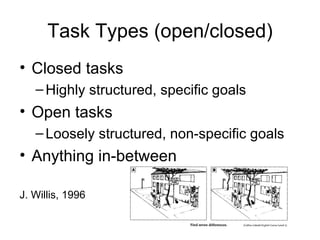
Task Types (open/closed) Closed tasks Highly structured, specific goals Open tasks Loosely structured, non-specific goals Anything in-between J. Willis, 1996
Task Types (focus) Focused tasks encourage the use of particular linguistic items through noticing in pre-task Unfocused tasks allow learners to use an array of language features or structures Blending is possible
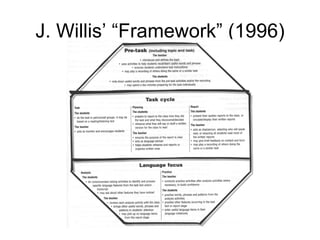
J. Willis’ “Framework” (1996)
3 Stages (phases) of TBLL Pre-Task Preparation A mini-task Task – during the “main” task Outcome is principal focus Language-learning Objective Post-Task Language-learning support
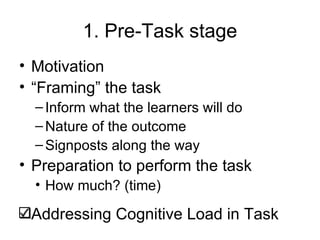
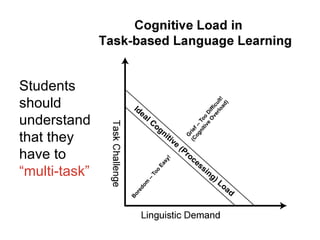
1. Pre-Task stage Motivation “ Framing” the task Inform what the learners will do Nature of the outcome Signposts along the way Preparation to perform the task How much? (time) Addressing Cognitive Load in Task
Students should understand that they have to  “multi-task”
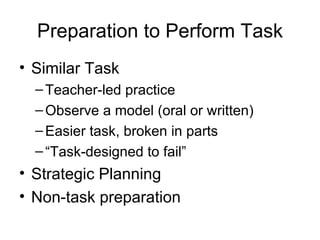
Preparation to Perform Task Similar Task Teacher-led practice Observe a model (oral or written) Easier task, broken in parts “ Task-designed to fail” Strategic Planning Non-task preparation
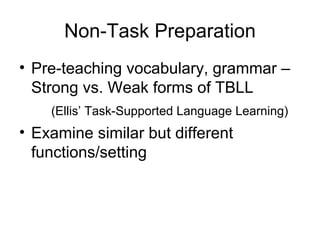
Non-Task Preparation Pre-teaching vocabulary, grammar – Strong vs. Weak forms of TBLL (Ellis’ Task-Supported Language Learning) Examine similar but different functions/setting
2. Task (main) stage Task Performance Options (planned before class) Task Process Options (determined “live” inside the task event)
a. Task Performance Options Time limit? Strictly enforced?  Re-negotiated?  More time    more accuracy?  (Lang, Content) Access to data during the task? How complex is the data? Can see notes or whole data, or nothing? Surprise?  (change something) Pairs/Groups, moving around
b. Task Process Options Classroom participants must  forget where they are and why they are there Classroom participants must  believe in learn by doing rather than by studying Teacher  monitors  learners’ performance to impact future teaching and tasks Focus-on-Form classroom with teacher interaction in tasks  (error-correction)
3. Post-task (stage) Repeat performance Reflecting on performance Individually or in groups Focus on Forms Consciousness-Raising Noticing Review of Errors  (Explicit, Non-explicit) Production Practice activities/exercises
Task Input Data “ Text”  (Written or Oral) Non-verbal materials Realia, pictures, diagrams, tables,or other… Specific to the task (model) or less-specific Procedures Consider “setting” (groups, etc)
Factors Affecting Task Difficulty Context & Abstractness Degree of cognitive demand Access to background knowledge Level of learner support available Language complexity Emotional stress in task completion Interest and Motivation of the learner
Task Varieties Listing Ordering & Sorting Comparing Problem-solving Sharing personal experiences Creative tasks (projects) J. Willis, 1996
Critique of TBLL Learners might be led to focus on meaning over form, “ fluent” rather than challenging language “ Practice” of inaccurate or simplistic language Time away from instruction (new materials)
Observations on Willis ‘96 “ Event” (task) very short (1-5 min) Planning time for report of event is substantial (though this too is a task) Reporting on the event is a third type of task Language Focus (post-task) is approx ½ of lesson period
Lesson Plan Stages (Phases) PPP(+P) XXX(+X) IDC TTT ARC ESA OHE  &  I-I-I Deep-end Strategy
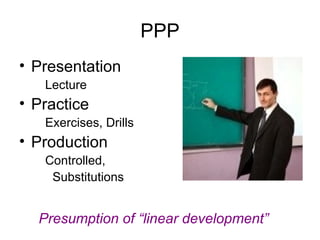
PPP Presentation Lecture Practice Exercises, Drills Production Controlled,  Substitutions Presumption of “linear development”
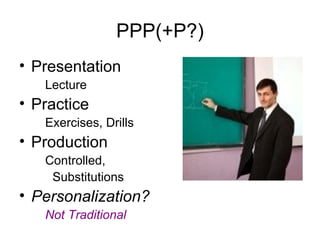
PPP(+P?) Presentation Lecture Practice Exercises, Drills Production Controlled, Substitutions Personalization? Not Traditional
XXX(+X)? X – e X plain X – e X ample X – e X ercise X - e X amination
IDC Introduction (Less than 5 minutes) Development Consolidation
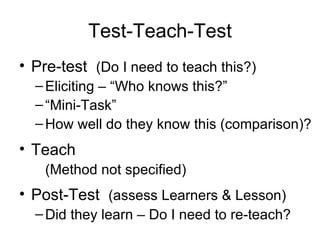
Test-Teach-Test Pre-test  (Do I need to teach this?) Eliciting – “Who knows this?” “ Mini-Task” How well do they know this (comparison)? Teach (Method not specified) Post-Test  (assess Learners & Lesson) Did they learn – Do I need to re-teach?
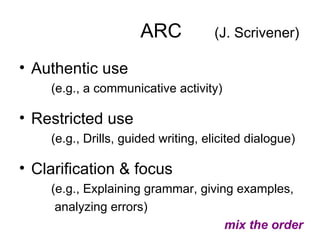
ARC  (J. Scrivener) Authentic use (e.g., a communicative activity) Restricted use (e.g., Drills, guided writing, elicited dialogue) Clarification & focus (e.g., Explaining grammar, giving examples,   analyzing errors) mix the order
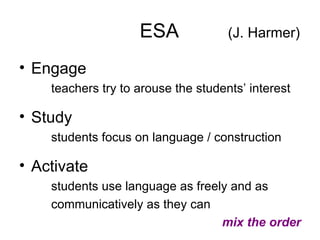
ESA  (J. Harmer) Engage teachers try to arouse the students’ interest Study students focus on language / construction Activate students use language as freely and as communicatively as they can mix the order
OHE  (M. Lewis) Observe (read or listen to language) which will then provoke them to Hypothesize about how the language works before going on to Experiment on the basis of that hypothesis
I-I-I   (McCarthy & Carter) Illustration examining real data in specific contexts Interaction consciousness-raising activities designed to focus on the inter-personal use of language and the negotiation of meaning Induction encouraging students to notice the different functions of the lexio-grammatical features
Other Elements to consider Warmer  Review last class Elicitation Check Homework Peer-Coaching Extension Homework Assignment Review this class  Preview next class Fillers Wind-down
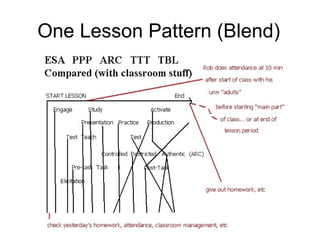
One Lesson Pattern (Blend)
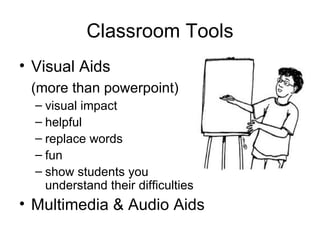
Classroom Tools Visual Aids  (more than powerpoint) visual impact helpful replace words fun show students you understand their difficulties Multimedia & Audio Aids
Instructional Techniques Consciousness-Raising  Activities Teacher (or Learner) -driven Drawing awareness to Language properties for FUTURE noticing Noticing Where “input” may become “intake”
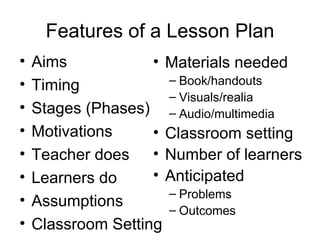
Features of a Lesson Plan Aims Timing Stages (Phases) Motivations Teacher does Learners do Assumptions Classroom Setting Materials needed Book/handouts Visuals/realia Audio/multimedia Classroom setting Number of learners Anticipated Problems Outcomes
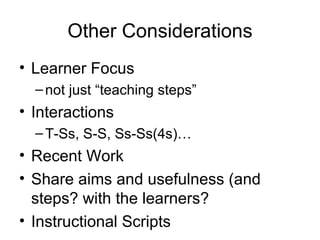
Other Considerations Learner Focus not just “teaching steps” Interactions T-Ss, S-S, Ss-Ss(4s)… Recent Work Share aims and usefulness (and steps? with the learners? Instructional Scripts
Lesson Plan Features (TKT) (A boring lesson?)   TKT [book] (2005)
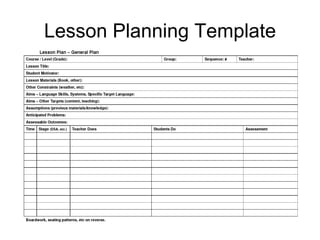
Lesson Planning Template
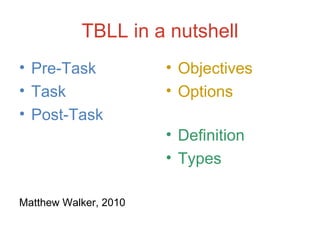
TBLL in a nutshell Pre-Task Task Post-Task Matthew Walker, 2010 Objectives Options Definition Types
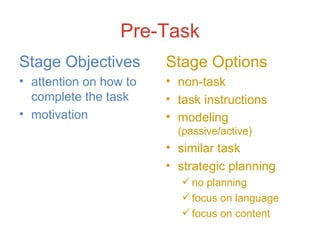
Pre-Task Stage Objectives attention on how to complete the task motivation Stage Options non-task task instructions modeling  (passive/active) similar task strategic planning no planning focus on language focus on content
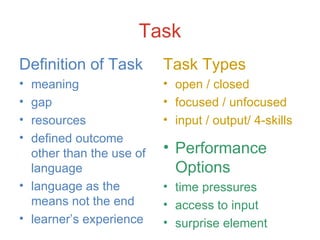
Task Definition of Task meaning gap resources defined outcome other than the use of language language as the means not the end learner’s experience Task Types open / closed focused / unfocused input / output/ 4-skills Performance Options time pressures access to input surprise element
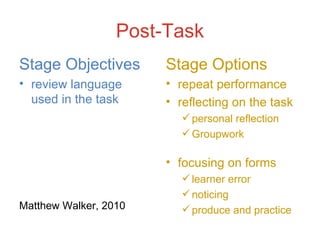
Post-Task Stage Objectives review language  used in the task Matthew Walker, 2010 Stage Options repeat performance reflecting on the task personal reflection Groupwork focusing on forms learner error noticing produce and practice
Hope this Helps! Robert J. Dickey Keimyung University Daegu, S. Korea [email_address]

TBLT Lesson Planning

  • 1.
    Robert J. DickeyKeimyung University, S. Korea
  • 2.
    Lesson Conceptualization Aims/Objectives– Why are you teaching this class? Linguistic Content Other
  • 3.
    Purpose of theLesson Plan a clear working document, another teacher could pick up it and use Coverage of subject matter Comprehensive Organized Cohesion & Variety Inter-lesson consistency? Exploitation of materials
  • 4.
  • 5.
    Lesson Development FrameworkIdentify the specific course & group of students to teach. Identify the content to be utilized. Identify why the students should care. Identify the specific “leaning ojective.” Develop/locate an exemplar text. Design student responses to the text. Students check their own work, and of their peers. Groupwork. Students create new stories / endings, and tell groupmates. Testing.
  • 6.
    What is atask?
  • 7.
    Task = Doing for a purpose
  • 8.
    Language Learning Objective(s)Not just an activity or exercise Not just language practice Not “teaching time” Intimately connected to current language-learning syllabus objectives (i.e., this is a language learning classroom)
  • 9.
    How is aLanguage-Learning Task different from an Activity or Exercise?
  • 10.
    Task-based Defined -Willis Activities where the target language is used by the learner for a communicative purpose (goal) in order to achieve an outcome. is central to the methodological cycle learners are free chose whatever language form they wish
  • 11.
    Task-based - EllisA workplan (plan for learning) Primary focus on meaning Real-world processes of language use (even if task is artificial) Any of the 4 language skills Involves cognitive processes Clearly-defined communicative outcome
  • 12.
    Task-based - NunanSyllabus is centered NOT on an ordered list of linguistic items but on a collection of tasks Distinction between Real-world tasks Pedagogical tasks Mobilizing grammatical knowledge in order to express meaning
  • 13.
    Pedagogical Task -Nunan a piece of classroom work that involves the learners in comprehending , manipulating , producing or interacting in the target language while their attention is focused on mobilizing their grammatical knowledge in order to express meaning , and in which the intention is to convey meaning rather than to manipulate form.“ (Nunan, 2004, p.4).
  • 14.
    Task Types (open/closed)Closed tasks Highly structured, specific goals Open tasks Loosely structured, non-specific goals Anything in-between J. Willis, 1996
  • 15.
    Task Types (focus)Focused tasks encourage the use of particular linguistic items through noticing in pre-task Unfocused tasks allow learners to use an array of language features or structures Blending is possible
  • 16.
  • 17.
    3 Stages (phases)of TBLL Pre-Task Preparation A mini-task Task – during the “main” task Outcome is principal focus Language-learning Objective Post-Task Language-learning support
  • 18.
    1. Pre-Task stageMotivation “ Framing” the task Inform what the learners will do Nature of the outcome Signposts along the way Preparation to perform the task How much? (time) Addressing Cognitive Load in Task
  • 19.
    Students should understandthat they have to “multi-task”
  • 20.
    Preparation to PerformTask Similar Task Teacher-led practice Observe a model (oral or written) Easier task, broken in parts “ Task-designed to fail” Strategic Planning Non-task preparation
  • 21.
    Non-Task Preparation Pre-teachingvocabulary, grammar – Strong vs. Weak forms of TBLL (Ellis’ Task-Supported Language Learning) Examine similar but different functions/setting
  • 22.
    2. Task (main)stage Task Performance Options (planned before class) Task Process Options (determined “live” inside the task event)
  • 23.
    a. Task PerformanceOptions Time limit? Strictly enforced? Re-negotiated? More time  more accuracy? (Lang, Content) Access to data during the task? How complex is the data? Can see notes or whole data, or nothing? Surprise? (change something) Pairs/Groups, moving around
  • 24.
    b. Task ProcessOptions Classroom participants must forget where they are and why they are there Classroom participants must believe in learn by doing rather than by studying Teacher monitors learners’ performance to impact future teaching and tasks Focus-on-Form classroom with teacher interaction in tasks (error-correction)
  • 25.
    3. Post-task (stage)Repeat performance Reflecting on performance Individually or in groups Focus on Forms Consciousness-Raising Noticing Review of Errors (Explicit, Non-explicit) Production Practice activities/exercises
  • 26.
    Task Input Data“ Text” (Written or Oral) Non-verbal materials Realia, pictures, diagrams, tables,or other… Specific to the task (model) or less-specific Procedures Consider “setting” (groups, etc)
  • 27.
    Factors Affecting TaskDifficulty Context & Abstractness Degree of cognitive demand Access to background knowledge Level of learner support available Language complexity Emotional stress in task completion Interest and Motivation of the learner
  • 28.
    Task Varieties ListingOrdering & Sorting Comparing Problem-solving Sharing personal experiences Creative tasks (projects) J. Willis, 1996
  • 29.
    Critique of TBLLLearners might be led to focus on meaning over form, “ fluent” rather than challenging language “ Practice” of inaccurate or simplistic language Time away from instruction (new materials)
  • 30.
    Observations on Willis‘96 “ Event” (task) very short (1-5 min) Planning time for report of event is substantial (though this too is a task) Reporting on the event is a third type of task Language Focus (post-task) is approx ½ of lesson period
  • 31.
    Lesson Plan Stages(Phases) PPP(+P) XXX(+X) IDC TTT ARC ESA OHE & I-I-I Deep-end Strategy
  • 32.
    PPP Presentation LecturePractice Exercises, Drills Production Controlled, Substitutions Presumption of “linear development”
  • 33.
    PPP(+P?) Presentation LecturePractice Exercises, Drills Production Controlled, Substitutions Personalization? Not Traditional
  • 34.
    XXX(+X)? X –e X plain X – e X ample X – e X ercise X - e X amination
  • 35.
    IDC Introduction (Lessthan 5 minutes) Development Consolidation
  • 36.
    Test-Teach-Test Pre-test (Do I need to teach this?) Eliciting – “Who knows this?” “ Mini-Task” How well do they know this (comparison)? Teach (Method not specified) Post-Test (assess Learners & Lesson) Did they learn – Do I need to re-teach?
  • 37.
    ARC (J.Scrivener) Authentic use (e.g., a communicative activity) Restricted use (e.g., Drills, guided writing, elicited dialogue) Clarification & focus (e.g., Explaining grammar, giving examples, analyzing errors) mix the order
  • 38.
    ESA (J.Harmer) Engage teachers try to arouse the students’ interest Study students focus on language / construction Activate students use language as freely and as communicatively as they can mix the order
  • 39.
    OHE (M.Lewis) Observe (read or listen to language) which will then provoke them to Hypothesize about how the language works before going on to Experiment on the basis of that hypothesis
  • 40.
    I-I-I (McCarthy & Carter) Illustration examining real data in specific contexts Interaction consciousness-raising activities designed to focus on the inter-personal use of language and the negotiation of meaning Induction encouraging students to notice the different functions of the lexio-grammatical features
  • 41.
    Other Elements toconsider Warmer Review last class Elicitation Check Homework Peer-Coaching Extension Homework Assignment Review this class Preview next class Fillers Wind-down
  • 42.
  • 43.
    Classroom Tools VisualAids (more than powerpoint) visual impact helpful replace words fun show students you understand their difficulties Multimedia & Audio Aids
  • 44.
    Instructional Techniques Consciousness-Raising Activities Teacher (or Learner) -driven Drawing awareness to Language properties for FUTURE noticing Noticing Where “input” may become “intake”
  • 45.
    Features of aLesson Plan Aims Timing Stages (Phases) Motivations Teacher does Learners do Assumptions Classroom Setting Materials needed Book/handouts Visuals/realia Audio/multimedia Classroom setting Number of learners Anticipated Problems Outcomes
  • 46.
    Other Considerations LearnerFocus not just “teaching steps” Interactions T-Ss, S-S, Ss-Ss(4s)… Recent Work Share aims and usefulness (and steps? with the learners? Instructional Scripts
  • 47.
    Lesson Plan Features(TKT) (A boring lesson?) TKT [book] (2005)
  • 48.
  • 49.
    TBLL in anutshell Pre-Task Task Post-Task Matthew Walker, 2010 Objectives Options Definition Types
  • 50.
    Pre-Task Stage Objectivesattention on how to complete the task motivation Stage Options non-task task instructions modeling (passive/active) similar task strategic planning no planning focus on language focus on content
  • 51.
    Task Definition ofTask meaning gap resources defined outcome other than the use of language language as the means not the end learner’s experience Task Types open / closed focused / unfocused input / output/ 4-skills Performance Options time pressures access to input surprise element
  • 52.
    Post-Task Stage Objectivesreview language used in the task Matthew Walker, 2010 Stage Options repeat performance reflecting on the task personal reflection Groupwork focusing on forms learner error noticing produce and practice
  • 53.
    Hope this Helps!Robert J. Dickey Keimyung University Daegu, S. Korea [email_address]

Editor's Notes

  • #10 A task has a non-linguistic outcome.