

UNDERSTANDING
SENTENCES
PART 2
Lecturer :
Unggul
Djatmika
UNDERSTANDINGUNDERSTANDING
SENTENCES PART 2SENTENCES PART 2
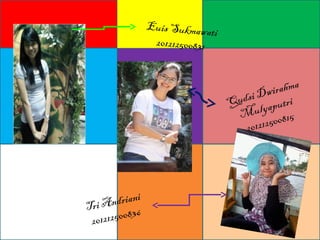
GROUP C
Euis Sukmawati
Qudsi Dwirahma Mulyaputri
Tri Andriani
Euis Sukmawati
201212500831
Qudsi Dwirahma
Mulyaputri
201212500815
Tri Andriani
201212500836
DISCUSSION TOPICSDISCUSSION TOPICS
IDENTIFYING CORE PARTS IN COMPLICATEDIDENTIFYING CORE PARTS IN COMPLICATED
SENTENCESSENTENCES
PUNCTUATION: AN AID TO SENTENCEPUNCTUATION: AN AID TO SENTENCE
COMPREHENSIONCOMPREHENSION
1. THE COMMA1. THE COMMA
2. THE SEMICOLON2. THE SEMICOLON
3.THE COLON3.THE COLON
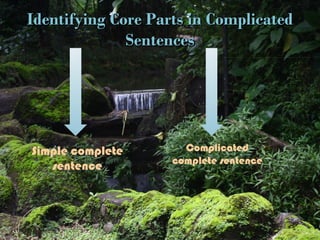
Identifying Core Parts in ComplicatedIdentifying Core Parts in Complicated
SentencesSentences
Simple complete
sentence
Complicated
complete sentence
AA Simple Complete SentenceSimple Complete Sentence is a sentenceis a sentence
structure that contains one independentstructure that contains one independent
clause and has no dependent clause.clause and has no dependent clause.
AA Complicated Complete SentenceComplicated Complete Sentence is ais a
sentence such as the third which is made upsentence such as the third which is made up
of one independent clause and one or moreof one independent clause and one or more
dependent clauses.dependent clauses.
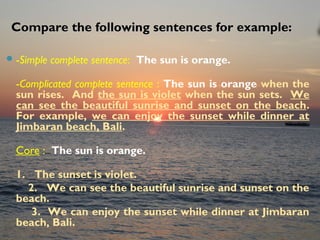
Compare the following sentences for example:Compare the following sentences for example:
-Simple complete sentence: The sun is orange.
-Complicated complete sentence : The sun is orange when the
sun rises. And the sun is violet when the sun sets. We
can see the beautiful sunrise and sunset on the beach.
For example, we can enjoy the sunset while dinner at
Jimbaran beach, Bali.
Core : The sun is orange.
1. The sunset is violet.
2. We can see the beautiful sunrise and sunset on the
beach.
3. We can enjoy the sunset while dinner at Jimbaran
beach, Bali.
PUNCTUATIO
N
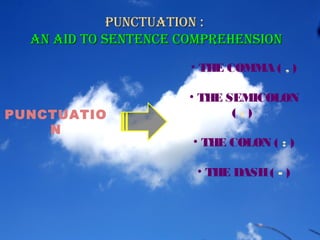
Punctuation :Punctuation :
an aid to Sentence comPrehenSionan aid to Sentence comPrehenSion
• THE COMMA ( , )
• THE SEMICOLON
( ; )
• THE COLON ( : )
• THE DASH( - )
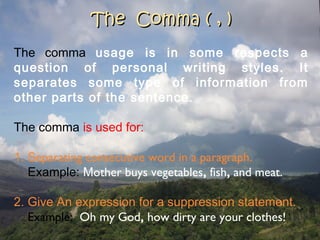
The Comma ( , )The Comma ( , )
The comma usage is in some respects a
question of personal writing styles. It
separates some type of information from
other parts of the sentence.
The comma is used for:
1. Separating consecutive word in a paragraph.
Example: Mother buys vegetables, fish, and meat.
2. Give An expression for a suppression statement.
Example: Oh my God, how dirty are your clothes!
3. Behind the words in a sentence relation.
Example: So, are you not coming with us?
4. Give comparison for a statement.
Example: That house is big, but not beautiful.
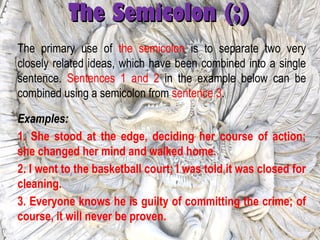
The Semicolon (;)The Semicolon (;)
The primary use of the semicolon is to separate two very
closely related ideas, which have been combined into a single
sentence. Sentences 1 and 2 in the example below can be
combined using a semicolon from sentence 3.
Examples:
1. She stood at the edge, deciding her course of action;
she changed her mind and walked home.
2. I went to the basketball court; I was told it was closed for
cleaning.
3. Everyone knows he is guilty of committing the crime; of
course, it will never be proven.
The Colon ( : )The Colon ( : )
Thecolonismostoftenusedtointroducealist,statement,orquotation.
Example:
1.You may be required to bring many items: sleeping bags, pans, and warm
clothing.
2. Date:July14th
2013
Place:Pancoran,SouthJakarta
The Dash ( - )The Dash ( - )
The dash is most commonly used in a sentence to separate
unessential or parenthetical elements from the core sentence,
when using a comma would be confusing. This usage also
assists the reader in separating core parts from supporting
information
Examples:
1.His job – we all know that he likes to keep busy ! – was to
tend the children while their parents attended church
2.Her goal – did she send you the memo? – was to raise
money for a new child care center
V
I
D
E
O
THANKS
FOR YOUR
ATTENTIO
N GUYS

Understanding Sentences Part 2

  • 1.
  • 2.
    UNDERSTANDINGUNDERSTANDING SENTENCES PART 2SENTENCESPART 2 GROUP C Euis Sukmawati Qudsi Dwirahma Mulyaputri Tri Andriani
  • 3.
  • 4.
    DISCUSSION TOPICSDISCUSSION TOPICS IDENTIFYINGCORE PARTS IN COMPLICATEDIDENTIFYING CORE PARTS IN COMPLICATED SENTENCESSENTENCES PUNCTUATION: AN AID TO SENTENCEPUNCTUATION: AN AID TO SENTENCE COMPREHENSIONCOMPREHENSION 1. THE COMMA1. THE COMMA 2. THE SEMICOLON2. THE SEMICOLON 3.THE COLON3.THE COLON
  • 6.
    Identifying Core Partsin ComplicatedIdentifying Core Parts in Complicated SentencesSentences Simple complete sentence Complicated complete sentence
  • 7.
    AA Simple CompleteSentenceSimple Complete Sentence is a sentenceis a sentence structure that contains one independentstructure that contains one independent clause and has no dependent clause.clause and has no dependent clause. AA Complicated Complete SentenceComplicated Complete Sentence is ais a sentence such as the third which is made upsentence such as the third which is made up of one independent clause and one or moreof one independent clause and one or more dependent clauses.dependent clauses.
  • 8.
    Compare the followingsentences for example:Compare the following sentences for example: -Simple complete sentence: The sun is orange. -Complicated complete sentence : The sun is orange when the sun rises. And the sun is violet when the sun sets. We can see the beautiful sunrise and sunset on the beach. For example, we can enjoy the sunset while dinner at Jimbaran beach, Bali. Core : The sun is orange. 1. The sunset is violet. 2. We can see the beautiful sunrise and sunset on the beach. 3. We can enjoy the sunset while dinner at Jimbaran beach, Bali.
  • 9.
    PUNCTUATIO N Punctuation :Punctuation : anaid to Sentence comPrehenSionan aid to Sentence comPrehenSion • THE COMMA ( , ) • THE SEMICOLON ( ; ) • THE COLON ( : ) • THE DASH( - )
  • 10.
    The Comma (, )The Comma ( , ) The comma usage is in some respects a question of personal writing styles. It separates some type of information from other parts of the sentence. The comma is used for: 1. Separating consecutive word in a paragraph. Example: Mother buys vegetables, fish, and meat. 2. Give An expression for a suppression statement. Example: Oh my God, how dirty are your clothes!
  • 11.
    3. Behind thewords in a sentence relation. Example: So, are you not coming with us? 4. Give comparison for a statement. Example: That house is big, but not beautiful.
  • 12.
    The Semicolon (;)TheSemicolon (;) The primary use of the semicolon is to separate two very closely related ideas, which have been combined into a single sentence. Sentences 1 and 2 in the example below can be combined using a semicolon from sentence 3. Examples: 1. She stood at the edge, deciding her course of action; she changed her mind and walked home. 2. I went to the basketball court; I was told it was closed for cleaning. 3. Everyone knows he is guilty of committing the crime; of course, it will never be proven.
  • 13.
    The Colon (: )The Colon ( : ) Thecolonismostoftenusedtointroducealist,statement,orquotation. Example: 1.You may be required to bring many items: sleeping bags, pans, and warm clothing. 2. Date:July14th 2013 Place:Pancoran,SouthJakarta
  • 14.
    The Dash (- )The Dash ( - ) The dash is most commonly used in a sentence to separate unessential or parenthetical elements from the core sentence, when using a comma would be confusing. This usage also assists the reader in separating core parts from supporting information Examples: 1.His job – we all know that he likes to keep busy ! – was to tend the children while their parents attended church 2.Her goal – did she send you the memo? – was to raise money for a new child care center
  • 15.
  • 16.