THE SCOPE OF A COMMUNICATIVE
SYLLABUS
Prepared by:
 Toni Agus Susanto 201012500902
 Yusri Fahmia 201012500017
Lecturer : Y.B. Unggul Jatmika, S.Pd
OUTLINE
1. Overview
2. Expansion of the language content dimension
2.1. Conceptual and functional meaning
2.2. Sociocultural appropriateness
2.3. Longer spans of discourse
3. Communicative processes
3.1. Workouts
3.2. A scale for assessing the communicative
potential of workouts
3.3. A scale for assessing the cognitive potential of
workouts
OUTLINE
4. Expanded Product
4.1. Implementation of language skill
4.2. Individual needs
4.3. Learner autonomy-an added product
4.4. Highlighting particular syllabus
components
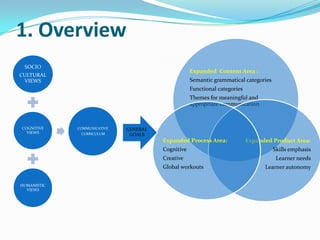
1. Overview
SOCIO
CULTURAL
VIEWS
COGNITIVE
VIEWS
HUMANISTIC
VIEWS
COMMUNICATIVE
CURRICULUM
Expanded Content Area :
Semantic grammatical categories
Functional categories
Themes for meaningful and
appropriate communication
Expanded Product Area:
Skills emphasis
Learner needs
Learner autonomy
Expanded Process Area:
Cognitive
Creative
Global workouts
GENERAL
GOALS
2. Expansion of the language
content dimension
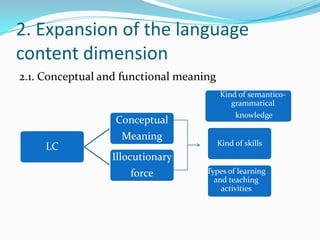
2.1. Conceptual and functional meaning
LC
Conceptual
Meaning
Illocutionary
force
Kind of semantico-
grammatical
knowledge
Kind of skills
Types of learning
and teaching
activities
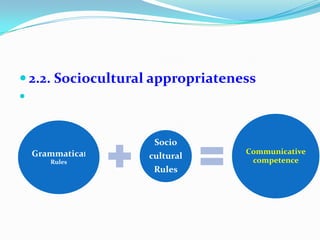
 2.2. Sociocultural appropriateness

Grammatical
Rules
Socio
cultural
Rules
Communicative
competence
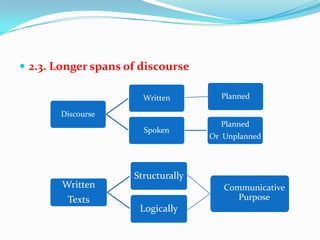
 2.3. Longer spans of discourse
Discourse
Written
Spoken
Planned
Or Unplanned
Written
Texts
Structurally
Logically
Communicative
Purpose
Planned
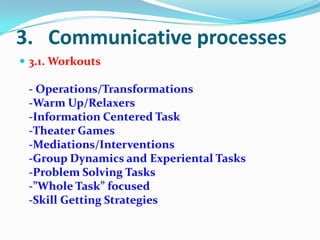
3. Communicative processes
 3.1. Workouts
- Operations/Transformations
-Warm Up/Relaxers
-Information Centered Task
-Theater Games
-Mediations/Interventions
-Group Dynamics and Experiental Tasks
-Problem Solving Tasks
-”Whole Task” focused
-Skill Getting Strategies
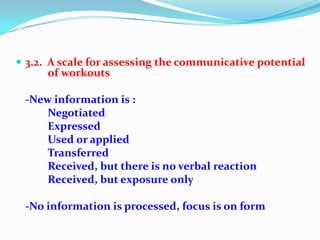
 3.2. A scale for assessing the communicative potential
of workouts
-New information is :
Negotiated
Expressed
Used or applied
Transferred
Received, but there is no verbal reaction
Received, but exposure only
-No information is processed, focus is on form
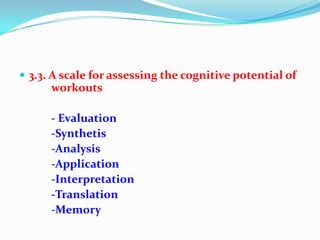
 3.3. A scale for assessing the cognitive potential of
workouts
- Evaluation
-Synthetis
-Analysis
-Application
-Interpretation
-Translation
-Memory
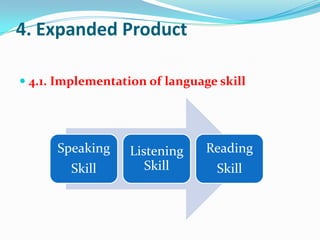
4. Expanded Product
 4.1. Implementation of language skill
Speaking
Skill
Listening
Skill
Reading
Skill
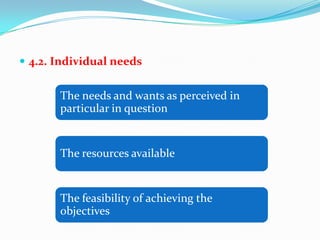
 4.2. Individual needs
The needs and wants as perceived in
particular in question
The resources available
The feasibility of achieving the
objectives
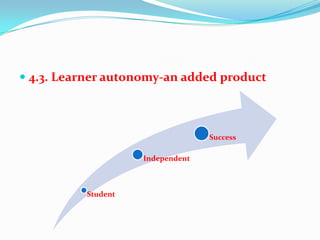
 4.3. Learner autonomy-an added product
Student
Independent
Success
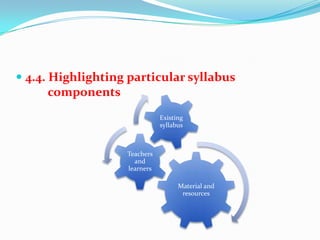
 4.4. Highlighting particular syllabus
components
Material and
resources
Teachers
and
learners
Existing
syllabus
Thank you
Any comments ?

The scope of a communicative syllabus

  • 1.
    THE SCOPE OFA COMMUNICATIVE SYLLABUS Prepared by:  Toni Agus Susanto 201012500902  Yusri Fahmia 201012500017 Lecturer : Y.B. Unggul Jatmika, S.Pd
  • 2.
    OUTLINE 1. Overview 2. Expansionof the language content dimension 2.1. Conceptual and functional meaning 2.2. Sociocultural appropriateness 2.3. Longer spans of discourse 3. Communicative processes 3.1. Workouts 3.2. A scale for assessing the communicative potential of workouts 3.3. A scale for assessing the cognitive potential of workouts
  • 3.
    OUTLINE 4. Expanded Product 4.1.Implementation of language skill 4.2. Individual needs 4.3. Learner autonomy-an added product 4.4. Highlighting particular syllabus components
  • 4.
    1. Overview SOCIO CULTURAL VIEWS COGNITIVE VIEWS HUMANISTIC VIEWS COMMUNICATIVE CURRICULUM Expanded ContentArea : Semantic grammatical categories Functional categories Themes for meaningful and appropriate communication Expanded Product Area: Skills emphasis Learner needs Learner autonomy Expanded Process Area: Cognitive Creative Global workouts GENERAL GOALS
  • 5.
    2. Expansion ofthe language content dimension 2.1. Conceptual and functional meaning LC Conceptual Meaning Illocutionary force Kind of semantico- grammatical knowledge Kind of skills Types of learning and teaching activities
  • 6.
     2.2. Socioculturalappropriateness  Grammatical Rules Socio cultural Rules Communicative competence
  • 7.
     2.3. Longerspans of discourse Discourse Written Spoken Planned Or Unplanned Written Texts Structurally Logically Communicative Purpose Planned
  • 8.
    3. Communicative processes 3.1. Workouts - Operations/Transformations -Warm Up/Relaxers -Information Centered Task -Theater Games -Mediations/Interventions -Group Dynamics and Experiental Tasks -Problem Solving Tasks -”Whole Task” focused -Skill Getting Strategies
  • 9.
     3.2. Ascale for assessing the communicative potential of workouts -New information is : Negotiated Expressed Used or applied Transferred Received, but there is no verbal reaction Received, but exposure only -No information is processed, focus is on form
  • 10.
     3.3. Ascale for assessing the cognitive potential of workouts - Evaluation -Synthetis -Analysis -Application -Interpretation -Translation -Memory
  • 11.
    4. Expanded Product 4.1. Implementation of language skill Speaking Skill Listening Skill Reading Skill
  • 12.
     4.2. Individualneeds The needs and wants as perceived in particular in question The resources available The feasibility of achieving the objectives
  • 13.
     4.3. Learnerautonomy-an added product Student Independent Success
  • 14.
     4.4. Highlightingparticular syllabus components Material and resources Teachers and learners Existing syllabus
  • 15.