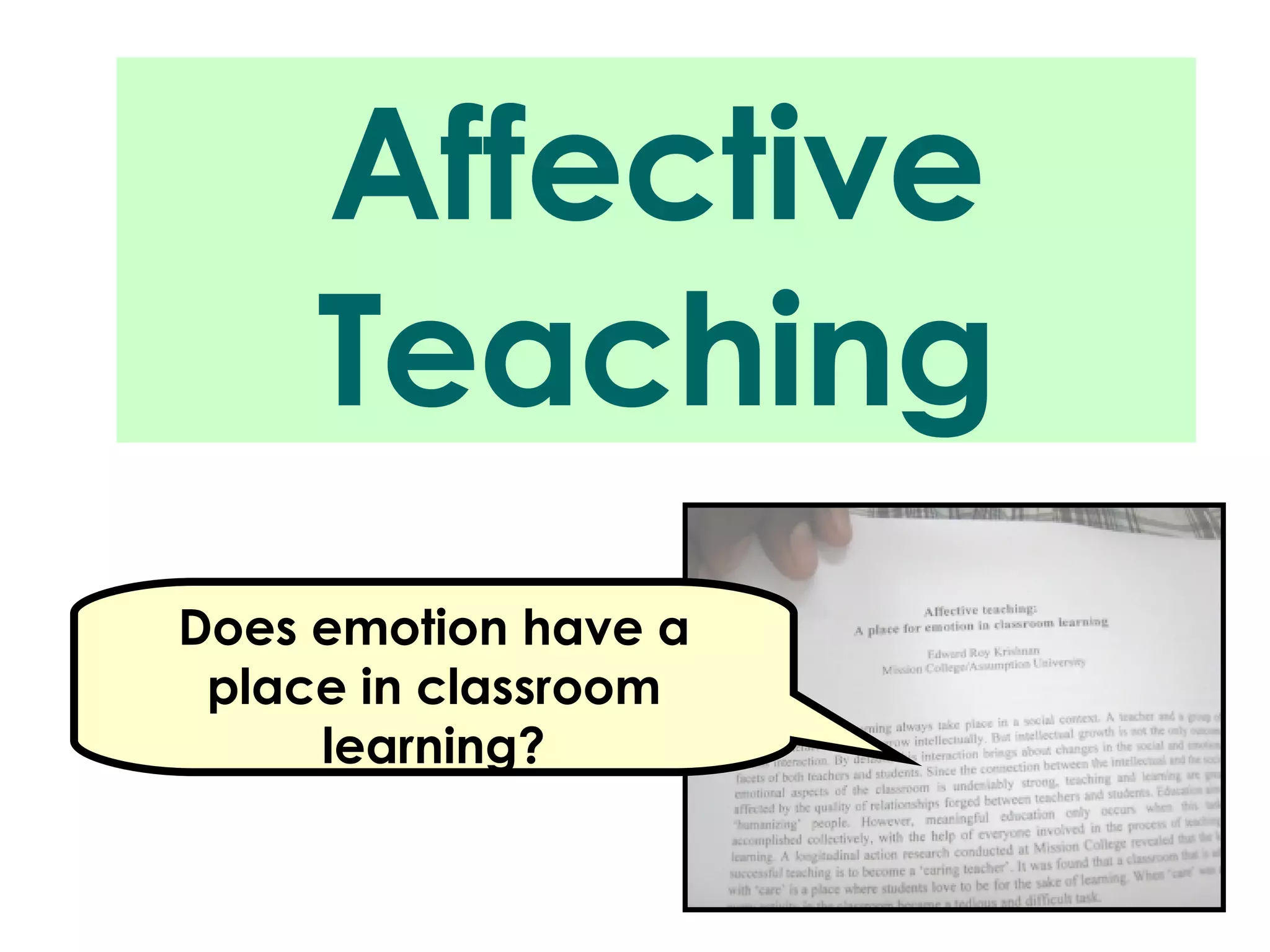
Affective Teaching Does emotion have a place in classroom learning?
1 What this paper is all about…
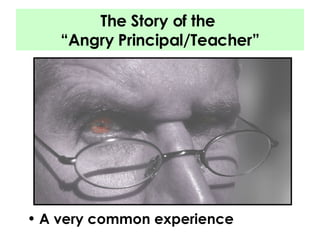
The Story of the  “Angry Principal/Teacher” A very common experience
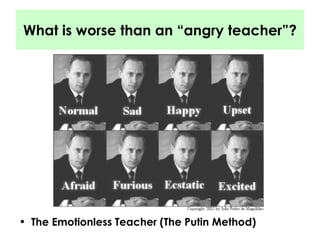
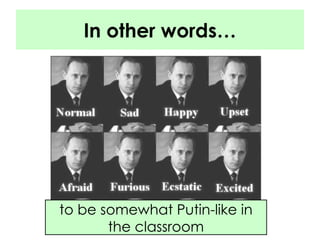
What is worse than an “angry teacher”? The Emotionless Teacher (The Putin Method)
What does educational thinkers say? The key to successful teaching is to become a caring teacher (e.g., Berliner, 1995; Bracey, 1991; Brookover, 1981; Brown, 1971; Deutsch, 1949;  Flanders, 1970; Glasser, 1969; Glidewell, 1976; Hentoff, 1966; Johnson & Johnson, 1991; Kohl, 1969; Kozol, 1967; Krishnan, 2006; Lightfoot, 1983; Lippitt & Gold, 1959; McMillan, 1980; Nyquist & Hawes, 1972; Purkey, 1983; Rogers, 1969; Schmuck & Schmuk, 1974, 1976; Silverstein, 1994; Thelen, 1960, Withall, 1949a, 1949b, 1977).
In other words… to be somewhat Mother Theresa-like in the classroom
What does some teachers say? Hi Roy, My sister and I were discussing whether teachers being “caring” is essential to learning. For instance, should teachers be personable to their students?  She did not feel that it was necessity for a teacher to indicate care for his/her students, so long as the teacher provided the knowledge needed, and the inspiration to keep learning. :-) janelle (not her real name)
What does some teachers say? “If a teacher shows too much care towards students…students will take advantage of the teacher.”  ---A lecturer “A caring teacher will ultimately see the sole of their students shoes.” ---A high school teacher
What does some teachers say? “The best thing is to keep a straight face. Don’t show any emotion. It will make you vulnerable. It will make you lose control over your classroom. ---A Middle School Teacher
In other words… to be somewhat Putin-like in the classroom
So…what is the Big Question here? Should I become a caring teacher or not?
Or in other words… Should a teacher be  Putin-like  OR  Mother Theresa-like ?
2 Methodology & Procedures
Primary Data Reflective-Participant-Observation reports compiled by the researcher. Consisted of anecdotal records of the experiences of both the teacher/researcher and the students in a period of 2 years.
Participants Sophomore, junior and senior students in the Education/Psychology Department at Mission College. Students came from a variety of backgrounds and represented different nationalities. Students differ in general English proficiency and overall academic achievement
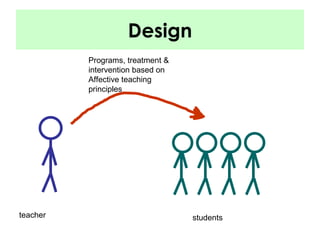
Design teacher students Programs, treatment & intervention based on Affective teaching principles
Data Collection Students’ academic achievement and feedback are recorded Feedback obtained are in verbal and non verbal form. This include blog comments at researcher’s website. Level and frequency of participation, performance in exams are noted.
Data Analysis The researcher engaged in content analysis by looking at emerging themes and patterns from narrative field notes that were collected and collated during the two years time period. These themes and patterns were then coded and categorized to be presented as findings of the study.

3 Results & Findings
2 Major Findings The study enumerate the 14 most effective ways to implement Affective Teaching. The study enumerate the experiences of students across areas of functioning in the classroom.
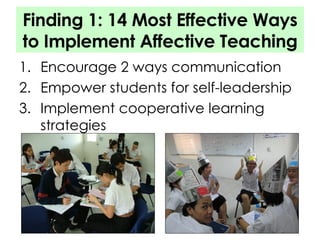
Finding 1: 14 Most Effective Ways to Implement Affective Teaching Encourage 2 ways communication Empower students for self-leadership Implement cooperative learning strategies
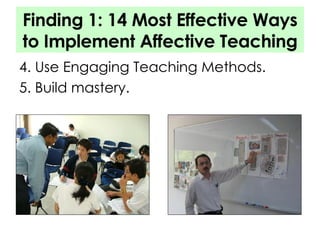
Finding 1: 14 Most Effective Ways to Implement Affective Teaching 4. Use Engaging Teaching Methods. 5. Build mastery.
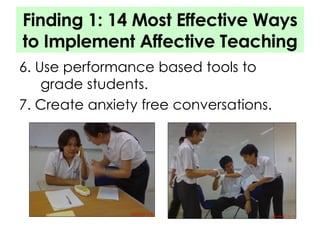
Finding 1: 14 Most Effective Ways to Implement Affective Teaching 6. Use performance based tools to grade students. 7. Create anxiety free conversations.
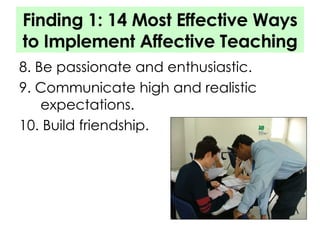
Finding 1: 14 Most Effective Ways to Implement Affective Teaching 8. Be passionate and enthusiastic. 9. Communicate high and realistic expectations. 10. Build friendship.
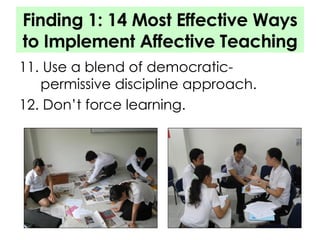
Finding 1: 14 Most Effective Ways to Implement Affective Teaching 11. Use a blend of democratic-permissive discipline approach. 12. Don’t force learning.
Finding 1: 14 Most Effective Ways to Implement Affective Teaching 13. Admit mistakes and amend things when you know you are wrong. 14. Use and encourage Creativity.
Finding 2: Enumeration of Students Experience & Performance Students are more cohesive in the classroom. They experience personal and collective satisfaction. They developed a sense of direction to fulfill academic and non academic goals.
Finding 2: Enumeration of Students Experience & Performance 4. Frictions were reduced. 5. Students progressed academically. 6. Students developed a sense of control. 7. Learning became exciting, interesting & progressive.
Finding 2: Enumeration of Students Experience & Performance 8. Critical and creative thinking skills were developed and enhanced. 9. Confidence was built. 10. A trusting relationship between students and teacher developed.
Finding 2: Enumeration of Students Experience & Performance 11. Students became responsible for their own learning. 12. Boredom was removed. Motivation for learning increased. 13. Students became more inspired and focused about their future.
Finding 2: Enumeration of Students Experience & Performance 14. Students actively participated in class.  15. Students imitate the affective teaching practice of the teacher. 16. Students change their attitude towards teaching and learning.
In the light of these findings…
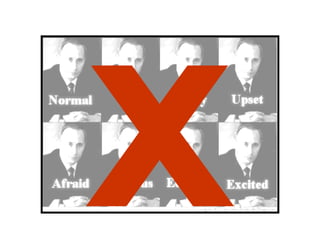
Let’s go back to our original question Should a teacher be  Putin-like  OR  Mother Theresa-like ?
The answer is…
x
4 Discussion
1. Affective Teaching is a practical working model. Affective teaching helps create caring classrooms that facilitates the development of self-esteem and satisfaction of fundamental motives. (Fraser & Fisher, 1982; Walberg, 1979)
2. Mastery and Interpersonal Power leads to Positive Feelings and involvement in schools. (Argyris, 1976; Benham, 1980; Bowman, et al., 1999; Brookhart, 1997; Brookhart & DeVoge, 1999; Calonico & Calonico, 1972; Chen, et al., 1999; Dorman, 1996; Duck, 1986; Fyans; 1980; Howes, 2000; Pulvers & Diekhoff, 1999; Schmuck & Schmuck, 1992).
3. Affective Teaching entails 2 education practice Teachers must care enough to ensure maximum learning in students. Teachers must have the right orientation towards learning and teaching. He must be Learning centered as opposed to other centers.
4. Affective Teaching calls for brain research based practice To be learning centered, a teacher must take account of the way the brain works and learns.
5 Recommendations
1. Change Attitude  (Di Martino & Zan, 2003; Hannel, 2005; Kouladis, 1987; McDermott, 1991; Moreira, 1993; Nemser-Feinman & Floden, 1986).
2. Find Good Role Models Tiberghien (1993)
3. Expose teachers to relevant media Literature, films & lectures
4. Join or Create a support group
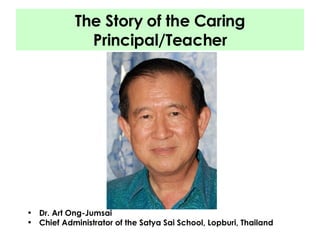
The Story of the Caring Principal/Teacher Dr. Art Ong-Jumsai  Chief Administrator of the Satya Sai School, Lopburi, Thailand
6 Last words…
I have started a website to create awareness on  the need for Affective Teaching
A place where teachers can learn from each other
www.affectiveteaching.com Join the discussion at my blog…
Books on Affective Teaching are available at our booth
Acknowledgment Many thanks to the students in the Psychology/Education Department at Mission College (2003 – 2005 batches) for cooperating to make this research a success. Your patience, dedication, and willingness to learn and grow have given birth to ideas that would change and revolutionize the face of education in this part of the world.

Affective Teaching Vs. Putin Method

  • 1.
    Affective Teaching Doesemotion have a place in classroom learning?
  • 2.
    1 What thispaper is all about…
  • 3.
    The Story ofthe “Angry Principal/Teacher” A very common experience
  • 4.
    What is worsethan an “angry teacher”? The Emotionless Teacher (The Putin Method)
  • 5.
    What does educationalthinkers say? The key to successful teaching is to become a caring teacher (e.g., Berliner, 1995; Bracey, 1991; Brookover, 1981; Brown, 1971; Deutsch, 1949; Flanders, 1970; Glasser, 1969; Glidewell, 1976; Hentoff, 1966; Johnson & Johnson, 1991; Kohl, 1969; Kozol, 1967; Krishnan, 2006; Lightfoot, 1983; Lippitt & Gold, 1959; McMillan, 1980; Nyquist & Hawes, 1972; Purkey, 1983; Rogers, 1969; Schmuck & Schmuk, 1974, 1976; Silverstein, 1994; Thelen, 1960, Withall, 1949a, 1949b, 1977).
  • 6.
    In other words…to be somewhat Mother Theresa-like in the classroom
  • 7.
    What does someteachers say? Hi Roy, My sister and I were discussing whether teachers being “caring” is essential to learning. For instance, should teachers be personable to their students? She did not feel that it was necessity for a teacher to indicate care for his/her students, so long as the teacher provided the knowledge needed, and the inspiration to keep learning. :-) janelle (not her real name)
  • 8.
    What does someteachers say? “If a teacher shows too much care towards students…students will take advantage of the teacher.” ---A lecturer “A caring teacher will ultimately see the sole of their students shoes.” ---A high school teacher
  • 9.
    What does someteachers say? “The best thing is to keep a straight face. Don’t show any emotion. It will make you vulnerable. It will make you lose control over your classroom. ---A Middle School Teacher
  • 10.
    In other words…to be somewhat Putin-like in the classroom
  • 11.
    So…what is theBig Question here? Should I become a caring teacher or not?
  • 12.
    Or in otherwords… Should a teacher be Putin-like OR Mother Theresa-like ?
  • 13.
    2 Methodology &Procedures
  • 14.
    Primary Data Reflective-Participant-Observationreports compiled by the researcher. Consisted of anecdotal records of the experiences of both the teacher/researcher and the students in a period of 2 years.
  • 15.
    Participants Sophomore, juniorand senior students in the Education/Psychology Department at Mission College. Students came from a variety of backgrounds and represented different nationalities. Students differ in general English proficiency and overall academic achievement
  • 16.
    Design teacher studentsPrograms, treatment & intervention based on Affective teaching principles
  • 17.
    Data Collection Students’academic achievement and feedback are recorded Feedback obtained are in verbal and non verbal form. This include blog comments at researcher’s website. Level and frequency of participation, performance in exams are noted.
  • 18.
    Data Analysis Theresearcher engaged in content analysis by looking at emerging themes and patterns from narrative field notes that were collected and collated during the two years time period. These themes and patterns were then coded and categorized to be presented as findings of the study.
  • 19.
    3 Results &Findings
  • 20.
    2 Major FindingsThe study enumerate the 14 most effective ways to implement Affective Teaching. The study enumerate the experiences of students across areas of functioning in the classroom.
  • 21.
    Finding 1: 14Most Effective Ways to Implement Affective Teaching Encourage 2 ways communication Empower students for self-leadership Implement cooperative learning strategies
  • 22.
    Finding 1: 14Most Effective Ways to Implement Affective Teaching 4. Use Engaging Teaching Methods. 5. Build mastery.
  • 23.
    Finding 1: 14Most Effective Ways to Implement Affective Teaching 6. Use performance based tools to grade students. 7. Create anxiety free conversations.
  • 24.
    Finding 1: 14Most Effective Ways to Implement Affective Teaching 8. Be passionate and enthusiastic. 9. Communicate high and realistic expectations. 10. Build friendship.
  • 25.
    Finding 1: 14Most Effective Ways to Implement Affective Teaching 11. Use a blend of democratic-permissive discipline approach. 12. Don’t force learning.
  • 26.
    Finding 1: 14Most Effective Ways to Implement Affective Teaching 13. Admit mistakes and amend things when you know you are wrong. 14. Use and encourage Creativity.
  • 27.
    Finding 2: Enumerationof Students Experience & Performance Students are more cohesive in the classroom. They experience personal and collective satisfaction. They developed a sense of direction to fulfill academic and non academic goals.
  • 28.
    Finding 2: Enumerationof Students Experience & Performance 4. Frictions were reduced. 5. Students progressed academically. 6. Students developed a sense of control. 7. Learning became exciting, interesting & progressive.
  • 29.
    Finding 2: Enumerationof Students Experience & Performance 8. Critical and creative thinking skills were developed and enhanced. 9. Confidence was built. 10. A trusting relationship between students and teacher developed.
  • 30.
    Finding 2: Enumerationof Students Experience & Performance 11. Students became responsible for their own learning. 12. Boredom was removed. Motivation for learning increased. 13. Students became more inspired and focused about their future.
  • 31.
    Finding 2: Enumerationof Students Experience & Performance 14. Students actively participated in class. 15. Students imitate the affective teaching practice of the teacher. 16. Students change their attitude towards teaching and learning.
  • 32.
    In the lightof these findings…
  • 33.
    Let’s go backto our original question Should a teacher be Putin-like OR Mother Theresa-like ?
  • 34.
  • 35.
  • 36.
  • 37.
    1. Affective Teachingis a practical working model. Affective teaching helps create caring classrooms that facilitates the development of self-esteem and satisfaction of fundamental motives. (Fraser & Fisher, 1982; Walberg, 1979)
  • 38.
    2. Mastery andInterpersonal Power leads to Positive Feelings and involvement in schools. (Argyris, 1976; Benham, 1980; Bowman, et al., 1999; Brookhart, 1997; Brookhart & DeVoge, 1999; Calonico & Calonico, 1972; Chen, et al., 1999; Dorman, 1996; Duck, 1986; Fyans; 1980; Howes, 2000; Pulvers & Diekhoff, 1999; Schmuck & Schmuck, 1992).
  • 39.
    3. Affective Teachingentails 2 education practice Teachers must care enough to ensure maximum learning in students. Teachers must have the right orientation towards learning and teaching. He must be Learning centered as opposed to other centers.
  • 40.
    4. Affective Teachingcalls for brain research based practice To be learning centered, a teacher must take account of the way the brain works and learns.
  • 41.
  • 42.
    1. Change Attitude (Di Martino & Zan, 2003; Hannel, 2005; Kouladis, 1987; McDermott, 1991; Moreira, 1993; Nemser-Feinman & Floden, 1986).
  • 43.
    2. Find GoodRole Models Tiberghien (1993)
  • 44.
    3. Expose teachersto relevant media Literature, films & lectures
  • 45.
    4. Join orCreate a support group
  • 46.
    The Story ofthe Caring Principal/Teacher Dr. Art Ong-Jumsai Chief Administrator of the Satya Sai School, Lopburi, Thailand
  • 47.
  • 48.
    I have starteda website to create awareness on the need for Affective Teaching
  • 49.
    A place whereteachers can learn from each other
  • 50.
    www.affectiveteaching.com Join thediscussion at my blog…
  • 51.
    Books on AffectiveTeaching are available at our booth
  • 52.
    Acknowledgment Many thanksto the students in the Psychology/Education Department at Mission College (2003 – 2005 batches) for cooperating to make this research a success. Your patience, dedication, and willingness to learn and grow have given birth to ideas that would change and revolutionize the face of education in this part of the world.