PRINCIPLES OF
TEACHING AND
LANGUAGE
LEARNING
OBJECTIVES:
• Recall the different learning/ thinking
styles and multiple intelligences of the
learners
• Discuss principles of teaching and
learning as applied in the English and
Filipino subjects
• Cite applications of these principles in
language teaching
R
E
P
O
R
T
E
D
B
Y
“Every
child is
a
potential
genius”
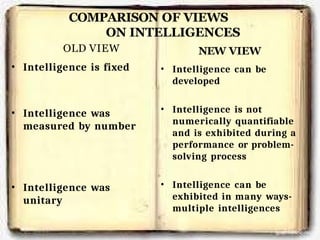
OLD VIEW
• Intelligence is fixed
• Intelligence was
measured by number
• Intelligence was
unitary
NEW VIEW
• Intelligence can be
developed
• Intelligence is not
numerically quantifiable
and is exhibited during a
performance or problem-
solving process
• Intelligence can be
exhibited in many ways-
multiple intelligences
COMPARISON OF VIEWS
ON INTELLIGENCES
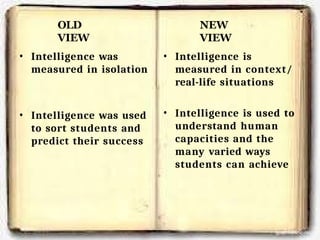
• Intelligence was
measured in isolation
• Intelligence was used
to sort students and
predict their success
NEW
VIEW
• Intelligence is
measured in context/
real-life situations
• Intelligence is used to
understand human
capacities and the
many varied ways
students can achieve
OLD
VIEW
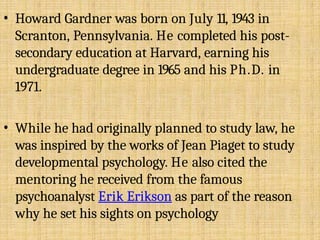
• Howard Gardner was born on July 11, 1943 in
Scranton, Pennsylvania. He completed his post-
secondary education at Harvard, earning his
undergraduate degree in 1965 and his Ph.D. in
1971.
• While he had originally planned to study law, he
was inspired by the works of Jean Piaget to study
developmental psychology. He also cited the
mentoring he received from the famous
psychoanalyst Erik Erikson as part of the reason
why he set his sights on psychology
• "My mind was really opened when I went
to Harvard College and had the opportunity
to study under individuals—such as
psychoanalyst Erik Erikson, sociologist David
Riesman, and cognitive psychologist Jerome
Bruner—who were creating knowledge about
human beings. That helped set me on the
course of investigating human nature,
particularly how human beings think,"
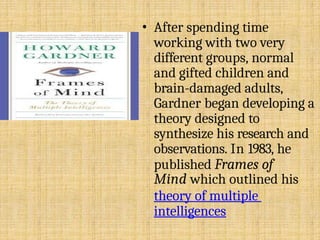
• After spending time
working with two very
different groups, normal
and gifted children and
brain-damaged adults,
Gardner began developing a
theory designed to
synthesize his research and
observations. In 1983, he
published Frames of
Mind which outlined his
theory of multiple
intelligences
• Gardner's theory has perhaps had the greatest
impact within the field of education, where it
has received considerable attention and use.
His conceptualization of intelligence as more
than a single, solitary quality has opened the
doors for further research and different ways
of thinking about human intelligence.
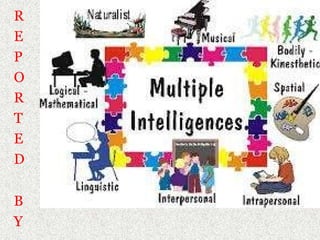
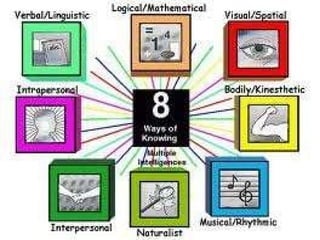
MULTIPLE
INTELLIGENCES
• The theory of multiple intelligences (MI) was
first described by Howard Gardner in Frames
of Mind (1983)
• Gardner defines intelligence as “ an ability or
set of abilities that allows a person to solve a
problem or fashion a product that is valued in
one or more cultures
• Gardner believes that different intelligences
may be independent abilities- a person can
be low in one domain area but high in
another
• All of us possess the intelligences but in
varying degrees of strength and skill
Verbal-
Linguistic
(Word
smart)
• Learning through the
spoken and written
word. This intelligence
was always valued in
the traditional
classroom and in
traditional assessments
of intelligence and
achievement
• Sensitivity to the
sounds, meanings,
structures, and styles of
language
Verbal-
Linguistic
(Word
smart)
• Inclination for listening,
speaking, reading, writing
• Ability to speak
effectively ( teacher,
religious leader, politician)
of write effectively ( poet,
journalist, book author)
Mathematical-Logical
(Number/Logic Smart)
• Learning through reasoning and
problem solving. Also highly
valued in the traditional classroom,
where students were asked to adapt
to logical sequenced delivery of
instruction
• Sensitivity to patterns, numbers
& numerical data, causes &
effects, objective & quantitative
reasoning
Mathematical-Logical
(Number/Logic Smart)
• Inclination for finding
patterns, making calculations,
forming and testing
hypotheses, using the scientific
method, deductive & inductive
reasoning
• Ability to work effectively
with numbers ( accountant,
engineer, economist) and
reason effectively ( scientist,
computer programmer)
Spatial
(Picture Smart)
• Learning visually and
organizing ideas spatially.
Seeing concepts in action in
order to understand them.
The ability to “see” things in
one’s mind in planning to
create a product or solve a
problem
• Sensitivity to colors, shapes,
visual puzzles, symmetry, lines,
images
• Inclination for representing
ideas visually, creating mental
images, noticing visual details,
drawing & sketching
• Ability to create visually
( artist, photographer,
decorator) and visualize
accurately ( tour guide, ranger,
scout)
Spatial
(Picture Smart)
Bodily-Kinesthetic
(Body Smart)
• Learning through interaction
with one’s environment. This
intelligence is not the domain
of “overly active” learners. It
promotes understanding
through concrete experience
• Sensitivity to touch,
movement, physical self,
athleticism
Bodily-Kinesthetic
(Body Smart)
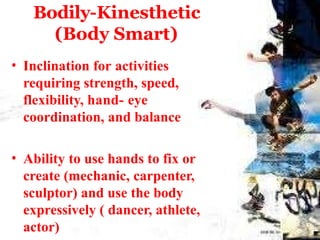
• Inclination for activities
requiring strength, speed,
flexibility, hand- eye
coordination, and balance
• Ability to use hands to fix or
create (mechanic, carpenter,
sculptor) and use the body
expressively ( dancer, athlete,
actor)
Musical
(Music
Smart)
• Learning through
patterns, rhythms
and music. This
includes not only
auditory learning
but the identification
of patterns through
all senses
• Sensitivity to tone,
beat, tempo, melody,
pitch, sound
Musical
(Music
Smart)
• Inclination for
listening,
singing, playing
an instrument
• Ability to
create music
( songwriter,
composer,
musician) and
analyze music
( music critic)
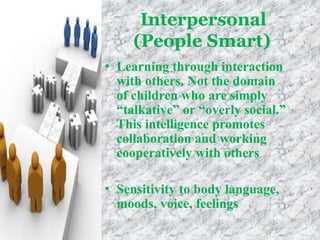
Interpersonal
(People Smart)
• Learning through interaction
with others. Not the domain
of children who are simply
“talkative” or “overly social.”
This intelligence promotes
collaboration and working
cooperatively with others
• Sensitivity to body language,
moods, voice, feelings
Interpersonal
(People Smart)
• Inclination for noticing &
responding to other
people’s feelings &
personalities
• Ability to work with
people (administrators,
managers, consultants,
teachers) and help identify
and overcome problems
(therapists, psychologists)
Intrapersonal (Self Smart)
• Learning through feelings, values, and
attitudes. This is decidedly affective
component of learning through which
students place value on what they
learn and take ownership for their
learning
• Sensitivity to one’s own strength,
weaknesses, goals and desires
Intrapersonal (Self Smart)
• Inclination for setting goals,
assessing personal abilities &
liabilities, monitoring one’s own
thinking
• Ability to meditate, reflect, exhibit
self-discipline, maintain composure,
and get the most out of oneself
Naturalist (Nature Smart)
• Learning through classification, categories,
and hierarchies. The naturalist intelligence
picks up on subtle differences in meaning.
It is not simply the study of nature; it can
be used in all areas of study
• Sensitivity to natural objects,
plants, animals, naturally occurring
patterns, ecological issues
Naturalist (Nature Smart)
• Inclination for identifying and
classifying living & natural objects
• Ability to analyze ecological and natural
situations & data ( ecologists, rangers),
learn from living things ( zoologist,
botanist, veterinarian), and work in natural
settings ( hunter, scout)
Existential (Spirit Smart)
• Learning by see their role in the big picture
more easily than others and this is very
important to them. They question the
meaning of life and seek the answers; most of
the time this is done through some form of
religion
• Sensitivity to and capacity to tackle deep
questions about human existence, such as the
meaning of life, why do we die, and how did
we get here
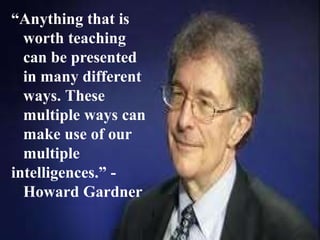
“Anything that is
worth teaching
can be presented
in many different
ways. These
multiple ways can
make use of our
multiple
intelligences.” -
Howard Gardner
THANK YOU


lesson1multipleintelligences-140217210913-phpapp01-2 (1).pptx

  • 1.
  • 2.
    OBJECTIVES: • Recall thedifferent learning/ thinking styles and multiple intelligences of the learners • Discuss principles of teaching and learning as applied in the English and Filipino subjects • Cite applications of these principles in language teaching
  • 3.
  • 4.
  • 5.
    OLD VIEW • Intelligenceis fixed • Intelligence was measured by number • Intelligence was unitary NEW VIEW • Intelligence can be developed • Intelligence is not numerically quantifiable and is exhibited during a performance or problem- solving process • Intelligence can be exhibited in many ways- multiple intelligences COMPARISON OF VIEWS ON INTELLIGENCES
  • 6.
    • Intelligence was measuredin isolation • Intelligence was used to sort students and predict their success NEW VIEW • Intelligence is measured in context/ real-life situations • Intelligence is used to understand human capacities and the many varied ways students can achieve OLD VIEW
  • 8.
    • Howard Gardnerwas born on July 11, 1943 in Scranton, Pennsylvania. He completed his post- secondary education at Harvard, earning his undergraduate degree in 1965 and his Ph.D. in 1971. • While he had originally planned to study law, he was inspired by the works of Jean Piaget to study developmental psychology. He also cited the mentoring he received from the famous psychoanalyst Erik Erikson as part of the reason why he set his sights on psychology
  • 9.
    • "My mindwas really opened when I went to Harvard College and had the opportunity to study under individuals—such as psychoanalyst Erik Erikson, sociologist David Riesman, and cognitive psychologist Jerome Bruner—who were creating knowledge about human beings. That helped set me on the course of investigating human nature, particularly how human beings think,"
  • 10.
    • After spendingtime working with two very different groups, normal and gifted children and brain-damaged adults, Gardner began developing a theory designed to synthesize his research and observations. In 1983, he published Frames of Mind which outlined his theory of multiple intelligences
  • 11.
    • Gardner's theoryhas perhaps had the greatest impact within the field of education, where it has received considerable attention and use. His conceptualization of intelligence as more than a single, solitary quality has opened the doors for further research and different ways of thinking about human intelligence.
  • 12.
    MULTIPLE INTELLIGENCES • The theoryof multiple intelligences (MI) was first described by Howard Gardner in Frames of Mind (1983) • Gardner defines intelligence as “ an ability or set of abilities that allows a person to solve a problem or fashion a product that is valued in one or more cultures • Gardner believes that different intelligences may be independent abilities- a person can be low in one domain area but high in another • All of us possess the intelligences but in varying degrees of strength and skill
  • 14.
    Verbal- Linguistic (Word smart) • Learning throughthe spoken and written word. This intelligence was always valued in the traditional classroom and in traditional assessments of intelligence and achievement • Sensitivity to the sounds, meanings, structures, and styles of language
  • 15.
    Verbal- Linguistic (Word smart) • Inclination forlistening, speaking, reading, writing • Ability to speak effectively ( teacher, religious leader, politician) of write effectively ( poet, journalist, book author)
  • 16.
    Mathematical-Logical (Number/Logic Smart) • Learningthrough reasoning and problem solving. Also highly valued in the traditional classroom, where students were asked to adapt to logical sequenced delivery of instruction • Sensitivity to patterns, numbers & numerical data, causes & effects, objective & quantitative reasoning
  • 17.
    Mathematical-Logical (Number/Logic Smart) • Inclinationfor finding patterns, making calculations, forming and testing hypotheses, using the scientific method, deductive & inductive reasoning • Ability to work effectively with numbers ( accountant, engineer, economist) and reason effectively ( scientist, computer programmer)
  • 18.
    Spatial (Picture Smart) • Learningvisually and organizing ideas spatially. Seeing concepts in action in order to understand them. The ability to “see” things in one’s mind in planning to create a product or solve a problem • Sensitivity to colors, shapes, visual puzzles, symmetry, lines, images
  • 19.
    • Inclination forrepresenting ideas visually, creating mental images, noticing visual details, drawing & sketching • Ability to create visually ( artist, photographer, decorator) and visualize accurately ( tour guide, ranger, scout) Spatial (Picture Smart)
  • 20.
    Bodily-Kinesthetic (Body Smart) • Learningthrough interaction with one’s environment. This intelligence is not the domain of “overly active” learners. It promotes understanding through concrete experience • Sensitivity to touch, movement, physical self, athleticism
  • 21.
    Bodily-Kinesthetic (Body Smart) • Inclinationfor activities requiring strength, speed, flexibility, hand- eye coordination, and balance • Ability to use hands to fix or create (mechanic, carpenter, sculptor) and use the body expressively ( dancer, athlete, actor)
  • 22.
    Musical (Music Smart) • Learning through patterns,rhythms and music. This includes not only auditory learning but the identification of patterns through all senses • Sensitivity to tone, beat, tempo, melody, pitch, sound
  • 23.
    Musical (Music Smart) • Inclination for listening, singing,playing an instrument • Ability to create music ( songwriter, composer, musician) and analyze music ( music critic)
  • 24.
    Interpersonal (People Smart) • Learningthrough interaction with others. Not the domain of children who are simply “talkative” or “overly social.” This intelligence promotes collaboration and working cooperatively with others • Sensitivity to body language, moods, voice, feelings
  • 25.
    Interpersonal (People Smart) • Inclinationfor noticing & responding to other people’s feelings & personalities • Ability to work with people (administrators, managers, consultants, teachers) and help identify and overcome problems (therapists, psychologists)
  • 26.
    Intrapersonal (Self Smart) •Learning through feelings, values, and attitudes. This is decidedly affective component of learning through which students place value on what they learn and take ownership for their learning • Sensitivity to one’s own strength, weaknesses, goals and desires
  • 27.
    Intrapersonal (Self Smart) •Inclination for setting goals, assessing personal abilities & liabilities, monitoring one’s own thinking • Ability to meditate, reflect, exhibit self-discipline, maintain composure, and get the most out of oneself
  • 28.
    Naturalist (Nature Smart) •Learning through classification, categories, and hierarchies. The naturalist intelligence picks up on subtle differences in meaning. It is not simply the study of nature; it can be used in all areas of study • Sensitivity to natural objects, plants, animals, naturally occurring patterns, ecological issues
  • 29.
    Naturalist (Nature Smart) •Inclination for identifying and classifying living & natural objects • Ability to analyze ecological and natural situations & data ( ecologists, rangers), learn from living things ( zoologist, botanist, veterinarian), and work in natural settings ( hunter, scout)
  • 30.
    Existential (Spirit Smart) •Learning by see their role in the big picture more easily than others and this is very important to them. They question the meaning of life and seek the answers; most of the time this is done through some form of religion • Sensitivity to and capacity to tackle deep questions about human existence, such as the meaning of life, why do we die, and how did we get here
  • 31.
    “Anything that is worthteaching can be presented in many different ways. These multiple ways can make use of our multiple intelligences.” - Howard Gardner
  • 32.