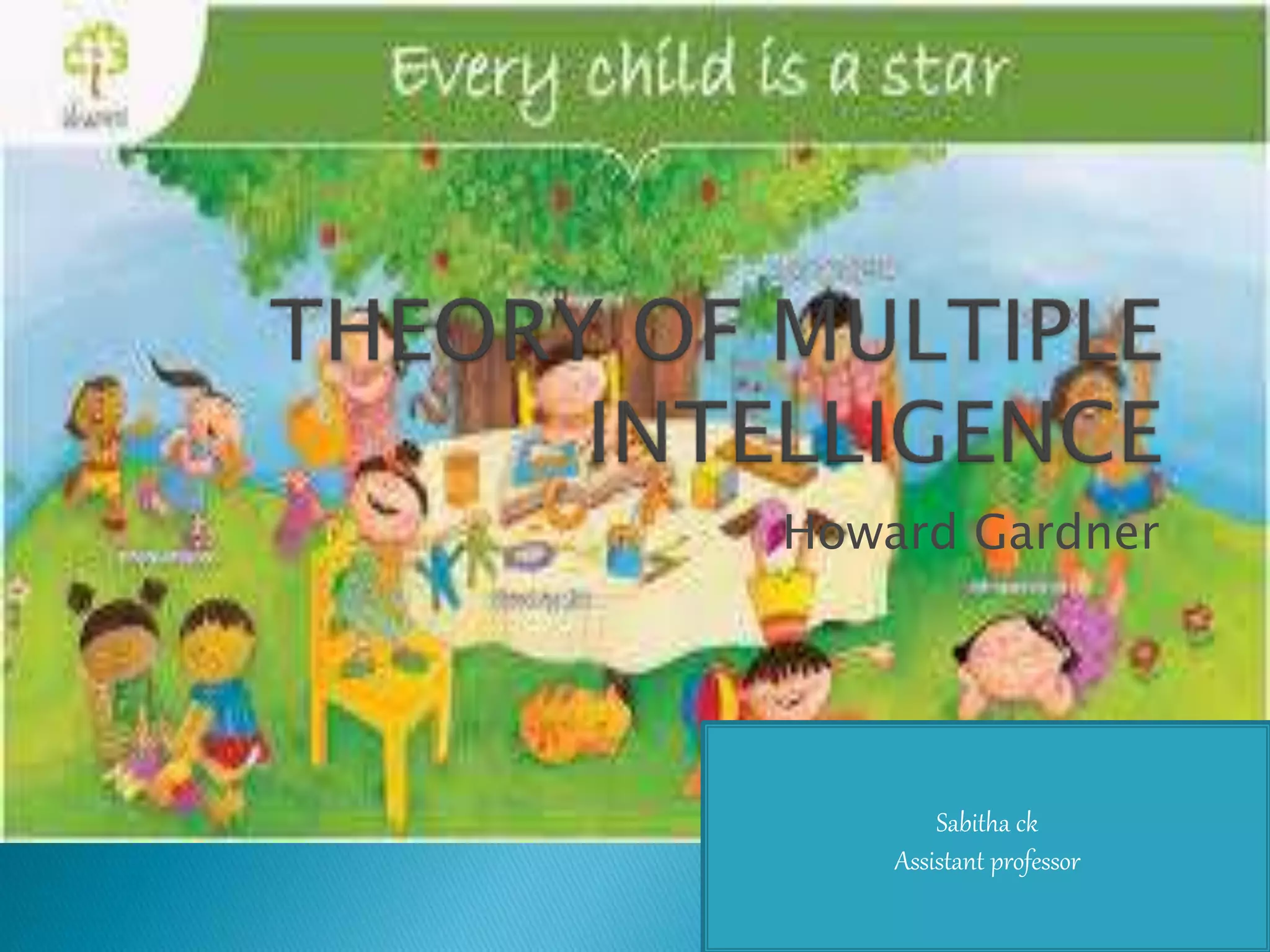
Howard Gardner
Sabitha ck
Assistant professor
 The theory of multiple intelligences was
developed in 1983 by Dr. Howard Gardner,
professor of education at Harvard University.
 Howard Gardner proposed this model in his
1983 book Frames of Mind: The Theory of
Multiple Intelligences
 Dr. Gardner proposes eight different
intelligences to account for a broader range of
human potential in children and adults.”
 He believes each of us have all of the eight
types of intelligence to varying degrees.
 These multiple intelligences are related to
how an individual prefers to learn and
process information.
 Gardner defines an intelligence as "bio
psychological potential to process
information that can be activated in a cultural
setting to solve problems or create products
that are of value in a culture”
1. Verbal/Linguistic Intelligence
2. Logical-mathematical Intelligence
3. Visual/Spatial Intelligence
4. Bodily/Kinesthetic Intelligence
5. Musical/Rhythmic Intelligence
6. Interpersonal Intelligence
7. Intrapersonal Intelligence
8. Naturalist Intelligence
 The ability to think in words
and use language express meaning or
Sensitivity to the meanings and sounds of
words, mastery of syntax, appreciation of the
ways language can be used (authors,
journalists, speakers, poets, teachers)
 The ability to carry out mathematical
operations , Understanding of objects
and symbols and of actions
that be performed on them and of the
relations between these actions, ability for
abstraction, ability to identify problems and
seek explanations (scientists, engineers,
accountants)
 The ability to think three-dimensionally
 Capacity to perceive the visual world
accurately, to perform transformations upon
perceptions and to re-create aspects of visual
experience in the absence of physical stimuli,
sensitivity to tension, balance, and
composition, ability to detect similar patterns
(architects, artists, sailors, chess masters)
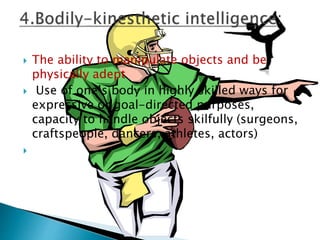
 The ability to manipulate objects and be
physically adept
 Use of one’s body in highly skilled ways for
expressive or goal-directed purposes,
capacity to handle objects skilfully (surgeons,
craftspeople, dancers, athletes, actors)

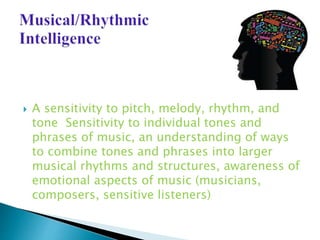
 A sensitivity to pitch, melody, rhythm, and
tone Sensitivity to individual tones and
phrases of music, an understanding of ways
to combine tones and phrases into larger
musical rhythms and structures, awareness of
emotional aspects of music (musicians,
composers, sensitive listeners)
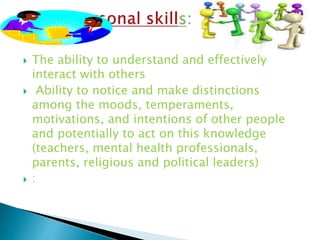
 The ability to understand and effectively
interact with others
 Ability to notice and make distinctions
among the moods, temperaments,
motivations, and intentions of other people
and potentially to act on this knowledge
(teachers, mental health professionals,
parents, religious and political leaders)
 :
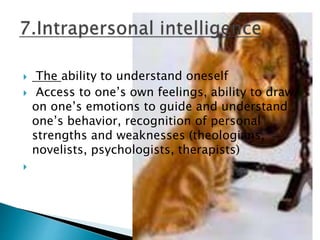
 The ability to understand oneself
 Access to one’s own feelings, ability to draw
on one’s emotions to guide and understand
one’s behavior, recognition of personal
strengths and weaknesses (theologians,
novelists, psychologists, therapists)

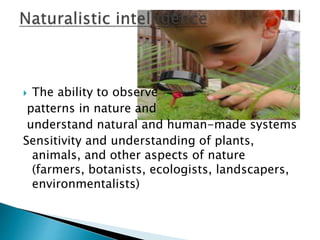
 The ability to observe
patterns in nature and
understand natural and human-made systems
Sensitivity and understanding of plants,
animals, and other aspects of nature
(farmers, botanists, ecologists, landscapers,
environmentalists)
 ."[44] Gardner believes that the purpose of
schooling "should be to develop intelligences
and to help people reach vocational and a
vocational goals that are appropriate to their
particular spectrum of intelligences. People
who are helped to do so, [he] believe[s], feel
more engaged and competent and therefore
more inclined to serve society in a
constructive way."[a]
 Gardner's theory argues that students will be
better served by a broader vision of
education, wherein teachers use different
methodologies, exercises and activities to
reach all students, not just those who excel at
linguistic and logical intelligence. It
challenges educators to find "ways that will
work for this student learning this topic".[46]
 It suggests that teachers be trained to present their
lessons in a wide variety of ways using music,
cooperative learning, art activities, role play,
multimedia, field trips, inner reflection, and much
more.

Multiple intelligence

  • 1.
  • 2.
     The theoryof multiple intelligences was developed in 1983 by Dr. Howard Gardner, professor of education at Harvard University.  Howard Gardner proposed this model in his 1983 book Frames of Mind: The Theory of Multiple Intelligences  Dr. Gardner proposes eight different intelligences to account for a broader range of human potential in children and adults.”
  • 3.
     He believeseach of us have all of the eight types of intelligence to varying degrees.  These multiple intelligences are related to how an individual prefers to learn and process information.
  • 4.
     Gardner definesan intelligence as "bio psychological potential to process information that can be activated in a cultural setting to solve problems or create products that are of value in a culture”
  • 5.
    1. Verbal/Linguistic Intelligence 2.Logical-mathematical Intelligence 3. Visual/Spatial Intelligence 4. Bodily/Kinesthetic Intelligence 5. Musical/Rhythmic Intelligence 6. Interpersonal Intelligence 7. Intrapersonal Intelligence 8. Naturalist Intelligence
  • 6.
     The abilityto think in words and use language express meaning or Sensitivity to the meanings and sounds of words, mastery of syntax, appreciation of the ways language can be used (authors, journalists, speakers, poets, teachers)
  • 7.
     The abilityto carry out mathematical operations , Understanding of objects and symbols and of actions that be performed on them and of the relations between these actions, ability for abstraction, ability to identify problems and seek explanations (scientists, engineers, accountants)
  • 8.
     The abilityto think three-dimensionally  Capacity to perceive the visual world accurately, to perform transformations upon perceptions and to re-create aspects of visual experience in the absence of physical stimuli, sensitivity to tension, balance, and composition, ability to detect similar patterns (architects, artists, sailors, chess masters)
  • 9.
     The abilityto manipulate objects and be physically adept  Use of one’s body in highly skilled ways for expressive or goal-directed purposes, capacity to handle objects skilfully (surgeons, craftspeople, dancers, athletes, actors) 
  • 10.
     A sensitivityto pitch, melody, rhythm, and tone Sensitivity to individual tones and phrases of music, an understanding of ways to combine tones and phrases into larger musical rhythms and structures, awareness of emotional aspects of music (musicians, composers, sensitive listeners)
  • 11.
     The abilityto understand and effectively interact with others  Ability to notice and make distinctions among the moods, temperaments, motivations, and intentions of other people and potentially to act on this knowledge (teachers, mental health professionals, parents, religious and political leaders)  :
  • 12.
     The abilityto understand oneself  Access to one’s own feelings, ability to draw on one’s emotions to guide and understand one’s behavior, recognition of personal strengths and weaknesses (theologians, novelists, psychologists, therapists) 
  • 13.
     The abilityto observe patterns in nature and understand natural and human-made systems Sensitivity and understanding of plants, animals, and other aspects of nature (farmers, botanists, ecologists, landscapers, environmentalists)
  • 14.
     ."[44] Gardnerbelieves that the purpose of schooling "should be to develop intelligences and to help people reach vocational and a vocational goals that are appropriate to their particular spectrum of intelligences. People who are helped to do so, [he] believe[s], feel more engaged and competent and therefore more inclined to serve society in a constructive way."[a]
  • 15.
     Gardner's theoryargues that students will be better served by a broader vision of education, wherein teachers use different methodologies, exercises and activities to reach all students, not just those who excel at linguistic and logical intelligence. It challenges educators to find "ways that will work for this student learning this topic".[46]
  • 16.
     It suggeststhat teachers be trained to present their lessons in a wide variety of ways using music, cooperative learning, art activities, role play, multimedia, field trips, inner reflection, and much more.