


COMMUNICATIVE  LANGUAGE  TEACHING m  n  R A J U
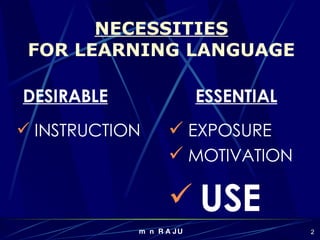
NECESSITIES FOR LEARNING LANGUAGE EXPOSURE MOTIVATION USE INSTRUCTION ESSENTIAL DESIRABLE
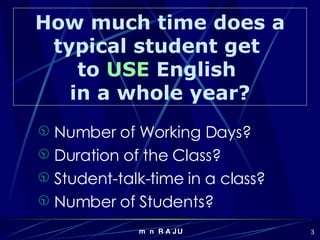
Number of Working Days? Duration of the Class? Student-talk-time in a class? Number of Students? How much time does a typical student get  to  USE  English  in a whole year?
HOW TO     STUDENT   USE   TIME IN THE CLASS? INCREASE
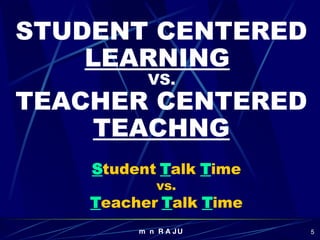
STUDENT CENTERED  LEARNING   VS. TEACHER CENTERED  TEACHNG S tudent  T alk  T ime vs. T eacher  T alk  T ime
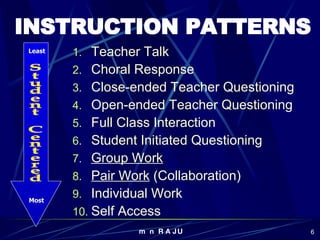
INSTRUCTION PATTERNS Teacher Talk Choral Response Close-ended Teacher Questioning Open-ended Teacher Questioning Full Class Interaction Student Initiated Questioning Group Work Pair Work  (Collaboration) Individual Work Self Access Student Centered Least Most
‘ Tell me, I forget;   Show me, I remember; Involve me, I understand.’
PAIR WORK What is it?  How is it done?  Have you ever used it?
PAIR WORK - ADVANTAGES THINK   – make notes form   PAIRS SHARE   with Partner SHARE   with Class
PAIR WORK - ADVANTAGES Greater opportunity for USE  Learners gain confidence/overcome fear Real time feedback/response Peer learning Cooperation – a life skill
PAIR WORK - REVIEW T HINK P AIR S HARE CLASS SHARE
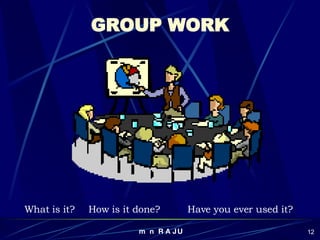
GROUP WORK What is it?  How is it done?  Have you ever used it?
GROUP WORK - ADVANTAGES  More S T T More listening time More fun Exchange of ideas Seeing others’ point of view Improved social skills Improved problem solving skills
GROUP WORK - PROBLEMS Students use mother tongue Teacher loses control Noisy classes Too much confusion Students don’t perform the task
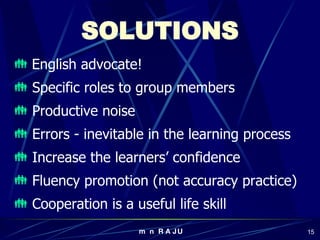
SOLUTIONS English advocate! Specific roles to group members Productive noise Errors - inevitable in the learning process Increase the learners’ confidence Fluency promotion (not accuracy practice) Cooperation is a useful life skill
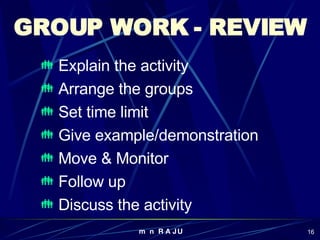
GROUP WORK - REVIEW Explain the activity Arrange the groups Set time limit Give example/demonstration Move & Monitor Follow up Discuss the activity
TEACHING SPEAKING nagaRAJU
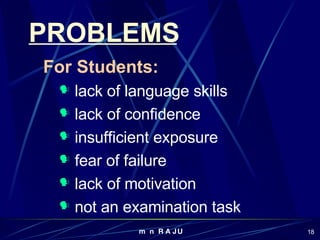
For Students: lack of language skills  lack of confidence insufficient exposure fear of failure lack of motivation not an examination task PROBLEMS
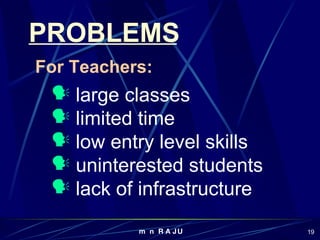
For Teachers: large classes limited time low entry level skills uninterested students lack of infrastructure PROBLEMS
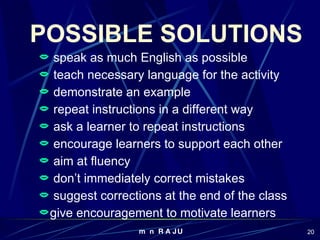
speak as much English as possible teach necessary language for the activity demonstrate an example repeat instructions in a different way ask a learner to repeat instructions encourage learners to support each other aim at fluency don’t immediately correct mistakes suggest corrections at the end of the class give encouragement to motivate learners POSSIBLE SOLUTIONS
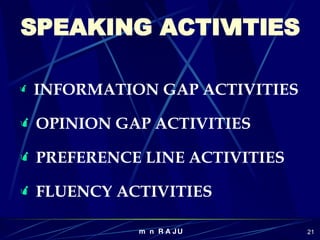
SPEAKING ACTIVITIES INFORMATION GAP ACTIVITIES OPINION GAP ACTIVITIES PREFERENCE LINE ACTIVITIES FLUENCY ACTIVITIES
TEACHING LISTENING nagaRAJU
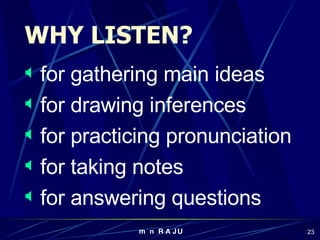
for gathering main ideas for drawing inferences for practicing pronunciation for taking notes for answering questions WHY LISTEN?
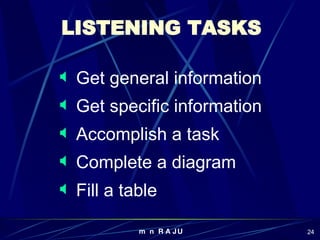
LISTENING TASKS Get general information Get specific information Accomplish a task Complete a diagram Fill a table
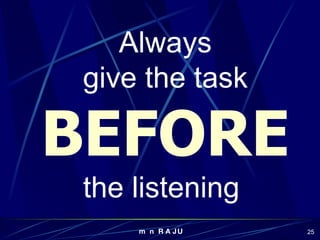
Always give the task BEFORE the listening
ALL THE BEST [email_address]

Communicative Language Teaching

  • 1.
    COMMUNICATIVE LANGUAGE TEACHING m n R A J U
  • 2.
    NECESSITIES FOR LEARNINGLANGUAGE EXPOSURE MOTIVATION USE INSTRUCTION ESSENTIAL DESIRABLE
  • 3.
    Number of WorkingDays? Duration of the Class? Student-talk-time in a class? Number of Students? How much time does a typical student get to USE English in a whole year?
  • 4.
    HOW TO STUDENT USE TIME IN THE CLASS? INCREASE
  • 5.
    STUDENT CENTERED LEARNING VS. TEACHER CENTERED TEACHNG S tudent T alk T ime vs. T eacher T alk T ime
  • 6.
    INSTRUCTION PATTERNS TeacherTalk Choral Response Close-ended Teacher Questioning Open-ended Teacher Questioning Full Class Interaction Student Initiated Questioning Group Work Pair Work (Collaboration) Individual Work Self Access Student Centered Least Most
  • 7.
    ‘ Tell me,I forget; Show me, I remember; Involve me, I understand.’
  • 8.
    PAIR WORK Whatis it? How is it done? Have you ever used it?
  • 9.
    PAIR WORK -ADVANTAGES THINK – make notes form PAIRS SHARE with Partner SHARE with Class
  • 10.
    PAIR WORK -ADVANTAGES Greater opportunity for USE Learners gain confidence/overcome fear Real time feedback/response Peer learning Cooperation – a life skill
  • 11.
    PAIR WORK -REVIEW T HINK P AIR S HARE CLASS SHARE
  • 12.
    GROUP WORK Whatis it? How is it done? Have you ever used it?
  • 13.
    GROUP WORK -ADVANTAGES More S T T More listening time More fun Exchange of ideas Seeing others’ point of view Improved social skills Improved problem solving skills
  • 14.
    GROUP WORK -PROBLEMS Students use mother tongue Teacher loses control Noisy classes Too much confusion Students don’t perform the task
  • 15.
    SOLUTIONS English advocate!Specific roles to group members Productive noise Errors - inevitable in the learning process Increase the learners’ confidence Fluency promotion (not accuracy practice) Cooperation is a useful life skill
  • 16.
    GROUP WORK -REVIEW Explain the activity Arrange the groups Set time limit Give example/demonstration Move & Monitor Follow up Discuss the activity
  • 17.
  • 18.
    For Students: lackof language skills lack of confidence insufficient exposure fear of failure lack of motivation not an examination task PROBLEMS
  • 19.
    For Teachers: largeclasses limited time low entry level skills uninterested students lack of infrastructure PROBLEMS
  • 20.
    speak as muchEnglish as possible teach necessary language for the activity demonstrate an example repeat instructions in a different way ask a learner to repeat instructions encourage learners to support each other aim at fluency don’t immediately correct mistakes suggest corrections at the end of the class give encouragement to motivate learners POSSIBLE SOLUTIONS
  • 21.
    SPEAKING ACTIVITIES INFORMATIONGAP ACTIVITIES OPINION GAP ACTIVITIES PREFERENCE LINE ACTIVITIES FLUENCY ACTIVITIES
  • 22.
  • 23.
    for gathering mainideas for drawing inferences for practicing pronunciation for taking notes for answering questions WHY LISTEN?
  • 24.
    LISTENING TASKS Getgeneral information Get specific information Accomplish a task Complete a diagram Fill a table
  • 25.
    Always give thetask BEFORE the listening
  • 26.
    ALL THE BEST[email_address]