 Introduction
 history
 Why multi-core ?
 What do you mean by multicore?
 Multi core architecture
 Comparison of Different Architectures
 Single Core vs. Multicore
 What is a 64 bit chip?
 Performance analysis
CONTENTS
• Part 1
• Part 2
 Advantages & Disadvantages
 Application
 Future aspect
 Conclusion
 References of work
• Part 3
• Part 4
• Multi-core processors represent a major
evolution in computing technology.
• They are several mostly independent cores
which work together in parallel
•This important development is coming at a time
when businesses and consumers are require it
benefits offered by these processors due to the
exponential growth of digital data and the
globalization of the Internet.
•performance and productivity benefits beyond the
capabilities of today’s single-core processors.
Introduction
• Part 1
•The first commercial dual core processor was
IBM's Power 4 processor for it's RISC servers in
2001.
•The first dual core processor for home use was
Intel's Pentium Processor Extreme Edition 840,
released in early April 2005.
•Less than two weeks later AMD brought their
Opteron 800 Series and Athlon 64 X2
processors to market.
History
Why multi-core pocessor-?
Once upon a time, when human realized that
in a normal atmosphere ,it is not possible to
increase the CPU’s clock speed after above
standard level (generally at a frequency about
4Ghz the CPU would get too hot and take a
lot of electricity). Because of too much heat
generated by CPU both Intel & AMD faced
problem. High clock speed means high heat
& resulted boom the CPU.
Faster processing is the basic reason ,so
that’s why technology shifted towards the
Multicore processor rather than increase the
clock frequency. It was decided to put more
than one processor on a single die. That is
what we call two core or dual core .
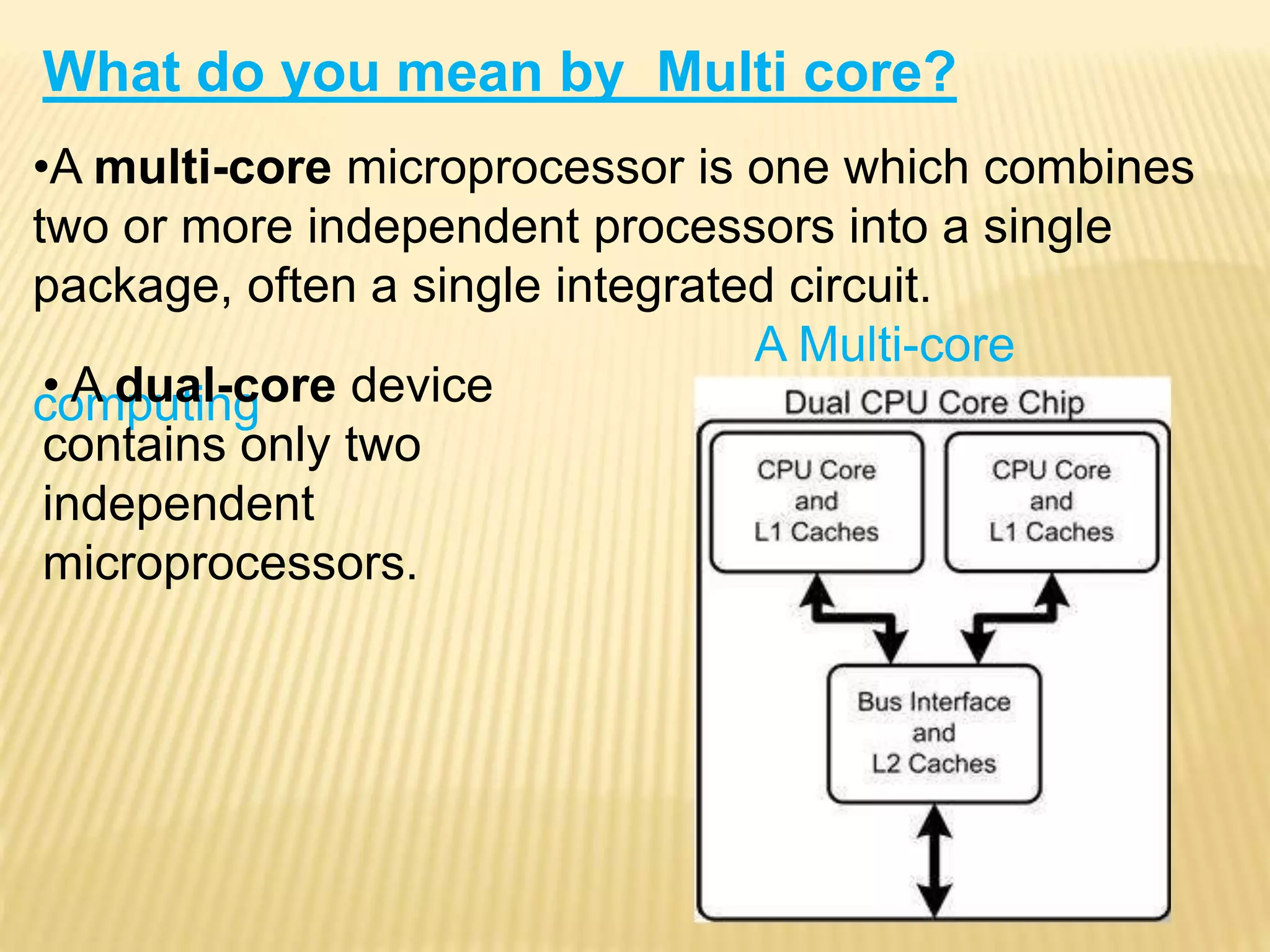
•A multi-core microprocessor is one which combines
two or more independent processors into a single
package, often a single integrated circuit.
A Multi-core
computing• A dual-core device
contains only two
independent
microprocessors.
What do you mean by Multi core?
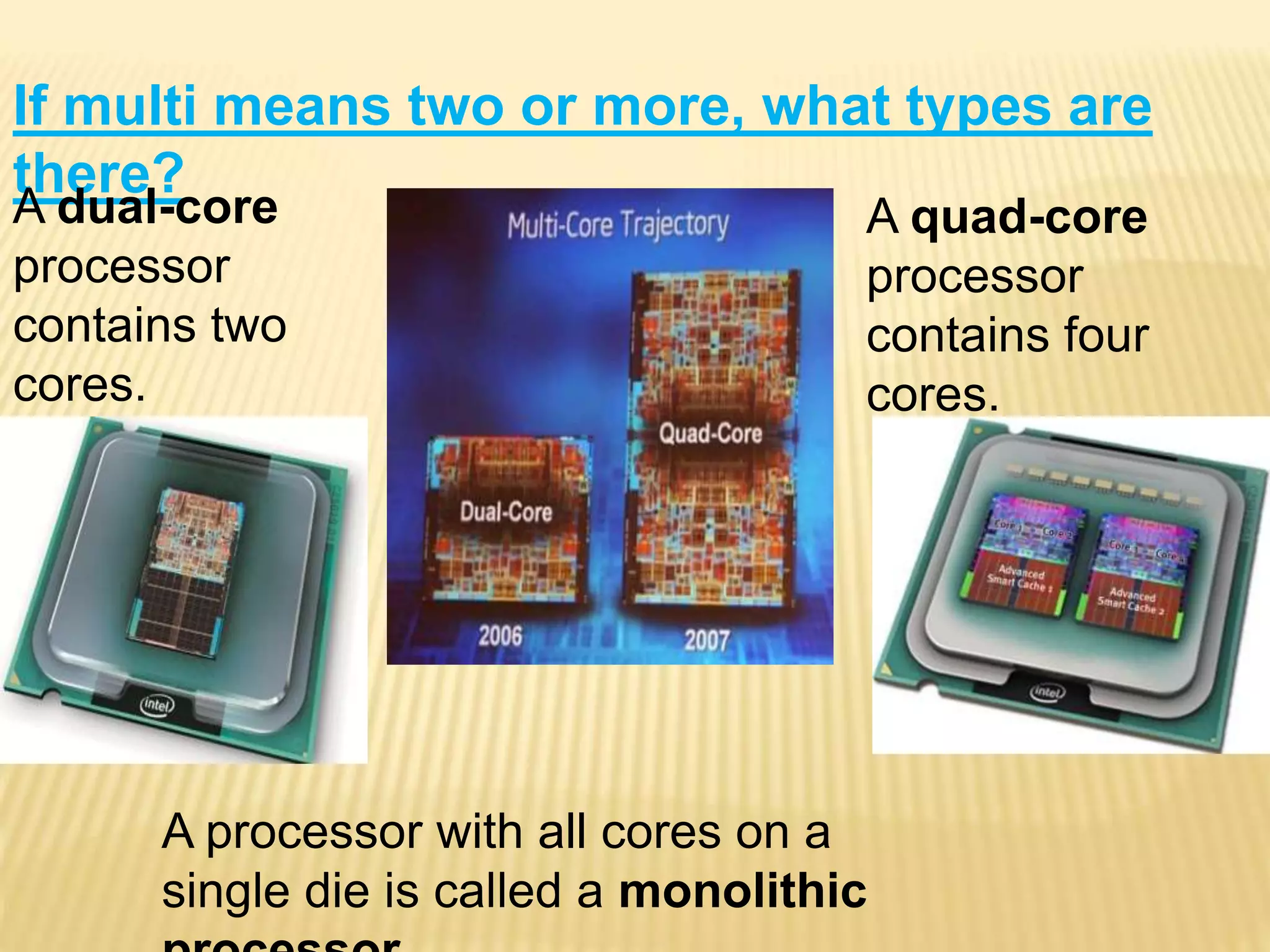
If multi means two or more, what types are
there?
A dual-core
processor
contains two
cores.
A quad-core
processor
contains four
cores.
A processor with all cores on a
single die is called a monolithic
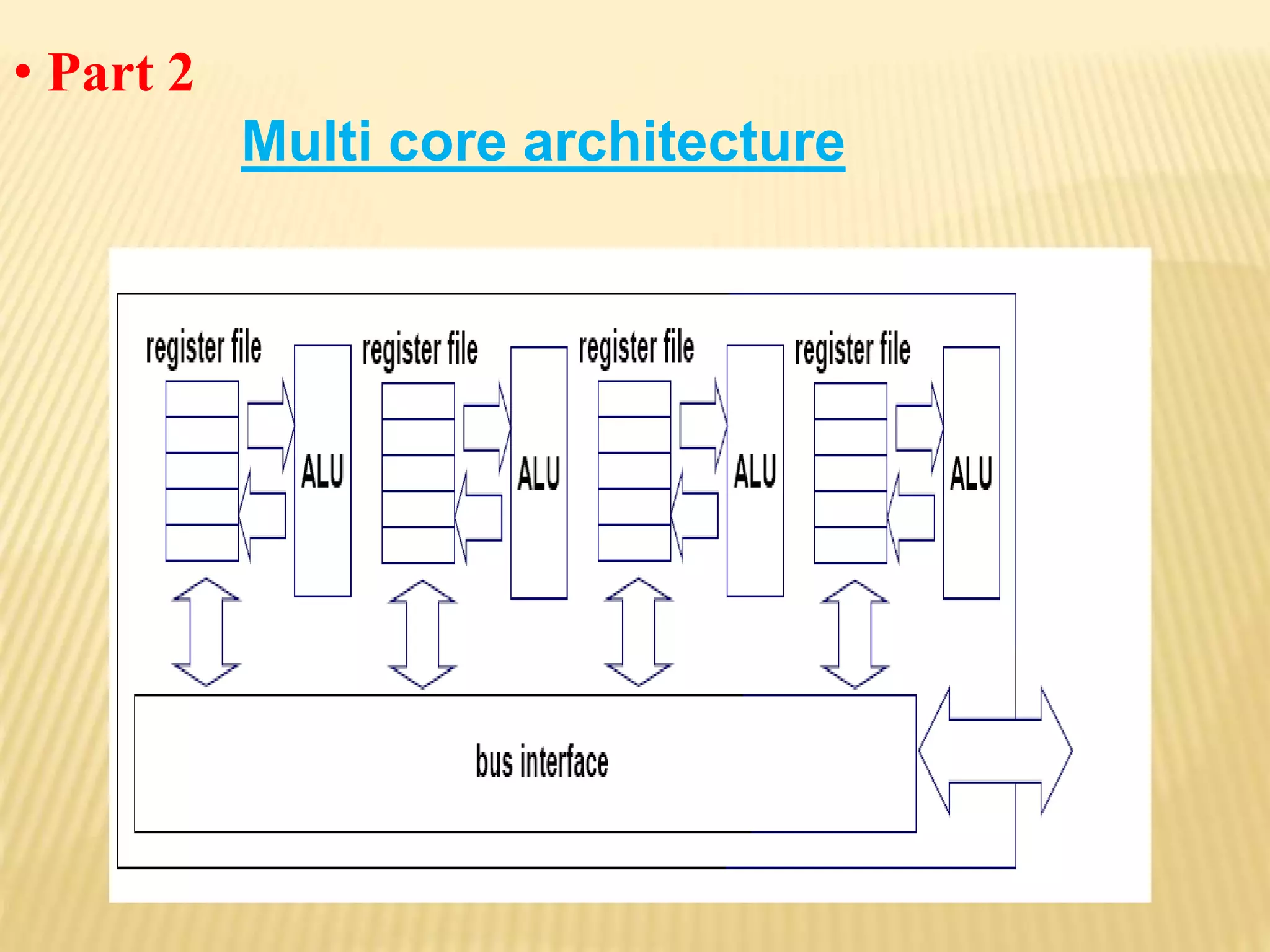
Multi core architecture
• Part 2
11
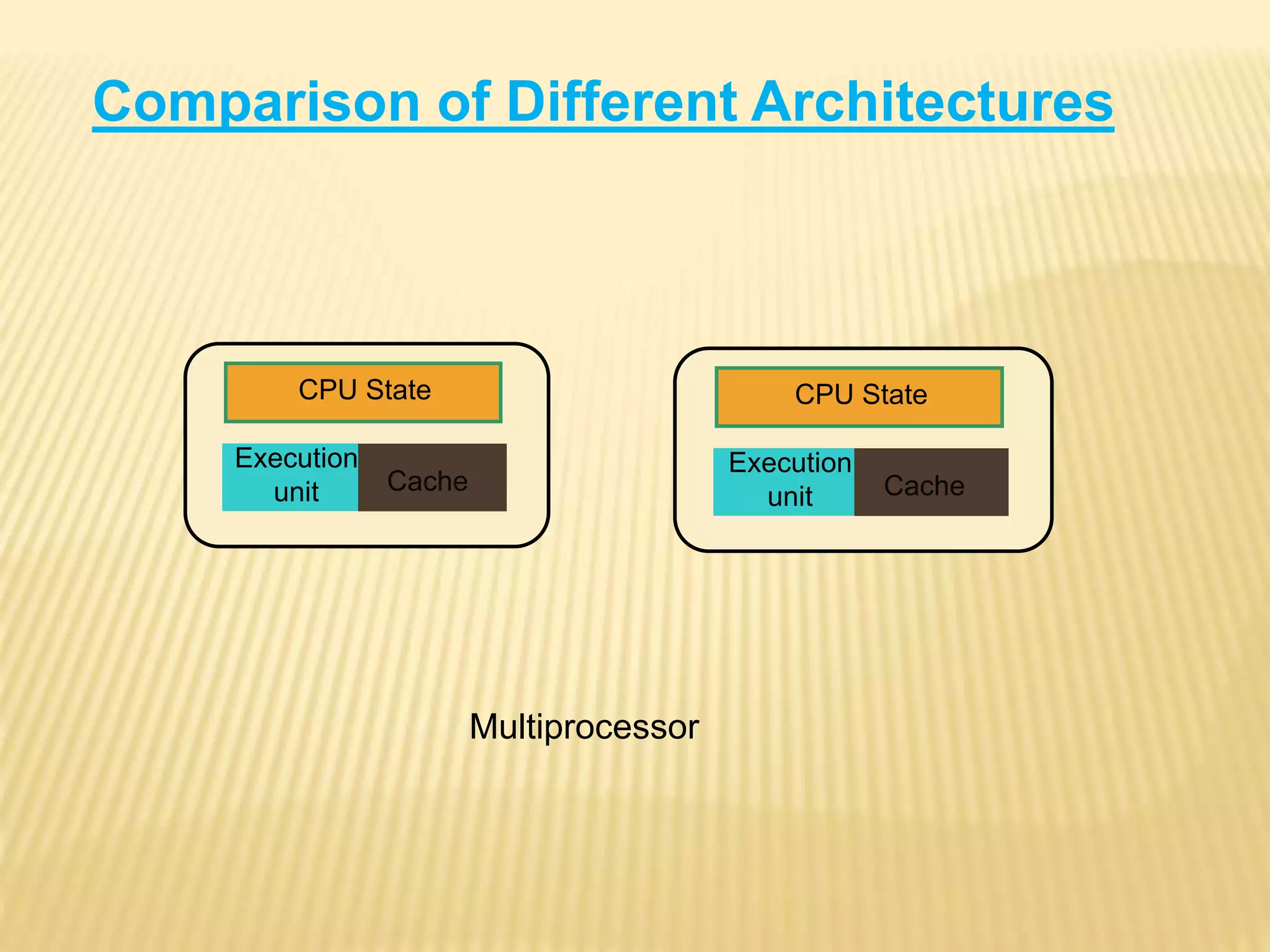
Comparison of Different Architectures
CPU State
Cache
Execution
unit
Single Core
Architecture
CPU State
Cache
Execution
unit
CPU State
Cache
Execution
unit
Comparison of Different Architectures
Multiprocessor
13
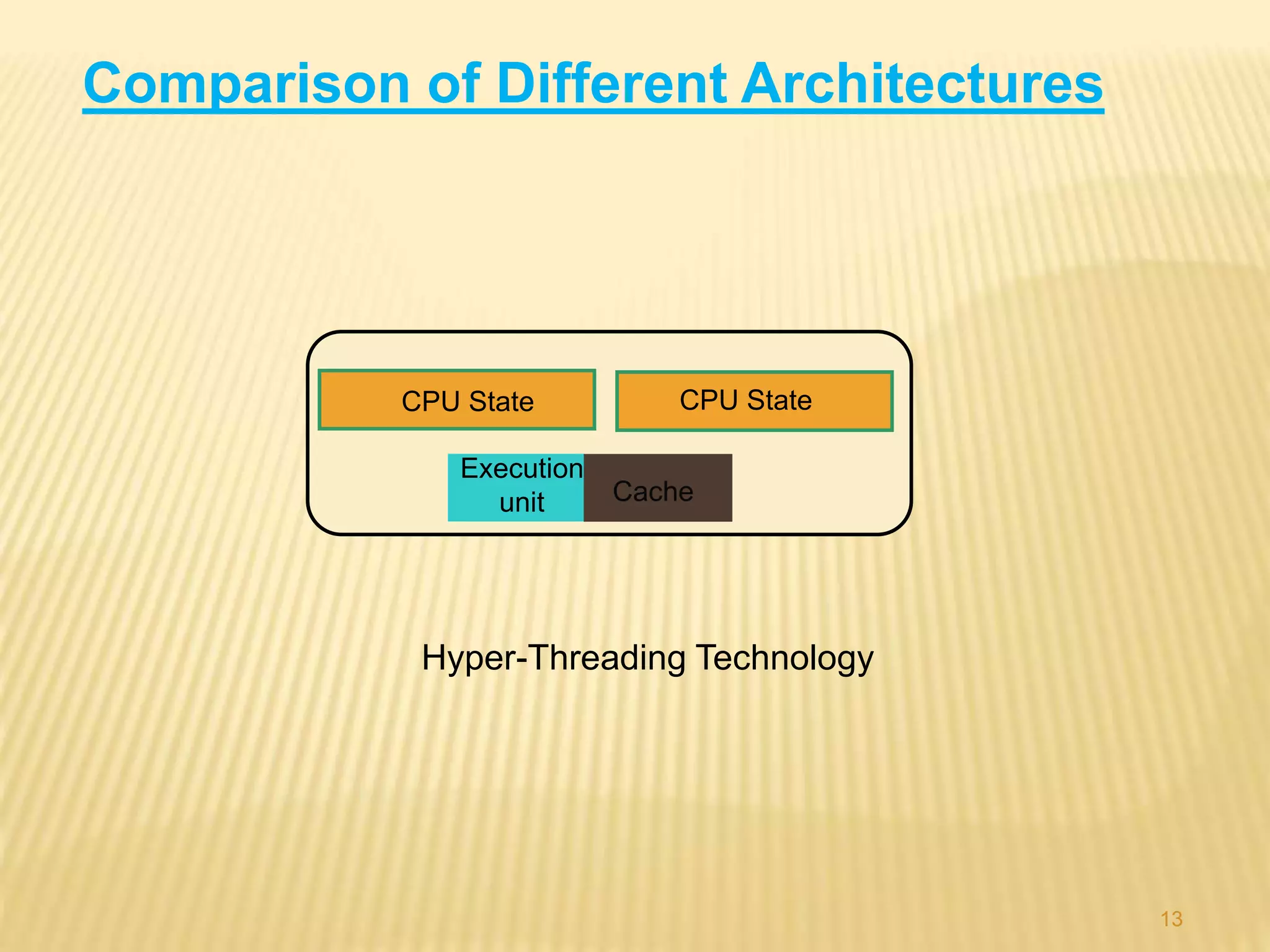
Comparison of Different Architectures
CPU State
Cache
Execution
unit
Hyper-Threading Technology
CPU State
14
Comparison of Different Architectures
CPUa State
Cache
Execution
unit
Multi-Core Architecture
CPU State
Cache
Execution
unit
15
Comparison of Different Architectures
CPU State
Execution
unit
Multi-Core Architecture with Shared Cache
CPU State
Cache
Execution
unit
16
Comparison of Different Architectures
Multi-Core with Hyper-Threading Technology
CPU State
Cache
Execution
unit
CPU State CPU State
Cache
Execution
unit
CPU State
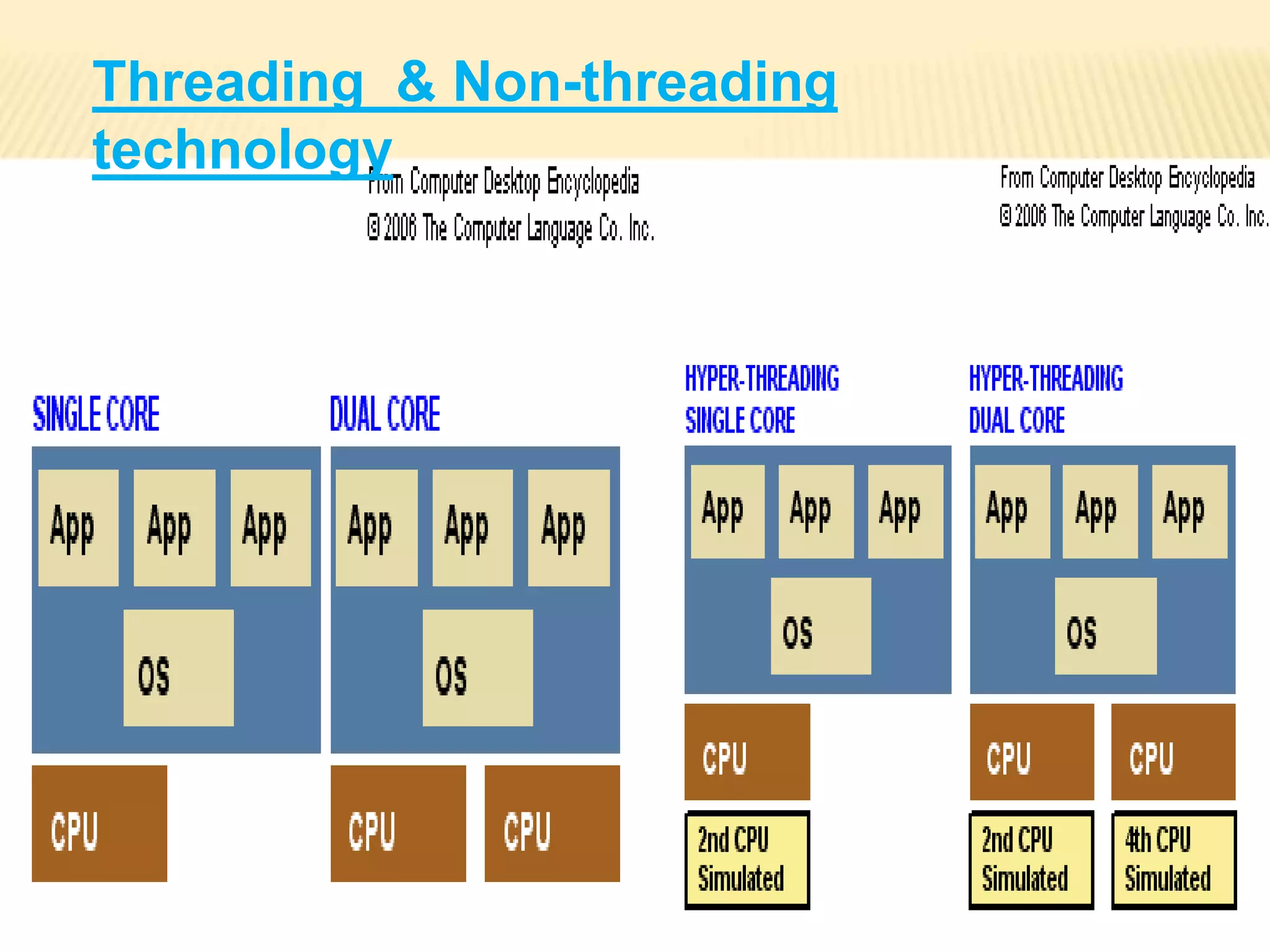
Threading & Non-threading
technology
Single Core vs. Multicore
What is a 64 bit chip?
• A 64-bit processor means that it can handle
64 bits of data at one time.
• A 64-bit processor can handle more
intensive programs than a 32-bit.
• The 64-bit processor also supports more
memory than a 32-bit processor. 32-bit
CPUs can generally handle up to 4GB of
memory, with the ability to process 2GB of
memory at a time while a 64-bit system can
utilize more significantly
Performance Analysis
•Multi-tasking productivity
• it will work faster for certain programs
•PC security
•Cool and quiet
•The signals between different CPUs travel shorter
distances, therefore they degrade less
•More features can be added to the computer
Advantages
• Part 3
•They do not work at twice the speed as a normal
processor. They get only 60-80% more speed.
•The speed that the computer works at depends on
what the user is doing with it.
•They cost more than single core processors.
•They are more difficult to manage thermally than
lower-density single-core processors.
Disadvantages
Applications
• Video editing
• Encoding .
• 3D gaming.
• Powerful graphics solution
• Optimized productivity titles, such as
AVG's virus-scanning software.
The full effect and the advantage of having
a multi-core processor, when it is used
together with a multithreading operating .
Multicore Challenges
Having multiple cores on a single chip gives some
challenges .
• Power and temperature management
• Memory/cache coherence is another challenge
• And finally, using a multicore processor to its full
potential is another issue
Next-generation software applications will
require the performance capacity provided by
multi-core processors. Software destined to
break barriers in the user experience, like as
• Voice recognition
• Artificial intelligence (AI)
That will be only possible by multi-core
processors
Future aspect
In the next years the trend will go to multi-core
processors more and more. The main reason is
that they are faster than single-core processors
and they can be still improved., but added
interesting new problems. But in the future there
will be still some applications for single-core
processors because not every system needs a
fast processor.
Conclusion
• Part 4
References
• R. Merritt, “CPU Designers Debate Multi-core Future”, EETimes Online, February
2008, http://www.eetimes.com/showArticle.jhtml?articleID=206105179
• R. Merritt, “Multicore Puts Screws to Parallel-Programming Models”, EETimes Online,
February 2008,
http://www.eetimes.com/news/latest/showArticle.jtml?articleID=206504466
• R. Merritt, “X86 Cuts to the Cores”, EETimes Online, September 2007,
http://www.eetimes.com/showArticle.jtml?articleID=202100022
• R. Merritt, “Multicore Goals Mesh at Hot Chips”, EETimes Online, August 2007,
http://www.eetimes.com/showArticle.jtml?articleID=201800925
• P. Frost Gorder, “Multicore Processors for Science and Engineering”, IEEE CS,
March/April 2007
• D. Geer, “Chip Makers Turn to Multicore Processors”, Computer, IEEE Computer
Society, May 2005 [5] L. Peng et al, “Memory Performance and
It has been taken from various sources
Multicore Processor Technology

Multicore Processor Technology

  • 2.
     Introduction  history Why multi-core ?  What do you mean by multicore?  Multi core architecture  Comparison of Different Architectures  Single Core vs. Multicore  What is a 64 bit chip?  Performance analysis CONTENTS • Part 1 • Part 2
  • 3.
     Advantages &Disadvantages  Application  Future aspect  Conclusion  References of work • Part 3 • Part 4
  • 4.
    • Multi-core processorsrepresent a major evolution in computing technology. • They are several mostly independent cores which work together in parallel •This important development is coming at a time when businesses and consumers are require it benefits offered by these processors due to the exponential growth of digital data and the globalization of the Internet. •performance and productivity benefits beyond the capabilities of today’s single-core processors. Introduction • Part 1
  • 5.
    •The first commercialdual core processor was IBM's Power 4 processor for it's RISC servers in 2001. •The first dual core processor for home use was Intel's Pentium Processor Extreme Edition 840, released in early April 2005. •Less than two weeks later AMD brought their Opteron 800 Series and Athlon 64 X2 processors to market. History
  • 6.
    Why multi-core pocessor-? Onceupon a time, when human realized that in a normal atmosphere ,it is not possible to increase the CPU’s clock speed after above standard level (generally at a frequency about 4Ghz the CPU would get too hot and take a lot of electricity). Because of too much heat generated by CPU both Intel & AMD faced problem. High clock speed means high heat & resulted boom the CPU.
  • 7.
    Faster processing isthe basic reason ,so that’s why technology shifted towards the Multicore processor rather than increase the clock frequency. It was decided to put more than one processor on a single die. That is what we call two core or dual core .
  • 8.
    •A multi-core microprocessoris one which combines two or more independent processors into a single package, often a single integrated circuit. A Multi-core computing• A dual-core device contains only two independent microprocessors. What do you mean by Multi core?
  • 9.
    If multi meanstwo or more, what types are there? A dual-core processor contains two cores. A quad-core processor contains four cores. A processor with all cores on a single die is called a monolithic
  • 10.
  • 11.
    11 Comparison of DifferentArchitectures CPU State Cache Execution unit Single Core Architecture
  • 12.
  • 13.
    13 Comparison of DifferentArchitectures CPU State Cache Execution unit Hyper-Threading Technology CPU State
  • 14.
    14 Comparison of DifferentArchitectures CPUa State Cache Execution unit Multi-Core Architecture CPU State Cache Execution unit
  • 15.
    15 Comparison of DifferentArchitectures CPU State Execution unit Multi-Core Architecture with Shared Cache CPU State Cache Execution unit
  • 16.
    16 Comparison of DifferentArchitectures Multi-Core with Hyper-Threading Technology CPU State Cache Execution unit CPU State CPU State Cache Execution unit CPU State
  • 17.
  • 18.
    Single Core vs.Multicore
  • 19.
    What is a64 bit chip? • A 64-bit processor means that it can handle 64 bits of data at one time. • A 64-bit processor can handle more intensive programs than a 32-bit. • The 64-bit processor also supports more memory than a 32-bit processor. 32-bit CPUs can generally handle up to 4GB of memory, with the ability to process 2GB of memory at a time while a 64-bit system can utilize more significantly
  • 20.
  • 21.
    •Multi-tasking productivity • itwill work faster for certain programs •PC security •Cool and quiet •The signals between different CPUs travel shorter distances, therefore they degrade less •More features can be added to the computer Advantages • Part 3
  • 22.
    •They do notwork at twice the speed as a normal processor. They get only 60-80% more speed. •The speed that the computer works at depends on what the user is doing with it. •They cost more than single core processors. •They are more difficult to manage thermally than lower-density single-core processors. Disadvantages
  • 23.
    Applications • Video editing •Encoding . • 3D gaming. • Powerful graphics solution • Optimized productivity titles, such as AVG's virus-scanning software. The full effect and the advantage of having a multi-core processor, when it is used together with a multithreading operating .
  • 24.
    Multicore Challenges Having multiplecores on a single chip gives some challenges . • Power and temperature management • Memory/cache coherence is another challenge • And finally, using a multicore processor to its full potential is another issue
  • 25.
    Next-generation software applicationswill require the performance capacity provided by multi-core processors. Software destined to break barriers in the user experience, like as • Voice recognition • Artificial intelligence (AI) That will be only possible by multi-core processors Future aspect
  • 26.
    In the nextyears the trend will go to multi-core processors more and more. The main reason is that they are faster than single-core processors and they can be still improved., but added interesting new problems. But in the future there will be still some applications for single-core processors because not every system needs a fast processor. Conclusion • Part 4
  • 27.
    References • R. Merritt,“CPU Designers Debate Multi-core Future”, EETimes Online, February 2008, http://www.eetimes.com/showArticle.jhtml?articleID=206105179 • R. Merritt, “Multicore Puts Screws to Parallel-Programming Models”, EETimes Online, February 2008, http://www.eetimes.com/news/latest/showArticle.jtml?articleID=206504466 • R. Merritt, “X86 Cuts to the Cores”, EETimes Online, September 2007, http://www.eetimes.com/showArticle.jtml?articleID=202100022 • R. Merritt, “Multicore Goals Mesh at Hot Chips”, EETimes Online, August 2007, http://www.eetimes.com/showArticle.jtml?articleID=201800925 • P. Frost Gorder, “Multicore Processors for Science and Engineering”, IEEE CS, March/April 2007 • D. Geer, “Chip Makers Turn to Multicore Processors”, Computer, IEEE Computer Society, May 2005 [5] L. Peng et al, “Memory Performance and It has been taken from various sources