Evolution of Microprocessors
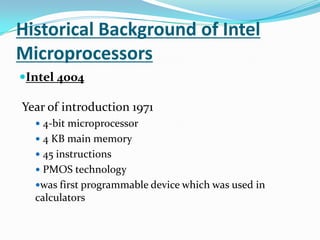
Historical Background of Intel MicroprocessorsIntel 4004 Year of introduction 1971 4-bit microprocessor 4 KB main memory 45 instructions PMOS technologywas first programmable device which was used in calculators
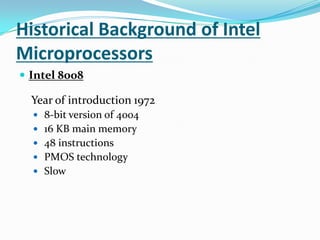
Historical Background of Intel MicroprocessorsIntel 8008 Year of introduction 1972 8-bit version of 4004 16 KB main memory 48 instructions PMOS technology Slow
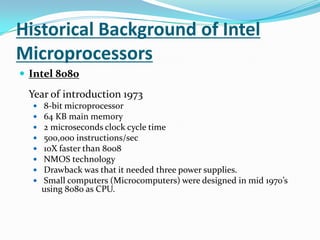
Historical Background of Intel MicroprocessorsIntel 8080Year of introduction 1973 8-bit microprocessor 64 KB main memory 2 microseconds clock cycle time 500,000 instructions/sec 10X faster than 8008 NMOS technology Drawback was that it needed three power supplies. Small computers (Microcomputers) were designed in mid 1970’s using 8080 as CPU.
Historical Background of Intel MicroprocessorsIntel 8085 Year of introduction 1975 8-bit microprocessor-upgraded version of 8080 64 KB main memory 1.3 microseconds clock cycle time 246 instructions Intel sold 100 million copies of this 8-bit microprocessor uses only one +5v power supply.
Historical Background of Intel MicroprocessorsIntel 8086/8088 Year of introduction 1978 for 8086 and 1979 for 8088 16-bit microprocessors Data bus width of 8086 is 16 bit and 8 bit for 8088 1 MB main memory 400 nanoseconds clock cycle time 6 byte instruction cache for 8086 and 4 byte for 8088 Other improvements included more registers and additional instructionsIn 1981 IBM decided to use 8088 in its personal computer
Historical Background of Intel MicroprocessorsIntel 80186 Year of introduction 1982 16-bit microprocessor-upgraded version of 8086 1 MB main memory Contained special hardware like programmable counters, interrupt controller etc. Never used in the PC But was ideal for systems that required a minimum of hardware
Historical Background of Intel MicroprocessorsIntel 80286 Year of introduction 1983 16-bit high performance microprocessor with memory management & protection 16 MB main memory Few additional instructions to handle extra 15 MB Instruction execution time is as little as 250 ns Concentrates on the features needed to implement MULTITASKING
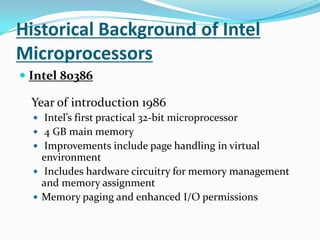
Historical Background of Intel MicroprocessorsIntel 80386 Year of introduction 1986 Intel’s first practical 32-bit microprocessor 4 GB main memory Improvements include page handling in virtual environment Includes hardware circuitry for memory management and memory assignmentMemory paging and enhanced I/O permissions
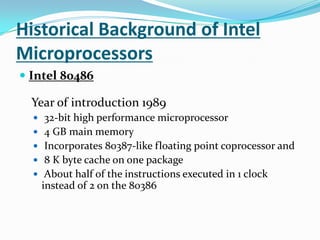
Historical Background of Intel MicroprocessorsIntel 80486 Year of introduction 1989 32-bit high performance microprocessor 4 GB main memory Incorporates 80387-like floating point coprocessor and 8 K byte cache on one package About half of the instructions executed in 1 clock instead of 2 on the 80386
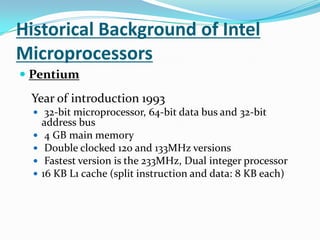
Historical Background of Intel MicroprocessorsPentium Year of introduction 1993 32-bit microprocessor, 64-bit data bus and 32-bit address bus 4 GB main memory Double clocked 120 and 133MHz versions Fastest version is the 233MHz, Dual integer processor16 KB L1 cache (split instruction and data: 8 KB each)
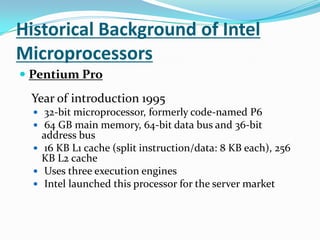
Historical Background of Intel MicroprocessorsPentium Pro Year of introduction 1995 32-bit microprocessor, formerly code-named P6 64 GB main memory, 64-bit data bus and 36-bit  address bus 16 KB L1 cache (split instruction/data: 8 KB each), 256 KB L2 cache Uses three execution engines Intel launched this processor for the server market
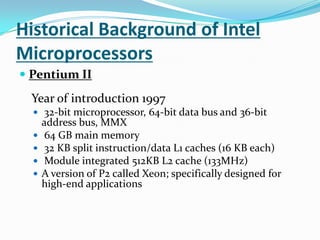
Historical Background of Intel MicroprocessorsPentium II Year of introduction 1997 32-bit microprocessor, 64-bit data bus and 36-bit address bus, MMX 64 GB main memory 32 KB split instruction/data L1 caches (16 KB each) Module integrated 512KB L2 cache (133MHz)A version of P2 called Xeon; specifically designed for high-end applications
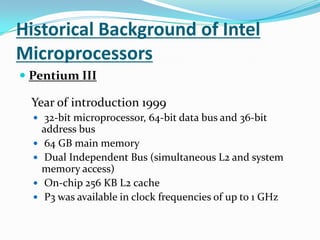
Historical Background of Intel MicroprocessorsPentium III Year of introduction 1999 32-bit microprocessor, 64-bit data bus and 36-bit address bus 64 GBmain memory Dual Independent Bus (simultaneous L2 and system memory access) On-chip 256 KB L2 cache P3 was available in clock frequencies of up to 1 GHz
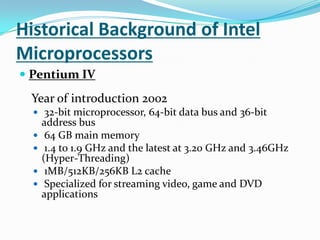
Historical Background of Intel MicroprocessorsPentium IV Year of introduction 2002 32-bit microprocessor, 64-bit data bus and 36-bit address bus 64 GB main memory 1.4 to 1.9 GHz and the latest at 3.20 GHz and 3.46GHz (Hyper-Threading) 1MB/512KB/256KB L2 cache Specialized for streaming video, game and DVD applications
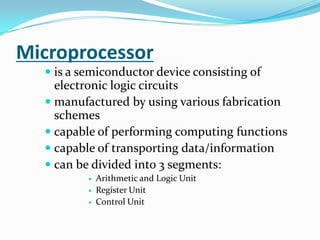
Microprocessoris a semiconductor device consisting of electronic logic circuits manufactured by using various fabrication schemescapable of performing computing functionscapable of transporting data/informationcan be divided into 3 segments:Arithmetic and Logic UnitRegister UnitControl Unit
Von Neumann Machine Three key concepts:Data and instructions are stored in a single set of    read-write memoryContents of memory are addressable by memory address, without regard to the type of data containedExecution occurs in a sequential fashion, unless explicitly altered, from one instruction to the other
Computer System ComponentsMemoryStores instructions and dataInput/OutputCalled peripheralsUsed to input and output instructions and dataArithmetic and Logic Unit– Performs arithmetic operations (addition, subtraction)– Performs logical operations (AND, OR, XOR,    SHIFT, ROTATE)
Computer System ComponentsControl Unit– Coordinates the operation of the computerSystem Interconnection and InteractionBus—A group of lines used to transfer bits between the microprocessor and other components of the computer system.Busis used to communicate between parts of the computer. There is only one transmitter at a time and only the addressed device can respond.Types» Address» Data» Control signals
CPU ComponentsRegistersHold data, instructions, or other itemsVarious sizesProgram counter and memory address registers must be of same size/width as address busRegisters which hold data must be of same size/width as memory words
CPU ComponentsControl UnitGenerates control signals which are necessary for execution of an instruction.Connect registers to the bus.Controls the data flow between CPU and peripherals (including memory).Provides status, control & timing signals required for the operation of memory and I/O devices to the system.Acts as a brain of computer systemAll actions of the control unit are associated with the decoding and executions of instructions (fetch and execute cycles).
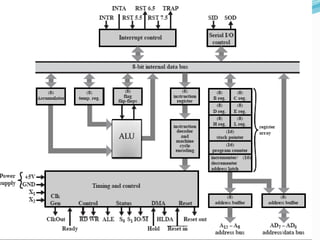
CPU ComponentsArithmetic and Logic UnitExecutes arithmetic and logical operations.Accumulator is a special 8-bit register associated with ALU.Register ‘A’ in 8085 is an accumulator.Source of one of the operands of an arithmetic or logical operation.serves as one input to ALU.Final result of an arithmetic or logical operation is placed in accumulator.
Arithmetic and Logic UnitALU performs the following arithmetic & logical operations:AdditionSubtractionLogical ANDLogical ORLogical EXCLUSIVE ORComplement(logical NOT)Increment (add 1)Decrement (subtract 1)Left shift, Rotate Left, Rotate rightClear etc.
Status Flags Intel 8085 microprocessor contains five flip-flops to serve as status flags. The flip-flops are set or reset according to the conditions which arise due to an arithmetic & logical operation
 Intel 8085 Architecture
  ALU
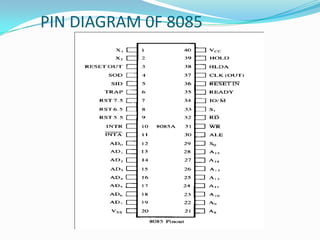
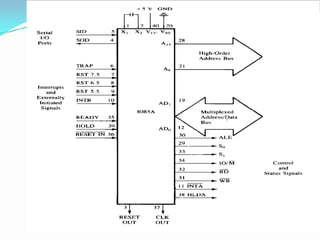
PIN DIAGRAM 0F 8085
Evolution Of Microprocessors

Evolution Of Microprocessors

  • 1.
  • 2.
    Historical Background ofIntel MicroprocessorsIntel 4004 Year of introduction 1971 4-bit microprocessor 4 KB main memory 45 instructions PMOS technologywas first programmable device which was used in calculators
  • 3.
    Historical Background ofIntel MicroprocessorsIntel 8008 Year of introduction 1972 8-bit version of 4004 16 KB main memory 48 instructions PMOS technology Slow
  • 4.
    Historical Background ofIntel MicroprocessorsIntel 8080Year of introduction 1973 8-bit microprocessor 64 KB main memory 2 microseconds clock cycle time 500,000 instructions/sec 10X faster than 8008 NMOS technology Drawback was that it needed three power supplies. Small computers (Microcomputers) were designed in mid 1970’s using 8080 as CPU.
  • 5.
    Historical Background ofIntel MicroprocessorsIntel 8085 Year of introduction 1975 8-bit microprocessor-upgraded version of 8080 64 KB main memory 1.3 microseconds clock cycle time 246 instructions Intel sold 100 million copies of this 8-bit microprocessor uses only one +5v power supply.
  • 6.
    Historical Background ofIntel MicroprocessorsIntel 8086/8088 Year of introduction 1978 for 8086 and 1979 for 8088 16-bit microprocessors Data bus width of 8086 is 16 bit and 8 bit for 8088 1 MB main memory 400 nanoseconds clock cycle time 6 byte instruction cache for 8086 and 4 byte for 8088 Other improvements included more registers and additional instructionsIn 1981 IBM decided to use 8088 in its personal computer
  • 7.
    Historical Background ofIntel MicroprocessorsIntel 80186 Year of introduction 1982 16-bit microprocessor-upgraded version of 8086 1 MB main memory Contained special hardware like programmable counters, interrupt controller etc. Never used in the PC But was ideal for systems that required a minimum of hardware
  • 8.
    Historical Background ofIntel MicroprocessorsIntel 80286 Year of introduction 1983 16-bit high performance microprocessor with memory management & protection 16 MB main memory Few additional instructions to handle extra 15 MB Instruction execution time is as little as 250 ns Concentrates on the features needed to implement MULTITASKING
  • 9.
    Historical Background ofIntel MicroprocessorsIntel 80386 Year of introduction 1986 Intel’s first practical 32-bit microprocessor 4 GB main memory Improvements include page handling in virtual environment Includes hardware circuitry for memory management and memory assignmentMemory paging and enhanced I/O permissions
  • 10.
    Historical Background ofIntel MicroprocessorsIntel 80486 Year of introduction 1989 32-bit high performance microprocessor 4 GB main memory Incorporates 80387-like floating point coprocessor and 8 K byte cache on one package About half of the instructions executed in 1 clock instead of 2 on the 80386
  • 11.
    Historical Background ofIntel MicroprocessorsPentium Year of introduction 1993 32-bit microprocessor, 64-bit data bus and 32-bit address bus 4 GB main memory Double clocked 120 and 133MHz versions Fastest version is the 233MHz, Dual integer processor16 KB L1 cache (split instruction and data: 8 KB each)
  • 12.
    Historical Background ofIntel MicroprocessorsPentium Pro Year of introduction 1995 32-bit microprocessor, formerly code-named P6 64 GB main memory, 64-bit data bus and 36-bit address bus 16 KB L1 cache (split instruction/data: 8 KB each), 256 KB L2 cache Uses three execution engines Intel launched this processor for the server market
  • 13.
    Historical Background ofIntel MicroprocessorsPentium II Year of introduction 1997 32-bit microprocessor, 64-bit data bus and 36-bit address bus, MMX 64 GB main memory 32 KB split instruction/data L1 caches (16 KB each) Module integrated 512KB L2 cache (133MHz)A version of P2 called Xeon; specifically designed for high-end applications
  • 14.
    Historical Background ofIntel MicroprocessorsPentium III Year of introduction 1999 32-bit microprocessor, 64-bit data bus and 36-bit address bus 64 GBmain memory Dual Independent Bus (simultaneous L2 and system memory access) On-chip 256 KB L2 cache P3 was available in clock frequencies of up to 1 GHz
  • 15.
    Historical Background ofIntel MicroprocessorsPentium IV Year of introduction 2002 32-bit microprocessor, 64-bit data bus and 36-bit address bus 64 GB main memory 1.4 to 1.9 GHz and the latest at 3.20 GHz and 3.46GHz (Hyper-Threading) 1MB/512KB/256KB L2 cache Specialized for streaming video, game and DVD applications
  • 16.
    Microprocessoris a semiconductordevice consisting of electronic logic circuits manufactured by using various fabrication schemescapable of performing computing functionscapable of transporting data/informationcan be divided into 3 segments:Arithmetic and Logic UnitRegister UnitControl Unit
  • 17.
    Von Neumann MachineThree key concepts:Data and instructions are stored in a single set of read-write memoryContents of memory are addressable by memory address, without regard to the type of data containedExecution occurs in a sequential fashion, unless explicitly altered, from one instruction to the other
  • 18.
    Computer System ComponentsMemoryStoresinstructions and dataInput/OutputCalled peripheralsUsed to input and output instructions and dataArithmetic and Logic Unit– Performs arithmetic operations (addition, subtraction)– Performs logical operations (AND, OR, XOR, SHIFT, ROTATE)
  • 19.
    Computer System ComponentsControlUnit– Coordinates the operation of the computerSystem Interconnection and InteractionBus—A group of lines used to transfer bits between the microprocessor and other components of the computer system.Busis used to communicate between parts of the computer. There is only one transmitter at a time and only the addressed device can respond.Types» Address» Data» Control signals
  • 20.
    CPU ComponentsRegistersHold data,instructions, or other itemsVarious sizesProgram counter and memory address registers must be of same size/width as address busRegisters which hold data must be of same size/width as memory words
  • 21.
    CPU ComponentsControl UnitGeneratescontrol signals which are necessary for execution of an instruction.Connect registers to the bus.Controls the data flow between CPU and peripherals (including memory).Provides status, control & timing signals required for the operation of memory and I/O devices to the system.Acts as a brain of computer systemAll actions of the control unit are associated with the decoding and executions of instructions (fetch and execute cycles).
  • 22.
    CPU ComponentsArithmetic andLogic UnitExecutes arithmetic and logical operations.Accumulator is a special 8-bit register associated with ALU.Register ‘A’ in 8085 is an accumulator.Source of one of the operands of an arithmetic or logical operation.serves as one input to ALU.Final result of an arithmetic or logical operation is placed in accumulator.
  • 23.
    Arithmetic and LogicUnitALU performs the following arithmetic & logical operations:AdditionSubtractionLogical ANDLogical ORLogical EXCLUSIVE ORComplement(logical NOT)Increment (add 1)Decrement (subtract 1)Left shift, Rotate Left, Rotate rightClear etc.
  • 24.
    Status Flags Intel8085 microprocessor contains five flip-flops to serve as status flags. The flip-flops are set or reset according to the conditions which arise due to an arithmetic & logical operation
  • 25.
    Intel 8085Architecture
  • 26.
  • 27.