


Deep Kakkad
de e p-kak kad. g i thub . io
SINGLE CORE, DUAL CORE AND QUAD
CORE PROCESSORS
BACK IN THE DAYS WHEN…
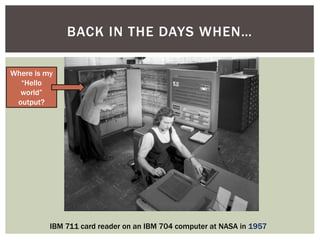
IBM 711 card reader on an IBM 704 computer at NASA in 1957
Where is my
“Hello
world”
output?
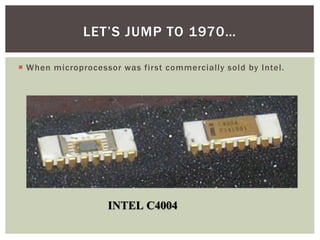
 When microprocessor was first commercially sold by Intel.
LET’S JUMP TO 1970…
INTEL C4004
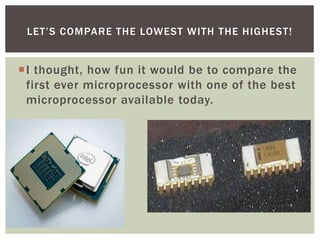
I thought, how fun it would be to compare the
first ever microprocessor with one of the best
microprocessor available today.
LET’S COMPARE THE LOWEST WITH THE HIGHEST!
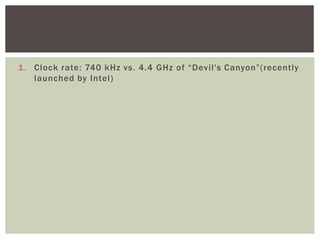
1. Clock rate: 740 kHz vs. 4.4 GHz of “Devil's Canyon”(recently
launched by Intel)
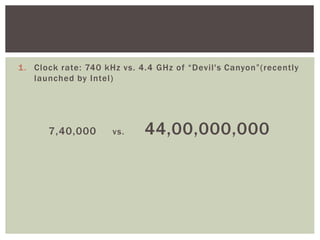
1. Clock rate: 740 kHz vs. 4.4 GHz of “Devil's Canyon”(recently
launched by Intel)
7,40,000 vs. 44,00,000,000
1. Clock rate: 740 kHz vs. 4.4 GHz of “Devil's Canyon”(recently
launched by Intel)
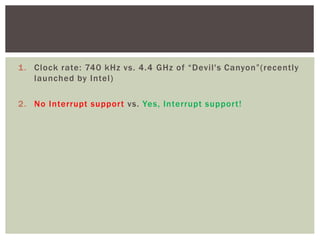
2. No Interrupt support vs. Yes, Interrupt support!
1. Clock rate: 740 kHz vs. 4.4 GHz of “Devil's Canyon”(recently
launched by Intel)
2. No Interrupt support vs. Yes, Interrupt support!
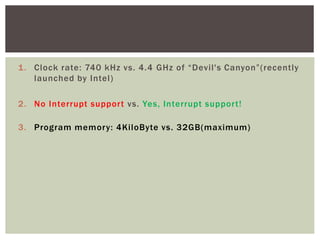
3. Program memory: 4KiloByte vs. 32GB(maximum)
1. Clock rate: 740 kHz vs. 4.4 GHz of “Devil's Canyon”(recently
launched by Intel)
2. No Interrupt support vs. Yes, Interrupt support!
3. Program memory: 4KiloByte vs. 32GB(maximum)
1. Clock rate: 740 kHz vs. 4.4 GHz of “Devil's Canyon”(recently
launched by Intel)
2. No Interrupt support vs. Yes, Interrupt support!
3. Program memory: 4KiloByte vs. 32GB(maximum)
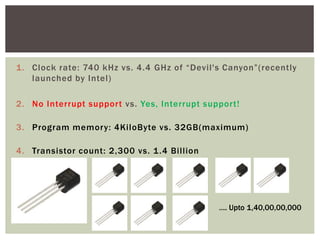
4. Transistor count: 2,300 vs. 1.4 Billion
…. Upto 1,40,00,00,000
What is a microprocessor ?
How is it related with CPU ?
What do you mean when you say core ?
lets see…
ENOUGH OF FACTUAL COMPARISONS…
 Any answers for difference between CPU, processor
and microprocessor?
THE STORY OF PROCESSOR AND CPU!
 Any answers for difference between CPU, processor
and microprocessor?
 No difference between Microprocessor, Processor
and CPU as long as we’re talking about a modern
computer.
THE STORY OF PROCESSOR AND CPU!
 No difference between Microprocessor, Processor
and CPU as long as we’re talking about a modern
computer.
Now, Let’s add out main actor “CORE” to the story.
THE STORY OF PROCESSOR AND CPU!
 A core is usually the basic computation unit of the CPU
that handles the mathematical and logical operations.
While, CPU is something that can contain more than
one core to perform more tasks at given time(software
processes and threads scheduled by OS).
In Layman-terms, we can say core takes high level
machine instructions and decode them into physical circuit
operations and collection of such “cores” with supporting
hardware makes a CPU.
THE STORY OF CORE AND CPU
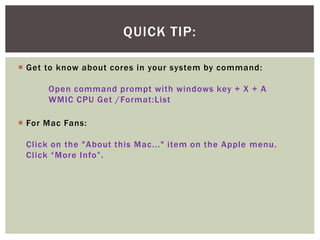
 Get to know about cores in your system by command:
Open command prompt with windows key + X + A
WMIC CPU Get /Format:List
 For Mac Fans:
Click on the "About this Mac..." item on the Apple menu.
Click “More Info”.
QUICK TIP:
 How does “CORE” work ?
LET’S KNOW THE CORE, PERSONALLY
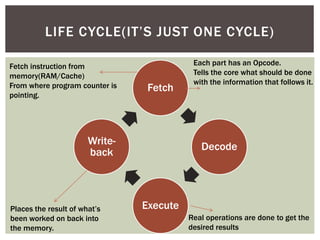
Fetch
Decode
Execute
Write-
back
LIFE CYCLE(IT’S JUST ONE CYCLE)
Fetch instruction from
memory(RAM/Cache)
From where program counter is
pointing.
Each part has an Opcode.
Tells the core what should be done
with the information that follows it.
Real operations are done to get the
desired results
Places the result of what’s
been worked on back into
the memory.
 How does “CORE” work ?
 So, Now we can are smart enough to understand:
More the number of cores,
more the computer’s speed.
Right ??
LET’S KNOW THE CORE, PERSONALLY
 How does “CORE” work ?
 So, Now we can are smart enough to understand:
More the number of cores,
more the computer’s speed.
Right ??
Yes, right. But not exactly. How?
LET’S KNOW THE CORE, PERSONALLY
 How does “CORE” work ?
 So, Now we can are smart enough to understand:
No, More number of cores does not necessarily
promises more speed of computer.
LET’S KNOW THE CORE, PERSONALLY
 How does “CORE” work ?
 So, Now we can are smart enough to understand:
No, More number of cores does not necessarily
promises more speed of computer.
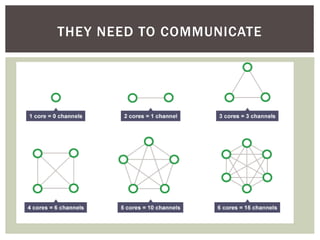
Because, CPU cores have to communicate with each
other through channels and this uses up some of the
extra speed.
How??
LET’S KNOW THE CORE, PERSONALLY
THEY NEED TO COMMUNICATE
 Why do we need multiple cores?
As CPU speeds rose into the 3-4 GHz range the amount of
electrical power required to go faster started to become
prohibitive. The technical reasons for this are complex but
factors like heat losses and leakage current (power that simply
passes through the circuitry without doing anything useful) both
increase faster as frequencies rise. While it's certainly possible
to build a 6 GHz general purpose x86 CPU, it's not proven
economical to do so efficiently. That's why the move to multi-
core started.
Also because, we want to play games!
THE (MULTI-CORES)
THE DIFFERENCE!
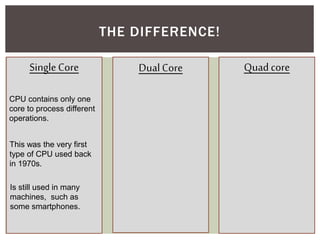
SingleCore DualCore Quad core
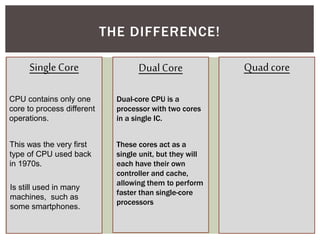
CPU contains only one
core to process different
operations.
This was the very first
type of CPU used back
in 1970s.
Is still used in many
machines, such as
some smartphones.
Is multi-tasking possible in single core processor ?
I HAVE A SIMPLE QUESTION.
Is multi-tasking possible in single core processor ?
I HAVE A SIMPLE QUESTION.
YES
 How multi-tasking is possible in single core if there is only
one core to perform operations??
I HAVE A SIMPLE QUESTION.
 How multi-tasking is possible in single core if there is only
one core to perform operations??
Pre-emptive Round Robin scheduling 
I HAVE A SIMPLE QUESTION.
THE DIFFERENCE!
SingleCore DualCore Quad core
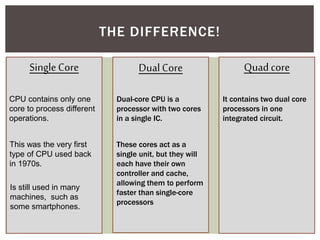
CPU contains only one
core to process different
operations.
This was the very first
type of CPU used back
in 1970s.
Is still used in many
machines, such as
some smartphones.
Dual-core CPU is a
processor with two cores
in a single IC.
These cores act as a
single unit, but they will
each have their own
controller and cache,
allowing them to perform
faster than single-core
processors
It contains two dual core
processors in one
integrated circuit.
THE DIFFERENCE!
SingleCore DualCore Quad core
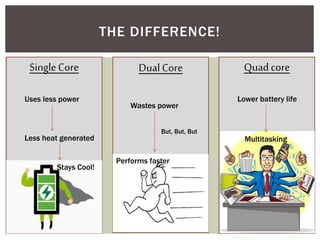
Uses less power
Less heat generated
Stays Cool!
Wastes power
Performs faster
But, But, But
Lower battery life
Multitasking
 I know what is single core. OK!
I know what is dual core. Great!
I can understand the concept of quad core. Awesome!
But, What does the term “core 2 duo” mean?
MAY I ASK A QUESTION?
 I know what is single core. OK!
I know what is dual core. Great!
I can understand the concept of quad core. Awesome!
But, What does the term “core 2 duo” mean?
Dual core processors are those that contains 2 cores in a single
silicon chip while Core 2 Duo is the name given by Intel to its
second batch of dual core processors.
MAY I ASK A QUESTION?
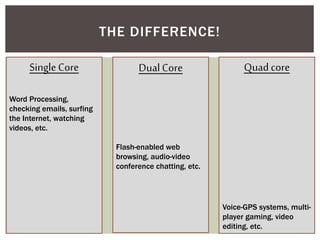
THE DIFFERENCE!
SingleCore DualCore Quad core
Word Processing,
checking emails, surfing
the Internet, watching
videos, etc.
Flash-enabled web
browsing, audio-video
conference chatting, etc.
Voice-GPS systems, multi-
player gaming, video
editing, etc.
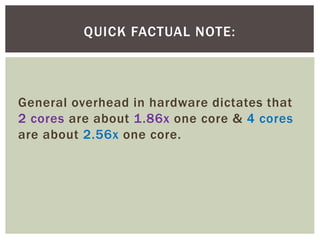
General overhead in hardware dictates that
2 cores are about 1.86x one core & 4 cores
are about 2.56x one core.
QUICK FACTUAL NOTE:
Google
Through which I could find many useful links.
RESOURCES:
ANY QUESTIONS THAT I KNOW ANSWER OF ?
Q A&