C Optimization
Techniques
Team Emertxe
Optimization ?
✔ Program optimization or software optimization is
the process of modifying a software system to make
some aspect of it work more efficiently or use fewer
resources.
✔ Optimization is a process of improving efficiency of
a program in time (speed) or Space (size).
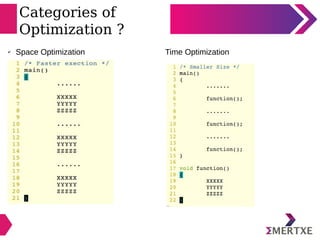
Categories of
Optimization ?
✔ Space Optimization Time Optimization
General
Phenomenon
Note : However this may not always true.
Code size speed
Bigger Greater
Smaller Lesser
Compiler
Code Optimization
✔ Compilers can be designed to provide code
optimization.
✔ Users should only focus on optimization not
provided by the compiler such as choosing a faster
and/or less memory intensive algorithm
Optimization:
Methods
✔ Choice of Compiler
✔ Compiler settings
✔ Programming Algorithm and Techniques
✔ Rewriting program in Assembly
✔ Code profilers
✔ Disassemble & code analysis
Programming
Algorithms & Techniques
✔ Data Handling
✔ Flow control
✔ Other Handling
Data Handling
✔ RAM Usage
✔ Data Types Usage
✔ Avoid Type Coversion
✔ Unsigned Advantage
✔ Float & Double
✔ Constant & Volatile
✔ Data Alignment – Arrangement & Packing
✔ Pass by Reference
RAM Usage
✔ Four main Component of program memory
Text
Data
Heap
Stack
✔ The reduction in one component will enable the increase in the
others.
✔ Unlike stack and heap, which are dynamic in nature, global data is
fixed in size.
Data Usage Types
The use of correct data type is important in a recursive calculation or
large array processing.
The extra size, which is not required, is taking up much space and
processing time.
Example:
If your variable range is varying in between 0 to 200 then you should take variable type
of unsigned char.
Avoid
Type Conversion
✔ Programmers should plan to use the same type of variables for
processing. Type conversion must be avoided.
✔ Otherwise, precious cycles will be waste to convert one type to
another (here Signed and Unsigned variables are considered as
different types.)
Usage: Signed &
Unsigned
In summary,
✔ use unsigned types for:
Division and remainders
Loop counters
Array indexing
✔ Use signed types for:
Integer-to-floating-point conversion
Floats & Doubles
✔ Maximum value of Float = 0x7F7F FFFF
✔ Maximum Value of Double = 0x7F7F FFFF FFFF FFFF
✔ To avoid the unnecessary type conversion or confusion,
programmers can assign the letter 'f' following the numeric value.
x = y + 0.2f;
Const & Volatile
✔ The “const” keyword is to define the data as a constant, which will
allocate it in the ROM space.
✔ Otherwise a RAM space will also be reserved for this data. This is
unnecessary as the constant data is supposed to be read-only.
Data Alignment :
Arrangment and Packing
✔ The declaration of the component in a structure will determine how
the components are being stored.
✔ Due to the Memory alignment, it is possible to have dummy area
within the structure. It is advised to place all similar size variables
in the same group.
Data Arrangment
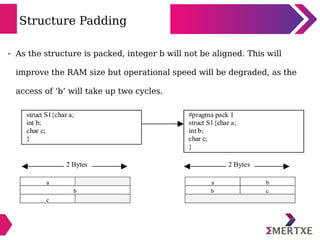
Structure Padding
✔ As the structure is packed, integer b will not be aligned. This will
improve the RAM size but operational speed will be degraded, as the
access of ‘b’ will take up two cycles.
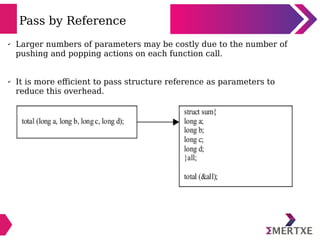
Pass by Reference
✔ Larger numbers of parameters may be costly due to the number of
pushing and popping actions on each function call.
✔ It is more efficient to pass structure reference as parameters to
reduce this overhead.
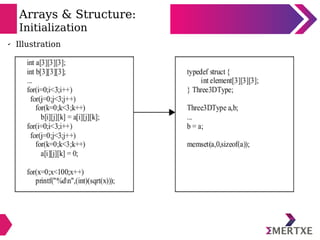
Arrays & Structure:
Initialization
✔ Illustration
Return Value
✔ The return value of a function will be stored in a register. If this
return data has no intended usage, time and space are wasted in
storing this information.
✔ Programmer should define the function as “void” to minimize the
extra handling in the function.
Flow Control
✔ Use of switch statement
✔ Inline function
✔ Loop unrolling
✔ Loop Hoisting
✔ Loop Overhead
Switch & Non-Contiguous
Case Expressions
✔ Use if-else statements in place of switch statements that have
noncontiguous case expressions.
✔ If the case expressions are contiguous or nearly contiguous integer
values, most compilers translate the switch statement as a jump table
instead of a comparison chain.
Inline Function
✔ The technique will cause the compiler to replace all calls to the
function, with a copy of the function’s code.
✔ This will eliminate the runtime overhead associated with the function
call.
✔ This is most effective if the function is called frequently, but contains
only a few lines of code.
✔ In-lining large functions will make the executable too large.
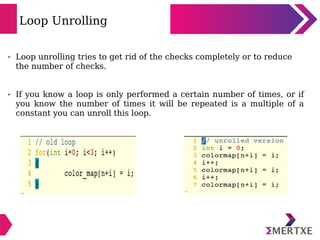
Loop Unrolling
✔ Loop unrolling tries to get rid of the checks completely or to reduce
the number of checks.
✔ If you know a loop is only performed a certain number of times, or if
you know the number of times it will be repeated is a multiple of a
constant you can unroll this loop.
Loop Hoisting
✔ Moving computations outside loops
✔ Saves computing time
Loop Overhead
✔ The MCU have a conditional branch mechanism that works well when
counting down from positive number to zero.
✔ It is easier to detect “Zero” (Branch non zero – single instruction) than
a “predefined number” (Compare and perform jump – two
instructions)
Other Handling
✔ Use of operators
✔ Use formula
✔ Inline Assembly
✔ Fixed point & Floating point
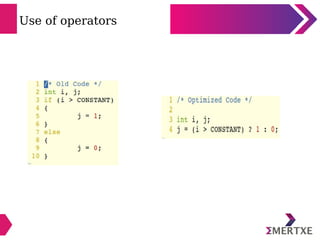
Use of operators
Replacing: Integer
Division With Multiplication
✔ Replace integer division with multiplication when there are multiple
divisions in an expression.
✔ This is possible only if no overflow will occur during the
computation of the product. The possibility of an overflow can be
determined by considering the possible ranges of the divisors.
✔ Integer division is the slowest of all integer arithmetic operations.
Example
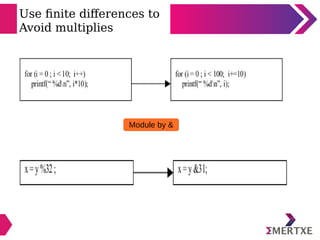
Use finite differences to
Avoid multiplies
Module by &
Extracting common
subexpressions
✔ Manually extract common subexpressions where C compilers may be
unable to extract them from floating-point expressions due to the
guarantee against reordering of such expressions in the ANSI
standard.
Manual Optimization
Example 1
Manual Optimization
Example 2
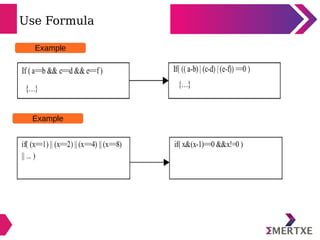
Use Formula
✔ Use formula instead of loops
✔ What is the formula for sum of naturals numbers?
Example
Use Formula
Example
Example
Inline Assembly
In case you want write code is best optimized assembly code,
__asm__ ("movl %eax, %ebxnt"
"movl $56, %esint"
"movl %ecx, $label(%edx,%ebx,$4)nt"
"movb %ah, (%ebx)");
THANK YOU

Embedded C - Optimization techniques

  • 1.
  • 2.
    Optimization ? ✔ Programoptimization or software optimization is the process of modifying a software system to make some aspect of it work more efficiently or use fewer resources. ✔ Optimization is a process of improving efficiency of a program in time (speed) or Space (size).
  • 3.
    Categories of Optimization ? ✔Space Optimization Time Optimization
  • 4.
    General Phenomenon Note : Howeverthis may not always true. Code size speed Bigger Greater Smaller Lesser
  • 5.
    Compiler Code Optimization ✔ Compilerscan be designed to provide code optimization. ✔ Users should only focus on optimization not provided by the compiler such as choosing a faster and/or less memory intensive algorithm
  • 6.
    Optimization: Methods ✔ Choice ofCompiler ✔ Compiler settings ✔ Programming Algorithm and Techniques ✔ Rewriting program in Assembly ✔ Code profilers ✔ Disassemble & code analysis
  • 7.
    Programming Algorithms & Techniques ✔Data Handling ✔ Flow control ✔ Other Handling
  • 8.
    Data Handling ✔ RAMUsage ✔ Data Types Usage ✔ Avoid Type Coversion ✔ Unsigned Advantage ✔ Float & Double ✔ Constant & Volatile ✔ Data Alignment – Arrangement & Packing ✔ Pass by Reference
  • 9.
    RAM Usage ✔ Fourmain Component of program memory Text Data Heap Stack ✔ The reduction in one component will enable the increase in the others. ✔ Unlike stack and heap, which are dynamic in nature, global data is fixed in size.
  • 10.
    Data Usage Types Theuse of correct data type is important in a recursive calculation or large array processing. The extra size, which is not required, is taking up much space and processing time. Example: If your variable range is varying in between 0 to 200 then you should take variable type of unsigned char.
  • 11.
    Avoid Type Conversion ✔ Programmersshould plan to use the same type of variables for processing. Type conversion must be avoided. ✔ Otherwise, precious cycles will be waste to convert one type to another (here Signed and Unsigned variables are considered as different types.)
  • 12.
    Usage: Signed & Unsigned Insummary, ✔ use unsigned types for: Division and remainders Loop counters Array indexing ✔ Use signed types for: Integer-to-floating-point conversion
  • 13.
    Floats & Doubles ✔Maximum value of Float = 0x7F7F FFFF ✔ Maximum Value of Double = 0x7F7F FFFF FFFF FFFF ✔ To avoid the unnecessary type conversion or confusion, programmers can assign the letter 'f' following the numeric value. x = y + 0.2f;
  • 14.
    Const & Volatile ✔The “const” keyword is to define the data as a constant, which will allocate it in the ROM space. ✔ Otherwise a RAM space will also be reserved for this data. This is unnecessary as the constant data is supposed to be read-only.
  • 15.
    Data Alignment : Arrangmentand Packing ✔ The declaration of the component in a structure will determine how the components are being stored. ✔ Due to the Memory alignment, it is possible to have dummy area within the structure. It is advised to place all similar size variables in the same group.
  • 16.
  • 17.
    Structure Padding ✔ Asthe structure is packed, integer b will not be aligned. This will improve the RAM size but operational speed will be degraded, as the access of ‘b’ will take up two cycles.
  • 18.
    Pass by Reference ✔Larger numbers of parameters may be costly due to the number of pushing and popping actions on each function call. ✔ It is more efficient to pass structure reference as parameters to reduce this overhead.
  • 19.
  • 20.
    Return Value ✔ Thereturn value of a function will be stored in a register. If this return data has no intended usage, time and space are wasted in storing this information. ✔ Programmer should define the function as “void” to minimize the extra handling in the function.
  • 21.
    Flow Control ✔ Useof switch statement ✔ Inline function ✔ Loop unrolling ✔ Loop Hoisting ✔ Loop Overhead
  • 22.
    Switch & Non-Contiguous CaseExpressions ✔ Use if-else statements in place of switch statements that have noncontiguous case expressions. ✔ If the case expressions are contiguous or nearly contiguous integer values, most compilers translate the switch statement as a jump table instead of a comparison chain.
  • 23.
    Inline Function ✔ Thetechnique will cause the compiler to replace all calls to the function, with a copy of the function’s code. ✔ This will eliminate the runtime overhead associated with the function call. ✔ This is most effective if the function is called frequently, but contains only a few lines of code. ✔ In-lining large functions will make the executable too large.
  • 24.
    Loop Unrolling ✔ Loopunrolling tries to get rid of the checks completely or to reduce the number of checks. ✔ If you know a loop is only performed a certain number of times, or if you know the number of times it will be repeated is a multiple of a constant you can unroll this loop.
  • 25.
    Loop Hoisting ✔ Movingcomputations outside loops ✔ Saves computing time
  • 26.
    Loop Overhead ✔ TheMCU have a conditional branch mechanism that works well when counting down from positive number to zero. ✔ It is easier to detect “Zero” (Branch non zero – single instruction) than a “predefined number” (Compare and perform jump – two instructions)
  • 27.
    Other Handling ✔ Useof operators ✔ Use formula ✔ Inline Assembly ✔ Fixed point & Floating point
  • 28.
  • 29.
    Replacing: Integer Division WithMultiplication ✔ Replace integer division with multiplication when there are multiple divisions in an expression. ✔ This is possible only if no overflow will occur during the computation of the product. The possibility of an overflow can be determined by considering the possible ranges of the divisors. ✔ Integer division is the slowest of all integer arithmetic operations. Example
  • 30.
    Use finite differencesto Avoid multiplies Module by &
  • 31.
    Extracting common subexpressions ✔ Manuallyextract common subexpressions where C compilers may be unable to extract them from floating-point expressions due to the guarantee against reordering of such expressions in the ANSI standard.
  • 32.
  • 33.
  • 34.
    Use Formula ✔ Useformula instead of loops ✔ What is the formula for sum of naturals numbers? Example
  • 35.
  • 36.
    Inline Assembly In caseyou want write code is best optimized assembly code, __asm__ ("movl %eax, %ebxnt" "movl $56, %esint" "movl %ecx, $label(%edx,%ebx,$4)nt" "movb %ah, (%ebx)");
  • 37.