PRESENTED BY,
M. JUNO ISABEL SUSINTHRA
 Medium Access Control (MAC) protocols is the first
protocol layer above the Physical Layer (PHY) .
 The fundamental task of any MAC protocol is to regulate
the access of a number of nodes to a shared medium in
such a way that certain application-dependent performance
requirements are satisfied.
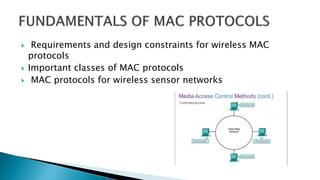
 Requirements and design constraints for wireless MAC
protocols
 Important classes of MAC protocols
 MAC protocols for wireless sensor networks
 The most important performance requirements for MAC
protocols are throughput efficiency, stability, fairness, low
access delay, and low transmission delay, as well as a low
overhead.
 Overhead of MAC protocols:
Per packet overhead
Collision-Multiple sender wants to talk.
Collisions can happen if the MAC
protocol allows two or more nodes to send packets at the same
time.
 Hidden-terminal problem
The hidden-terminal problem occurs specifically for
the class of Carrier Sense Multiple Access (CSMA) protocols,
where a node senses the medium before starting to transmit a
packet.
 Exposed-terminal scenario
In wireless networks, when a node is prevented
from sending packets to other nodes because of a neighbouring
transmitter is known as the exposed node problem.
The exposed terminal analogy is described as follows:
 B sends to A, C wants to send to another terminal D not A or B
 C senses the carrier and detects that the carrier is busy.
 C postpones its transmission until it detects the medium as
being idle again
 But A is outside radio range of C, waiting is not necessary
 C is “exposed” to B
Tip: Hidden terminals cause collisions, where as Exposed
terminals causes unnecessary delay.
 A huge number of (wireless) MAC protocols have been devised
during the last thirty years. They can be roughly classified into
the following classes.
 fixed assignment protocols
 Demand assignment protocols
 Random access protocols.
 fixed assignment protocols
-In fixed-assignment schemes, each
communicating node is assigned a frequency band in FDMA
systems or a time slot in TDMA systems.
 Demand assignment protocols
-Demand Assigned Multiple Access (DAMA) is
a protocol used in satellite communications, particularly Very
Small Aperture Terminal (VSAT) systems.
 Random access protocols
- In random access or contention methods,
no station is superior to another station and none is assigned
the control over another.
-Transmission is random among the
stations.
-That is why these methods are
called random access.
 Balance of requirements
 Energy problems on the MAC layer
 Balance of requirements
-The balance of requirements is different
from traditional (wireless) networks. Additional requirements
come up, first and foremost, the need to conserve energy.
Important requirements for MAC protocols
-scalability
-The need for scalability is evident
when considering very dense sensor networks with dozens or
hundreds of nodes in mutual range.
 Energy problems on the MAC layer
 Collisions -Multiple sender wants to talk.
 Overhearing-The wireless medium is a broadcast medium
and all the source’s neighbours that are in receive state
hear a packet and drop it when it is not destined to them;
these nodes overhear the packet.
 Protocol overhead -RTS and CTS packets or request
packets in demand assignment protocols, and furthermore
by per-packet overhead like packet headers and trailers.
 Idle listening –active listening to an redundant channel.
A node being in idle state is ready to receive a packet but
is not currently receiving anything.
THANK YOU

Mac protocols

  • 1.
    PRESENTED BY, M. JUNOISABEL SUSINTHRA
  • 2.
     Medium AccessControl (MAC) protocols is the first protocol layer above the Physical Layer (PHY) .  The fundamental task of any MAC protocol is to regulate the access of a number of nodes to a shared medium in such a way that certain application-dependent performance requirements are satisfied.
  • 3.
     Requirements anddesign constraints for wireless MAC protocols  Important classes of MAC protocols  MAC protocols for wireless sensor networks
  • 4.
     The mostimportant performance requirements for MAC protocols are throughput efficiency, stability, fairness, low access delay, and low transmission delay, as well as a low overhead.  Overhead of MAC protocols: Per packet overhead Collision-Multiple sender wants to talk. Collisions can happen if the MAC protocol allows two or more nodes to send packets at the same time.
  • 5.
     Hidden-terminal problem Thehidden-terminal problem occurs specifically for the class of Carrier Sense Multiple Access (CSMA) protocols, where a node senses the medium before starting to transmit a packet.  Exposed-terminal scenario In wireless networks, when a node is prevented from sending packets to other nodes because of a neighbouring transmitter is known as the exposed node problem.
  • 7.
    The exposed terminalanalogy is described as follows:  B sends to A, C wants to send to another terminal D not A or B  C senses the carrier and detects that the carrier is busy.  C postpones its transmission until it detects the medium as being idle again  But A is outside radio range of C, waiting is not necessary  C is “exposed” to B Tip: Hidden terminals cause collisions, where as Exposed terminals causes unnecessary delay.
  • 8.
     A hugenumber of (wireless) MAC protocols have been devised during the last thirty years. They can be roughly classified into the following classes.  fixed assignment protocols  Demand assignment protocols  Random access protocols.
  • 9.
     fixed assignmentprotocols -In fixed-assignment schemes, each communicating node is assigned a frequency band in FDMA systems or a time slot in TDMA systems.  Demand assignment protocols -Demand Assigned Multiple Access (DAMA) is a protocol used in satellite communications, particularly Very Small Aperture Terminal (VSAT) systems.
  • 10.
     Random accessprotocols - In random access or contention methods, no station is superior to another station and none is assigned the control over another. -Transmission is random among the stations. -That is why these methods are called random access.
  • 11.
     Balance ofrequirements  Energy problems on the MAC layer
  • 12.
     Balance ofrequirements -The balance of requirements is different from traditional (wireless) networks. Additional requirements come up, first and foremost, the need to conserve energy. Important requirements for MAC protocols -scalability -The need for scalability is evident when considering very dense sensor networks with dozens or hundreds of nodes in mutual range.
  • 13.
     Energy problemson the MAC layer  Collisions -Multiple sender wants to talk.  Overhearing-The wireless medium is a broadcast medium and all the source’s neighbours that are in receive state hear a packet and drop it when it is not destined to them; these nodes overhear the packet.  Protocol overhead -RTS and CTS packets or request packets in demand assignment protocols, and furthermore by per-packet overhead like packet headers and trailers.  Idle listening –active listening to an redundant channel. A node being in idle state is ready to receive a packet but is not currently receiving anything.
  • 14.