Introduction
Components
Working
Applications
Conclusion
CONTENTS:
INTRODUCTION
 A wearable gestural interface that augments
the physical world around us with digital
information
 Developed by Pranav Mistry.
 It Bridges the gap by bringing intangible,
digital information out into the tangible
world, via natural hand
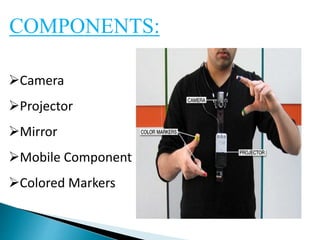
COMPONENTS:
Camera
Projector
Mirror
Mobile Component
Colored Markers
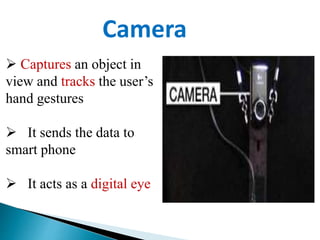
 Captures an object in
view and tracks the user’s
hand gestures
 It sends the data to
smart phone
 It acts as a digital eye
Camera
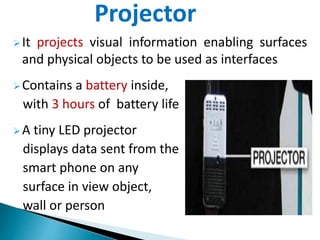
It projects visual information enabling surfaces
and physical objects to be used as interfaces
Contains a battery inside,
with 3 hours of battery life
A tiny LED projector
displays data sent from the
smart phone on any
surface in view object,
wall or person
Projector
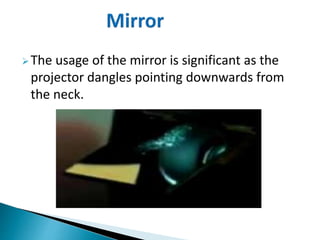
The usage of the mirror is significant as the
projector dangles pointing downwards from
the neck.
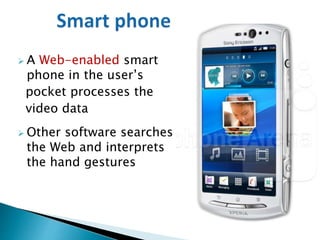
 A Web-enabled smart
phone in the user’s
pocket processes the
video data
 Other software searches
the Web and interprets
the hand gestures
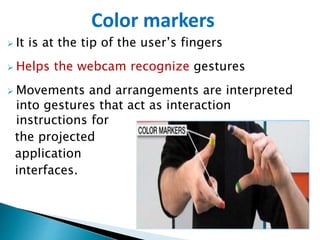
 It is at the tip of the user’s fingers
 Helps the webcam recognize gestures
 Movements and arrangements are interpreted
into gestures that act as interaction
instructions for
the projected
application
interfaces.
Color markers
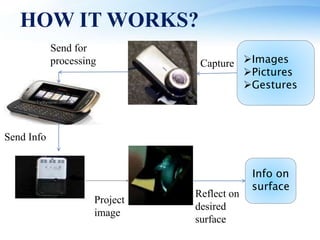
HOW IT WORKS?
Images
Pictures
Gestures
Info on
surface
Capture
Send for
processing
Reflect on
desired
surface
Project
image
Send Info
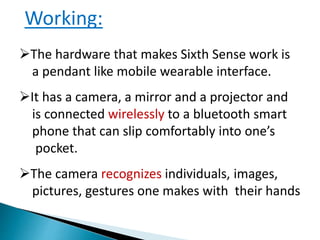
Working:
The hardware that makes Sixth Sense work is
a pendant like mobile wearable interface.
It has a camera, a mirror and a projector and
is connected wirelessly to a bluetooth smart
phone that can slip comfortably into one’s
pocket.
The camera recognizes individuals, images,
pictures, gestures one makes with their hands
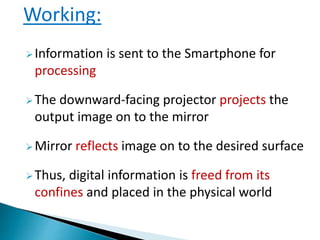
Information is sent to the Smartphone for
processing
The downward-facing projector projects the
output image on to the mirror
Mirror reflects image on to the desired surface
Thus, digital information is freed from its
confines and placed in the physical world
Working:
 Augmented reality is a term for a live direct or
indirect view of a physical real world
environment whose elements are augmented by
virtual computer generated imagery.
 Gesture recognition is a topic in computer
science and language technology with the goal
of interpreting human gestures via
mathematical algorithms.
 Computer vision concerned with the theory
behind artificial systems that extract
information from images.
 Radio Frequency Identification is basically an
electronic tagging technology that allows the
detection, tracking of tags and consequently
the objects that they are affixed to.
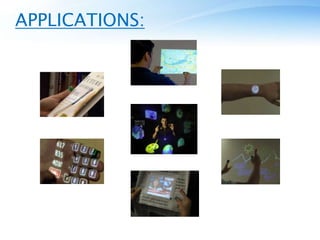
APPLICATIONS:
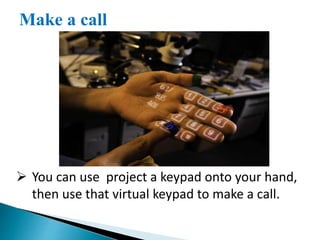
 You can use project a keypad onto your hand,
then use that virtual keypad to make a call.
Make a call
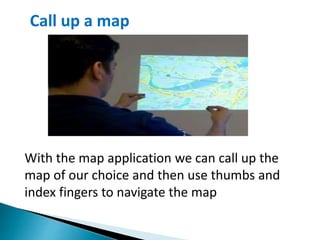
Call up a map
With the map application we can call up the
map of our choice and then use thumbs and
index fingers to navigate the map
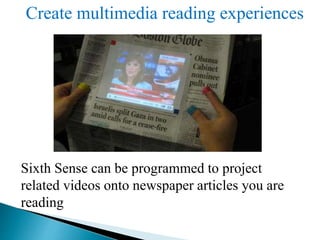
Create multimedia reading experiences
Sixth Sense can be programmed to project
related videos onto newspaper articles you are
reading
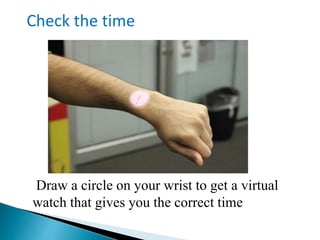
Draw a circle on your wrist to get a virtual
watch that gives you the correct time
Check the time
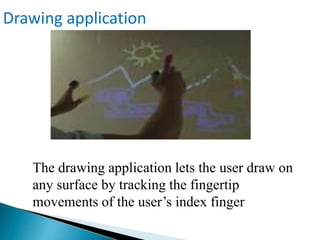
The drawing application lets the user draw on
any surface by tracking the fingertip
movements of the user’s index finger
Drawing application
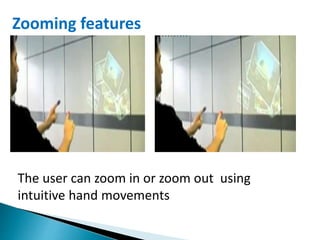
The user can zoom in or zoom out using
intuitive hand movements
Zooming features
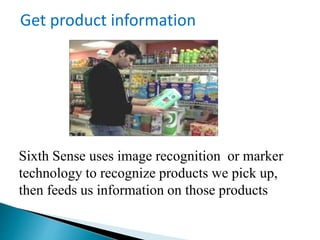
Sixth Sense uses image recognition or marker
technology to recognize products we pick up,
then feeds us information on those products
Get product information
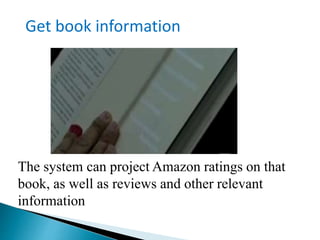
The system can project Amazon ratings on that
book, as well as reviews and other relevant
information
Get book information
The system will recognize your boarding pass
and let you know whether your flight is on
time and if the gate has changed.
Get flight updates
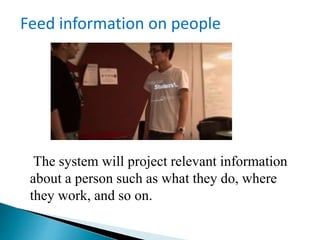
The system will project relevant information
about a person such as what they do, where
they work, and so on.
Feed information on people
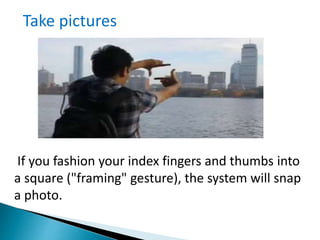
If you fashion your index fingers and thumbs into
a square ("framing" gesture), the system will snap
a photo.
Take pictures
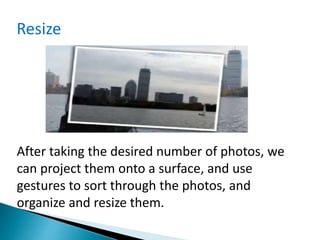
After taking the desired number of photos, we
can project them onto a surface, and use
gestures to sort through the photos, and
organize and resize them.
Resize
ADVANTAGES:
 Portable
 Supports multi touch and multi user interaction
 Connectedness between world and information
 Cost effective
 Data access directly from machine is real time
 Mind maps the idea anywhere
 It is an open source
CONCLUSION:
It recognizes the objects around us, displaying
information automatically and letting us to access it
in any way we need
Allowing us to interact with this information via
natural hand gestures
The potential of becoming the ultimate
"transparent" user interface for accessing information
about everything around us
THANK YOU

The Sixth Sense

  • 2.
  • 3.
    INTRODUCTION  A wearablegestural interface that augments the physical world around us with digital information  Developed by Pranav Mistry.  It Bridges the gap by bringing intangible, digital information out into the tangible world, via natural hand
  • 5.
  • 6.
     Captures anobject in view and tracks the user’s hand gestures  It sends the data to smart phone  It acts as a digital eye Camera
  • 7.
    It projects visualinformation enabling surfaces and physical objects to be used as interfaces Contains a battery inside, with 3 hours of battery life A tiny LED projector displays data sent from the smart phone on any surface in view object, wall or person Projector
  • 8.
    The usage ofthe mirror is significant as the projector dangles pointing downwards from the neck.
  • 9.
     A Web-enabledsmart phone in the user’s pocket processes the video data  Other software searches the Web and interprets the hand gestures
  • 10.
     It isat the tip of the user’s fingers  Helps the webcam recognize gestures  Movements and arrangements are interpreted into gestures that act as interaction instructions for the projected application interfaces. Color markers
  • 11.
    HOW IT WORKS? Images Pictures Gestures Infoon surface Capture Send for processing Reflect on desired surface Project image Send Info
  • 12.
    Working: The hardware thatmakes Sixth Sense work is a pendant like mobile wearable interface. It has a camera, a mirror and a projector and is connected wirelessly to a bluetooth smart phone that can slip comfortably into one’s pocket. The camera recognizes individuals, images, pictures, gestures one makes with their hands
  • 13.
    Information is sentto the Smartphone for processing The downward-facing projector projects the output image on to the mirror Mirror reflects image on to the desired surface Thus, digital information is freed from its confines and placed in the physical world Working:
  • 14.
     Augmented realityis a term for a live direct or indirect view of a physical real world environment whose elements are augmented by virtual computer generated imagery.  Gesture recognition is a topic in computer science and language technology with the goal of interpreting human gestures via mathematical algorithms.
  • 15.
     Computer visionconcerned with the theory behind artificial systems that extract information from images.  Radio Frequency Identification is basically an electronic tagging technology that allows the detection, tracking of tags and consequently the objects that they are affixed to.
  • 16.
  • 17.
     You canuse project a keypad onto your hand, then use that virtual keypad to make a call. Make a call
  • 18.
    Call up amap With the map application we can call up the map of our choice and then use thumbs and index fingers to navigate the map
  • 19.
    Create multimedia readingexperiences Sixth Sense can be programmed to project related videos onto newspaper articles you are reading
  • 20.
    Draw a circleon your wrist to get a virtual watch that gives you the correct time Check the time
  • 21.
    The drawing applicationlets the user draw on any surface by tracking the fingertip movements of the user’s index finger Drawing application
  • 22.
    The user canzoom in or zoom out using intuitive hand movements Zooming features
  • 23.
    Sixth Sense usesimage recognition or marker technology to recognize products we pick up, then feeds us information on those products Get product information
  • 24.
    The system canproject Amazon ratings on that book, as well as reviews and other relevant information Get book information
  • 25.
    The system willrecognize your boarding pass and let you know whether your flight is on time and if the gate has changed. Get flight updates
  • 26.
    The system willproject relevant information about a person such as what they do, where they work, and so on. Feed information on people
  • 27.
    If you fashionyour index fingers and thumbs into a square ("framing" gesture), the system will snap a photo. Take pictures
  • 28.
    After taking thedesired number of photos, we can project them onto a surface, and use gestures to sort through the photos, and organize and resize them. Resize
  • 29.
    ADVANTAGES:  Portable  Supportsmulti touch and multi user interaction  Connectedness between world and information  Cost effective  Data access directly from machine is real time  Mind maps the idea anywhere  It is an open source
  • 30.
    CONCLUSION: It recognizes theobjects around us, displaying information automatically and letting us to access it in any way we need Allowing us to interact with this information via natural hand gestures The potential of becoming the ultimate "transparent" user interface for accessing information about everything around us
  • 31.