Multi-Core Processor
Prepared by
Dr.S.Raja Ratna
1
2
Multicore Processor
• A multi-core processor is an integrated circuit with two or more
processors connected to it for faster simultaneous processing of
several tasks, reduced power consumption, and for greater
performance.
• It is made up of two or more processors that read and execute
program instructions.
• On a single chip, a multi-core processor comprises numerous
processing units, or "Cores," each of which has the potential to do
distinct tasks.
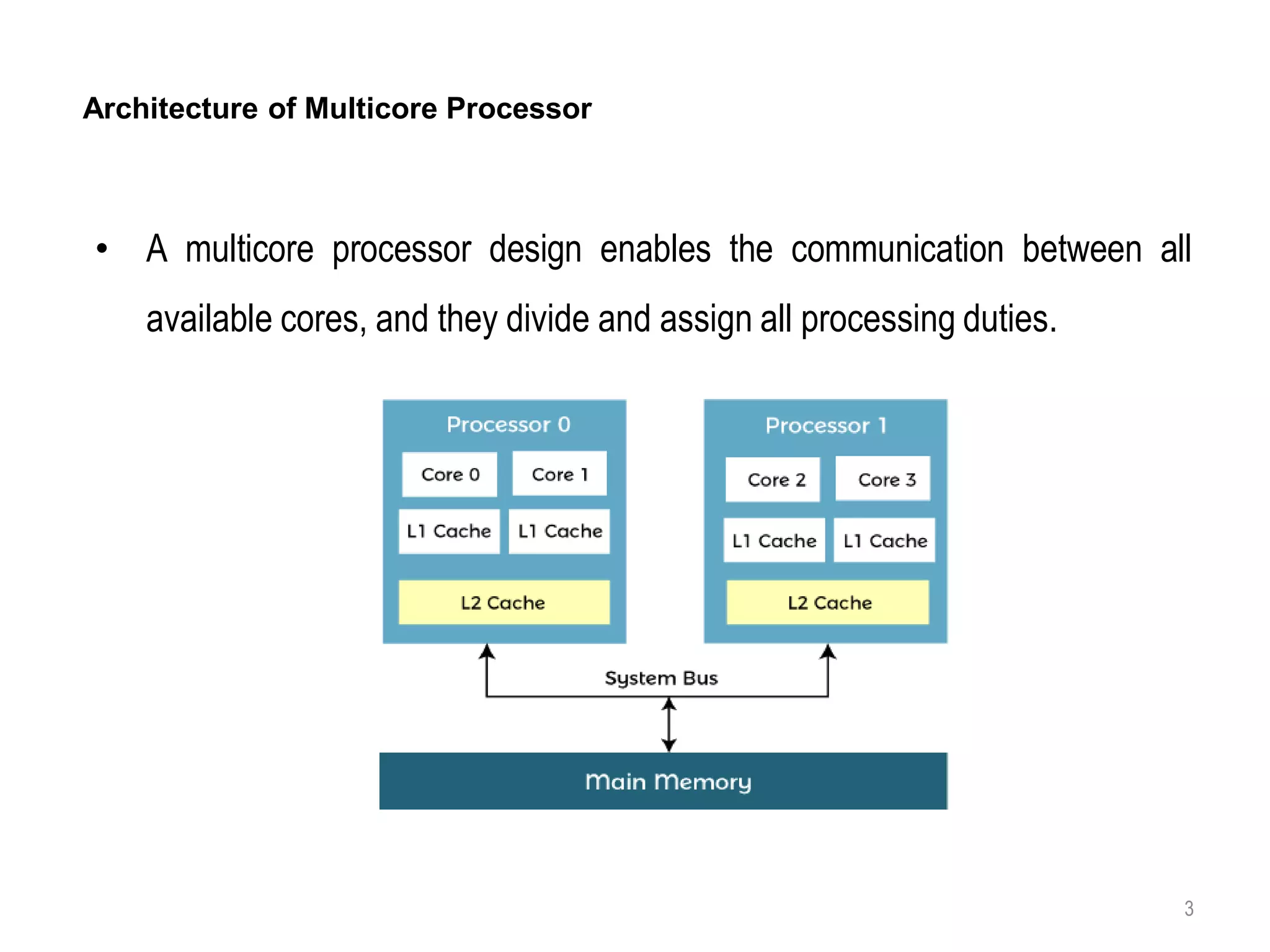
Architecture of Multicore Processor
• A multicore processor design enables the communication between all
available cores, and they divide and assign all processing duties.
3
Advantages of Multi-Core Processor
• Performance
• Reliability
• Software Interactions
• Multitasking
• Power Consumption
• Obsolescence Avoidance
• Isolation
• When compared to single-core processors, a multicore processor has
the potential of doing more tasks.
• Low energy consumption when doing many activities at once.
• Data takes less time to reach its destination since both cores are
integrated on a single chip.
• With the use of a small circuit, the speed can be increased.
4
Multi-Core Processor
• For instance, if you are performing many tasks at once, such as
watching a movie and using WhatsApp, one core will handle activities
like watching a movie while the other handles other responsibilities like
WhatsApp.
• The processed data from each core is transmitted back to the
computer's main board (Motherboard) via a single common gateway
once all of the processing operations have been finished. This method
beats a single-core CPU in terms of total performance.
• These processors also enable more efficient simultaneous processing
of multiple tasks, such as with parallel processing and Multithreading.
5
6
Multi core Processor
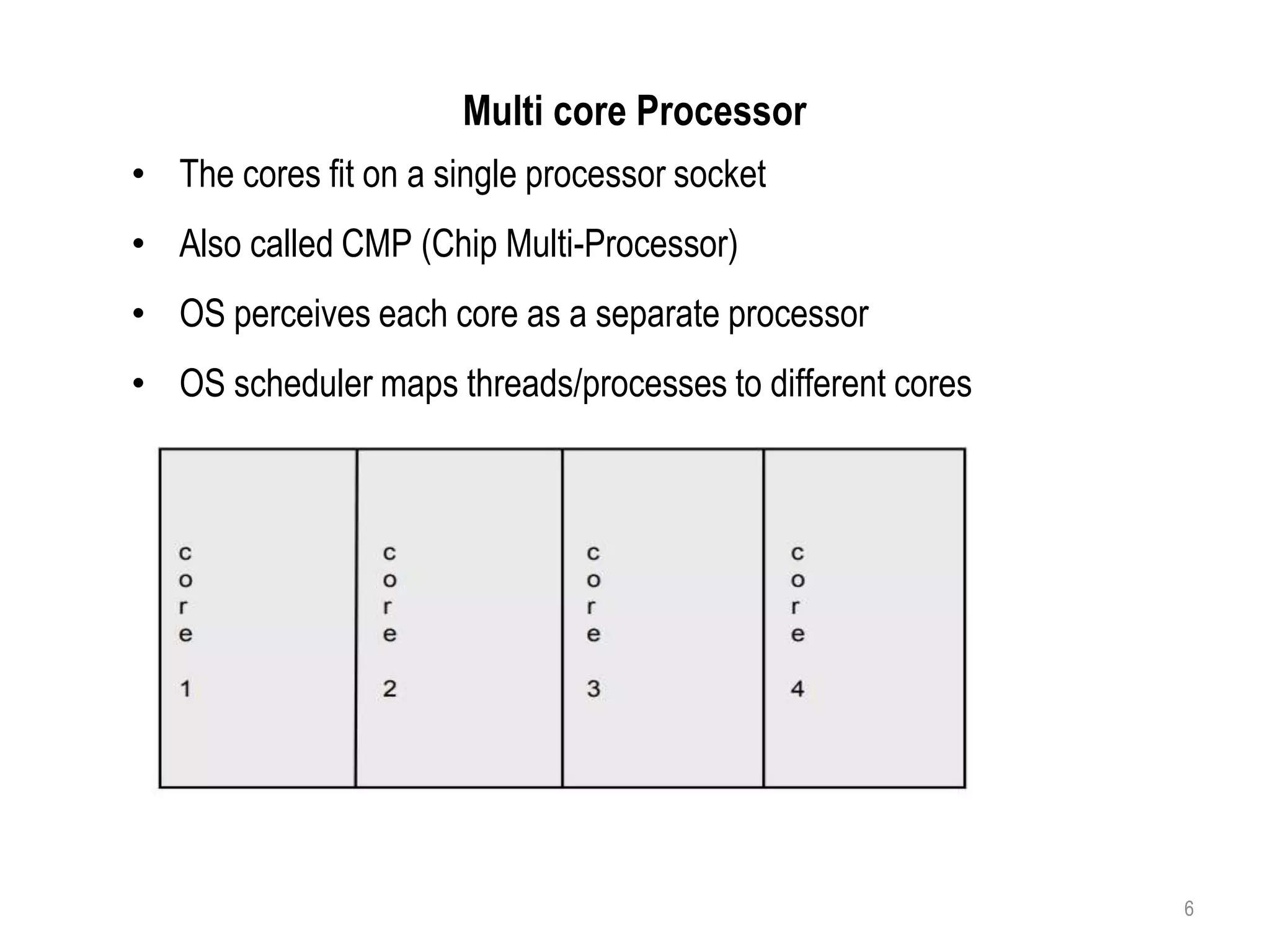
• The cores fit on a single processor socket
• Also called CMP (Chip Multi-Processor)
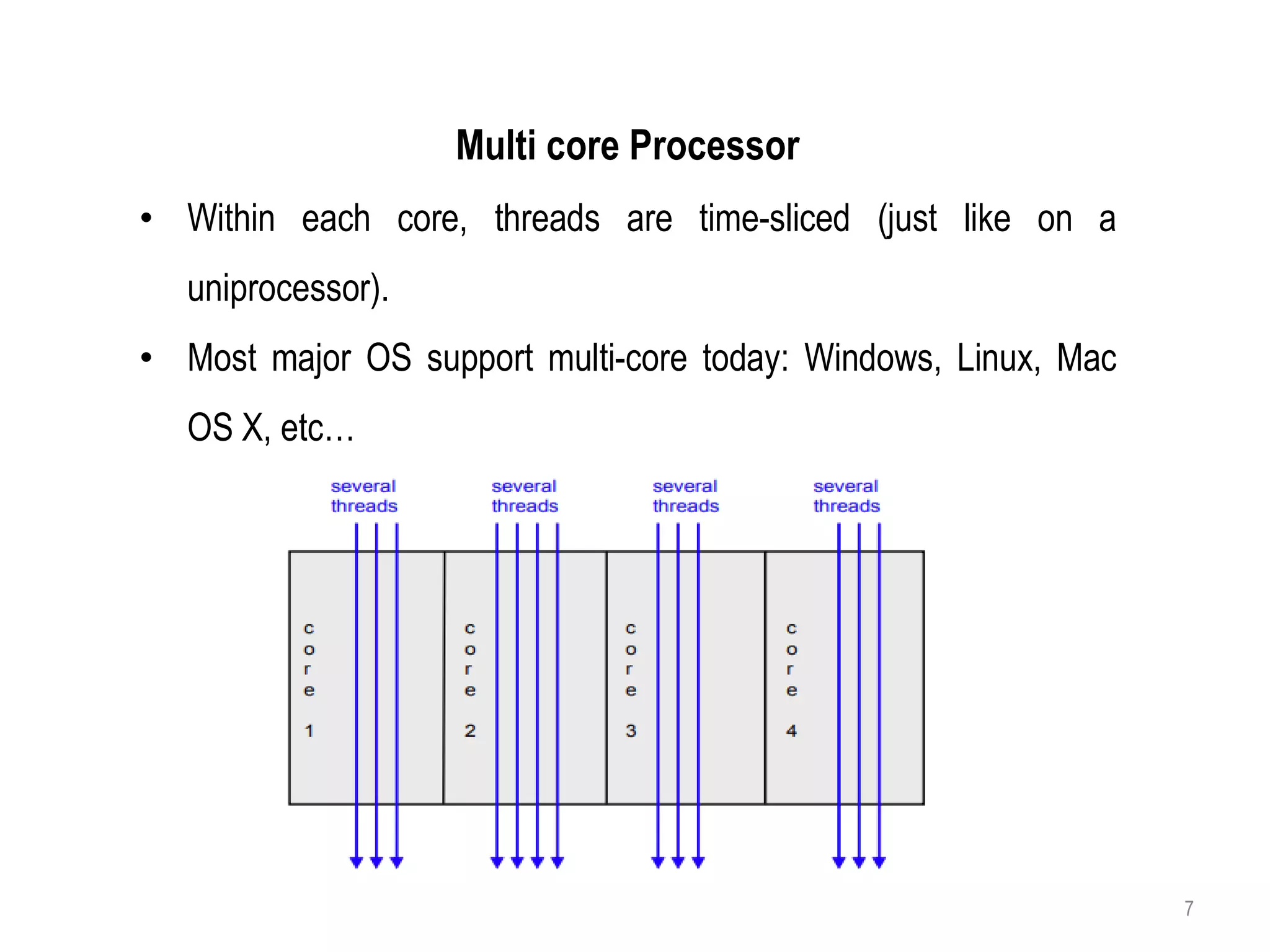
• OS perceives each core as a separate processor
• OS scheduler maps threads/processes to different cores
Multi core Processor
• Within each core, threads are time-sliced (just like on a
uniprocessor).
• Most major OS support multi-core today: Windows, Linux, Mac
OS X, etc…
7
Instruction-level parallelism
• Parallelism at the machine-instruction level
• The processor can re-order, pipeline instructions, split them into
microinstructions, do aggressive branch prediction, etc.
• Instruction-level parallelism enabled rapid increases in processor
speeds over the last 15 years.
8
Thread-level parallelism (TLP)
• This is parallelism on a more coarser scale.
• Server can serve each client in a separate thread (Web server,
database server)
• A computer game can do AI, graphics, and physics in three
separate threads
• Single-core superscalar processors cannot fully exploit TLP
• Multi-core architectures are the next step in processor evolution:
explicitly exploiting TLP
9

Multicore processor.pdf

  • 1.
  • 2.
    2 Multicore Processor • Amulti-core processor is an integrated circuit with two or more processors connected to it for faster simultaneous processing of several tasks, reduced power consumption, and for greater performance. • It is made up of two or more processors that read and execute program instructions. • On a single chip, a multi-core processor comprises numerous processing units, or "Cores," each of which has the potential to do distinct tasks.
  • 3.
    Architecture of MulticoreProcessor • A multicore processor design enables the communication between all available cores, and they divide and assign all processing duties. 3
  • 4.
    Advantages of Multi-CoreProcessor • Performance • Reliability • Software Interactions • Multitasking • Power Consumption • Obsolescence Avoidance • Isolation • When compared to single-core processors, a multicore processor has the potential of doing more tasks. • Low energy consumption when doing many activities at once. • Data takes less time to reach its destination since both cores are integrated on a single chip. • With the use of a small circuit, the speed can be increased. 4
  • 5.
    Multi-Core Processor • Forinstance, if you are performing many tasks at once, such as watching a movie and using WhatsApp, one core will handle activities like watching a movie while the other handles other responsibilities like WhatsApp. • The processed data from each core is transmitted back to the computer's main board (Motherboard) via a single common gateway once all of the processing operations have been finished. This method beats a single-core CPU in terms of total performance. • These processors also enable more efficient simultaneous processing of multiple tasks, such as with parallel processing and Multithreading. 5
  • 6.
    6 Multi core Processor •The cores fit on a single processor socket • Also called CMP (Chip Multi-Processor) • OS perceives each core as a separate processor • OS scheduler maps threads/processes to different cores
  • 7.
    Multi core Processor •Within each core, threads are time-sliced (just like on a uniprocessor). • Most major OS support multi-core today: Windows, Linux, Mac OS X, etc… 7
  • 8.
    Instruction-level parallelism • Parallelismat the machine-instruction level • The processor can re-order, pipeline instructions, split them into microinstructions, do aggressive branch prediction, etc. • Instruction-level parallelism enabled rapid increases in processor speeds over the last 15 years. 8
  • 9.
    Thread-level parallelism (TLP) •This is parallelism on a more coarser scale. • Server can serve each client in a separate thread (Web server, database server) • A computer game can do AI, graphics, and physics in three separate threads • Single-core superscalar processors cannot fully exploit TLP • Multi-core architectures are the next step in processor evolution: explicitly exploiting TLP 9