Multicore Processors
Presented by:
Ummiya Mohammedi
2
Core:
In computing a core refers to a single
processor.
 Today's processors are almost all at
least dual-core, meaning that the entire
processor itself contains two separate
cores with which it can process
information.
History
• In the early 1970’s the first Microprocessor
was developed by Intel.
• It was a 4 bit machine that was named the
4004
• The 4004 was followed by Intel’s 8008 and
8080, as well as motorola’s 6800 and
68000
Growth
With each new generation of processors
there were several developments such as:
• Smaller size
• Faster
• Increased heat dissipation
• Greater Consumption of power
Single Core Performance
On technique used to increase single core performance
was:
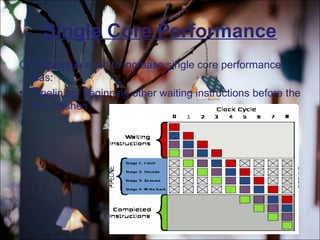
• Pipelining: beginning other waiting instructions before the
first finishes
Single Core continued
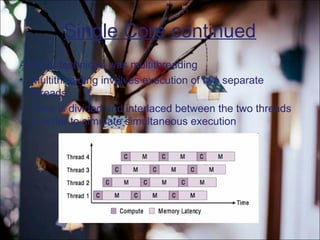
Another technique was multithreading
• Multithreading involves execution of two separate
threads.
• Time is divided and interlaced between the two threads
in order to simulate simultaneous execution
Problems with Single Core
To execute the tasks faster you must
increase the clock time.
Increasing clock times too high drastically
increases power consumption and heat
dissipation to extremely high levels,
making the processor inefficient.
Multi Core solution
Creating two cores or more on the same Die
increases processing power while keeping clock
speeds at an efficient level.
A processor with 2 cores running at efficient clock
speeds can process instructions with similar
speed to a single core processor running at
twice the clock speed, yet the dual core
processor would still consume less energy.
Multi-Core Advantages
• While working with many threads, a Multi Core processor
with n cores can execute n threads simultaneously by
assigning a core to each thread. If it must process more
than n threads , say x, it can apply multithreading
procedures with each core working with an average of
x/n threads.
• A Single core processor must multithread with every
single thread.
Implementations
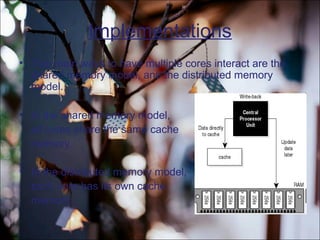
• Two main ways to have multiple cores interact are the
shared memory model, and the distributed memory
model.
• In the shared memory model,
all cores share the same cache
memory.
• In the distributed memory model,
each core has its own cache
memory.
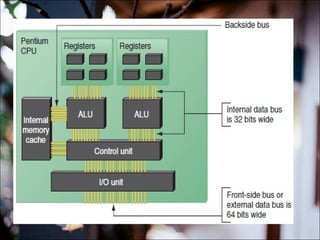
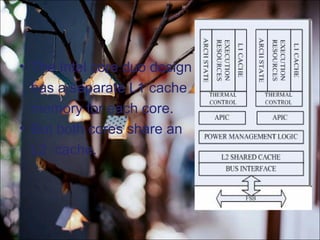
• The Intel core duo design
has a separate L1 cache
memory for each core.
• But both cores share an
L2 cache.
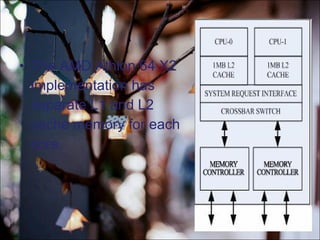
• The AMD Athlon 64 X2
implementation has
separate L1 and L2
cache memory for each
core.
Problems
Some of the current problems found with
multi core processors include:
• Memory/Cache coherence. As mentioned
earlier, some implementations have
distributed L1 caches but must share an
L2 cache. This poses the problem of
making sure each core keeps the other
updated with changes in the data in its
own cache.
 Multi threading is also a problem when the
software being run is not designed to take
advantage of the multi core processor.
 This may mean that one core does most
of the work which means that the
processor is running no more efficiently
than a single core.
Future of Multi Core
• Current debates argue over whether future
multi core processors should be
homogenous or heterogenous.
• That is, should all the cores be the same
or should there be a mix of different
types?
• Having all cores be the same makes
production easier and keeps its complexity
to a minimum.
• Having different cores that are specialized
in specific tasks increases complexity but
has the potential to be much more efficient
in speed and power consumption.
Thank You!!

Multi core processors

  • 1.
  • 2.
    2 Core: In computing acore refers to a single processor.  Today's processors are almost all at least dual-core, meaning that the entire processor itself contains two separate cores with which it can process information.
  • 3.
    History • In theearly 1970’s the first Microprocessor was developed by Intel. • It was a 4 bit machine that was named the 4004 • The 4004 was followed by Intel’s 8008 and 8080, as well as motorola’s 6800 and 68000
  • 5.
    Growth With each newgeneration of processors there were several developments such as: • Smaller size • Faster • Increased heat dissipation • Greater Consumption of power
  • 6.
    Single Core Performance Ontechnique used to increase single core performance was: • Pipelining: beginning other waiting instructions before the first finishes
  • 7.
    Single Core continued Anothertechnique was multithreading • Multithreading involves execution of two separate threads. • Time is divided and interlaced between the two threads in order to simulate simultaneous execution
  • 8.
    Problems with SingleCore To execute the tasks faster you must increase the clock time. Increasing clock times too high drastically increases power consumption and heat dissipation to extremely high levels, making the processor inefficient.
  • 9.
    Multi Core solution Creatingtwo cores or more on the same Die increases processing power while keeping clock speeds at an efficient level. A processor with 2 cores running at efficient clock speeds can process instructions with similar speed to a single core processor running at twice the clock speed, yet the dual core processor would still consume less energy.
  • 10.
    Multi-Core Advantages • Whileworking with many threads, a Multi Core processor with n cores can execute n threads simultaneously by assigning a core to each thread. If it must process more than n threads , say x, it can apply multithreading procedures with each core working with an average of x/n threads. • A Single core processor must multithread with every single thread.
  • 11.
    Implementations • Two mainways to have multiple cores interact are the shared memory model, and the distributed memory model. • In the shared memory model, all cores share the same cache memory. • In the distributed memory model, each core has its own cache memory.
  • 12.
    • The Intelcore duo design has a separate L1 cache memory for each core. • But both cores share an L2 cache.
  • 13.
    • The AMDAthlon 64 X2 implementation has separate L1 and L2 cache memory for each core.
  • 14.
    Problems Some of thecurrent problems found with multi core processors include: • Memory/Cache coherence. As mentioned earlier, some implementations have distributed L1 caches but must share an L2 cache. This poses the problem of making sure each core keeps the other updated with changes in the data in its own cache.
  • 15.
     Multi threadingis also a problem when the software being run is not designed to take advantage of the multi core processor.  This may mean that one core does most of the work which means that the processor is running no more efficiently than a single core.
  • 16.
    Future of MultiCore • Current debates argue over whether future multi core processors should be homogenous or heterogenous. • That is, should all the cores be the same or should there be a mix of different types?
  • 17.
    • Having allcores be the same makes production easier and keeps its complexity to a minimum. • Having different cores that are specialized in specific tasks increases complexity but has the potential to be much more efficient in speed and power consumption.
  • 18.