Department: Information Technology
Computer Organization
Multiprocessor
Presented By:
Neelkumar J Patel
5/8/2017
Contents
• Introduction
• Why Choose a Multiprocessor?
• How multiprocessor are classified?
• Interconnection structures
• References
5/8/2017
Introduction
• Multiprocessor system is an interconnection of two or
more CPUs with memory and input-output equipment
• The components that forms multiprocessor are
CPUs IOPs connected to input –output devices ,
and memory unit that may be partitioned into a
number of separate modules.
• Multiprocessor are classified as multiple
instruction stream, multiple data stream (MIMD)
system.
5/8/2017
Why Choose a Multiprocessor?
• A single CPU can only go so fast, use more than
one CPU to improve performance
• Multiple users
• Multiple applications
• Multi-tasking within an application
• Responsiveness and/or throughput
• Share hardware between CPUs
5/8/2017
What you the difference between
Multiprocessor and Multicomputer?
Multiprocessor
• A multiprocessor system is simply a
computer that has more than one
CPU on its motherboard.
• Multiprocessing is the use of two or
more central processing units
(CPUs) within a single computer
system.
Multicomputer
• A computer made up of several
computers. The term generally refers
to an architecture in which each
processor has its own memory rather
than multiple processors with a
shared memory
5/8/2017
How multiprocessor are classified?
• Multiprocessor are classified by the way their
memory is organized, mainly it is classified
into two types
1. Tightly coupled multiprocessor
2. Loosely coupled multiprocessor
5/8/2017
Tightly coupled Multiprocessor
• A multiprocessor is a tightly coupled
computer system having two or more
processing units (Multiple Processors) each
sharing main memory and peripherals, in
order to simultaneously process programs
• Tightly coupled Multiprocessor is also know as
shared memory system
5/8/2017
Loosely-coupled multiprocessor
• Loosely-coupled multiprocessor systems
(often referred to as clusters ) are based on
multiple standalone single or dual processor
commodity computers interconnected via a
high speed communication system.
• Loosely-coupled multiprocessor is also known
as distributed memory.
• Example
A Linux beowulf cluster
5/8/2017
Difference b/w Tightly coupled and
Loosely coupled multiprocessor
Tightly coupled
• Tightly-coupled systems
physically smaller than
loosely-coupled system.
• More expensive .
Loosely coupled
• It is just opposite of tightly
coupled system.
• Less expensive.
5/8/2017
Interconnection Structures
• The physical forms for establishing an
interconnection network .
1. Time shared common bus.
2. Multiport memory.
3. Crossbar switch
4. Multistage switching network.
5. Hypercube system.
5/8/2017
1. Time –shared common bus.
• A system common bus multiprocessor system
consists of a number of processors connected
through path to a memory unit.
5/8/2017
Memory Unit
CPU 1 IOP 1CPU 3CPU 2 IOP 2
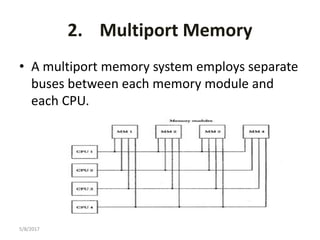
2. Multiport Memory
• A multiport memory system employs separate
buses between each memory module and
each CPU.
5/8/2017
3. Cross bar switch
5/8/2017
4. Multistage switching Network
• The basic component of a multistage network
is a two- input , two- output interchange
switch.
5/8/2017
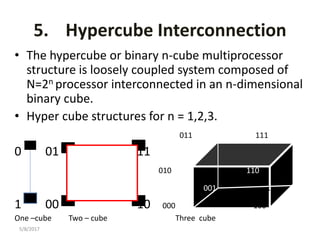
5. Hypercube Interconnection
• The hypercube or binary n-cube multiprocessor
structure is loosely coupled system composed of
N=2n processor interconnected in an n-dimensional
binary cube.
• Hyper cube structures for n = 1,2,3.
011 111
0 01 11
010 110
001 101
1 00 10 000 100
One –cube Two – cube Three cube
5/8/2017
References
• M.Morris Mano Computer System
Architecture , Third Edition , Pearson
Education.
• Aakriti Sharma, Advance Computer
Architecture in simple steps.
5/8/2017
Thank you….
5/8/2017

Multiprocessor

  • 1.
    Department: Information Technology ComputerOrganization Multiprocessor Presented By: Neelkumar J Patel 5/8/2017
  • 2.
    Contents • Introduction • WhyChoose a Multiprocessor? • How multiprocessor are classified? • Interconnection structures • References 5/8/2017
  • 3.
    Introduction • Multiprocessor systemis an interconnection of two or more CPUs with memory and input-output equipment • The components that forms multiprocessor are CPUs IOPs connected to input –output devices , and memory unit that may be partitioned into a number of separate modules. • Multiprocessor are classified as multiple instruction stream, multiple data stream (MIMD) system. 5/8/2017
  • 4.
    Why Choose aMultiprocessor? • A single CPU can only go so fast, use more than one CPU to improve performance • Multiple users • Multiple applications • Multi-tasking within an application • Responsiveness and/or throughput • Share hardware between CPUs 5/8/2017
  • 5.
    What you thedifference between Multiprocessor and Multicomputer? Multiprocessor • A multiprocessor system is simply a computer that has more than one CPU on its motherboard. • Multiprocessing is the use of two or more central processing units (CPUs) within a single computer system. Multicomputer • A computer made up of several computers. The term generally refers to an architecture in which each processor has its own memory rather than multiple processors with a shared memory 5/8/2017
  • 6.
    How multiprocessor areclassified? • Multiprocessor are classified by the way their memory is organized, mainly it is classified into two types 1. Tightly coupled multiprocessor 2. Loosely coupled multiprocessor 5/8/2017
  • 7.
    Tightly coupled Multiprocessor •A multiprocessor is a tightly coupled computer system having two or more processing units (Multiple Processors) each sharing main memory and peripherals, in order to simultaneously process programs • Tightly coupled Multiprocessor is also know as shared memory system 5/8/2017
  • 8.
    Loosely-coupled multiprocessor • Loosely-coupledmultiprocessor systems (often referred to as clusters ) are based on multiple standalone single or dual processor commodity computers interconnected via a high speed communication system. • Loosely-coupled multiprocessor is also known as distributed memory. • Example A Linux beowulf cluster 5/8/2017
  • 9.
    Difference b/w Tightlycoupled and Loosely coupled multiprocessor Tightly coupled • Tightly-coupled systems physically smaller than loosely-coupled system. • More expensive . Loosely coupled • It is just opposite of tightly coupled system. • Less expensive. 5/8/2017
  • 10.
    Interconnection Structures • Thephysical forms for establishing an interconnection network . 1. Time shared common bus. 2. Multiport memory. 3. Crossbar switch 4. Multistage switching network. 5. Hypercube system. 5/8/2017
  • 11.
    1. Time –sharedcommon bus. • A system common bus multiprocessor system consists of a number of processors connected through path to a memory unit. 5/8/2017 Memory Unit CPU 1 IOP 1CPU 3CPU 2 IOP 2
  • 12.
    2. Multiport Memory •A multiport memory system employs separate buses between each memory module and each CPU. 5/8/2017
  • 13.
    3. Cross barswitch 5/8/2017
  • 14.
    4. Multistage switchingNetwork • The basic component of a multistage network is a two- input , two- output interchange switch. 5/8/2017
  • 15.
    5. Hypercube Interconnection •The hypercube or binary n-cube multiprocessor structure is loosely coupled system composed of N=2n processor interconnected in an n-dimensional binary cube. • Hyper cube structures for n = 1,2,3. 011 111 0 01 11 010 110 001 101 1 00 10 000 100 One –cube Two – cube Three cube 5/8/2017
  • 16.
    References • M.Morris ManoComputer System Architecture , Third Edition , Pearson Education. • Aakriti Sharma, Advance Computer Architecture in simple steps. 5/8/2017
  • 17.