Linux Kernel Architecture
Contents What is Kernel ? Kernel Architecture Overview User Space Kernel Space Kernel Functional Overview File System Process Management Device Driver Memory Management Networking
What is Kernel ? The Core of OS a kernel is really nothing more than a resource manager the kernel manages and arbitrates access to the resource between multiple competing users
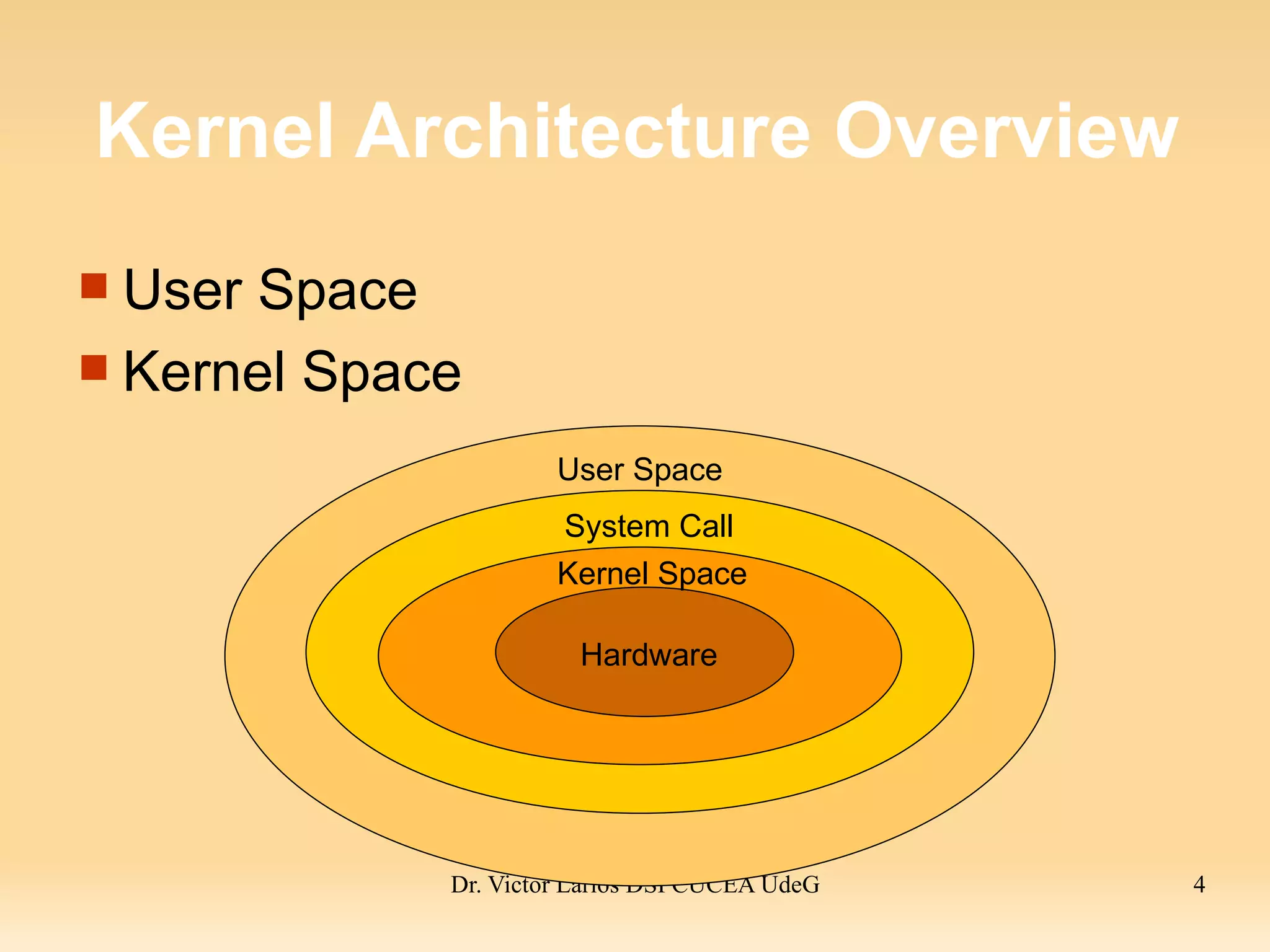
Kernel Architecture Overview User Space Kernel Space User Space System Call Hardware Kernel Space
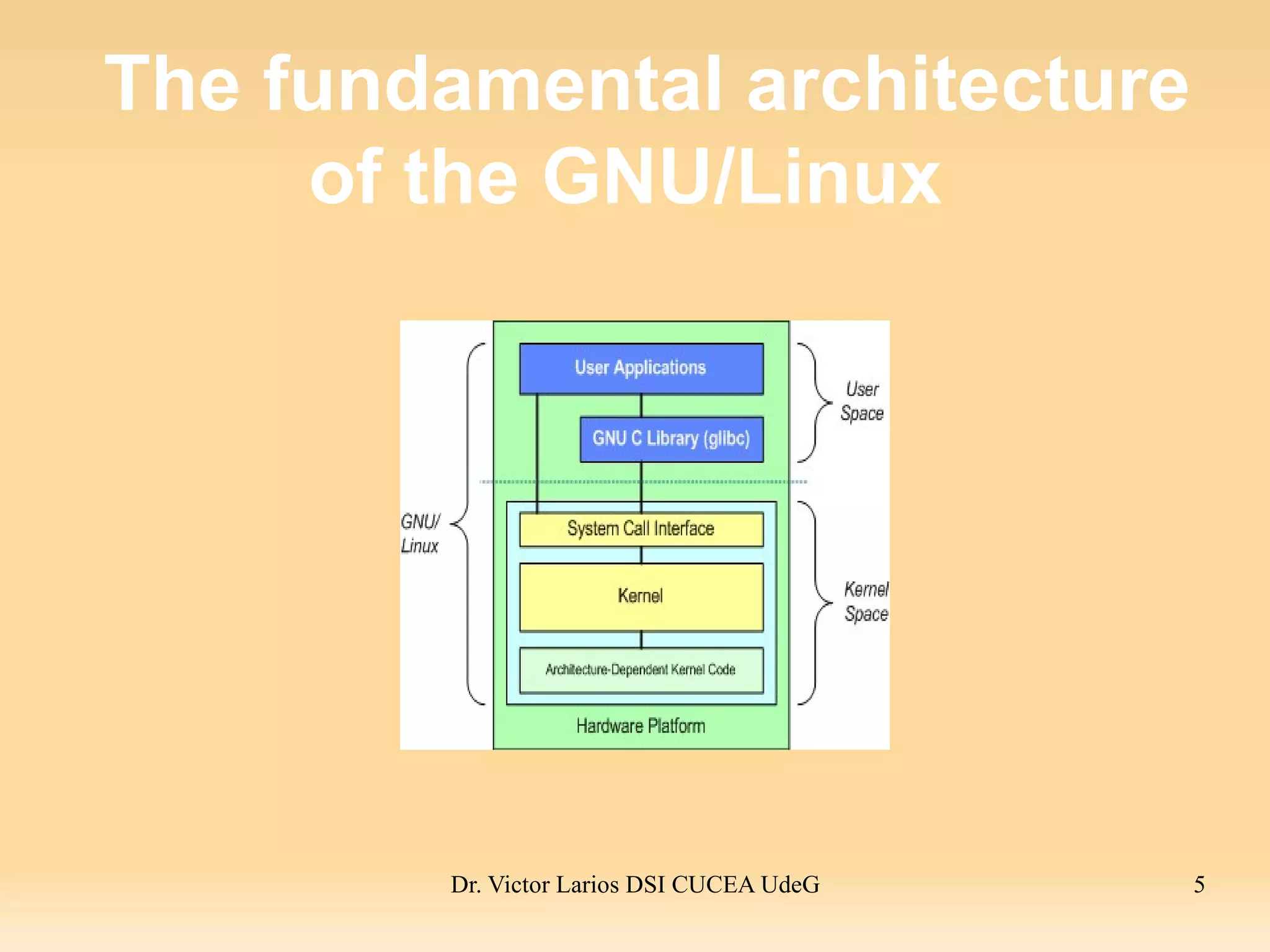
The fundamental architecture of the GNU/Linux
The User Space is the space in memory where user applications are executed. The kernel Space is the space in memory where kernel processes run. The user has access to it only through the system call.
Linux kernal is a monolithic kernal It includes all the necessary functions
Kernel Functional Overview File System Process Management Device Driver Memory Management Networking
Kernel Functional Overview
Functional Layer & Architectural Layer User Space System Call Hardware MM PM Net DM FS
File System It is responsible for storing information on disk and retrieving and updating this information. accessed through  system calls  eg. FAT16, FAT32, NTFS,ext2, ext3…
Type of Files The Unix system has the following types of files: Ordinary Files Directory Files Special Files (devices)‏ FIFO Files for Pipes
Virtual File System It manages all the different file system. The virtual file system is designed to present a consistent view of data as stored on hardware devices.
Process Management Kernel creates, manages and deletes the processes. Kernal helps to increase the performance of OS, by executing the process in pre emptive manner.
Process Management  (Cont.)‏ Each process has a unique identifier ( Process ID ). System calls used for process management-”fork”,”exec”,”kill”,”exit”,”signal”
States Running   Waiting Stopped Zombie
Device Driver Linux kernel contains the code to manage the HW controller . Character devices, Block devices,Network devices are different types of devices
Memory Management Physical memory is limited. Virtual memory  is developed to overcome this limitation.
Linux network layers The network subsystem allows Linux systems to connect to other systems over a network.  The network subsystem abstracts  implementation details of network devices and protocols

KERNAL ARCHITECTURE

  • 1.
  • 2.
    Contents What isKernel ? Kernel Architecture Overview User Space Kernel Space Kernel Functional Overview File System Process Management Device Driver Memory Management Networking
  • 3.
    What is Kernel? The Core of OS a kernel is really nothing more than a resource manager the kernel manages and arbitrates access to the resource between multiple competing users
  • 4.
    Kernel Architecture OverviewUser Space Kernel Space User Space System Call Hardware Kernel Space
  • 5.
  • 6.
    The User Spaceis the space in memory where user applications are executed. The kernel Space is the space in memory where kernel processes run. The user has access to it only through the system call.
  • 7.
    Linux kernal isa monolithic kernal It includes all the necessary functions
  • 8.
    Kernel Functional OverviewFile System Process Management Device Driver Memory Management Networking
  • 9.
  • 10.
    Functional Layer &Architectural Layer User Space System Call Hardware MM PM Net DM FS
  • 11.
    File System Itis responsible for storing information on disk and retrieving and updating this information. accessed through system calls eg. FAT16, FAT32, NTFS,ext2, ext3…
  • 12.
    Type of FilesThe Unix system has the following types of files: Ordinary Files Directory Files Special Files (devices)‏ FIFO Files for Pipes
  • 13.
    Virtual File SystemIt manages all the different file system. The virtual file system is designed to present a consistent view of data as stored on hardware devices.
  • 14.
    Process Management Kernelcreates, manages and deletes the processes. Kernal helps to increase the performance of OS, by executing the process in pre emptive manner.
  • 15.
    Process Management (Cont.)‏ Each process has a unique identifier ( Process ID ). System calls used for process management-”fork”,”exec”,”kill”,”exit”,”signal”
  • 16.
    States Running Waiting Stopped Zombie
  • 17.
    Device Driver Linuxkernel contains the code to manage the HW controller . Character devices, Block devices,Network devices are different types of devices
  • 18.
    Memory Management Physicalmemory is limited. Virtual memory is developed to overcome this limitation.
  • 19.
    Linux network layersThe network subsystem allows Linux systems to connect to other systems over a network. The network subsystem abstracts implementation details of network devices and protocols