Submitted to: Submitted by:
Er.Deepesh Namdev Name: Manisha Meena
HOD cum Asso. Prof. Roll no.:10EGKEC038
(E&C, EE Department)
DEPARTMENT OF ELECTRONICS & COMMUNICATION ENGG.
Gurukul Institute of Engineering & Technology, Kota
 Introduction
 Multi core
 Multi core architecture
 Comparison of Different Architectures
 Performance analysis
 Advantages & Disadvantages
 Application
CONTENTS
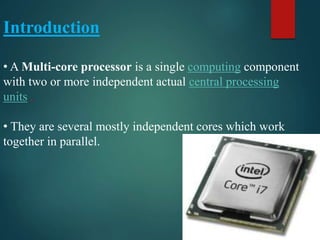
• A Multi-core processor is a single computing component
with two or more independent actual central processing
units .
• They are several mostly independent cores which work
together in parallel.
Introduction
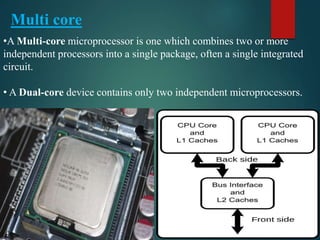
•A Multi-core microprocessor is one which combines two or more
independent processors into a single package, often a single integrated
circuit.
• A Dual-core device contains only two independent microprocessors.
Multi core
Types of Cores
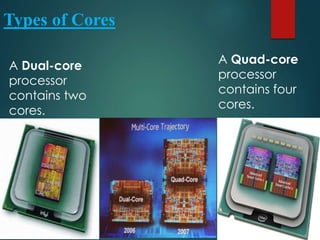
A Dual-core
processor
contains two
cores.
A Quad-core
processor
contains four
cores.
Multi core architecture
Comparison of Different Architectures
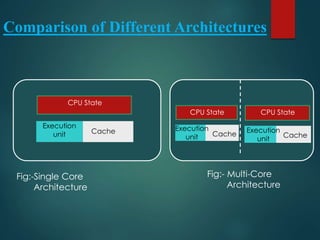
CPU State
Cache
Execution
unit
Fig:-Single Core
Architecture
CPU State
Cache
Execution
unit
Fig:- Multi-Core
Architecture
CPU State
Cache
Execution
unit
CPU State
CacheExecution
unit
CPU State
Cache
Execution
unit
Comparison of Different Architectures
Fig:-Multiprocessor
Comparison of Different Architectures
CPU State
Execution
unit
fig:- Multi-Core Architecture with Shared Cache
CPU State
Cache
Execution
unit
Performance Analysis
• Multi-tasking productivity.
• It will work faster for certain programs.
• PC security.
• The signals between different CPUs travel shorter
distances.
Advantages
•They get only 60-80% more speed.
•The speed that the computer works at depends on what the
user is doing with it.
•They cost more than single core processors.
•They are more difficult to manage thermally than lower-
density single-core processors.
Disadvantages
Applications
• Video editing.
• Encoding .
• 3D gaming.
• Powerful graphics solution.
THANK YOU

Multicore Processsors

  • 1.
    Submitted to: Submittedby: Er.Deepesh Namdev Name: Manisha Meena HOD cum Asso. Prof. Roll no.:10EGKEC038 (E&C, EE Department) DEPARTMENT OF ELECTRONICS & COMMUNICATION ENGG. Gurukul Institute of Engineering & Technology, Kota
  • 2.
     Introduction  Multicore  Multi core architecture  Comparison of Different Architectures  Performance analysis  Advantages & Disadvantages  Application CONTENTS
  • 3.
    • A Multi-coreprocessor is a single computing component with two or more independent actual central processing units . • They are several mostly independent cores which work together in parallel. Introduction
  • 4.
    •A Multi-core microprocessoris one which combines two or more independent processors into a single package, often a single integrated circuit. • A Dual-core device contains only two independent microprocessors. Multi core
  • 5.
    Types of Cores ADual-core processor contains two cores. A Quad-core processor contains four cores.
  • 6.
  • 7.
    Comparison of DifferentArchitectures CPU State Cache Execution unit Fig:-Single Core Architecture CPU State Cache Execution unit Fig:- Multi-Core Architecture CPU State Cache Execution unit
  • 8.
  • 9.
    Comparison of DifferentArchitectures CPU State Execution unit fig:- Multi-Core Architecture with Shared Cache CPU State Cache Execution unit
  • 10.
  • 11.
    • Multi-tasking productivity. •It will work faster for certain programs. • PC security. • The signals between different CPUs travel shorter distances. Advantages
  • 12.
    •They get only60-80% more speed. •The speed that the computer works at depends on what the user is doing with it. •They cost more than single core processors. •They are more difficult to manage thermally than lower- density single-core processors. Disadvantages
  • 13.
    Applications • Video editing. •Encoding . • 3D gaming. • Powerful graphics solution.
  • 14.