Overview
 Introduction to motors
 Comparing AC & DC motors
 Servo mechanism & motors
 Stepper motors
 Motors used in CNC’s
 Selection of motors for CNC’s
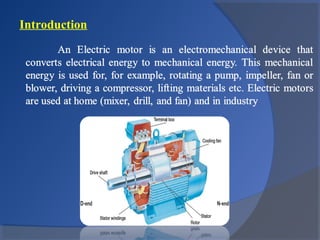
Introduction
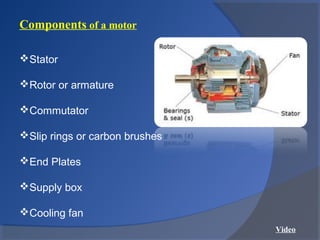
Components of a motor
Stator
Rotor or armature
Commutator
Slip rings or carbon brushes
End Plates
Supply box
Cooling fan
Video
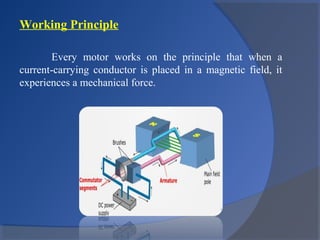
Working Principle
Every motor works on the principle that when a
current-carrying conductor is placed in a magnetic field, it
experiences a mechanical force.
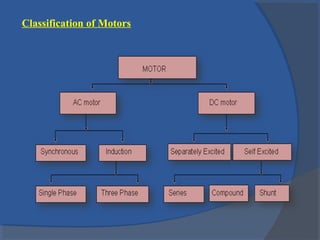
Classification of Motors
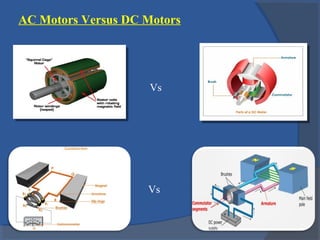
AC Motors Versus DC Motors
Vs
Vs
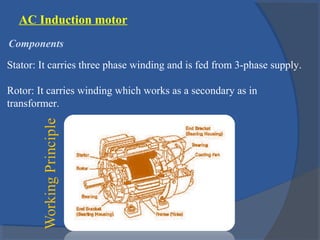
AC Induction motor
Components
Stator: It carries three phase winding and is fed from 3-phase supply.
Rotor: It carries winding which works as a secondary as in
transformer.
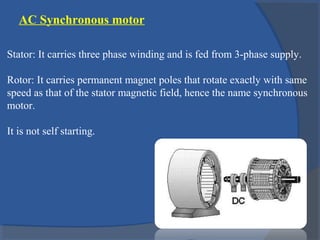
AC Synchronous motor
Stator: It carries three phase winding and is fed from 3-phase supply.
Rotor: It carries permanent magnet poles that rotate exactly with same
speed as that of the stator magnetic field, hence the name synchronous
motor.
It is not self starting.
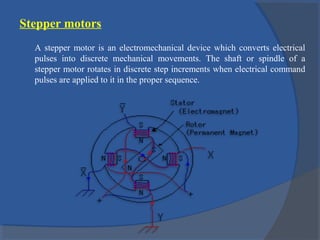
Stepper motors
A stepper motor is an electromechanical device which converts electrical
pulses into discrete mechanical movements. The shaft or spindle of a
stepper motor rotates in discrete step increments when electrical command
pulses are applied to it in the proper sequence.
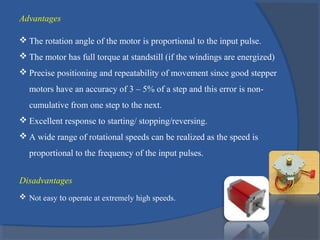
Advantages
 The rotation angle of the motor is proportional to the input pulse.
 The motor has full torque at standstill (if the windings are energized)
 Precise positioning and repeatability of movement since good stepper
motors have an accuracy of 3 – 5% of a step and this error is non-
cumulative from one step to the next.
 Excellent response to starting/ stopping/reversing.
 A wide range of rotational speeds can be realized as the speed is
proportional to the frequency of the input pulses.
Disadvantages
 Not easy to operate at extremely high speeds.
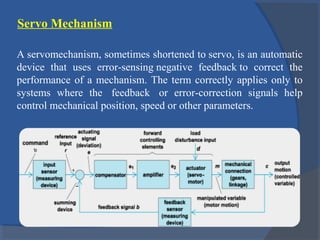
Servo Mechanism
A servomechanism, sometimes shortened to servo, is an automatic
device that uses error-sensing negative feedback to correct the
performance of a mechanism. The term correctly applies only to
systems where the feedback or error-correction signals help
control mechanical position, speed or other parameters.
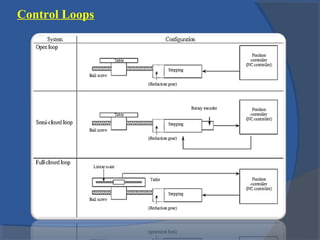
Control Loops
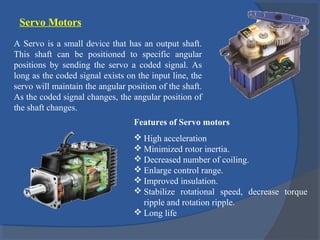
Servo Motors
A Servo is a small device that has an output shaft.
This shaft can be positioned to specific angular
positions by sending the servo a coded signal. As
long as the coded signal exists on the input line, the
servo will maintain the angular position of the shaft.
As the coded signal changes, the angular position of
the shaft changes.
Features of Servo motors
 High acceleration
 Minimized rotor inertia.
 Decreased number of coiling.
 Enlarge control range.
 Improved insulation.
 Stabilize rotational speed, decrease torque
ripple and rotation ripple.
 Long life
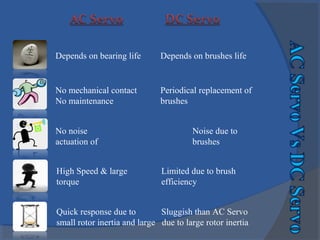
Depends on bearing life Depends on brushes life
No mechanical contact Periodical replacement of
No maintenance brushes
No noise Noise due to
actuation of brushes
High Speed & large Limited due to brush
torque efficiency
Quick response due to Sluggish than AC Servo
small rotor inertia and large due to large rotor inertia
Motors used in CNC machines
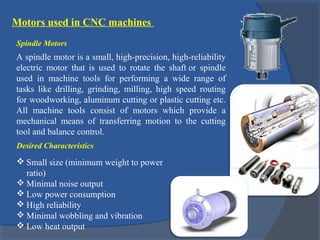
Spindle Motors
A spindle motor is a small, high-precision, high-reliability
electric motor that is used to rotate the shaft or spindle
used in machine tools for performing a wide range of
tasks like drilling, grinding, milling, high speed routing
for woodworking, aluminum cutting or plastic cutting etc.
All machine tools consist of motors which provide a
mechanical means of transferring motion to the cutting
tool and balance control.
 Small size (minimum weight to power
ratio)
 Minimal noise output
 Low power consumption
 High reliability
 Minimal wobbling and vibration
 Low heat output
Desired Characteristics
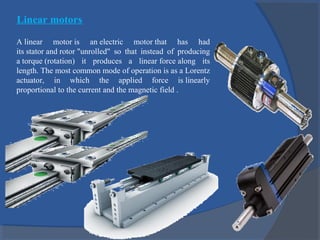
Linear motors
A linear motor is an electric motor that has had
its stator and rotor "unrolled" so that instead of producing
a torque (rotation) it produces a linear force along its
length. The most common mode of operation is as a Lorentz
actuator, in which the applied force is linearly
proportional to the current and the magnetic field .
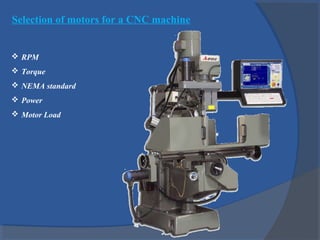
Selection of motors for a CNC machine
 RPM
 Torque
 NEMA standard
 Power
 Motor Load
NO Questions Please!!!!!!!!!
Than Q

Motors

  • 3.
    Overview  Introduction tomotors  Comparing AC & DC motors  Servo mechanism & motors  Stepper motors  Motors used in CNC’s  Selection of motors for CNC’s
  • 4.
  • 5.
    Components of amotor Stator Rotor or armature Commutator Slip rings or carbon brushes End Plates Supply box Cooling fan Video
  • 6.
    Working Principle Every motorworks on the principle that when a current-carrying conductor is placed in a magnetic field, it experiences a mechanical force.
  • 7.
  • 8.
    AC Motors VersusDC Motors Vs Vs
  • 9.
    AC Induction motor Components Stator:It carries three phase winding and is fed from 3-phase supply. Rotor: It carries winding which works as a secondary as in transformer.
  • 10.
    AC Synchronous motor Stator:It carries three phase winding and is fed from 3-phase supply. Rotor: It carries permanent magnet poles that rotate exactly with same speed as that of the stator magnetic field, hence the name synchronous motor. It is not self starting.
  • 11.
    Stepper motors A steppermotor is an electromechanical device which converts electrical pulses into discrete mechanical movements. The shaft or spindle of a stepper motor rotates in discrete step increments when electrical command pulses are applied to it in the proper sequence.
  • 12.
    Advantages  The rotationangle of the motor is proportional to the input pulse.  The motor has full torque at standstill (if the windings are energized)  Precise positioning and repeatability of movement since good stepper motors have an accuracy of 3 – 5% of a step and this error is non- cumulative from one step to the next.  Excellent response to starting/ stopping/reversing.  A wide range of rotational speeds can be realized as the speed is proportional to the frequency of the input pulses. Disadvantages  Not easy to operate at extremely high speeds.
  • 13.
    Servo Mechanism A servomechanism,sometimes shortened to servo, is an automatic device that uses error-sensing negative feedback to correct the performance of a mechanism. The term correctly applies only to systems where the feedback or error-correction signals help control mechanical position, speed or other parameters.
  • 14.
  • 15.
    Servo Motors A Servois a small device that has an output shaft. This shaft can be positioned to specific angular positions by sending the servo a coded signal. As long as the coded signal exists on the input line, the servo will maintain the angular position of the shaft. As the coded signal changes, the angular position of the shaft changes. Features of Servo motors  High acceleration  Minimized rotor inertia.  Decreased number of coiling.  Enlarge control range.  Improved insulation.  Stabilize rotational speed, decrease torque ripple and rotation ripple.  Long life
  • 16.
    Depends on bearinglife Depends on brushes life No mechanical contact Periodical replacement of No maintenance brushes No noise Noise due to actuation of brushes High Speed & large Limited due to brush torque efficiency Quick response due to Sluggish than AC Servo small rotor inertia and large due to large rotor inertia
  • 17.
    Motors used inCNC machines Spindle Motors A spindle motor is a small, high-precision, high-reliability electric motor that is used to rotate the shaft or spindle used in machine tools for performing a wide range of tasks like drilling, grinding, milling, high speed routing for woodworking, aluminum cutting or plastic cutting etc. All machine tools consist of motors which provide a mechanical means of transferring motion to the cutting tool and balance control.  Small size (minimum weight to power ratio)  Minimal noise output  Low power consumption  High reliability  Minimal wobbling and vibration  Low heat output Desired Characteristics
  • 18.
    Linear motors A linearmotor is an electric motor that has had its stator and rotor "unrolled" so that instead of producing a torque (rotation) it produces a linear force along its length. The most common mode of operation is as a Lorentz actuator, in which the applied force is linearly proportional to the current and the magnetic field .
  • 19.
    Selection of motorsfor a CNC machine  RPM  Torque  NEMA standard  Power  Motor Load
  • 20.