Synchronous Motor
Mr. C D Patil
Dept. of EE
•The motor which runs at synchronous speed is
known as the synchronous motor.
•The synchronous speed is the constant speed at
which motor generates the electromotive force.
• The synchronous motor is used for converting
the electrical energy into mechanical energy.
Defination of Synchronous Motor
• The stator and the rotor are the two main parts of the synchronous motor.
• The stator becomes stationary, and it carries the armature winding of the
motor.
• The armature winding is the main winding because of which the EMF
induces in the motor. The rotator carry the field windings.
• The main field flux induces in the rotor. The rotor is designed in two ways, i.e.,
the salient pole rotor and the non-salient pole rotor.
Construction of Synchronous Motor
Working Principle of Synchronous Motor
• When a 3-φ winding is fed by a 3-φ supply, then
a magnetic flux of constant magnitude but
rotating at synchronous speed, is produced.
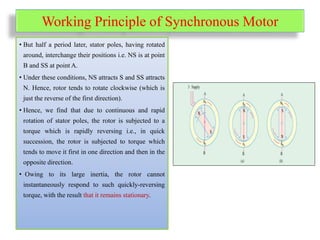
• Consider a two-pole stator shown in Fig. in
which two stator poles(marked NS and SS)
rotating at synchronous speed, say, in clockwise
direction.
• With the rotor position as shown, suppose the
stator poles are at that instant situated at points A
and B. The two similar poles, N (of rotor)and NS
(of stator) as well as S and SS will repel each
other, with the result that the rotor tends to rotate
in the anticlockwise direction.
Working Principle of Synchronous Motor
• But half a period later, stator poles, having rotated
around, interchange their positions i.e. NS is at point
B and SS at point A.
• Under these conditions, NS attracts S and SS attracts
N. Hence, rotor tends to rotate clockwise (which is
just the reverse of the first direction).
• Hence, we find that due to continuous and rapid
rotation of stator poles, the rotor is subjected to a
torque which is rapidly reversing i.e., in quick
succession, the rotor is subjected to torque which
tends to move it first in one direction and then in the
opposite direction.
• Owing to its large inertia, the rotor cannot
instantaneously respond to such quickly-reversing
torque, with the result that it remains stationary.
Method of starting of Synchronous Motor
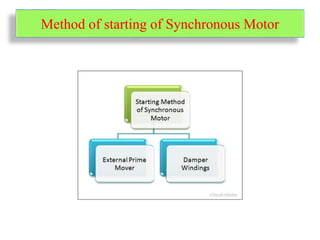
1. Motor Starting with an External Prime Mover
• In this method, an external prime mover drives the synchronous
motor and brings it to synchronous speed.
• The synchronous machine is then synchronized with the bus bar
as a synchronous generator.
• The prime mover is then disconnected. Once operating in
parallel condition, the synchronous machine will work as a
motor.
• Thus, the load can be connected to the synchronous motor.
Method of starting of Synchronous Motor
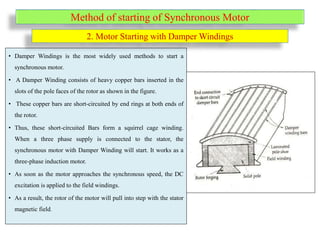
• Damper Windings is the most widely used methods to start a
synchronous motor.
• A Damper Winding consists of heavy copper bars inserted in the
slots of the pole faces of the rotor as shown in the figure.
• These copper bars are short-circuited by end rings at both ends of
the rotor.
• Thus, these short-circuited Bars form a squirrel cage winding.
When a three phase supply is connected to the stator, the
synchronous motor with Damper Winding will start. It works as a
three-phase induction motor.
• As soon as the motor approaches the synchronous speed, the DC
excitation is applied to the field windings.
• As a result, the rotor of the motor will pull into step with the stator
magnetic field.
2. Motor Starting with Damper Windings
Different Torques of a Synchronous Motor
The following types of torques are available in synchronous
motor
1. Starting Torque
2. Running Torque
3. Pull-in Torque
4. Pull-out Torque
Different Torques of a Synchronous Motor
1. Starting Torque:-
• It is the torque (or turning effort) developed by the motor
when full voltage is applied to its stator (armature) winding.
• It is also sometimes called breakaway torque. Its value may
be as low as 10% as in the case of centrifugal pumps and as
high as 200 to 250% of full-load torque as in the case of loaded
reciprocating two-cylinder compressors.
Different Torques of a Synchronous Motor
2. Running Torque:-
• As its name indicates, it is the torque developed by the motor
under running conditions.
• It is determined by the horse-power and speed of the driven
machine.
• The peak horsepower determines the maximum torque that
would be required by the driven machine.
• The motor must have a breakdown or a maximum running
torque greater than this value in order to avoid stalling.
Different Torques of a Synchronous Motor
3. Pull-in Torque:-
A synchronous motor is started as induction motor till it runs 2 to 5% below the synchronous
speed. Afterwards, excitation is switched on and the rotor pulls into step with the synchronously
rotating stator field. The amount of torque at which the motor will pull into step is called the pull-
in torque.
4. Pull-Out Torque :-
•The maximum torque which the motor can develop without pulling out of step or synchronism is
called the pull-out torque.
•Normally, when load on the motor is increased, its rotor progressively tends to fall back in phase
by some angle (called load angle) behind the synchronously-revolving stator magnetic field
though it keeps running synchronously. Motor develops maximum torque when its rotor is
retarded by an angle of 90º (or in other words, it has shifted backward by a distance equal to half
the distance between adjacent poles). Any further increase in load will cause the motor to pull out
of step (or synchronism) and stop.

Synchronous motor

  • 1.
    Synchronous Motor Mr. CD Patil Dept. of EE
  • 2.
    •The motor whichruns at synchronous speed is known as the synchronous motor. •The synchronous speed is the constant speed at which motor generates the electromotive force. • The synchronous motor is used for converting the electrical energy into mechanical energy. Defination of Synchronous Motor
  • 3.
    • The statorand the rotor are the two main parts of the synchronous motor. • The stator becomes stationary, and it carries the armature winding of the motor. • The armature winding is the main winding because of which the EMF induces in the motor. The rotator carry the field windings. • The main field flux induces in the rotor. The rotor is designed in two ways, i.e., the salient pole rotor and the non-salient pole rotor. Construction of Synchronous Motor
  • 4.
    Working Principle ofSynchronous Motor • When a 3-φ winding is fed by a 3-φ supply, then a magnetic flux of constant magnitude but rotating at synchronous speed, is produced. • Consider a two-pole stator shown in Fig. in which two stator poles(marked NS and SS) rotating at synchronous speed, say, in clockwise direction. • With the rotor position as shown, suppose the stator poles are at that instant situated at points A and B. The two similar poles, N (of rotor)and NS (of stator) as well as S and SS will repel each other, with the result that the rotor tends to rotate in the anticlockwise direction.
  • 5.
    Working Principle ofSynchronous Motor • But half a period later, stator poles, having rotated around, interchange their positions i.e. NS is at point B and SS at point A. • Under these conditions, NS attracts S and SS attracts N. Hence, rotor tends to rotate clockwise (which is just the reverse of the first direction). • Hence, we find that due to continuous and rapid rotation of stator poles, the rotor is subjected to a torque which is rapidly reversing i.e., in quick succession, the rotor is subjected to torque which tends to move it first in one direction and then in the opposite direction. • Owing to its large inertia, the rotor cannot instantaneously respond to such quickly-reversing torque, with the result that it remains stationary.
  • 6.
    Method of startingof Synchronous Motor
  • 7.
    Method of startingof Synchronous Motor 1. Motor Starting with an External Prime Mover • In this method, an external prime mover drives the synchronous motor and brings it to synchronous speed. • The synchronous machine is then synchronized with the bus bar as a synchronous generator. • The prime mover is then disconnected. Once operating in parallel condition, the synchronous machine will work as a motor. • Thus, the load can be connected to the synchronous motor.
  • 8.
    Method of startingof Synchronous Motor • Damper Windings is the most widely used methods to start a synchronous motor. • A Damper Winding consists of heavy copper bars inserted in the slots of the pole faces of the rotor as shown in the figure. • These copper bars are short-circuited by end rings at both ends of the rotor. • Thus, these short-circuited Bars form a squirrel cage winding. When a three phase supply is connected to the stator, the synchronous motor with Damper Winding will start. It works as a three-phase induction motor. • As soon as the motor approaches the synchronous speed, the DC excitation is applied to the field windings. • As a result, the rotor of the motor will pull into step with the stator magnetic field. 2. Motor Starting with Damper Windings
  • 9.
    Different Torques ofa Synchronous Motor The following types of torques are available in synchronous motor 1. Starting Torque 2. Running Torque 3. Pull-in Torque 4. Pull-out Torque
  • 10.
    Different Torques ofa Synchronous Motor 1. Starting Torque:- • It is the torque (or turning effort) developed by the motor when full voltage is applied to its stator (armature) winding. • It is also sometimes called breakaway torque. Its value may be as low as 10% as in the case of centrifugal pumps and as high as 200 to 250% of full-load torque as in the case of loaded reciprocating two-cylinder compressors.
  • 11.
    Different Torques ofa Synchronous Motor 2. Running Torque:- • As its name indicates, it is the torque developed by the motor under running conditions. • It is determined by the horse-power and speed of the driven machine. • The peak horsepower determines the maximum torque that would be required by the driven machine. • The motor must have a breakdown or a maximum running torque greater than this value in order to avoid stalling.
  • 12.
    Different Torques ofa Synchronous Motor 3. Pull-in Torque:- A synchronous motor is started as induction motor till it runs 2 to 5% below the synchronous speed. Afterwards, excitation is switched on and the rotor pulls into step with the synchronously rotating stator field. The amount of torque at which the motor will pull into step is called the pull- in torque. 4. Pull-Out Torque :- •The maximum torque which the motor can develop without pulling out of step or synchronism is called the pull-out torque. •Normally, when load on the motor is increased, its rotor progressively tends to fall back in phase by some angle (called load angle) behind the synchronously-revolving stator magnetic field though it keeps running synchronously. Motor develops maximum torque when its rotor is retarded by an angle of 90º (or in other words, it has shifted backward by a distance equal to half the distance between adjacent poles). Any further increase in load will cause the motor to pull out of step (or synchronism) and stop.