CONTENTS
Introduction
Types
Speed control
(a) Sinusoidally Excited Motor
(b) Trapezoidally Excited Motor
BLDC Motor Vs PMSM
Conclusion
References
Kongunadu College of Engineering & Technology Permanent Magnet Synchronous Motor
PERMANENT MAGNET SYNCHRONOUS MOTOR
 The notation for PMSM is PMAC
 In PMSM the D.C field winding of the rotor is replaced by Permanent Magnets
 Permanent Magnet Materials: Alnico, Cobalt-Samarium, Ferrite.
Advantages:
 Elimination of field copper loss.
 Higher power density.
 Lower rotor inertia.
 More robust construction of motor.
 Higher efficiency.
Disadvantages :
 Loss of flexibility of field flux control.
 Remagnetization effect.
 Higher costs.
Application:
 Low power range motors are widely used in industries.
Kongunadu College of Engineering & Technology Permanent Magnet Synchronous Motor
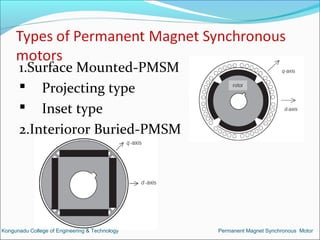
Types Permanent Magnet Synchronous
motors
1.Surface Mounted-PMSM
 Projecting type
 Inset type
2.Interioror Buried-PMSM
Kongunadu College of Engineering & Technology Permanent Magnet Synchronous Motor
1.Surface Mounted-PMSM
 Projecting type
 Inset type
2.Interioror Buried-PMSM
Kongunadu College of Engineering & Technology Permanent Magnet Synchronous Motor
Types of Permanent Magnet Synchronous
motors
Based on nature of voltage induced in the stator
classified as
Sinusoid ally excited PMAC:
Stator has distributed winding.
Stator induced voltage has sinusoidal waveform.
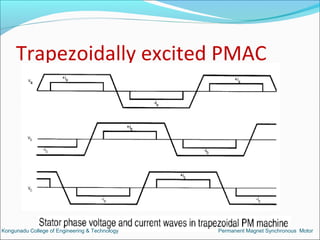
Trapezoid ally excited PMAC:
Stator has concentrated winding.
Stator induced voltage has trapezoidal waveform.
Kongunadu College of Engineering & Technology Permanent Magnet Synchronous Motor
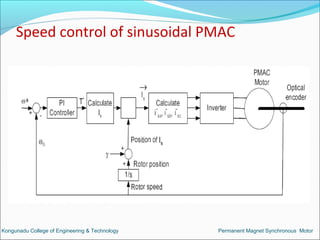
Speed control of sinusoidal PMAC
The speed of the PMAC motor is controlled by feeding them
from variable frequency ,voltage and current.
They are operated in self controlled mode.
 In closed loop control ,current regulated VSI is used.
The inverter is operated to supply motor three phase currents of
the magnitude and phase commanded by reference currents
isa,isb and isc which generated by a reference current
generator.
The stator current templates for the three phases are generated
by the rotor position sensors in such a way that δ = π/2
Kongunadu College of Engineering & Technology Permanent Magnet Synchronous Motor
Speed control of sinusoidal PMAC
Kongunadu College of Engineering & Technology Permanent Magnet Synchronous Motor
Sinusoidally excited PMAC
Kongunadu College of Engineering & Technology Permanent Magnet Synchronous Motor
Trapezoid ally excited PMAC
Kongunadu College of Engineering & Technology Permanent Magnet Synchronous Motor
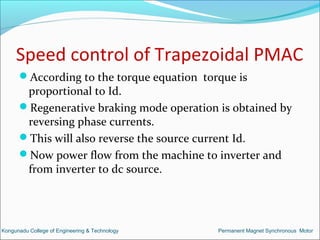
Speed control of Trapezoidal PMAC
According to the torque equation torque is
proportional to Id.
Regenerative braking mode operation is obtained by
reversing phase currents.
This will also reverse the source current Id.
Now power flow from the machine to inverter and
from inverter to dc source.
Kongunadu College of Engineering & Technology Permanent Magnet Synchronous Motor
Speed control of Trapezoidal PMAC
Kongunadu College of Engineering & Technology Permanent Magnet Synchronous Motor
Trapezoidally excited PMAC
Kongunadu College of Engineering & Technology Permanent Magnet Synchronous Motor
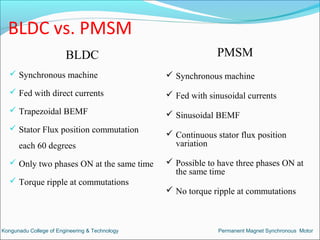
BLDC vs. PMSM
BLDC
 Synchronous machine
 Fed with direct currents
 Trapezoidal BEMF
 Stator Flux position commutation
each 60 degrees
 Only two phases ON at the same time
 Torque ripple at commutations
PMSM
 Synchronous machine
 Fed with sinusoidal currents
 Sinusoidal BEMF
 Continuous stator flux position
variation
 Possible to have three phases ON at
the same time
 No torque ripple at commutations
Kongunadu College of Engineering & Technology Permanent Magnet Synchronous Motor
Conclusion
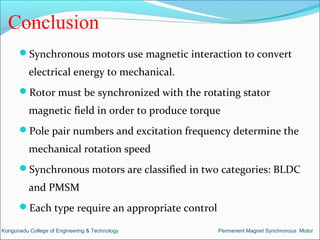
Synchronous motors use magnetic interaction to convert
electrical energy to mechanical.
Rotor must be synchronized with the rotating stator
magnetic field in order to produce torque
Pole pair numbers and excitation frequency determine the
mechanical rotation speed
Synchronous motors are classified in two categories: BLDC
and PMSM
Each type require an appropriate control
Kongunadu College of Engineering & Technology Permanent Magnet Synchronous Motor
REFERENCES
S.No Books / Web Sources
1. K.Venkataratnam, ‘Special Electrical Machines’, Universities Press (India) Private Limited, 2008
2. T.J.E. Miller, ‘Brushless Permanent Magnet and Reluctance Motor Drives’, Clarendon Press,Oxford, 1989.
3. T. Kenjo, ‘Stepping Motors and Their Microprocessor Controls’, Clarendon Press London, 1984.
4.
R.Krishnan, ‘Switched Reluctance Motor Drives – Modeling, Simulation, Analysis, Design andApplication’, CRC
Press, New York, 2001.
5. P.P. Aearnley, ‘Stepping Motors – A Guide to Motor Theory and Practice’, Peter Perengrinus ,London, 1982.
6. T. Kenjo and S. Nagamori, ‘Permanent Magnet and Brushless DC Motors’, Clarendon Press, London, 1988.
7. K.Dhayalini, “Special Electrical Machines,” Anuradha Publications, 2017.
8.
Google , Wikipedia and https://cnx.org/resources/.../PMSM_control.
Kongunadu College of Engineering & Technology Permanent Magnet Synchronous Motor

PMSM

  • 1.
    CONTENTS Introduction Types Speed control (a) SinusoidallyExcited Motor (b) Trapezoidally Excited Motor BLDC Motor Vs PMSM Conclusion References Kongunadu College of Engineering & Technology Permanent Magnet Synchronous Motor
  • 2.
    PERMANENT MAGNET SYNCHRONOUSMOTOR  The notation for PMSM is PMAC  In PMSM the D.C field winding of the rotor is replaced by Permanent Magnets  Permanent Magnet Materials: Alnico, Cobalt-Samarium, Ferrite. Advantages:  Elimination of field copper loss.  Higher power density.  Lower rotor inertia.  More robust construction of motor.  Higher efficiency. Disadvantages :  Loss of flexibility of field flux control.  Remagnetization effect.  Higher costs. Application:  Low power range motors are widely used in industries. Kongunadu College of Engineering & Technology Permanent Magnet Synchronous Motor
  • 3.
    Types Permanent MagnetSynchronous motors 1.Surface Mounted-PMSM  Projecting type  Inset type 2.Interioror Buried-PMSM Kongunadu College of Engineering & Technology Permanent Magnet Synchronous Motor
  • 4.
    1.Surface Mounted-PMSM  Projectingtype  Inset type 2.Interioror Buried-PMSM Kongunadu College of Engineering & Technology Permanent Magnet Synchronous Motor
  • 5.
    Types of PermanentMagnet Synchronous motors Based on nature of voltage induced in the stator classified as Sinusoid ally excited PMAC: Stator has distributed winding. Stator induced voltage has sinusoidal waveform. Trapezoid ally excited PMAC: Stator has concentrated winding. Stator induced voltage has trapezoidal waveform. Kongunadu College of Engineering & Technology Permanent Magnet Synchronous Motor
  • 6.
    Speed control ofsinusoidal PMAC The speed of the PMAC motor is controlled by feeding them from variable frequency ,voltage and current. They are operated in self controlled mode.  In closed loop control ,current regulated VSI is used. The inverter is operated to supply motor three phase currents of the magnitude and phase commanded by reference currents isa,isb and isc which generated by a reference current generator. The stator current templates for the three phases are generated by the rotor position sensors in such a way that δ = π/2 Kongunadu College of Engineering & Technology Permanent Magnet Synchronous Motor
  • 7.
    Speed control ofsinusoidal PMAC Kongunadu College of Engineering & Technology Permanent Magnet Synchronous Motor
  • 8.
    Sinusoidally excited PMAC KongunaduCollege of Engineering & Technology Permanent Magnet Synchronous Motor
  • 9.
    Trapezoid ally excitedPMAC Kongunadu College of Engineering & Technology Permanent Magnet Synchronous Motor
  • 10.
    Speed control ofTrapezoidal PMAC According to the torque equation torque is proportional to Id. Regenerative braking mode operation is obtained by reversing phase currents. This will also reverse the source current Id. Now power flow from the machine to inverter and from inverter to dc source. Kongunadu College of Engineering & Technology Permanent Magnet Synchronous Motor
  • 11.
    Speed control ofTrapezoidal PMAC Kongunadu College of Engineering & Technology Permanent Magnet Synchronous Motor
  • 12.
    Trapezoidally excited PMAC KongunaduCollege of Engineering & Technology Permanent Magnet Synchronous Motor
  • 13.
    BLDC vs. PMSM BLDC Synchronous machine  Fed with direct currents  Trapezoidal BEMF  Stator Flux position commutation each 60 degrees  Only two phases ON at the same time  Torque ripple at commutations PMSM  Synchronous machine  Fed with sinusoidal currents  Sinusoidal BEMF  Continuous stator flux position variation  Possible to have three phases ON at the same time  No torque ripple at commutations Kongunadu College of Engineering & Technology Permanent Magnet Synchronous Motor
  • 14.
    Conclusion Synchronous motors usemagnetic interaction to convert electrical energy to mechanical. Rotor must be synchronized with the rotating stator magnetic field in order to produce torque Pole pair numbers and excitation frequency determine the mechanical rotation speed Synchronous motors are classified in two categories: BLDC and PMSM Each type require an appropriate control Kongunadu College of Engineering & Technology Permanent Magnet Synchronous Motor
  • 15.
    REFERENCES S.No Books /Web Sources 1. K.Venkataratnam, ‘Special Electrical Machines’, Universities Press (India) Private Limited, 2008 2. T.J.E. Miller, ‘Brushless Permanent Magnet and Reluctance Motor Drives’, Clarendon Press,Oxford, 1989. 3. T. Kenjo, ‘Stepping Motors and Their Microprocessor Controls’, Clarendon Press London, 1984. 4. R.Krishnan, ‘Switched Reluctance Motor Drives – Modeling, Simulation, Analysis, Design andApplication’, CRC Press, New York, 2001. 5. P.P. Aearnley, ‘Stepping Motors – A Guide to Motor Theory and Practice’, Peter Perengrinus ,London, 1982. 6. T. Kenjo and S. Nagamori, ‘Permanent Magnet and Brushless DC Motors’, Clarendon Press, London, 1988. 7. K.Dhayalini, “Special Electrical Machines,” Anuradha Publications, 2017. 8. Google , Wikipedia and https://cnx.org/resources/.../PMSM_control. Kongunadu College of Engineering & Technology Permanent Magnet Synchronous Motor