A
PRESENTATION
ON
WEB BASED MANUFACTURING
http://studygalaxy.com/
INTRODUCTION
 With the advent of the World Wide Web (www),
information distributed at different location can be
accessed and shared by users anywhere in the world
using Web tools such as Web-browsers.
 The Web technologies have been applied widely in
developing manufacturing systems such as marketing,
design, process planning, production, customer
service etc. distributed at different locations into an
integrated environment.
WHY WEB BASED
MANUFACTURING?
1. Capturing global audience
The users of a manufacturing system can be in any
part of the world and therefore it is vital that the
system should be widely acceptable.
The web based manufacturing instead of developing
customized client - server architecture depends on
well defined and seasoned client-server architecture
running on the internet, which is the www, to serve
application logic in the form of Java applets, which
provide platform independent means of accessing the
system
2. HANDLING DATA LOSS AND OUT OF
ORDER DELIVERY OF DATA:
When the web has been chosen as platform for development of
the system, it should be noted that the application layer of web,
HTTP runs over the transport layer protocol, TCP which provides
reliable (connection-oriented) in order byte stream data transfer
takes care of the problem associated with data loss and out of
order delivery of data.
3. COORDINATING MULTI-USER ACCESS
The nature of operation of some operation in mfg. system
such as drilling is such that only one client should have full
control over the drilling machine at any given time. Due to
this restriction, coordination of multi-user access is vital in
ensuring fairness of use and safe operation of the
machining unit.
4. REDUCED SUSCEPTIBILITY TO TEMPORAL
COMMUNICATION DELAYS:
An important consequence of deciding against real time
direct control of the machining unit is that susceptibility of
the proposed system’s performance is reduced, thus
addressing the uncertain time delay problem
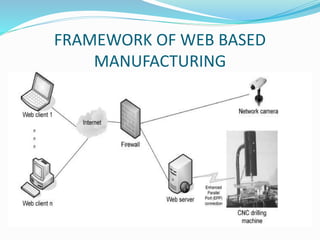
FRAMEWORK OF WEB BASED
MANUFACTURING
WBM FRAMEWORK (CONTD.)
 Web pages embedded with JAVA applets provide an
interface for the operations. Using the web interface, the
authorized remote clients (first tier) provide machining
parameters which are relayed to the web server.
 The machining parameters upon reaching the server
(middle tier) constitute a part-program which is stored in a
job file scheduled for execution of machining process
 The machining operation is monitored by the network
camera, which is a part of the middle tier providing real
time feedback to the remote user.
WBM FRAMEWORK (CONTD.)
 In addressing security issues pertaining to the web based
manufacturing system, the firewall is the first line of
defense in restricting unauthorized access to the server and
therefore the drilling machine
 In addition to this, the web server authenticates users prior
to granting permission to submit jobs, monitor the
machining process or participate in virtual discussion
 Finally all the sensitive communication between the client
and the server is carried over TLS (Transport Layer
Security) thereby ensuring confidentiality, data integrity
and server authentication
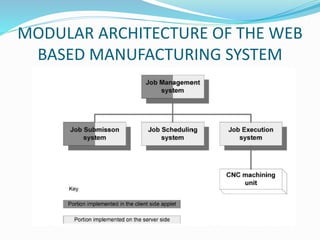
MODULAR ARCHITECTURE OF THE WEB
BASED MANUFACTURING SYSTEM
JOB SUBMISSION
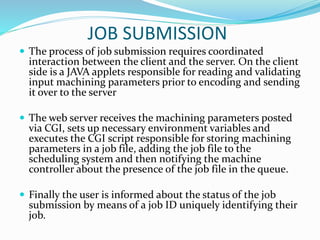
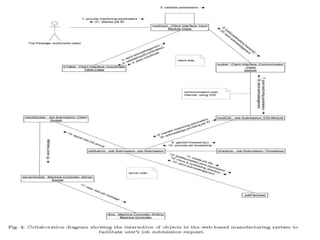
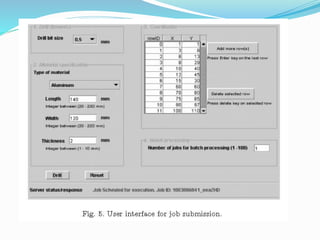
 The process of job submission requires coordinated
interaction between the client and the server. On the client
side is a JAVA applets responsible for reading and validating
input machining parameters prior to encoding and sending
it over to the server
 The web server receives the machining parameters posted
via CGI, sets up necessary environment variables and
executes the CGI script responsible for storing machining
parameters in a job file, adding the job file to the
scheduling system and then notifying the machine
controller about the presence of the job file in the queue.
 Finally the user is informed about the status of the job
submission by means of a job ID uniquely identifying their
job.
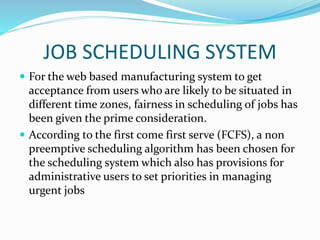
JOB SCHEDULING SYSTEM
 For the web based manufacturing system to get
acceptance from users who are likely to be situated in
different time zones, fairness in scheduling of jobs has
been given the prime consideration.
 According to the first come first serve (FCFS), a non
preemptive scheduling algorithm has been chosen for
the scheduling system which also has provisions for
administrative users to set priorities in managing
urgent jobs
JOB STORAGE SYSTEM
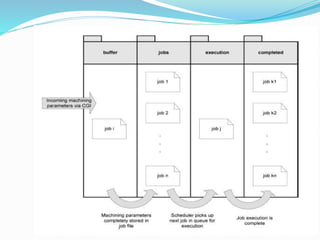
 The storage structure for processing the jobs consists
of four directories under a common parent directory.
 The logic behind such structure is that while the user
interface transmits machining parameters and the CGI
script stores it in the job files, there is a possibility
that the user can terminate the transmission by simply
closing the browser. In such cases it is pointless to
execute partially complete job.
JOB STORAGE (CONTD.)
 The machining parameters written to the buffer
directory and only when the job file is complete, it is
moved to the job directory
 The job directory stores all the job successfully
received by the server and waiting execution.
 The scheduler picks up the next job in queue from the
job directory and places it in the execution directory.
 The machine controller executes job from the
execution directory and after the completion the job
file is moved to the completed directory which can be
later used for billing the client
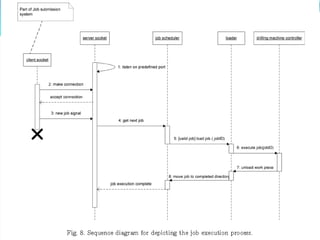
JOB EXECUTION
 Under the normal scenario, job execution commences
once the job file has been placed in the jobs directory
and the job submission systems sends notification
about the job file to the machine controller
 The main program which coordinates interaction
between the objects in executing a job is the job server
which runs as background process registered as a
system service.
 Just like any other system service, the job server
daemon is easily controllable using the standard
operating system utilities such as chkconfig and sevice.
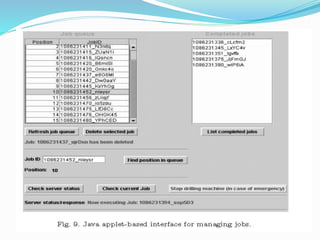
JOB MANAGEMENT SYSTEM
 After a job has been submitted it may have to wait in
the job queue for some time before its turn come up
for execution. In the meanwhile the user submitted
the job needs some way of knowing the position of
their job in the queue and also whether their job has
been completed.
 Furthermore, there has to be provision that allows
users to delete their own job from the queue if they
wish to cancel the job
JOB STATUS
 The carefully designed job storage structure of the
scheduling system seamlessly allows the remote users
to check the status of their job at various stages of
processing
 In similar fashion, a sorted directory listing of the
completed directory enables the users to check if their
job has been processed
 Likewise listing the job file execution directory
indicates the job that is currently being executed.
REMOTE PROCESS MONITORING
AND ONLINE COLLABORATION
 In an effort to lessen the impact of geographical
separation between the remote user and the
manufacturing equipment, the web based
manufacturing has provisions for remote process
monitoring and virtual discussion between remote
designers.
A
Methodology
For
Web based Manufacturing
Management and Control
INTRODUCTION
For the implementation of the methodology, tele-
manufacturing is used, which a part of the electronic-
manufacturing concept . The customer uses the
manufacturing services via web (Service Oriented
Application - SOA) to execute the operations and the
necessary processes, designing and manufacturing the
desired part efficiently, using computational tools for the
development of the product life cycle.
OVERVIEW
A. ERP Systems
Generally, in each company, some computer systems
were developed to meet specific requirements of the diverse
business units, factories, departments and offices. Thus,
information was fragmented among different systems. The
main problems of this fragmentation are the difficulty in
getting the consolidated information, and the inconsistency
of stored redundant data in more than one system. ERP
systems solve these problems by including, in just one
integrated system, functionalities that support the activities
of different companies .
B. Web Machining Methodology
The Web Machining methodology has the purpose of
allowing the integration of the collaborative design
activities (CAD), process planning (CAPP) and
manufacturing (CAM). The procedure begins in the
collaborative modeling of a part using features in a
context of remote manufacturing via web, in a client-
server computer model.
C. Cyber Cut
Cyber Cut is a web-based design-to-manufacturing system
developed by Brown and Wright who point out that, by
providing access to the CAD interface over the Internet,
any engineer becomes a potential user of this on-line rapid
prototyping tool. A remote user would be able to download
a CAD file in some specified universal exchange format to
the Cyber Cut server, which would in turn execute the
necessary process planning and generate the appropriate
NC code for milling.
THE PROMME METHODOLOGY
PROMME is a methodology to enable manufacturing
and control management in a distributed manufacturing
environment. It is applied on the WebMachining virtual
company, whose shop floor is formed by three
distributed manufacturing systems. An ERP software
was developed in order to carry out manufacturing
management, enabling the receipt of customer orders,
management functions, CAD/CAPP/CAM integration,
and part manufacture in one of the three manufacturing
systems.
PROMME METHODOLOGY Consists of
A. Distributed Shop Floor
B. ERP Manufacturing
1) Institutional module
2) Commercial module
3) Integration with the Part Development Environment
4) CAP – Computer Aided Production
i. Decision Making
ii. Production Scheduling
5) Integration with the Management Units of the
distributed shop floors
THE WEB-BASED SHOP FLOOR
CONTROLLER (WSFC) FOR THE FMC AT
GRACO/UNB
A web-based shop floor controller for the Flexible
Manufacturing Cell (FMC) at Graco/Unb (in Brasilia) was
also implemented, and it uses WWW resources to
perform the remote manufacture of parts. The FMC
receives instructions from the controller and converts
them into the operations necessary to manufacture the
parts.
The web based shop floor controller (WSFC)
should meet the following requirements:-
(a) it should support production Planning
(b) it should have functions to verify the availability of the
production resources allowing the instruction loading on
the workstations
(c) it should control and monitor the production process
reacting on any abnormal conditions that can hinder the
fulfillment of the activities established previously on the
production planning.
A. COMMUNICATION WITHIN THE FMC
In order to describe the implementation of the control for
the FMC at Graco/UnB, it is important to visualize the
FMC communication structure, describing the method
used by the operator to access the FMC resources
B. WEB-BASED SHOP FLOOR CONTROLLER
The implementation architecture of the controller should
encompass the main functionality that the real system
should offer. The implementation architecture was built
based on object oriented technology.
1) Implementation architecture – Component diagram
The component diagrams of the Unified Modeling Language
(UML) were used to design and to document the
implementation architecture.
The GUIs and the upper level functionalities are available on
the client module, while the lower level functionalities (e.g.
direct connection with the workstations) are available on the
server module.
2) Implementation under the distributed architecture
To provide remote access to the workstations (via web),
maintaining the portability that the system should offer, the
web-based shop floor controller was implemented in a
clientserver architecture.
C. RESULTS
1) Inspection and production planning
• The inspection plan is included in the information used to
plan, control and monitor the inspection of the parts. This
plan is composed by a set of inspection programs previously
recorded in the database. Each program has the part geometry
information (diameter and tolerance of each feature that will
be inspected), as well as the inspection conditions (unit
system, reference, scale, etc).
• The Master Production Scheduling (MPS) is added to the
work orders recorded on the database. One work order has
attributes such as priority, due date, process time, etc., which will
be used by other WSFC modules.
2) Scheduling production and dispatching
•After concluding the production plan, the next step
consists of establishing the sequence in which the work
orders will be manufactured. The scheduling method
adopted in this work is based on priority rules.
•The WSFC communicates with each workstation in order
to verify whether it is available to receive a task upload.
While the WSFC is checking the workstation status, a
report (log) of the executed command is shown on right
side of the GUI.
3) Production monitor and quality control
•The GUI Quality Control provides the human interaction
with the quality control process. The statistical method
selected to control the process is the pre-control, and this
method is composed of three steps: to qualify the process,
operation, and sample frequency.
•The inspection of a part starts with the positioning of the
manufactured part on the micrometer read unit. After
positioning the part on the micrometer and the programmed
inspection time(DataOutputTimer) expires, the micrometer
sends the inspection result to the WFSC via the RS232
interface.
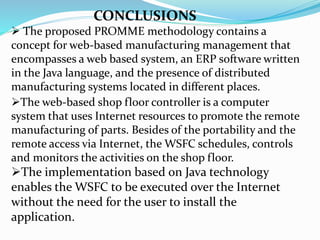
CONCLUSIONS
 The proposed PROMME methodology contains a
concept for web-based manufacturing management that
encompasses a web based system, an ERP software written
in the Java language, and the presence of distributed
manufacturing systems located in different places.
The web-based shop floor controller is a computer
system that uses Internet resources to promote the remote
manufacturing of parts. Besides of the portability and the
remote access via Internet, the WSFC schedules, controls
and monitors the activities on the shop floor.
The implementation based on Java technology
enables the WSFC to be executed over the Internet
without the need for the user to install the
application.
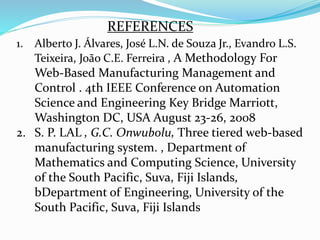
1. Alberto J. Álvares, José L.N. de Souza Jr., Evandro L.S.
Teixeira, João C.E. Ferreira , A Methodology For
Web-Based Manufacturing Management and
Control . 4th IEEE Conference on Automation
Science and Engineering Key Bridge Marriott,
Washington DC, USA August 23-26, 2008
2. S. P. LAL , G.C. Onwubolu, Three tiered web-based
manufacturing system. , Department of
Mathematics and Computing Science, University
of the South Pacific, Suva, Fiji Islands,
bDepartment of Engineering, University of the
South Pacific, Suva, Fiji Islands
REFERENCES
Any query ??
shivkumar pathak   web based manufacturing presentation

shivkumar pathak web based manufacturing presentation

  • 1.
  • 2.
    INTRODUCTION  With theadvent of the World Wide Web (www), information distributed at different location can be accessed and shared by users anywhere in the world using Web tools such as Web-browsers.  The Web technologies have been applied widely in developing manufacturing systems such as marketing, design, process planning, production, customer service etc. distributed at different locations into an integrated environment.
  • 3.
    WHY WEB BASED MANUFACTURING? 1.Capturing global audience The users of a manufacturing system can be in any part of the world and therefore it is vital that the system should be widely acceptable. The web based manufacturing instead of developing customized client - server architecture depends on well defined and seasoned client-server architecture running on the internet, which is the www, to serve application logic in the form of Java applets, which provide platform independent means of accessing the system
  • 4.
    2. HANDLING DATALOSS AND OUT OF ORDER DELIVERY OF DATA: When the web has been chosen as platform for development of the system, it should be noted that the application layer of web, HTTP runs over the transport layer protocol, TCP which provides reliable (connection-oriented) in order byte stream data transfer takes care of the problem associated with data loss and out of order delivery of data. 3. COORDINATING MULTI-USER ACCESS The nature of operation of some operation in mfg. system such as drilling is such that only one client should have full control over the drilling machine at any given time. Due to this restriction, coordination of multi-user access is vital in ensuring fairness of use and safe operation of the machining unit.
  • 5.
    4. REDUCED SUSCEPTIBILITYTO TEMPORAL COMMUNICATION DELAYS: An important consequence of deciding against real time direct control of the machining unit is that susceptibility of the proposed system’s performance is reduced, thus addressing the uncertain time delay problem
  • 6.
    FRAMEWORK OF WEBBASED MANUFACTURING
  • 7.
    WBM FRAMEWORK (CONTD.) Web pages embedded with JAVA applets provide an interface for the operations. Using the web interface, the authorized remote clients (first tier) provide machining parameters which are relayed to the web server.  The machining parameters upon reaching the server (middle tier) constitute a part-program which is stored in a job file scheduled for execution of machining process  The machining operation is monitored by the network camera, which is a part of the middle tier providing real time feedback to the remote user.
  • 8.
    WBM FRAMEWORK (CONTD.) In addressing security issues pertaining to the web based manufacturing system, the firewall is the first line of defense in restricting unauthorized access to the server and therefore the drilling machine  In addition to this, the web server authenticates users prior to granting permission to submit jobs, monitor the machining process or participate in virtual discussion  Finally all the sensitive communication between the client and the server is carried over TLS (Transport Layer Security) thereby ensuring confidentiality, data integrity and server authentication
  • 9.
    MODULAR ARCHITECTURE OFTHE WEB BASED MANUFACTURING SYSTEM
  • 10.
    JOB SUBMISSION  Theprocess of job submission requires coordinated interaction between the client and the server. On the client side is a JAVA applets responsible for reading and validating input machining parameters prior to encoding and sending it over to the server  The web server receives the machining parameters posted via CGI, sets up necessary environment variables and executes the CGI script responsible for storing machining parameters in a job file, adding the job file to the scheduling system and then notifying the machine controller about the presence of the job file in the queue.  Finally the user is informed about the status of the job submission by means of a job ID uniquely identifying their job.
  • 13.
    JOB SCHEDULING SYSTEM For the web based manufacturing system to get acceptance from users who are likely to be situated in different time zones, fairness in scheduling of jobs has been given the prime consideration.  According to the first come first serve (FCFS), a non preemptive scheduling algorithm has been chosen for the scheduling system which also has provisions for administrative users to set priorities in managing urgent jobs
  • 14.
    JOB STORAGE SYSTEM The storage structure for processing the jobs consists of four directories under a common parent directory.  The logic behind such structure is that while the user interface transmits machining parameters and the CGI script stores it in the job files, there is a possibility that the user can terminate the transmission by simply closing the browser. In such cases it is pointless to execute partially complete job.
  • 16.
    JOB STORAGE (CONTD.) The machining parameters written to the buffer directory and only when the job file is complete, it is moved to the job directory  The job directory stores all the job successfully received by the server and waiting execution.  The scheduler picks up the next job in queue from the job directory and places it in the execution directory.  The machine controller executes job from the execution directory and after the completion the job file is moved to the completed directory which can be later used for billing the client
  • 17.
    JOB EXECUTION  Underthe normal scenario, job execution commences once the job file has been placed in the jobs directory and the job submission systems sends notification about the job file to the machine controller  The main program which coordinates interaction between the objects in executing a job is the job server which runs as background process registered as a system service.  Just like any other system service, the job server daemon is easily controllable using the standard operating system utilities such as chkconfig and sevice.
  • 19.
    JOB MANAGEMENT SYSTEM After a job has been submitted it may have to wait in the job queue for some time before its turn come up for execution. In the meanwhile the user submitted the job needs some way of knowing the position of their job in the queue and also whether their job has been completed.  Furthermore, there has to be provision that allows users to delete their own job from the queue if they wish to cancel the job
  • 21.
    JOB STATUS  Thecarefully designed job storage structure of the scheduling system seamlessly allows the remote users to check the status of their job at various stages of processing  In similar fashion, a sorted directory listing of the completed directory enables the users to check if their job has been processed  Likewise listing the job file execution directory indicates the job that is currently being executed.
  • 22.
    REMOTE PROCESS MONITORING ANDONLINE COLLABORATION  In an effort to lessen the impact of geographical separation between the remote user and the manufacturing equipment, the web based manufacturing has provisions for remote process monitoring and virtual discussion between remote designers.
  • 23.
  • 24.
    INTRODUCTION For the implementationof the methodology, tele- manufacturing is used, which a part of the electronic- manufacturing concept . The customer uses the manufacturing services via web (Service Oriented Application - SOA) to execute the operations and the necessary processes, designing and manufacturing the desired part efficiently, using computational tools for the development of the product life cycle.
  • 25.
    OVERVIEW A. ERP Systems Generally,in each company, some computer systems were developed to meet specific requirements of the diverse business units, factories, departments and offices. Thus, information was fragmented among different systems. The main problems of this fragmentation are the difficulty in getting the consolidated information, and the inconsistency of stored redundant data in more than one system. ERP systems solve these problems by including, in just one integrated system, functionalities that support the activities of different companies .
  • 26.
    B. Web MachiningMethodology The Web Machining methodology has the purpose of allowing the integration of the collaborative design activities (CAD), process planning (CAPP) and manufacturing (CAM). The procedure begins in the collaborative modeling of a part using features in a context of remote manufacturing via web, in a client- server computer model.
  • 27.
    C. Cyber Cut CyberCut is a web-based design-to-manufacturing system developed by Brown and Wright who point out that, by providing access to the CAD interface over the Internet, any engineer becomes a potential user of this on-line rapid prototyping tool. A remote user would be able to download a CAD file in some specified universal exchange format to the Cyber Cut server, which would in turn execute the necessary process planning and generate the appropriate NC code for milling.
  • 28.
    THE PROMME METHODOLOGY PROMMEis a methodology to enable manufacturing and control management in a distributed manufacturing environment. It is applied on the WebMachining virtual company, whose shop floor is formed by three distributed manufacturing systems. An ERP software was developed in order to carry out manufacturing management, enabling the receipt of customer orders, management functions, CAD/CAPP/CAM integration, and part manufacture in one of the three manufacturing systems.
  • 29.
    PROMME METHODOLOGY Consistsof A. Distributed Shop Floor B. ERP Manufacturing 1) Institutional module 2) Commercial module 3) Integration with the Part Development Environment 4) CAP – Computer Aided Production i. Decision Making ii. Production Scheduling 5) Integration with the Management Units of the distributed shop floors
  • 30.
    THE WEB-BASED SHOPFLOOR CONTROLLER (WSFC) FOR THE FMC AT GRACO/UNB A web-based shop floor controller for the Flexible Manufacturing Cell (FMC) at Graco/Unb (in Brasilia) was also implemented, and it uses WWW resources to perform the remote manufacture of parts. The FMC receives instructions from the controller and converts them into the operations necessary to manufacture the parts.
  • 31.
    The web basedshop floor controller (WSFC) should meet the following requirements:- (a) it should support production Planning (b) it should have functions to verify the availability of the production resources allowing the instruction loading on the workstations (c) it should control and monitor the production process reacting on any abnormal conditions that can hinder the fulfillment of the activities established previously on the production planning.
  • 32.
    A. COMMUNICATION WITHINTHE FMC In order to describe the implementation of the control for the FMC at Graco/UnB, it is important to visualize the FMC communication structure, describing the method used by the operator to access the FMC resources B. WEB-BASED SHOP FLOOR CONTROLLER The implementation architecture of the controller should encompass the main functionality that the real system should offer. The implementation architecture was built based on object oriented technology.
  • 33.
    1) Implementation architecture– Component diagram The component diagrams of the Unified Modeling Language (UML) were used to design and to document the implementation architecture. The GUIs and the upper level functionalities are available on the client module, while the lower level functionalities (e.g. direct connection with the workstations) are available on the server module. 2) Implementation under the distributed architecture To provide remote access to the workstations (via web), maintaining the portability that the system should offer, the web-based shop floor controller was implemented in a clientserver architecture.
  • 34.
    C. RESULTS 1) Inspectionand production planning • The inspection plan is included in the information used to plan, control and monitor the inspection of the parts. This plan is composed by a set of inspection programs previously recorded in the database. Each program has the part geometry information (diameter and tolerance of each feature that will be inspected), as well as the inspection conditions (unit system, reference, scale, etc). • The Master Production Scheduling (MPS) is added to the work orders recorded on the database. One work order has attributes such as priority, due date, process time, etc., which will be used by other WSFC modules.
  • 35.
    2) Scheduling productionand dispatching •After concluding the production plan, the next step consists of establishing the sequence in which the work orders will be manufactured. The scheduling method adopted in this work is based on priority rules. •The WSFC communicates with each workstation in order to verify whether it is available to receive a task upload. While the WSFC is checking the workstation status, a report (log) of the executed command is shown on right side of the GUI.
  • 36.
    3) Production monitorand quality control •The GUI Quality Control provides the human interaction with the quality control process. The statistical method selected to control the process is the pre-control, and this method is composed of three steps: to qualify the process, operation, and sample frequency. •The inspection of a part starts with the positioning of the manufactured part on the micrometer read unit. After positioning the part on the micrometer and the programmed inspection time(DataOutputTimer) expires, the micrometer sends the inspection result to the WFSC via the RS232 interface.
  • 37.
    CONCLUSIONS  The proposedPROMME methodology contains a concept for web-based manufacturing management that encompasses a web based system, an ERP software written in the Java language, and the presence of distributed manufacturing systems located in different places. The web-based shop floor controller is a computer system that uses Internet resources to promote the remote manufacturing of parts. Besides of the portability and the remote access via Internet, the WSFC schedules, controls and monitors the activities on the shop floor. The implementation based on Java technology enables the WSFC to be executed over the Internet without the need for the user to install the application.
  • 38.
    1. Alberto J.Álvares, José L.N. de Souza Jr., Evandro L.S. Teixeira, João C.E. Ferreira , A Methodology For Web-Based Manufacturing Management and Control . 4th IEEE Conference on Automation Science and Engineering Key Bridge Marriott, Washington DC, USA August 23-26, 2008 2. S. P. LAL , G.C. Onwubolu, Three tiered web-based manufacturing system. , Department of Mathematics and Computing Science, University of the South Pacific, Suva, Fiji Islands, bDepartment of Engineering, University of the South Pacific, Suva, Fiji Islands REFERENCES
  • 39.