 Principles of :
 AC Series motors
 Universal motor
 Stepper motor
 Shaded pole motor
 A series ac motor is the same electrically as a dc
series motor but construction differs slightly.
 Special metals, laminations, and windings are
used which reduce losses caused by eddy
currents, hysteresis, and high reactance.
 Dc power can be used to drive an ac series
motor efficiently, but the opposite is not true.
 The characteristics of a series ac motor are
similar to those of a series dc motor. It is a
varying-speed machine.
 It has low speeds for large loads and high
speeds for light loads.
 Motor that can be used with a single-
phase ac source as well as a dc source of
supply voltages are called universal
motor.
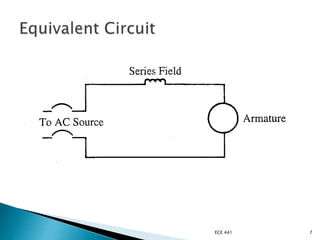
 The stator and rotor windings of the
motor are connected in series through
the rotor commutator.
 The universal motor is also known as an
AC series motor or an AC commutator
motor.
MOTORS 5
Universal Motor
 Series-connected
◦ Rotor and Stator are
connected in series
 Operates on either
ac or dc
MOTORS 6
ECE 441 7
ECE 441 8
Armature
(Rotor)
Field Winding
Field
(Stator)
ECE 441 9
The Commutator Bar and Brushes are a switch
that reverses the current in the armature coil as
it rotates
ECE 441 10
Force on conductor B is
upwards, rotation is
counter-clockwise (CCW)
Flux
“Bunching”
+Positive
Half-Cycle+
ECE 441 11
Force on Conductor B is
upwards, rotation is
counter-clockwise (CCW)
Flux
“Bunching”
-Negative Half-
Cycle-
 How do you reverse the direction of rotation?
◦ Reverse the direction of the current in either the field or in
the armature, but not both!
 How do you control the speed of the motor?
◦ Reduce the voltage applied to the motor
 Use an autotransformer or SCR/Triac
 This reduces the armature current, reducing the torque,
reducing the speed
 Applications
◦ Portable power tools
◦ Small appliances
ECE 441 12
 A special type of synchronous motor which is
designed to rotate a specific number of degrees
for every electric pulse received by its control
unit.
 It is a motor that can rotate in both directions,
move in precise angular increments, sustain a
holding torque at zero speed, and be controlled
with digital circuits.
 It moves in accurate angular increments known
as steps, in response to the application of
digital pulses to the electric drive circuit.
 Step motors are either bipolar, requiring two
power sources or uni polar requiring only one
power source.
2 2
1
N
S
1
S
N
Stators
Rotor
Cross Section of a Stepper Motor
2 2
1
1
S
N
S
N
NN
S S
1
a b
Winding number 1
2
a b
Winding number 2
One
step6 pole rotor
The top electromagnet (1) is turned on,
attracting the nearest teeth of a gear-
shaped iron rotor. With the teeth aligned
to electromagnet 1, they will be slightly
offset from electromagnet 2
The top electromagnet (1) is turned
off, and the right electromagnet (2) is
energized, pulling the nearest teeth
slightly to the right. This results in a
rotation of 3.6° in this example.
Practical Stepper motor operation
The bottom electromagnet (3) is
energized; another 3.6° rotation
occurs.
The left electromagnet (4) is enabled,
rotating again by 3.6°. When the top
electromagnet (1) is again enabled, the
teeth in the sprocket will have rotated by
one tooth position; since there are 25
teeth, it will take 100 steps to make a full
rotation in this example.
Stepping Motor to move read-write head
Stepper motor applications
Paper feeder on printers
CNC lathes
Stepper motors
Stepper motor applications
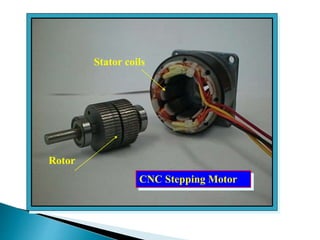
Rotor
Stator coils
CNC Stepping Motor
Advantages:-
Low cost for control achieved
Ruggedness
Simplicity of construction
Can operate in an open loop control system
Low maintenance
Less likely to stall or slip
Will work in any environment
Disadvantages:-
Require a dedicated control circuit
Use more current than D.C. motors
High torque output achieved at low speeds
Advantages / Disadvantages

Principles of Special Motors

  • 1.
     Principles of:  AC Series motors  Universal motor  Stepper motor  Shaded pole motor
  • 2.
     A seriesac motor is the same electrically as a dc series motor but construction differs slightly.  Special metals, laminations, and windings are used which reduce losses caused by eddy currents, hysteresis, and high reactance.  Dc power can be used to drive an ac series motor efficiently, but the opposite is not true.  The characteristics of a series ac motor are similar to those of a series dc motor. It is a varying-speed machine.  It has low speeds for large loads and high speeds for light loads.
  • 4.
     Motor thatcan be used with a single- phase ac source as well as a dc source of supply voltages are called universal motor.  The stator and rotor windings of the motor are connected in series through the rotor commutator.  The universal motor is also known as an AC series motor or an AC commutator motor.
  • 5.
  • 6.
     Series-connected ◦ Rotorand Stator are connected in series  Operates on either ac or dc MOTORS 6
  • 7.
  • 8.
    ECE 441 8 Armature (Rotor) FieldWinding Field (Stator)
  • 9.
    ECE 441 9 TheCommutator Bar and Brushes are a switch that reverses the current in the armature coil as it rotates
  • 10.
    ECE 441 10 Forceon conductor B is upwards, rotation is counter-clockwise (CCW) Flux “Bunching” +Positive Half-Cycle+
  • 11.
    ECE 441 11 Forceon Conductor B is upwards, rotation is counter-clockwise (CCW) Flux “Bunching” -Negative Half- Cycle-
  • 12.
     How doyou reverse the direction of rotation? ◦ Reverse the direction of the current in either the field or in the armature, but not both!  How do you control the speed of the motor? ◦ Reduce the voltage applied to the motor  Use an autotransformer or SCR/Triac  This reduces the armature current, reducing the torque, reducing the speed  Applications ◦ Portable power tools ◦ Small appliances ECE 441 12
  • 13.
     A specialtype of synchronous motor which is designed to rotate a specific number of degrees for every electric pulse received by its control unit.  It is a motor that can rotate in both directions, move in precise angular increments, sustain a holding torque at zero speed, and be controlled with digital circuits.  It moves in accurate angular increments known as steps, in response to the application of digital pulses to the electric drive circuit.  Step motors are either bipolar, requiring two power sources or uni polar requiring only one power source.
  • 18.
  • 19.
    2 2 1 1 S N S N NN S S 1 ab Winding number 1 2 a b Winding number 2 One step6 pole rotor
  • 20.
    The top electromagnet(1) is turned on, attracting the nearest teeth of a gear- shaped iron rotor. With the teeth aligned to electromagnet 1, they will be slightly offset from electromagnet 2 The top electromagnet (1) is turned off, and the right electromagnet (2) is energized, pulling the nearest teeth slightly to the right. This results in a rotation of 3.6° in this example. Practical Stepper motor operation
  • 21.
    The bottom electromagnet(3) is energized; another 3.6° rotation occurs. The left electromagnet (4) is enabled, rotating again by 3.6°. When the top electromagnet (1) is again enabled, the teeth in the sprocket will have rotated by one tooth position; since there are 25 teeth, it will take 100 steps to make a full rotation in this example.
  • 22.
    Stepping Motor tomove read-write head Stepper motor applications
  • 23.
    Paper feeder onprinters CNC lathes Stepper motors Stepper motor applications
  • 24.
  • 25.
    Advantages:- Low cost forcontrol achieved Ruggedness Simplicity of construction Can operate in an open loop control system Low maintenance Less likely to stall or slip Will work in any environment Disadvantages:- Require a dedicated control circuit Use more current than D.C. motors High torque output achieved at low speeds Advantages / Disadvantages