Sai kumar
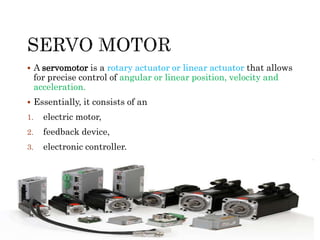
 A servomotor is a rotary actuator or linear actuator that allows
for precise control of angular or linear position, velocity and
acceleration.
 Essentially, it consists of an
1. electric motor,
2. feedback device,
3. electronic controller.
 Motors can be either AC or DC
 Can be of 1 phase or 3 phase.
 DC motors can be brushed or brushless.
 Brushless DC motors are more expensive, drives are more
complex, but are more reliable and maintenance free.
 Feedback device for servomotors is typically an encoder or
resolver built into the motor frame.
 Control circuitry is a motion controller (generates motion) and
a drive to supply power to the motor
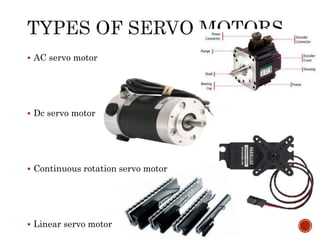
 AC servo motor
 Dc servo motor
 Continuous rotation servo motor
 Linear servo motor

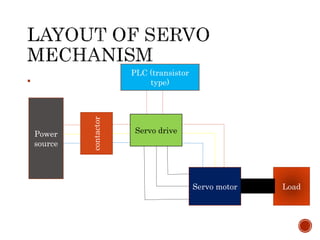
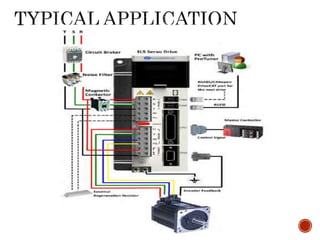
Servo drive
PLC (transistor
type)
Servo motor
Power
source
contactor
Load
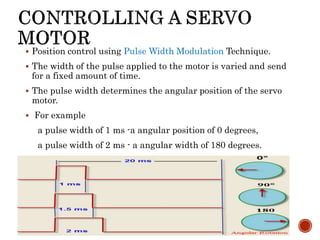
 Position control using Pulse Width Modulation Technique.
 The width of the pulse applied to the motor is varied and send
for a fixed amount of time.
 The pulse width determines the angular position of the servo
motor.
 For example
a pulse width of 1 ms -a angular position of 0 degrees,
a pulse width of 2 ms - a angular width of 180 degrees.
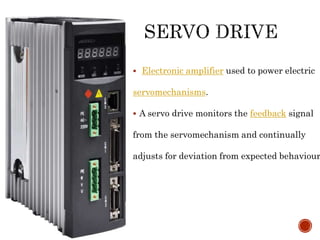
 Electronic amplifier used to power electric
servomechanisms.
 A servo drive monitors the feedback signal
from the servomechanism and continually
adjusts for deviation from expected behaviour.
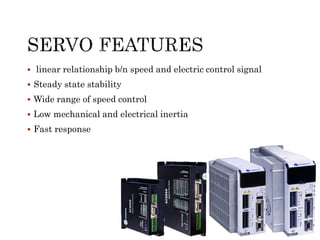
 linear relationship b/n speed and electric control signal
 Steady state stability
 Wide range of speed control
 Low mechanical and electrical inertia
 Fast response
 Robotics
 Conveyor belts
 Camera auto focus
 Robotic vehicles
 Solar tracking system
 CNC machines
 Antenna positioning
 Metal cutting & metal forming m/c – millimg m/c, lathe,
grinding, pressing, punching, bending in metal fabrication.
 Textiles
 Printers
 Automatic door openers
Thank you….

Servo motor and servo drive

  • 1.
  • 2.
     A servomotoris a rotary actuator or linear actuator that allows for precise control of angular or linear position, velocity and acceleration.  Essentially, it consists of an 1. electric motor, 2. feedback device, 3. electronic controller.
  • 3.
     Motors canbe either AC or DC  Can be of 1 phase or 3 phase.  DC motors can be brushed or brushless.  Brushless DC motors are more expensive, drives are more complex, but are more reliable and maintenance free.  Feedback device for servomotors is typically an encoder or resolver built into the motor frame.  Control circuitry is a motion controller (generates motion) and a drive to supply power to the motor
  • 4.
     AC servomotor  Dc servo motor  Continuous rotation servo motor  Linear servo motor
  • 5.
     Servo drive PLC (transistor type) Servomotor Power source contactor Load
  • 6.
     Position controlusing Pulse Width Modulation Technique.  The width of the pulse applied to the motor is varied and send for a fixed amount of time.  The pulse width determines the angular position of the servo motor.  For example a pulse width of 1 ms -a angular position of 0 degrees, a pulse width of 2 ms - a angular width of 180 degrees.
  • 7.
     Electronic amplifierused to power electric servomechanisms.  A servo drive monitors the feedback signal from the servomechanism and continually adjusts for deviation from expected behaviour.
  • 8.
     linear relationshipb/n speed and electric control signal  Steady state stability  Wide range of speed control  Low mechanical and electrical inertia  Fast response
  • 10.
     Robotics  Conveyorbelts  Camera auto focus  Robotic vehicles  Solar tracking system  CNC machines  Antenna positioning  Metal cutting & metal forming m/c – millimg m/c, lathe, grinding, pressing, punching, bending in metal fabrication.  Textiles  Printers  Automatic door openers
  • 12.