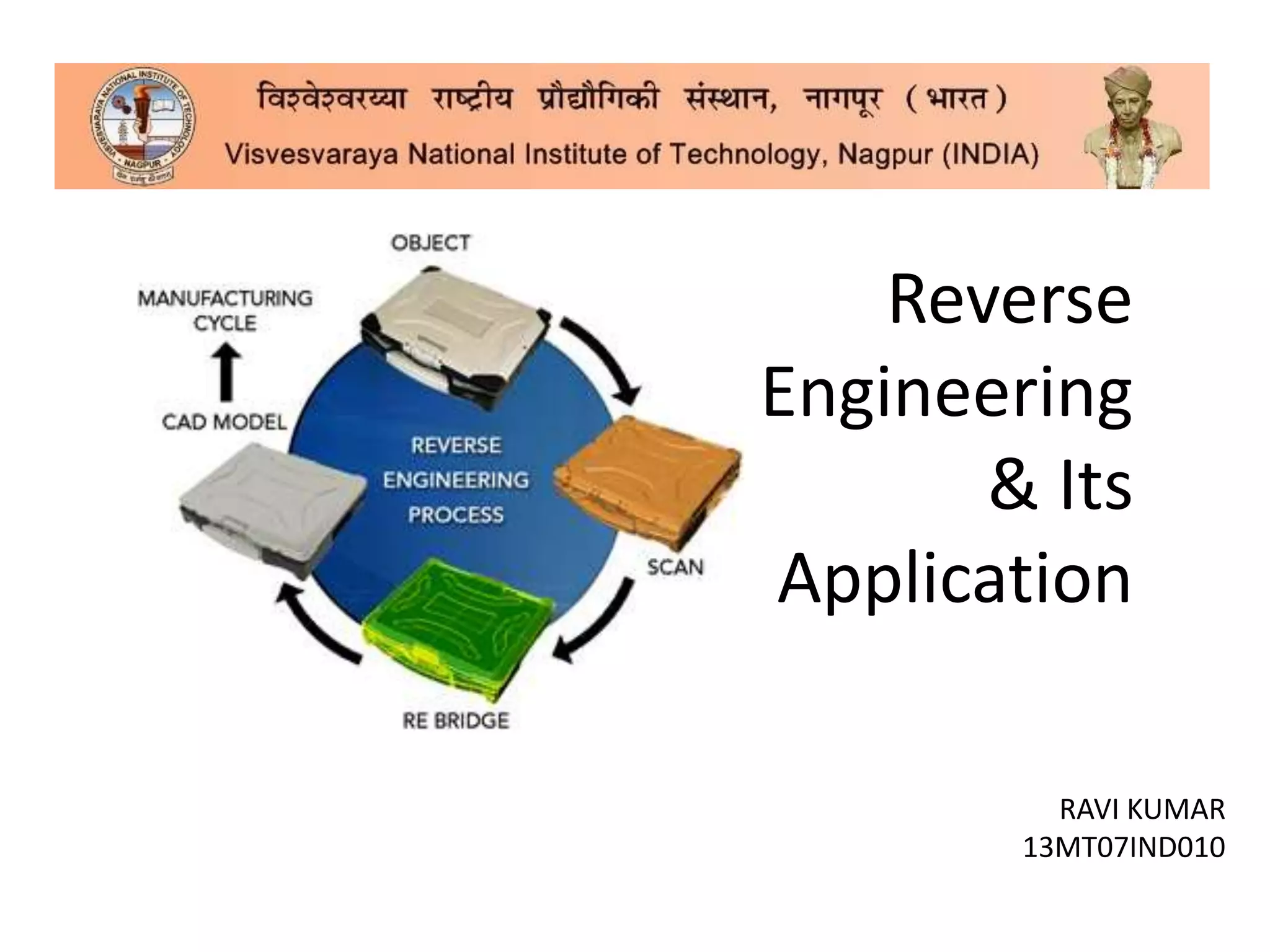
Reverse
Engineering
& Its
Application
RAVI KUMAR
13MT07IND010
Reverse Engineering
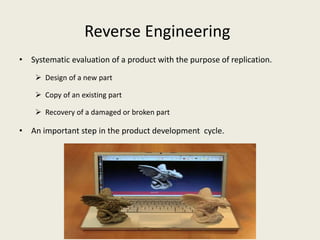
• Systematic evaluation of a product with the purpose of replication.
 Design of a new part
 Copy of an existing part
 Recovery of a damaged or broken part
• An important step in the product development cycle.
Importance
• We cannot start from the very beginning to develop a new product
every time.
• We need to optimize the resources available in our hands and
reduce the production time keeping in view the customers’
requirements.
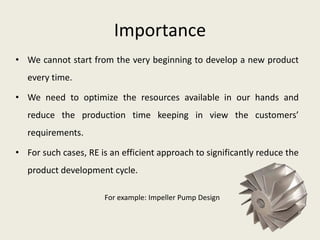
• For such cases, RE is an efficient approach to significantly reduce the
product development cycle.
For example: Impeller Pump Design
Need for reverse engineering
 Suppose there is a impellor pump which had an original pumping capacity
of 20000 cubic feet of water per minute; now, after a year of use, the
pump manufacturing company finds that it is pumping 19000 cubic feet
per minute. They need to figure out what happened to that extra 1
thousand cubic feet in performance. The pump manufacturer scans the
year-old impeller into the CAD system. Once those measurements are
captured, engineers can compare the measurements taken from the
actual impeller against the original, as-designed part. This helps determine
exactly how and where the part has degraded. With that information in
hand, engineers can redesign the impeller to avoid future loss in pumping
capability.
Advantages
 Cost saving for developing
new products.
 Lesser maintenance costs
 Quality improvement
 Competitive advantages
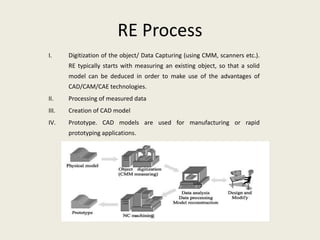
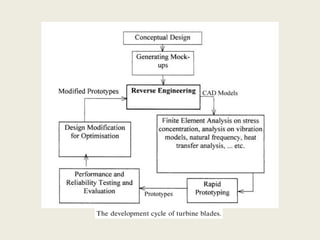
RE Process
I. Digitization of the object/ Data Capturing (using CMM, scanners etc.).
RE typically starts with measuring an existing object, so that a solid
model can be deduced in order to make use of the advantages of
CAD/CAM/CAE technologies.
II. Processing of measured data
III. Creation of CAD model
IV. Prototype. CAD models are used for manufacturing or rapid
prototyping applications.
Rapid Prototyping in combination with
RE
• A group of techniques to quickly fabricate a scale
model of a physical part or assembly using
3D CAD data
• Integration of reverse engineering and rapid
prototyping is being used for getting product to
the market quickly by resolving a long-standing
conflict between design and manufacturing
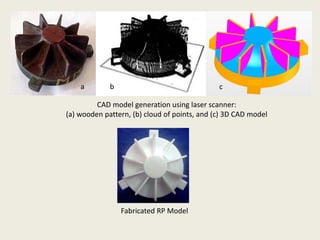
CAD model generation using laser scanner:
(a) wooden pattern, (b) cloud of points, and (c) 3D CAD model
a b c
Fabricated RP Model
Areas of Application
Design of a new component
Reproduction of an existing component
Improving quality & efficiency of existing parts
Manufacturing Engineering
• To create a 3D virtual model of an existing
physical part for use in 3D CAD, CAM, CAE or
other software
• To make a digital 3D record of own products
• To assess competitors' products
• To analyze the working of a product
• To identify potential patent infringement etc.
Software Engineering
• To extract design & implementation information
• To detect and neutralize viruses and malware
• To determine chemical composition
• To substitute or improve recipes to stimulate or improve the
products performance
Chemical Engineering
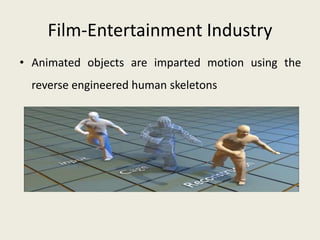
Film-Entertainment Industry
• Animated objects are imparted motion using the
reverse engineered human skeletons
Medical Field
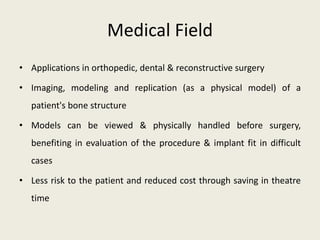
• Applications in orthopedic, dental & reconstructive surgery
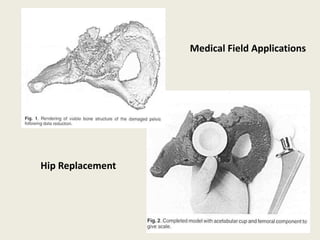
• Imaging, modeling and replication (as a physical model) of a
patient's bone structure
• Models can be viewed & physically handled before surgery,
benefiting in evaluation of the procedure & implant fit in difficult
cases
• Less risk to the patient and reduced cost through saving in theatre
time
Medical Field Applications
Hip Replacement
A Case Study
Adapted from “Reverse engineering in the
design of turbine blades-a case study in
applying the MAMDP” by Liang-Chia Chen, Grier
C.I. Lin
• The large amount of surface data generated from the fast
3D digitizers is not easily modeled by current CAD/CAM
systems. Inadequate data reduction methods are not only
time consuming, but lose surface characteristic points.
• Consequently, the reconstructed surfaces could lose their
true shape in the design cycle. The time required for
reprocessing in this case would be unacceptable to the
manufacturing industry and thereby be unusable for
further steps.
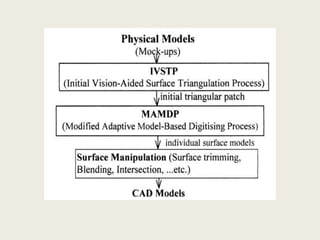
• The study describes how the developed
reverse engineering approach MAMDP was
successfully applied to design of turbine
blades and the existing problems encountered
in reverse engineering processes were
overcome.
• MAMDP stands for Modified Adaptive Model-
based Digitizing Process
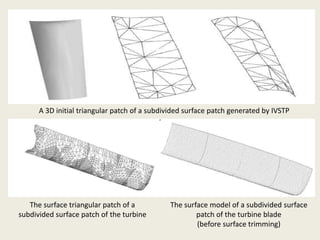
A 3D initial triangular patch of a subdivided surface patch generated by IVSTP
The surface triangular patch of a
subdivided surface patch of the turbine
The surface model of a subdivided surface
patch of the turbine blade
(before surface trimming)
Generation of initial surface triangular
patches of turbine blades
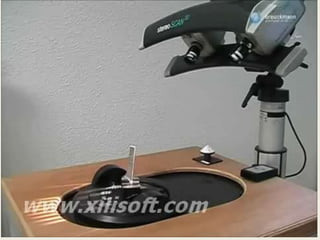
• A charge-coupled device (CCD) camera is used
to rapidly detect the object's position and
measure its surface boundary coordinates, to
establish exploration paths for further
automatic surface digitization of a touch
probe.
• Free-form surface subdivided into an adequate number of
individual surface patches
• 3D stereo detection method is applied to automatically
detect 3D surface boundaries
• Initial triangular patch by applying Triangulation process
• A 3D initial triangular surface patch can be rapidly
generated & used for probe exploration paths in the
following MAMDP
Automatic surface digitization &
surface modeling by using the MAMDP
• The surface model is used to calculate the
new exploration points at the approximate
midpoints between the vertices of the initial
triangular patch.
• CMM then automatically digitizes these
exploration targets
• Adaptive approach evaluates the digitizing accuracy by
calculating the deviations between the target points
and the digitized points
• New exploration targets will be generated at the
estimated midpoints between vertices of those
triangular patches where deviations are higher than
the user-specified tolerance
• This iterative digitizing loop will continue until all new
digitized deviations are within the specified tolerance
• Totally 786 surface characteristic points were automatically
digitized by a touch-triggered probe in CMM. The time
spent for this job was 45 min. The digitizing accuracy can be
controlled within 0.25 mm and the maximum fitted error in
the resulting surface model is reduced to 0.030 mm using a
least-squares fitting method.
• To generate a complete CAD surface model of turbine
blades, the individual surface models generated from the
MAMDP have to be merged, according to their geometric
relationship. (Using CAD/CAM package ANVIL5000)
Future Scope & Possibilities
With the advent of RE & RP, we can hope to see
commercial and domestic use of these technologies
to manufacture desired products at home and offices
which will be revolutionary in coming time.
Possibilities of use of this technology is only
restricted by boundaries of human thinking.
• 3D laser scanners as robot eye for scanning objects specially in
space missions.
• Scanning technology can be integrated with mobile
phones/cameras and can be used for 3D printing at domestic level.
• Tissue engineering applications where organs and body parts are
built using inkjet techniques. Layers of living cells are deposited
onto a gel medium or sugar matrix and slowly built up to form three
dimensional structures including vascular systems.
• Availability of 3D printers at every home as is now of the normal
printers.
Around the World…
• 'Wiki Weapon Project' Aims To Create A Gun
Anyone Can 3D-Print At Home.
• Some companies offer an on-line 3D printing
service open both to consumers and to
industry.
Thank You!

ravi reverseengineeringitsapplication01 121101044845-phpapp02

  • 1.
  • 2.
    Reverse Engineering • Systematicevaluation of a product with the purpose of replication.  Design of a new part  Copy of an existing part  Recovery of a damaged or broken part • An important step in the product development cycle.
  • 3.
    Importance • We cannotstart from the very beginning to develop a new product every time. • We need to optimize the resources available in our hands and reduce the production time keeping in view the customers’ requirements. • For such cases, RE is an efficient approach to significantly reduce the product development cycle. For example: Impeller Pump Design
  • 4.
    Need for reverseengineering  Suppose there is a impellor pump which had an original pumping capacity of 20000 cubic feet of water per minute; now, after a year of use, the pump manufacturing company finds that it is pumping 19000 cubic feet per minute. They need to figure out what happened to that extra 1 thousand cubic feet in performance. The pump manufacturer scans the year-old impeller into the CAD system. Once those measurements are captured, engineers can compare the measurements taken from the actual impeller against the original, as-designed part. This helps determine exactly how and where the part has degraded. With that information in hand, engineers can redesign the impeller to avoid future loss in pumping capability.
  • 5.
    Advantages  Cost savingfor developing new products.  Lesser maintenance costs  Quality improvement  Competitive advantages
  • 6.
    RE Process I. Digitizationof the object/ Data Capturing (using CMM, scanners etc.). RE typically starts with measuring an existing object, so that a solid model can be deduced in order to make use of the advantages of CAD/CAM/CAE technologies. II. Processing of measured data III. Creation of CAD model IV. Prototype. CAD models are used for manufacturing or rapid prototyping applications.
  • 7.
    Rapid Prototyping incombination with RE • A group of techniques to quickly fabricate a scale model of a physical part or assembly using 3D CAD data • Integration of reverse engineering and rapid prototyping is being used for getting product to the market quickly by resolving a long-standing conflict between design and manufacturing
  • 8.
    CAD model generationusing laser scanner: (a) wooden pattern, (b) cloud of points, and (c) 3D CAD model a b c Fabricated RP Model
  • 9.
    Areas of Application Designof a new component Reproduction of an existing component Improving quality & efficiency of existing parts
  • 10.
    Manufacturing Engineering • Tocreate a 3D virtual model of an existing physical part for use in 3D CAD, CAM, CAE or other software • To make a digital 3D record of own products • To assess competitors' products • To analyze the working of a product • To identify potential patent infringement etc.
  • 11.
    Software Engineering • Toextract design & implementation information • To detect and neutralize viruses and malware • To determine chemical composition • To substitute or improve recipes to stimulate or improve the products performance Chemical Engineering
  • 12.
    Film-Entertainment Industry • Animatedobjects are imparted motion using the reverse engineered human skeletons
  • 13.
    Medical Field • Applicationsin orthopedic, dental & reconstructive surgery • Imaging, modeling and replication (as a physical model) of a patient's bone structure • Models can be viewed & physically handled before surgery, benefiting in evaluation of the procedure & implant fit in difficult cases • Less risk to the patient and reduced cost through saving in theatre time
  • 14.
  • 15.
    A Case Study Adaptedfrom “Reverse engineering in the design of turbine blades-a case study in applying the MAMDP” by Liang-Chia Chen, Grier C.I. Lin
  • 17.
    • The largeamount of surface data generated from the fast 3D digitizers is not easily modeled by current CAD/CAM systems. Inadequate data reduction methods are not only time consuming, but lose surface characteristic points. • Consequently, the reconstructed surfaces could lose their true shape in the design cycle. The time required for reprocessing in this case would be unacceptable to the manufacturing industry and thereby be unusable for further steps.
  • 18.
    • The studydescribes how the developed reverse engineering approach MAMDP was successfully applied to design of turbine blades and the existing problems encountered in reverse engineering processes were overcome. • MAMDP stands for Modified Adaptive Model- based Digitizing Process
  • 20.
    A 3D initialtriangular patch of a subdivided surface patch generated by IVSTP The surface triangular patch of a subdivided surface patch of the turbine The surface model of a subdivided surface patch of the turbine blade (before surface trimming)
  • 22.
    Generation of initialsurface triangular patches of turbine blades • A charge-coupled device (CCD) camera is used to rapidly detect the object's position and measure its surface boundary coordinates, to establish exploration paths for further automatic surface digitization of a touch probe.
  • 23.
    • Free-form surfacesubdivided into an adequate number of individual surface patches • 3D stereo detection method is applied to automatically detect 3D surface boundaries • Initial triangular patch by applying Triangulation process • A 3D initial triangular surface patch can be rapidly generated & used for probe exploration paths in the following MAMDP
  • 24.
    Automatic surface digitization& surface modeling by using the MAMDP • The surface model is used to calculate the new exploration points at the approximate midpoints between the vertices of the initial triangular patch. • CMM then automatically digitizes these exploration targets
  • 25.
    • Adaptive approachevaluates the digitizing accuracy by calculating the deviations between the target points and the digitized points • New exploration targets will be generated at the estimated midpoints between vertices of those triangular patches where deviations are higher than the user-specified tolerance • This iterative digitizing loop will continue until all new digitized deviations are within the specified tolerance
  • 26.
    • Totally 786surface characteristic points were automatically digitized by a touch-triggered probe in CMM. The time spent for this job was 45 min. The digitizing accuracy can be controlled within 0.25 mm and the maximum fitted error in the resulting surface model is reduced to 0.030 mm using a least-squares fitting method. • To generate a complete CAD surface model of turbine blades, the individual surface models generated from the MAMDP have to be merged, according to their geometric relationship. (Using CAD/CAM package ANVIL5000)
  • 27.
    Future Scope &Possibilities With the advent of RE & RP, we can hope to see commercial and domestic use of these technologies to manufacture desired products at home and offices which will be revolutionary in coming time. Possibilities of use of this technology is only restricted by boundaries of human thinking.
  • 28.
    • 3D laserscanners as robot eye for scanning objects specially in space missions. • Scanning technology can be integrated with mobile phones/cameras and can be used for 3D printing at domestic level. • Tissue engineering applications where organs and body parts are built using inkjet techniques. Layers of living cells are deposited onto a gel medium or sugar matrix and slowly built up to form three dimensional structures including vascular systems. • Availability of 3D printers at every home as is now of the normal printers.
  • 29.
    Around the World… •'Wiki Weapon Project' Aims To Create A Gun Anyone Can 3D-Print At Home. • Some companies offer an on-line 3D printing service open both to consumers and to industry.
  • 30.