Electric motors
Presented at
MESCE KUTTIPPURAM
1
Over view
• Electric motors
• Types of electric motors
• Losses in induction machines
• Motor efficiency
• Energy efficient motor
2
ELECTRIC MOTORS
• Convert electric energy to mechanical energy
• Operate by the interaction between magnetic field and winding
current
• Operate in both motoring and braking mode
• Use in industrial fans ,pumps, machine tools etc..
3
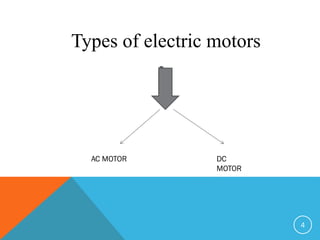
Types of electric motors
AC MOTOR DC
MOTOR
4
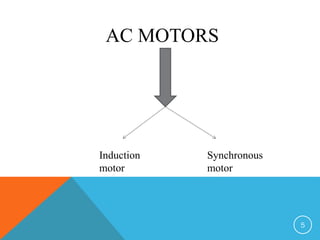
AC MOTORS
Induction
motor
Synchronous
motor
5
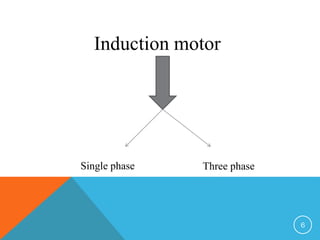
Induction motor
Three phaseSingle phase
6
7
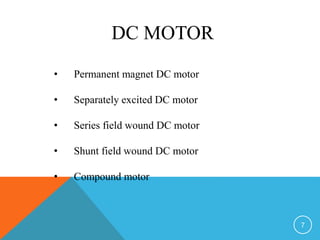
DC MOTOR
• Permanent magnet DC motor
• Separately excited DC motor
• Series field wound DC motor
• Shunt field wound DC motor
• Compound motor
8
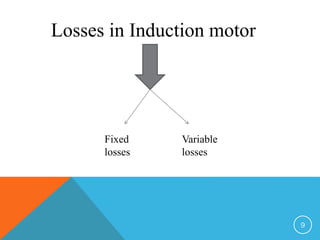
Losses in induction machines
• Electrical losses due to heat produced in the stator and
rotor winding (copper losses)
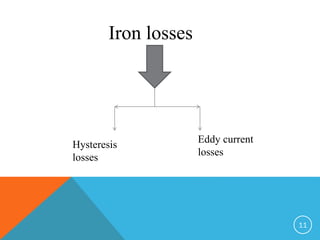
• Magnetic loss in the iron due to hysteresis and eddy
current
• Mechanical loss due to friction in the bearing and
ventilation
• Stray load losses
Losses in Induction motor
Variable
losses
Fixed
losses
9
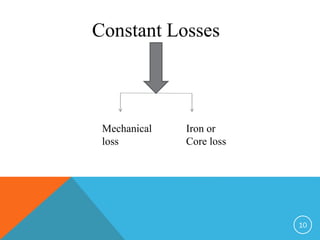
Constant Losses
Iron or
Core loss
Mechanical
loss
10
Iron losses
Eddy current
losses
Hysteresis
losses
11
12
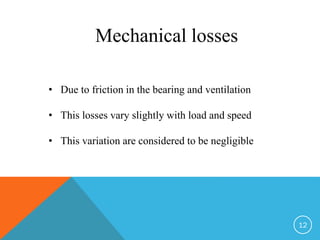
Mechanical losses
• Due to friction in the bearing and ventilation
• This losses vary slightly with load and speed
• This variation are considered to be negligible
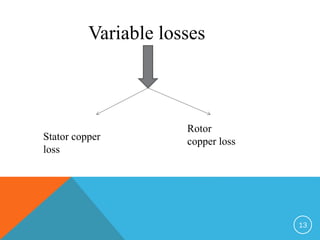
Variable losses
Stator copper
loss
Rotor
copper loss
13
Motor Efficiency
• Ratio between the shaft power out put to
the electrical input
• Ƞ = P out/P in
• Ƞm = (Pout )(746)/Pin
when Pout in hP
14
Energy Efficient motors
• 2 to 8 percentage more efficiency than the standard
motor
• Same out put by consuming lesser amount of power
• Achieved by
1. More copper in the winding
2. Reduced fan loss
3. Higher quality thinner steel lamination
4. Optimal air gap between rotor and stator
5. Greater length high quality aluminum used
in the rotor frame 15
16
THANK YOU

Electric motors