Made by:- 
Manish Bhagat
CONTENTS 
• What Is a Stepper Motor? 
• Construction 
• Working Of Stepper Motor? 
• The 3 Types Of Motors? 
• 1. Variable Reluctance Stepper 
• 2. Permanent Magnet Stepper 
• 3. Hybrid Synchronous Stepper 
• Phase Current Waveforms 
• Applications
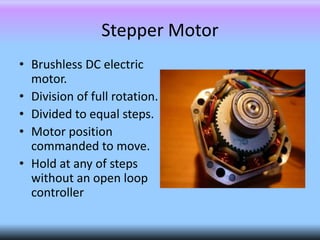
Stepper Motor 
• Brushless DC electric 
motor. 
• Division of full rotation. 
• Divided to equal steps. 
• Motor position 
commanded to move. 
• Hold at any of steps 
without an open loop 
controller
Rotor 
Stator 
Coils 
2 
1 
S 
1 
N 
2 
Construction 
Outside Casing 
Stator 
Rotor 
Internal components of a Stepper Motor
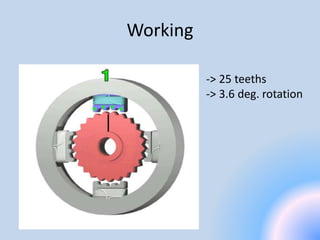
Working 
-> 25 teeths 
-> 3.6 deg. rotation
The 3 Types 
Of Motors? 
1. Variable 
Reluctance 
Stepper 
2. 
Permanent 
Magnet 
Stepper 
3. Hybrid 
Synchronous 
Stepper
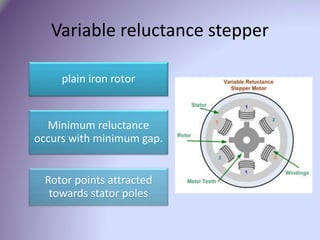
Variable reluctance stepper 
plain iron rotor 
Minimum reluctance 
occurs with minimum gap. 
Rotor points attracted 
towards stator poles
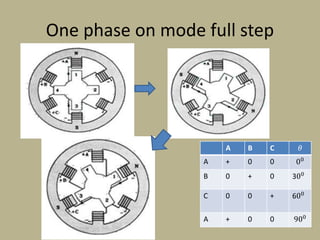
One phase on mode full step 
A B C 휃 
A + 0 0 00 
B 0 + 0 300 
C 0 0 + 600 
A + 0 0 900
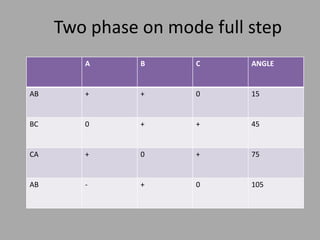
Two phase on mode full step 
A B C ANGLE 
AB + + 0 15 
BC 0 + + 45 
CA + 0 + 75 
AB - + 0 105
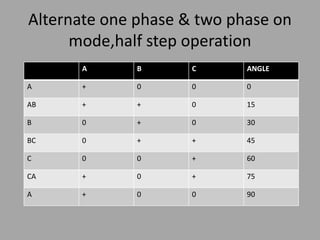
Alternate one phase & two phase on 
mode,half step operation 
A B C ANGLE 
A + 0 0 0 
AB + + 0 15 
B 0 + 0 30 
BC 0 + + 45 
C 0 0 + 60 
CA + 0 + 75 
A + 0 0 90
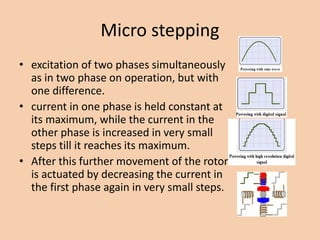
Micro stepping 
• excitation of two phases simultaneously 
as in two phase on operation, but with 
one difference. 
• current in one phase is held constant at 
its maximum, while the current in the 
other phase is increased in very small 
steps till it reaches its maximum. 
• After this further movement of the rotor 
is actuated by decreasing the current in 
the first phase again in very small steps.
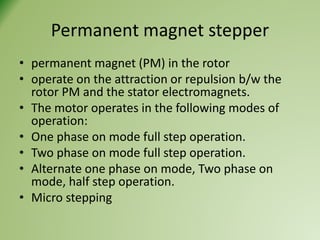
Permanent magnet stepper 
• permanent magnet (PM) in the rotor 
• operate on the attraction or repulsion b/w the 
rotor PM and the stator electromagnets. 
• The motor operates in the following modes of 
operation: 
• One phase on mode full step operation. 
• Two phase on mode full step operation. 
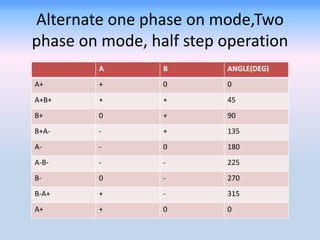
• Alternate one phase on mode, Two phase on 
mode, half step operation. 
• Micro stepping
One phase on mode full step operation 
A B ANGLE 
IN 
DEGRE 
ES 
A+ + 0 0 
B+ 0 + 90 
A- - 0 180 
B- 0 - 270 
A+ + 0 0
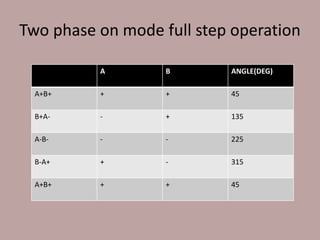
Two phase on mode full step operation 
A B ANGLE(DEG) 
A+B+ + + 45 
B+A- - + 135 
A-B- - - 225 
B-A+ + - 315 
A+B+ + + 45
Alternate one phase on mode,Two 
phase on mode, half step operation 
A B ANGLE(DEG) 
A+ + 0 0 
A+B+ + + 45 
B+ 0 + 90 
B+A- - + 135 
A- - 0 180 
A-B- - - 225 
B- 0 - 270 
B-A+ + - 315 
A+ + 0 0
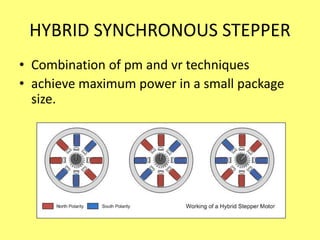
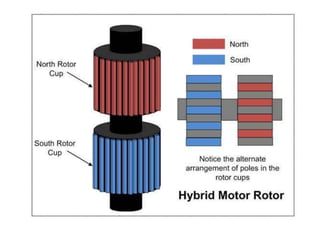
HYBRID SYNCHRONOUS STEPPER 
• Combination of pm and vr techniques 
• achieve maximum power in a small package 
size.
Phase current waveforms 
•WAVE DRIVE 
• FULL STEP DRIVE 
•HALF STEPPING 
•MICRO STEPPING
Wave drive 
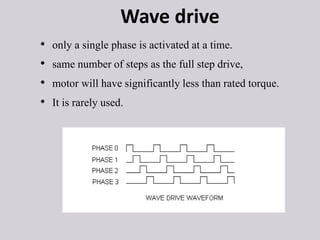
• only a single phase is activated at a time. 
• same number of steps as the full step drive, 
• motor will have significantly less than rated torque. 
• It is rarely used.
Full step drive 
• usual method for full step driving the motor 
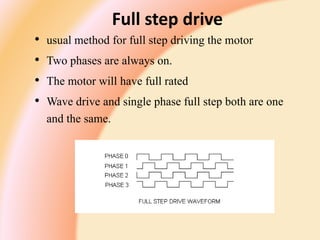
• Two phases are always on. 
• The motor will have full rated 
• Wave drive and single phase full step both are one 
and the same.
Half stepping 
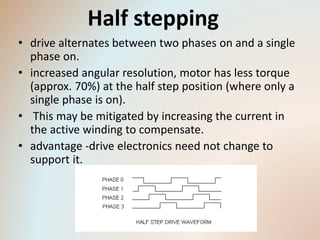
• drive alternates between two phases on and a single 
phase on. 
• increased angular resolution, motor has less torque 
(approx. 70%) at the half step position (where only a 
single phase is on). 
• This may be mitigated by increasing the current in 
the active winding to compensate. 
• advantage -drive electronics need not change to 
support it.
Micro stepping 
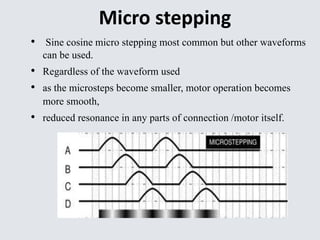
• Sine cosine micro stepping most common but other waveforms 
can be used. 
• Regardless of the waveform used 
• as the microsteps become smaller, motor operation becomes 
more smooth, 
• reduced resonance in any parts of connection /motor itself.
APPLICATIONS 
• They are commonly used in watches and old electric meters 
• They are used in wide variety 
1. In Industry 
As - Drilling Machine, 
- Grinder, 
- Laser Cutting, 
- Conveyor;& 
- Assembly Lines. 
2. In computer Peripherals 
As - Printer, 
- Plotter, 
- Tape Reader, 
- Card Reader;& 
- Copy Machines. 
3. In Business 
As - Banking systems;& 
- Automatic typewriters. 
4. In Motion Control and Robotics 
As - Silicon Processing;& 
- I.C. Bonding.
BIBLIOGRAPHY 
• Book: Basic Electrical Engineering 
Author: DC Kulshreshtha 
• http://en.wikipedia.org/wiki/Stepper_motor 
• http://www.omega.com/auto/pdf/REF_Intro 
StepMotors.pdf 
• http://users.ece.utexas.edu/~valvano/Datash 
eets/StepperMicrostep.pdf 
• http://zone.ni.com/devzone/cda/ph/p/id/28 
7#toc2
Stepper motors

Stepper motors

  • 1.
  • 2.
    CONTENTS • WhatIs a Stepper Motor? • Construction • Working Of Stepper Motor? • The 3 Types Of Motors? • 1. Variable Reluctance Stepper • 2. Permanent Magnet Stepper • 3. Hybrid Synchronous Stepper • Phase Current Waveforms • Applications
  • 3.
    Stepper Motor •Brushless DC electric motor. • Division of full rotation. • Divided to equal steps. • Motor position commanded to move. • Hold at any of steps without an open loop controller
  • 4.
    Rotor Stator Coils 2 1 S 1 N 2 Construction Outside Casing Stator Rotor Internal components of a Stepper Motor
  • 5.
    Working -> 25teeths -> 3.6 deg. rotation
  • 6.
    The 3 Types Of Motors? 1. Variable Reluctance Stepper 2. Permanent Magnet Stepper 3. Hybrid Synchronous Stepper
  • 7.
    Variable reluctance stepper plain iron rotor Minimum reluctance occurs with minimum gap. Rotor points attracted towards stator poles
  • 8.
    One phase onmode full step A B C 휃 A + 0 0 00 B 0 + 0 300 C 0 0 + 600 A + 0 0 900
  • 9.
    Two phase onmode full step A B C ANGLE AB + + 0 15 BC 0 + + 45 CA + 0 + 75 AB - + 0 105
  • 10.
    Alternate one phase& two phase on mode,half step operation A B C ANGLE A + 0 0 0 AB + + 0 15 B 0 + 0 30 BC 0 + + 45 C 0 0 + 60 CA + 0 + 75 A + 0 0 90
  • 11.
    Micro stepping •excitation of two phases simultaneously as in two phase on operation, but with one difference. • current in one phase is held constant at its maximum, while the current in the other phase is increased in very small steps till it reaches its maximum. • After this further movement of the rotor is actuated by decreasing the current in the first phase again in very small steps.
  • 12.
    Permanent magnet stepper • permanent magnet (PM) in the rotor • operate on the attraction or repulsion b/w the rotor PM and the stator electromagnets. • The motor operates in the following modes of operation: • One phase on mode full step operation. • Two phase on mode full step operation. • Alternate one phase on mode, Two phase on mode, half step operation. • Micro stepping
  • 13.
    One phase onmode full step operation A B ANGLE IN DEGRE ES A+ + 0 0 B+ 0 + 90 A- - 0 180 B- 0 - 270 A+ + 0 0
  • 14.
    Two phase onmode full step operation A B ANGLE(DEG) A+B+ + + 45 B+A- - + 135 A-B- - - 225 B-A+ + - 315 A+B+ + + 45
  • 15.
    Alternate one phaseon mode,Two phase on mode, half step operation A B ANGLE(DEG) A+ + 0 0 A+B+ + + 45 B+ 0 + 90 B+A- - + 135 A- - 0 180 A-B- - - 225 B- 0 - 270 B-A+ + - 315 A+ + 0 0
  • 16.
    HYBRID SYNCHRONOUS STEPPER • Combination of pm and vr techniques • achieve maximum power in a small package size.
  • 18.
    Phase current waveforms •WAVE DRIVE • FULL STEP DRIVE •HALF STEPPING •MICRO STEPPING
  • 19.
    Wave drive •only a single phase is activated at a time. • same number of steps as the full step drive, • motor will have significantly less than rated torque. • It is rarely used.
  • 20.
    Full step drive • usual method for full step driving the motor • Two phases are always on. • The motor will have full rated • Wave drive and single phase full step both are one and the same.
  • 21.
    Half stepping •drive alternates between two phases on and a single phase on. • increased angular resolution, motor has less torque (approx. 70%) at the half step position (where only a single phase is on). • This may be mitigated by increasing the current in the active winding to compensate. • advantage -drive electronics need not change to support it.
  • 22.
    Micro stepping •Sine cosine micro stepping most common but other waveforms can be used. • Regardless of the waveform used • as the microsteps become smaller, motor operation becomes more smooth, • reduced resonance in any parts of connection /motor itself.
  • 23.
    APPLICATIONS • Theyare commonly used in watches and old electric meters • They are used in wide variety 1. In Industry As - Drilling Machine, - Grinder, - Laser Cutting, - Conveyor;& - Assembly Lines. 2. In computer Peripherals As - Printer, - Plotter, - Tape Reader, - Card Reader;& - Copy Machines. 3. In Business As - Banking systems;& - Automatic typewriters. 4. In Motion Control and Robotics As - Silicon Processing;& - I.C. Bonding.
  • 24.
    BIBLIOGRAPHY • Book:Basic Electrical Engineering Author: DC Kulshreshtha • http://en.wikipedia.org/wiki/Stepper_motor • http://www.omega.com/auto/pdf/REF_Intro StepMotors.pdf • http://users.ece.utexas.edu/~valvano/Datash eets/StepperMicrostep.pdf • http://zone.ni.com/devzone/cda/ph/p/id/28 7#toc2