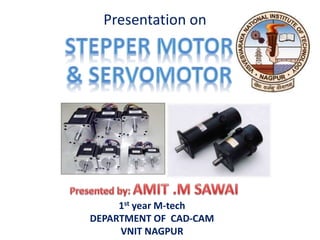
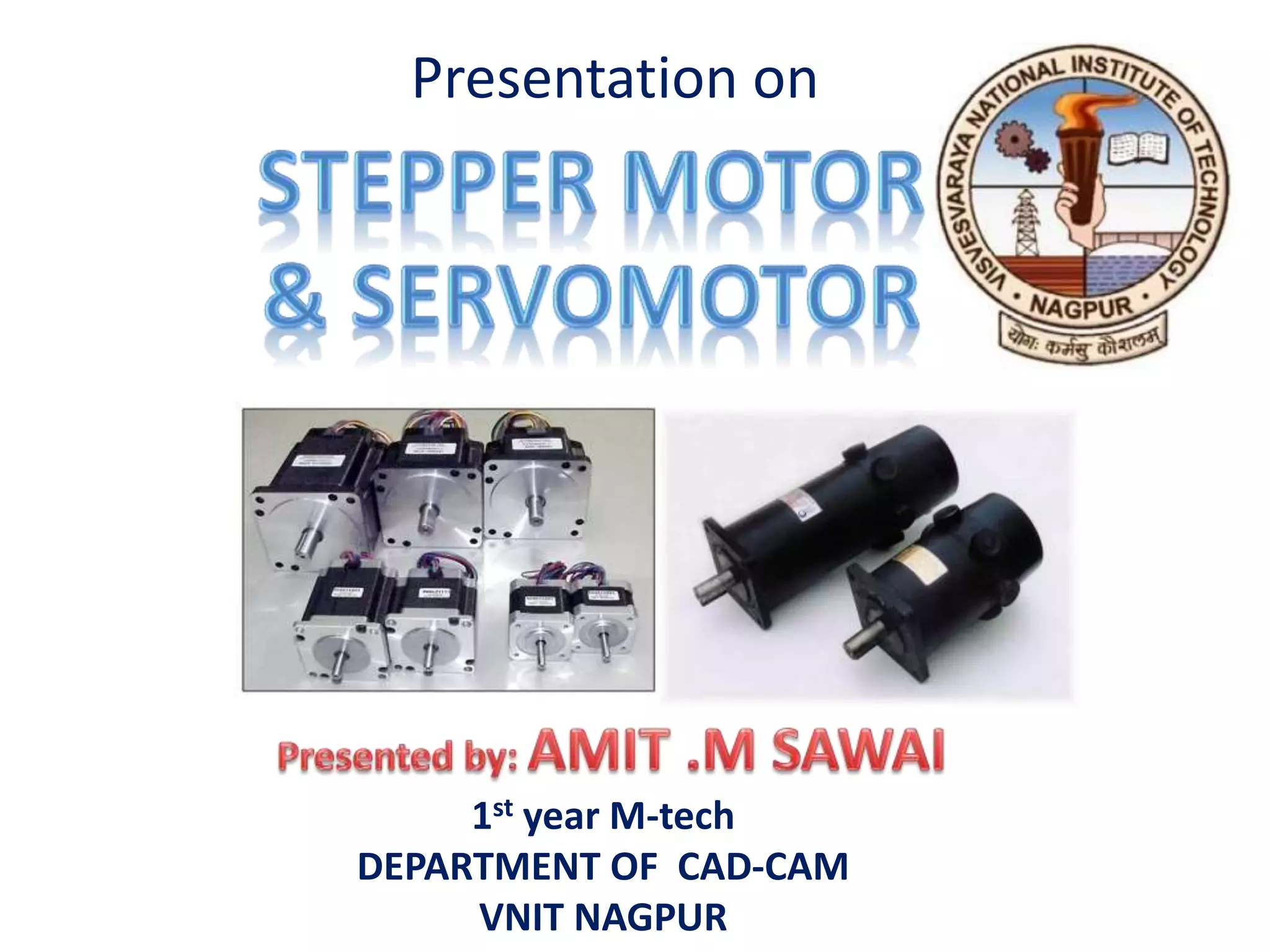
Presentation on
1st year M-tech
DEPARTMENT OF CAD-CAM
VNIT NAGPUR
What is Motor?
It may be DC or AC depending upon the type of power supply.
Stepper motor also stepping motor because this motor
rotates through a fixed angular step in response to each i/p
current pulse received by its controller.
Stepper motor popularity is due to fact that they can be
controlled directly by computer, microprocessors and
programmable controller.
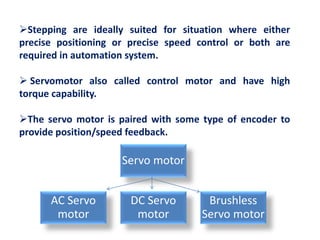
Stepping are ideally suited for situation where either
precise positioning or precise speed control or both are
required in automation system.
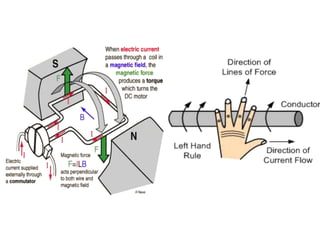
 Servomotor also called control motor and have high
torque capability.
The servo motor is paired with some type of encoder to
provide position/speed feedback.
Servo motor
AC Servo
motor
DC Servo
motor
Brushless
Servo motor
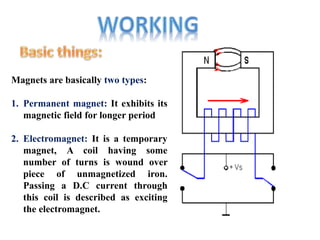
Magnets are basically two types:
1. Permanent magnet: It exhibits its
magnetic field for longer period
2. Electromagnet: It is a temporary
magnet, A coil having some
number of turns is wound over
piece of unmagnetized iron.
Passing a D.C current through
this coil is described as exciting
the electromagnet.
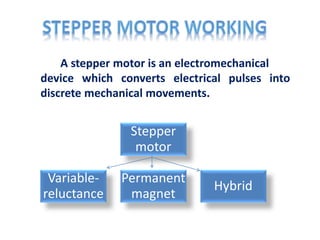
A stepper motor is an electromechanical
device which converts electrical pulses into
discrete mechanical movements.
Stepper
motor
Variable-
reluctance
Permanent
magnet
Hybrid
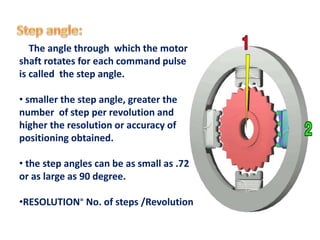
The angle through which the motor
shaft rotates for each command pulse
is called the step angle.
• smaller the step angle, greater the
number of step per revolution and
higher the resolution or accuracy of
positioning obtained.
• the step angles can be as small as .72
or as large as 90 degree.
•RESOLUTION⁼ No. of steps /Revolution
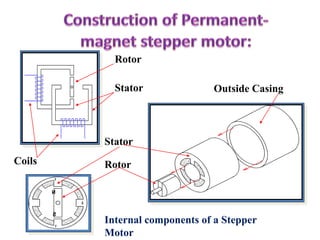
Rotor
Stator
Coils
2
1
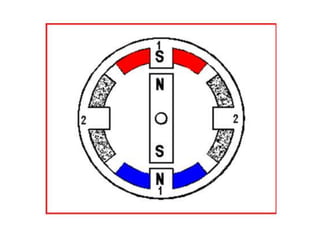
S
N
1
2
Outside Casing
Stator
Rotor
Internal components of a Stepper
Motor
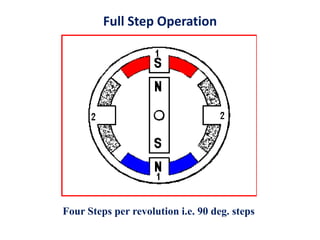
Full Step Operation
Four Steps per revolution i.e. 90 deg. steps
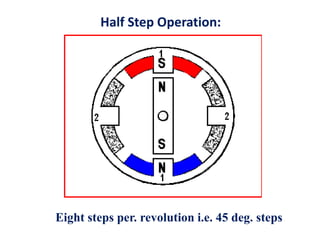
Half Step Operation:
Eight steps per. revolution i.e. 45 deg. steps
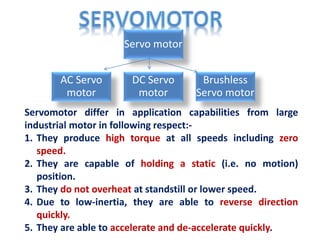
Servomotor differ in application capabilities from large
industrial motor in following respect:-
1. They produce high torque at all speeds including zero
speed.
2. They are capable of holding a static (i.e. no motion)
position.
3. They do not overheat at standstill or lower speed.
4. Due to low-inertia, they are able to reverse direction
quickly.
5. They are able to accelerate and de-accelerate quickly.
Servo motor
AC Servo
motor
DC Servo
motor
Brushless
Servo motor
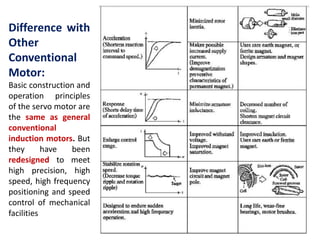
Difference with
Other
Conventional
Motor:
Basic construction and
operation principles
of the servo motor are
the same as general
conventional
induction motors. But
they have been
redesigned to meet
high precision, high
speed, high frequency
positioning and speed
control of mechanical
facilities
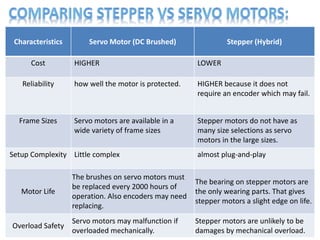
Characteristics Servo Motor (DC Brushed) Stepper (Hybrid)
Cost HIGHER LOWER
Reliability how well the motor is protected. HIGHER because it does not
require an encoder which may fail.
Frame Sizes Servo motors are available in a
wide variety of frame sizes
Stepper motors do not have as
many size selections as servo
motors in the large sizes.
Setup Complexity Little complex almost plug-and-play
Motor Life
The brushes on servo motors must
be replaced every 2000 hours of
operation. Also encoders may need
replacing.
The bearing on stepper motors are
the only wearing parts. That gives
stepper motors a slight edge on life.
Overload Safety
Servo motors may malfunction if
overloaded mechanically.
Stepper motors are unlikely to be
damages by mechanical overload.
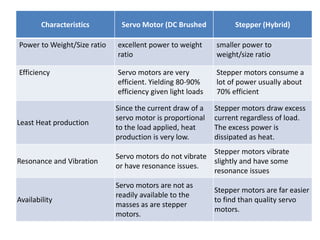
Characteristics Servo Motor (DC Brushed Stepper (Hybrid)
Power to Weight/Size ratio excellent power to weight
ratio
smaller power to
weight/size ratio
Efficiency Servo motors are very
efficient. Yielding 80-90%
efficiency given light loads
Stepper motors consume a
lot of power usually about
70% efficient
Least Heat production
Since the current draw of a
servo motor is proportional
to the load applied, heat
production is very low.
Stepper motors draw excess
current regardless of load.
The excess power is
dissipated as heat.
Resonance and Vibration
Servo motors do not vibrate
or have resonance issues.
Stepper motors vibrate
slightly and have some
resonance issues
Availability
Servo motors are not as
readily available to the
masses as are stepper
motors.
Stepper motors are far easier
to find than quality servo
motors.
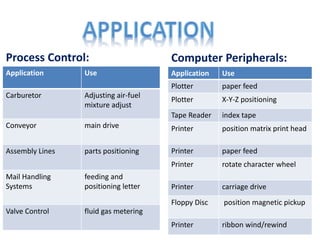
Application Use
Plotter paper feed
Plotter X-Y-Z positioning
Tape Reader index tape
Printer position matrix print head
Printer paper feed
Printer rotate character wheel
Printer carriage drive
Floppy Disc position magnetic pickup
Printer ribbon wind/rewind
Computer Peripherals:
Application Use
Carburetor Adjusting air-fuel
mixture adjust
Conveyor main drive
Assembly Lines parts positioning
Mail Handling
Systems
feeding and
positioning letter
Valve Control fluid gas metering
Process Control:
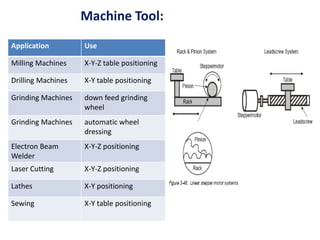
Machine Tool:
Application Use
Milling Machines X-Y-Z table positioning
Drilling Machines X-Y table positioning
Grinding Machines down feed grinding
wheel
Grinding Machines automatic wheel
dressing
Electron Beam
Welder
X-Y-Z positioning
Laser Cutting X-Y-Z positioning
Lathes X-Y positioning
Sewing X-Y table positioning
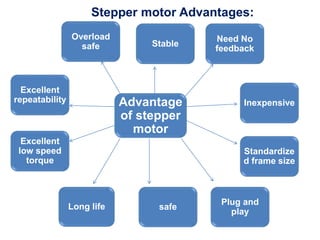
Stepper motor Advantages:
Advantage
of stepper
motor
Stable
Need No
feedback
Inexpensive
Standardize
d frame size
Plug and
play
safeLong life
Excellent
low speed
torque
Excellent
repeatability
Overload
safe
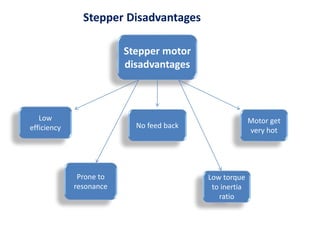
Stepper motor
disadvantages
Motor get
very hot
Low torque
to inertia
ratio
No feed back
Prone to
resonance
Low
efficiency
Stepper Disadvantages
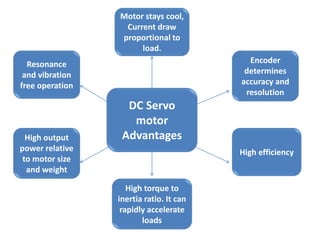
High output
power relative
to motor size
and weight
Motor stays cool,
Current draw
proportional to
load.
High efficiency
High torque to
inertia ratio. It can
rapidly accelerate
loads
Encoder
determines
accuracy and
resolution
Resonance
and vibration
free operation
DC Servo
motor
Advantages
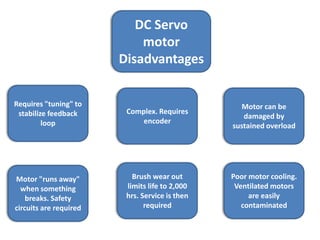
Poor motor cooling.
Ventilated motors
are easily
contaminated
Motor can be
damaged by
sustained overload
Brush wear out
limits life to 2,000
hrs. Service is then
required
Complex. Requires
encoder
Requires "tuning" to
stabilize feedback
loop
Motor "runs away"
when something
breaks. Safety
circuits are required
DC Servo
motor
Disadvantages
 a text book of ELECTRICAL TECHNOLOGY Vol.2 by B.L.
THERAJA and A.K. THEREJA
 a text book of BASIC ELECTRICAL ENGINEERING by S.B.
BODKHE and N.M. DESHKAR
Electromechanical Systems & Actuators BY Dr.AdelGastli

Step ppt

  • 1.
    Presentation on 1st yearM-tech DEPARTMENT OF CAD-CAM VNIT NAGPUR
  • 3.
    What is Motor? Itmay be DC or AC depending upon the type of power supply. Stepper motor also stepping motor because this motor rotates through a fixed angular step in response to each i/p current pulse received by its controller. Stepper motor popularity is due to fact that they can be controlled directly by computer, microprocessors and programmable controller.
  • 4.
    Stepping are ideallysuited for situation where either precise positioning or precise speed control or both are required in automation system.  Servomotor also called control motor and have high torque capability. The servo motor is paired with some type of encoder to provide position/speed feedback. Servo motor AC Servo motor DC Servo motor Brushless Servo motor
  • 5.
    Magnets are basicallytwo types: 1. Permanent magnet: It exhibits its magnetic field for longer period 2. Electromagnet: It is a temporary magnet, A coil having some number of turns is wound over piece of unmagnetized iron. Passing a D.C current through this coil is described as exciting the electromagnet.
  • 6.
    A stepper motoris an electromechanical device which converts electrical pulses into discrete mechanical movements. Stepper motor Variable- reluctance Permanent magnet Hybrid
  • 7.
    The angle throughwhich the motor shaft rotates for each command pulse is called the step angle. • smaller the step angle, greater the number of step per revolution and higher the resolution or accuracy of positioning obtained. • the step angles can be as small as .72 or as large as 90 degree. •RESOLUTION⁼ No. of steps /Revolution
  • 8.
  • 11.
    Full Step Operation FourSteps per revolution i.e. 90 deg. steps
  • 12.
    Half Step Operation: Eightsteps per. revolution i.e. 45 deg. steps
  • 13.
    Servomotor differ inapplication capabilities from large industrial motor in following respect:- 1. They produce high torque at all speeds including zero speed. 2. They are capable of holding a static (i.e. no motion) position. 3. They do not overheat at standstill or lower speed. 4. Due to low-inertia, they are able to reverse direction quickly. 5. They are able to accelerate and de-accelerate quickly. Servo motor AC Servo motor DC Servo motor Brushless Servo motor
  • 14.
    Difference with Other Conventional Motor: Basic constructionand operation principles of the servo motor are the same as general conventional induction motors. But they have been redesigned to meet high precision, high speed, high frequency positioning and speed control of mechanical facilities
  • 17.
    Characteristics Servo Motor(DC Brushed) Stepper (Hybrid) Cost HIGHER LOWER Reliability how well the motor is protected. HIGHER because it does not require an encoder which may fail. Frame Sizes Servo motors are available in a wide variety of frame sizes Stepper motors do not have as many size selections as servo motors in the large sizes. Setup Complexity Little complex almost plug-and-play Motor Life The brushes on servo motors must be replaced every 2000 hours of operation. Also encoders may need replacing. The bearing on stepper motors are the only wearing parts. That gives stepper motors a slight edge on life. Overload Safety Servo motors may malfunction if overloaded mechanically. Stepper motors are unlikely to be damages by mechanical overload.
  • 18.
    Characteristics Servo Motor(DC Brushed Stepper (Hybrid) Power to Weight/Size ratio excellent power to weight ratio smaller power to weight/size ratio Efficiency Servo motors are very efficient. Yielding 80-90% efficiency given light loads Stepper motors consume a lot of power usually about 70% efficient Least Heat production Since the current draw of a servo motor is proportional to the load applied, heat production is very low. Stepper motors draw excess current regardless of load. The excess power is dissipated as heat. Resonance and Vibration Servo motors do not vibrate or have resonance issues. Stepper motors vibrate slightly and have some resonance issues Availability Servo motors are not as readily available to the masses as are stepper motors. Stepper motors are far easier to find than quality servo motors.
  • 19.
    Application Use Plotter paperfeed Plotter X-Y-Z positioning Tape Reader index tape Printer position matrix print head Printer paper feed Printer rotate character wheel Printer carriage drive Floppy Disc position magnetic pickup Printer ribbon wind/rewind Computer Peripherals: Application Use Carburetor Adjusting air-fuel mixture adjust Conveyor main drive Assembly Lines parts positioning Mail Handling Systems feeding and positioning letter Valve Control fluid gas metering Process Control:
  • 20.
    Machine Tool: Application Use MillingMachines X-Y-Z table positioning Drilling Machines X-Y table positioning Grinding Machines down feed grinding wheel Grinding Machines automatic wheel dressing Electron Beam Welder X-Y-Z positioning Laser Cutting X-Y-Z positioning Lathes X-Y positioning Sewing X-Y table positioning
  • 21.
    Stepper motor Advantages: Advantage ofstepper motor Stable Need No feedback Inexpensive Standardize d frame size Plug and play safeLong life Excellent low speed torque Excellent repeatability Overload safe
  • 22.
    Stepper motor disadvantages Motor get veryhot Low torque to inertia ratio No feed back Prone to resonance Low efficiency Stepper Disadvantages
  • 23.
    High output power relative tomotor size and weight Motor stays cool, Current draw proportional to load. High efficiency High torque to inertia ratio. It can rapidly accelerate loads Encoder determines accuracy and resolution Resonance and vibration free operation DC Servo motor Advantages
  • 24.
    Poor motor cooling. Ventilatedmotors are easily contaminated Motor can be damaged by sustained overload Brush wear out limits life to 2,000 hrs. Service is then required Complex. Requires encoder Requires "tuning" to stabilize feedback loop Motor "runs away" when something breaks. Safety circuits are required DC Servo motor Disadvantages
  • 25.
     a textbook of ELECTRICAL TECHNOLOGY Vol.2 by B.L. THERAJA and A.K. THEREJA  a text book of BASIC ELECTRICAL ENGINEERING by S.B. BODKHE and N.M. DESHKAR Electromechanical Systems & Actuators BY Dr.AdelGastli