   Modulation is the process of putting binary bits (0s and 1s)
    onto a sine wave
   There are 3 basic ways of modulating a sine wave:
    ◦ Amplitude
       Changing the height of the peaks of the waves to represent the binary
        values
    ◦ Frequency
       Changing the frequency of the waves (the number of waves generated
        per second) to represent the value
    ◦ Phase
       Turning the wave off and on to represent the value (like Morse code)
   As wireless speeds increase more efficient ways of
    modulating the wave and encoding the bits are needed
   Fast modulation techniques use combinations of 2 or 3
    basic methods
   OFDM Orthogonal frequency division multiplexing
    ◦ Divides the transmission channel into sub-channels
    ◦ The digital data is divided and sent in parallel along sub-channels
    ◦ Modulation techniques such as BPSK, QPSK and QAM are used
      for each sub-channel
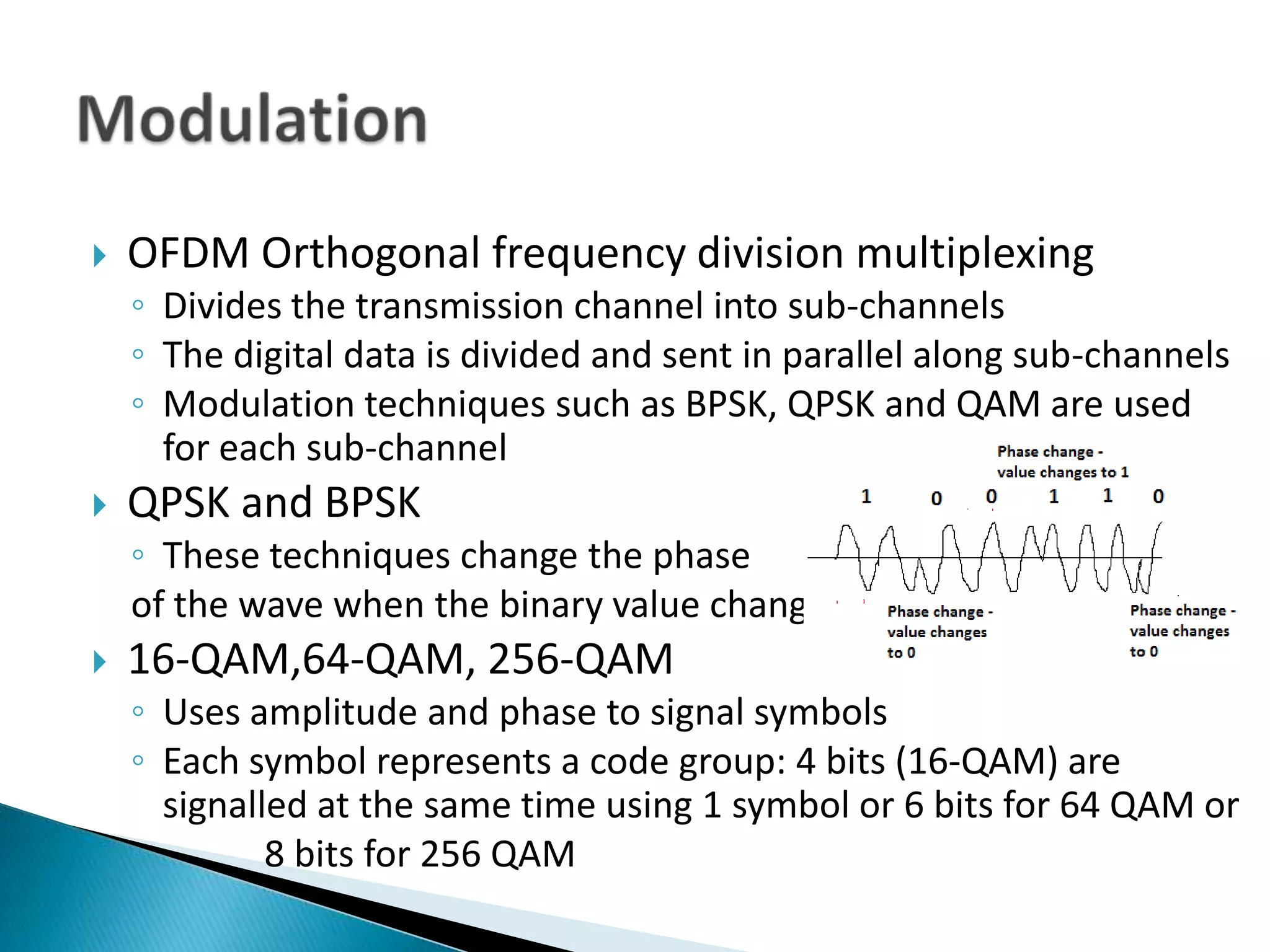
   QPSK and BPSK
    ◦ These techniques change the phase
    of the wave when the binary value changes
   16-QAM,64-QAM, 256-QAM
    ◦ Uses amplitude and phase to signal symbols
    ◦ Each symbol represents a code group: 4 bits (16-QAM) are
      signalled at the same time using 1 symbol or 6 bits for 64 QAM or
    ◦        8 bits for 256 QAM

Modulation

  • 1.
    Modulation is the process of putting binary bits (0s and 1s) onto a sine wave  There are 3 basic ways of modulating a sine wave: ◦ Amplitude  Changing the height of the peaks of the waves to represent the binary values ◦ Frequency  Changing the frequency of the waves (the number of waves generated per second) to represent the value ◦ Phase  Turning the wave off and on to represent the value (like Morse code)  As wireless speeds increase more efficient ways of modulating the wave and encoding the bits are needed  Fast modulation techniques use combinations of 2 or 3 basic methods
  • 2.
    OFDM Orthogonal frequency division multiplexing ◦ Divides the transmission channel into sub-channels ◦ The digital data is divided and sent in parallel along sub-channels ◦ Modulation techniques such as BPSK, QPSK and QAM are used for each sub-channel  QPSK and BPSK ◦ These techniques change the phase of the wave when the binary value changes  16-QAM,64-QAM, 256-QAM ◦ Uses amplitude and phase to signal symbols ◦ Each symbol represents a code group: 4 bits (16-QAM) are signalled at the same time using 1 symbol or 6 bits for 64 QAM or ◦ 8 bits for 256 QAM