

PHYSICAL SCIENCE
FORCES and INTERACTIONS
Bell Ringer
Why are MP3’s better than cassette tapes? List as
many reasons as you can for class discussion (at
least 2)
Objectives ForToday:
•By the end of the day you should:
Be able to… Make an argument that digitized signals are a
more reliable way to encode and transmit information than
analog signals
Agenda/Announcements!
Bell Ringer
DigitalVs. Analog Notes
DigitalVs. Analog reading/writing
Homework: If not finished, statement defense needs to
be finished before tomorrow in order to obtain ipad for
Friday time.
DigitalVs. Analog – Defining terms
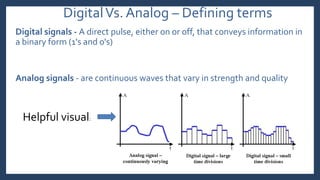
Digital signals - A direct pulse, either on or off, that conveys information in
a binary form (1's and 0's)
Analog signals - are continuous waves that vary in strength and quality
Helpful visual:
The Journey from Analog to Digital (Audio)
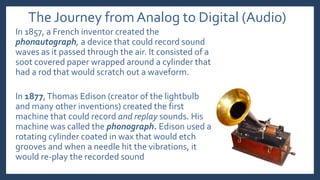
In 1857, a French inventor created the
phonautograph, a device that could record sound
waves as it passed through the air. It consisted of a
soot covered paper wrapped around a cylinder that
had a rod that would scratch out a waveform.
In 1877,Thomas Edison (creator of the lightbulb
and many other inventions) created the first
machine that could record and replay sounds. His
machine was called the phonograph. Edison used a
rotating cylinder coated in wax that would etch
grooves and when a needle hit the vibrations, it
would re-play the recorded sound
The Journey from Analog to Digital (Audio)
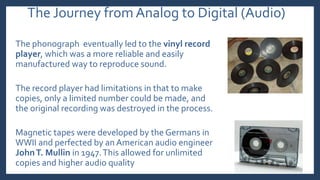
The phonograph eventually led to the vinyl record
player, which was a more reliable and easily
manufactured way to reproduce sound.
The record player had limitations in that to make
copies, only a limited number could be made, and
the original recording was destroyed in the process.
Magnetic tapes were developed by the Germans in
WWII and perfected by an American audio engineer
JohnT. Mullin in 1947.This allowed for unlimited
copies and higher audio quality
The Journey from Analog to Digital (Audio)
Throughout the 1970’s digital audio recorders were
created and developed. Digital audio took samples
of a sound at 44.1 kHz, or 44,100 times per second
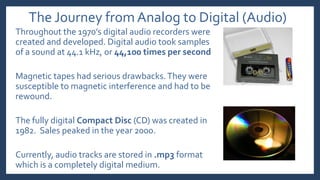
Magnetic tapes had serious drawbacks.They were
susceptible to magnetic interference and had to be
rewound.
The fully digital Compact Disc (CD) was created in
1982. Sales peaked in the year 2000.
Currently, audio tracks are stored in .mp3 format
which is a completely digital medium.
SoWhat IS Digital?
The main difference between digital and analog is HOW the information is
stored.
In an analog device, information is continuously recorded. In a digital
device, sound is sampled at thousands of times per second.
The difference is largely unnoticeable.
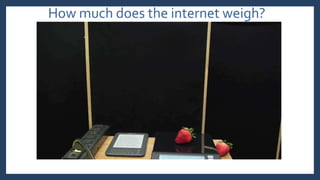
How much does the internet weigh?
Reading andWriting Prompt
Passing out of Reading – Read and Discuss
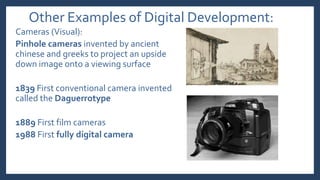
Other Examples of Digital Development:
Cameras (Visual):
Pinhole cameras invented by ancient
chinese and greeks to project an upside
down image onto a viewing surface
1839 First conventional camera invented
called the Daguerrotype
1889 First film cameras
1988 First fully digital camera
Pros and Cons of Digital Signals
Pros
•Storage – lots of
information in a small space
•Reproducibility – can be
copied indefinitely with zero
loss of quality
•Capability –You can layer
more information together
with digital signals (DTV,
Mantis Shrimp eye)
•***Easily created and
edited***
Cons
•Lacks fidelity – isn’t the
“true” record
•***Easily created and
edited*** (Internet hot-
heads, mistakes last
forever…think before you
post)
•Easily forgotten –Think
about letters, newspapers,
Rosetta stone etc
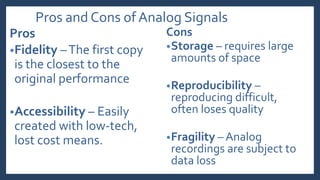
Pros and Cons of Analog Signals
Pros
•Fidelity –The first copy
is the closest to the
original performance
•Accessibility – Easily
created with low-tech,
lost cost means.
Cons
•Storage – requires large
amounts of space
•Reproducibility –
reproducing difficult,
often loses quality
•Fragility – Analog
recordings are subject to
data loss
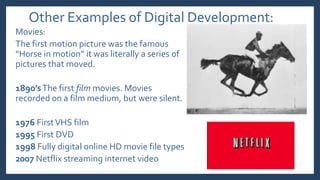
Other Examples of Digital Development:
Movies:
The first motion picture was the famous
“Horse in motion” it was literally a series of
pictures that moved.
1890’sThe first film movies. Movies
recorded on a film medium, but were silent.
1976 FirstVHS film
1995 First DVD
1998 Fully digital online HD movie file types
2007 Netflix streaming internet video
Reading andWriting Prompt
In your notebook, write three short paragraphs
summarizing why you think digitized signals are a
more reliable way to encode and transmit
information.
Use your notes, feel free to use examples from your
personal life and interaction with technology
This will be checked tomorrow before you check out
ipads

09 waves and er day 9 digital vs analog

  • 1.
  • 2.
    Bell Ringer Why areMP3’s better than cassette tapes? List as many reasons as you can for class discussion (at least 2)
  • 3.
    Objectives ForToday: •By theend of the day you should: Be able to… Make an argument that digitized signals are a more reliable way to encode and transmit information than analog signals
  • 4.
    Agenda/Announcements! Bell Ringer DigitalVs. AnalogNotes DigitalVs. Analog reading/writing Homework: If not finished, statement defense needs to be finished before tomorrow in order to obtain ipad for Friday time.
  • 5.
    DigitalVs. Analog –Defining terms Digital signals - A direct pulse, either on or off, that conveys information in a binary form (1's and 0's) Analog signals - are continuous waves that vary in strength and quality Helpful visual:
  • 6.
    The Journey fromAnalog to Digital (Audio) In 1857, a French inventor created the phonautograph, a device that could record sound waves as it passed through the air. It consisted of a soot covered paper wrapped around a cylinder that had a rod that would scratch out a waveform. In 1877,Thomas Edison (creator of the lightbulb and many other inventions) created the first machine that could record and replay sounds. His machine was called the phonograph. Edison used a rotating cylinder coated in wax that would etch grooves and when a needle hit the vibrations, it would re-play the recorded sound
  • 7.
    The Journey fromAnalog to Digital (Audio) The phonograph eventually led to the vinyl record player, which was a more reliable and easily manufactured way to reproduce sound. The record player had limitations in that to make copies, only a limited number could be made, and the original recording was destroyed in the process. Magnetic tapes were developed by the Germans in WWII and perfected by an American audio engineer JohnT. Mullin in 1947.This allowed for unlimited copies and higher audio quality
  • 8.
    The Journey fromAnalog to Digital (Audio) Throughout the 1970’s digital audio recorders were created and developed. Digital audio took samples of a sound at 44.1 kHz, or 44,100 times per second Magnetic tapes had serious drawbacks.They were susceptible to magnetic interference and had to be rewound. The fully digital Compact Disc (CD) was created in 1982. Sales peaked in the year 2000. Currently, audio tracks are stored in .mp3 format which is a completely digital medium.
  • 9.
    SoWhat IS Digital? Themain difference between digital and analog is HOW the information is stored. In an analog device, information is continuously recorded. In a digital device, sound is sampled at thousands of times per second. The difference is largely unnoticeable.
  • 10.
    How much doesthe internet weigh?
  • 11.
    Reading andWriting Prompt Passingout of Reading – Read and Discuss
  • 12.
    Other Examples ofDigital Development: Cameras (Visual): Pinhole cameras invented by ancient chinese and greeks to project an upside down image onto a viewing surface 1839 First conventional camera invented called the Daguerrotype 1889 First film cameras 1988 First fully digital camera
  • 13.
    Pros and Consof Digital Signals Pros •Storage – lots of information in a small space •Reproducibility – can be copied indefinitely with zero loss of quality •Capability –You can layer more information together with digital signals (DTV, Mantis Shrimp eye) •***Easily created and edited*** Cons •Lacks fidelity – isn’t the “true” record •***Easily created and edited*** (Internet hot- heads, mistakes last forever…think before you post) •Easily forgotten –Think about letters, newspapers, Rosetta stone etc
  • 14.
    Pros and Consof Analog Signals Pros •Fidelity –The first copy is the closest to the original performance •Accessibility – Easily created with low-tech, lost cost means. Cons •Storage – requires large amounts of space •Reproducibility – reproducing difficult, often loses quality •Fragility – Analog recordings are subject to data loss
  • 15.
    Other Examples ofDigital Development: Movies: The first motion picture was the famous “Horse in motion” it was literally a series of pictures that moved. 1890’sThe first film movies. Movies recorded on a film medium, but were silent. 1976 FirstVHS film 1995 First DVD 1998 Fully digital online HD movie file types 2007 Netflix streaming internet video
  • 16.
    Reading andWriting Prompt Inyour notebook, write three short paragraphs summarizing why you think digitized signals are a more reliable way to encode and transmit information. Use your notes, feel free to use examples from your personal life and interaction with technology This will be checked tomorrow before you check out ipads