Bell Work
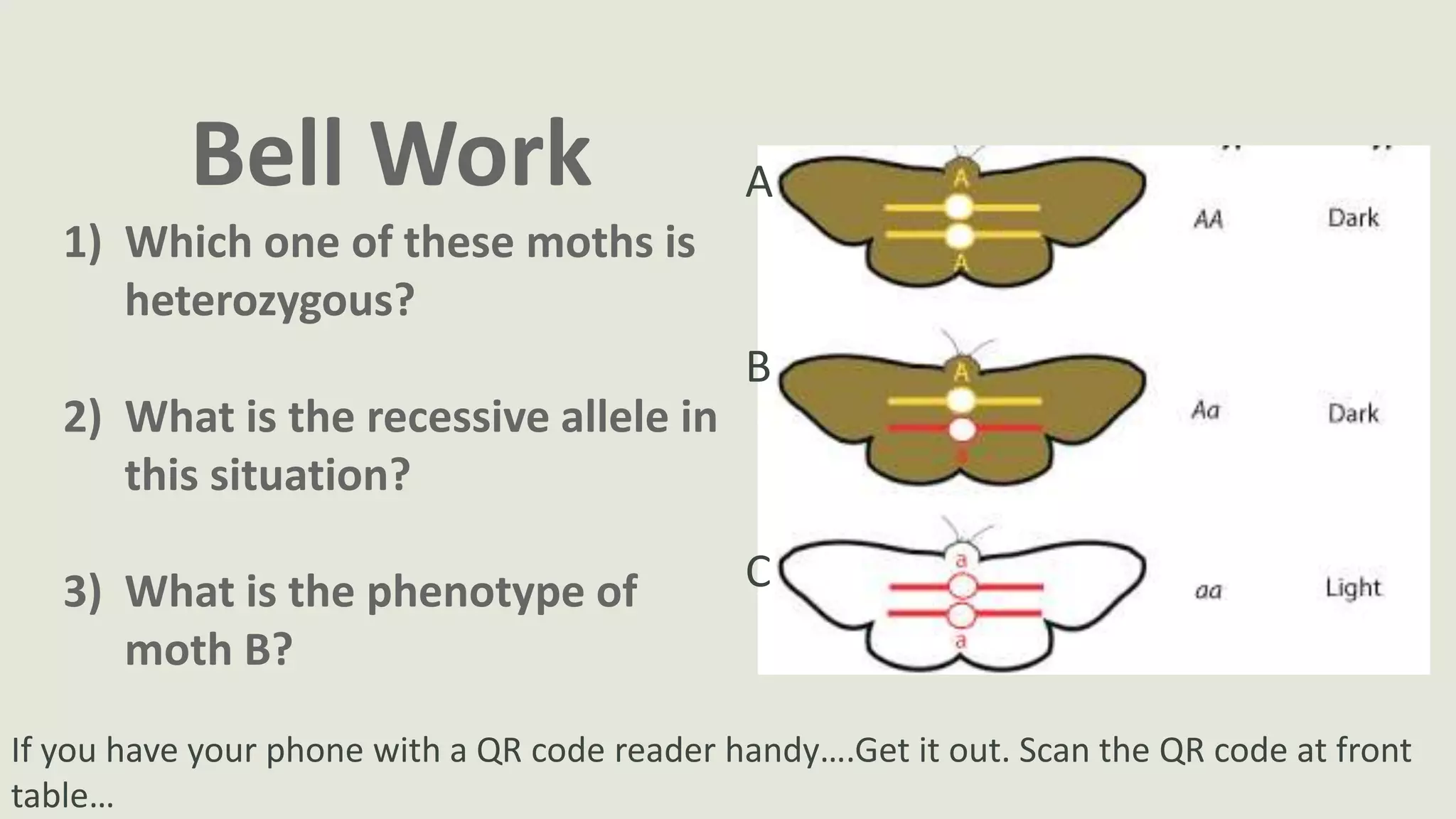
1) Which one of these moths is
heterozygous?
2) What is the recessive allele in
this situation?
3) What is the phenotype of
moth B?
If you have your phone with a QR code reader handy….Get it out. Scan the QR code at front
table…
A
B
C
Life Science
Unit 1 Heredity: Inheritance and Variation of traits
Bell Work 9-3
1) Define allele in your own words. Give an example
2) Give an example of cross breeding
3) What is stored in a chromosome?
When you get finished, sign into GOOGLE CLASSROOM.
classroom.google.com
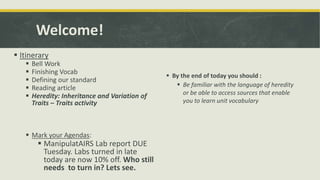
Welcome!
 Itinerary
 Bell Work
 Finishing Vocab
 Defining our standard
 Reading article
 Heredity: Inheritance and Variation of
Traits – Traits activity
 Mark your Agendas:
 ManipulatAIRS Lab report DUE
Tuesday. Labs turned in late
today are now 10% off. Who still
needs to turn in? Lets see.
 By the end of today you should :
 Be familiar with the language of heredity
or be able to access sources that enable
you to learn unit vocabulary
Quizlet Guess and Check
QUIZLET UNIT 1
Clarifying Traits vs. Alleles
Recall that a trait is
Alleles are
Ex:
Earwax – wet or dry?
A characteristic that an organism can pass on to its offspring through its genes.
Alternative forms of a gene for each variation of a trait of an organism.
EW.
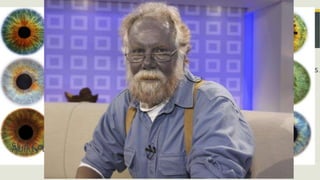
Eye ColorAbility to roll tongueSkin Color
Choosing a base pet
https://newsela.com/articles/apple-breeders/id/6156/
Article Discussion
What were some of the traits listed in the article?
Can you give an example of a cross-breed in this article?
Determining Traits
Look at the person across from you
Give them a high give. (Fist bump if you are super hip…wave
awkwardly if you are super shy…)
Identify AS MANY TRAITS AS POSSIBLE in 4 minutes.
Voting On Our Classroom Pet
 What kind of pet are we going with? Let’s decide.
Trait Similarities
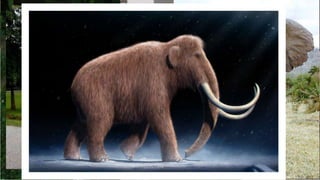
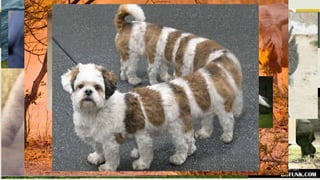
Notice that among related animals, general traits are similar.
(i.e. all of the Elephant varieties had 4 legs, a trunk and tusks)
But what if we COULD genetically alter a pet to produce a new
species with the traits of several species? What would your
ideal designer pet be??
Choosing a base pet
Discuss at your table ideas for a base pet. If you have your
phone, scan the QR codes at the front if you didn’t already.
What pet do we want to use as the class pet? Join the
discussion on Backchannel chat. NEW RULES FOR BCC
I’d like to end up with this being our class mascot. Really spend
some time thinking of good ideas for your animal that will
represent the class!
Choosing traits
We want to alter 7 traits for our pet.
What are your ideas for traits? Post them to Today’s meet.
A.) Animal size
B.) Body covering (skin? scales? Armor?
C.) Number of arms/legs
D.) Coloration
E.) Number of eyes
F.) Type of tail
G.) Hand/Foot type
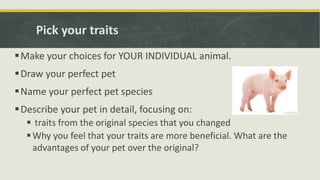
Pick your traits
Make your choices for YOUR INDIVIDUAL animal.
Draw your perfect pet
Name your perfect pet species
Describe your pet in detail, focusing on:
 traits from the original species that you changed
Why you feel that your traits are more beneficial. What are the
advantages of your pet over the original?
Standard?
Develop and use a model to describe why asexual reproduction
results in offspring with identical genetic information and sexual
reproduction results in offspring with genetic variation
So how do we remember this? Lets look at some examples.
Try creating your standard to share
5 minutes
Exit Slip Reflection:
Take a look at your picture.
What are the possible problems or disadvantages of owning
this pet in reality? Be specific.

02 heredity standard creation animal activity

  • 1.
    Bell Work 1) Whichone of these moths is heterozygous? 2) What is the recessive allele in this situation? 3) What is the phenotype of moth B? If you have your phone with a QR code reader handy….Get it out. Scan the QR code at front table… A B C
  • 2.
    Life Science Unit 1Heredity: Inheritance and Variation of traits
  • 3.
    Bell Work 9-3 1)Define allele in your own words. Give an example 2) Give an example of cross breeding 3) What is stored in a chromosome? When you get finished, sign into GOOGLE CLASSROOM. classroom.google.com
  • 4.
    Welcome!  Itinerary  BellWork  Finishing Vocab  Defining our standard  Reading article  Heredity: Inheritance and Variation of Traits – Traits activity  Mark your Agendas:  ManipulatAIRS Lab report DUE Tuesday. Labs turned in late today are now 10% off. Who still needs to turn in? Lets see.  By the end of today you should :  Be familiar with the language of heredity or be able to access sources that enable you to learn unit vocabulary
  • 5.
    Quizlet Guess andCheck QUIZLET UNIT 1
  • 6.
    Clarifying Traits vs.Alleles Recall that a trait is Alleles are Ex: Earwax – wet or dry? A characteristic that an organism can pass on to its offspring through its genes. Alternative forms of a gene for each variation of a trait of an organism. EW. Eye ColorAbility to roll tongueSkin Color
  • 7.
    Choosing a basepet https://newsela.com/articles/apple-breeders/id/6156/
  • 8.
    Article Discussion What weresome of the traits listed in the article? Can you give an example of a cross-breed in this article?
  • 9.
    Determining Traits Look atthe person across from you Give them a high give. (Fist bump if you are super hip…wave awkwardly if you are super shy…) Identify AS MANY TRAITS AS POSSIBLE in 4 minutes.
  • 10.
    Voting On OurClassroom Pet  What kind of pet are we going with? Let’s decide.
  • 11.
    Trait Similarities Notice thatamong related animals, general traits are similar. (i.e. all of the Elephant varieties had 4 legs, a trunk and tusks) But what if we COULD genetically alter a pet to produce a new species with the traits of several species? What would your ideal designer pet be??
  • 12.
    Choosing a basepet Discuss at your table ideas for a base pet. If you have your phone, scan the QR codes at the front if you didn’t already. What pet do we want to use as the class pet? Join the discussion on Backchannel chat. NEW RULES FOR BCC I’d like to end up with this being our class mascot. Really spend some time thinking of good ideas for your animal that will represent the class!
  • 13.
    Choosing traits We wantto alter 7 traits for our pet. What are your ideas for traits? Post them to Today’s meet. A.) Animal size B.) Body covering (skin? scales? Armor? C.) Number of arms/legs D.) Coloration E.) Number of eyes F.) Type of tail G.) Hand/Foot type
  • 14.
    Pick your traits Makeyour choices for YOUR INDIVIDUAL animal. Draw your perfect pet Name your perfect pet species Describe your pet in detail, focusing on:  traits from the original species that you changed Why you feel that your traits are more beneficial. What are the advantages of your pet over the original?
  • 15.
    Standard? Develop and usea model to describe why asexual reproduction results in offspring with identical genetic information and sexual reproduction results in offspring with genetic variation So how do we remember this? Lets look at some examples.
  • 16.
    Try creating yourstandard to share 5 minutes
  • 17.
    Exit Slip Reflection: Takea look at your picture. What are the possible problems or disadvantages of owning this pet in reality? Be specific.

Editor's Notes

  • #6 This bar timer, will start when anywhere on the slide is clicked. The bar will move from left to right and the word ‘End’ will appear at the end, accompanied by a ‘Deep Gong’ sound. It is possible to change the duration of this timer to any time, by entering the animation settings, and changing the timing for ‘rectangle 3’. Note the time has to be entered as a number of seconds – so if you want 2mins & 30secs – this is entered as 150 (60X2 + 30 = 150).
  • #9 This ‘sand timer’ will start on a mouse click anywhere on the slide. The ‘sand’ will drain from the top section to the lower section and when completed will show the word ‘End’. To change the timings of this timer, you need to enter the animation settings, and change the timings for the Isosceles Triangles. There will be 2 that need changing (to the same amount) – one animates the top triangle emptying, whilst the other animates the bottom triangle filling. When you change the timings these have to entered as a number of seconds.
  • #10 This ‘sand timer’ will start on a mouse click anywhere on the slide. The ‘sand’ will drain from the top section to the lower section and when completed will show the word ‘End’. To change the timings of this timer, you need to enter the animation settings, and change the timings for the Isosceles Triangles. There will be 2 that need changing (to the same amount) – one animates the top triangle emptying, whilst the other animates the bottom triangle filling. When you change the timings these have to entered as a number of seconds.
  • #11 This bar timer, will start when anywhere on the slide is clicked. The bar will move from left to right and the word ‘End’ will appear at the end, accompanied by a ‘Deep Gong’ sound. It is possible to change the duration of this timer to any time, by entering the animation settings, and changing the timing for ‘rectangle 3’. Note the time has to be entered as a number of seconds – so if you want 2mins & 30secs – this is entered as 150 (60X2 + 30 = 150).
  • #16 This ‘sand timer’ will start on a mouse click anywhere on the slide. The ‘sand’ will drain from the top section to the lower section and when completed will show the word ‘End’. To change the timings of this timer, you need to enter the animation settings, and change the timings for the Isosceles Triangles. There will be 2 that need changing (to the same amount) – one animates the top triangle emptying, whilst the other animates the bottom triangle filling. When you change the timings these have to entered as a number of seconds.
  • #17 These timers appear initially as a cream, coloured circle. The timer is initiated by clicking on, at which point the circle will fill up in a clockwise direction with the colour you see above. At the end of the time, a bell will sound. It is possible to change the timings of the timers by entering the animation settings and changing the timings of the relevant ‘Oval’. Note the timings have to be entered in seconds. It is possible to have multiple timers on the same slide as these work independently of each other.